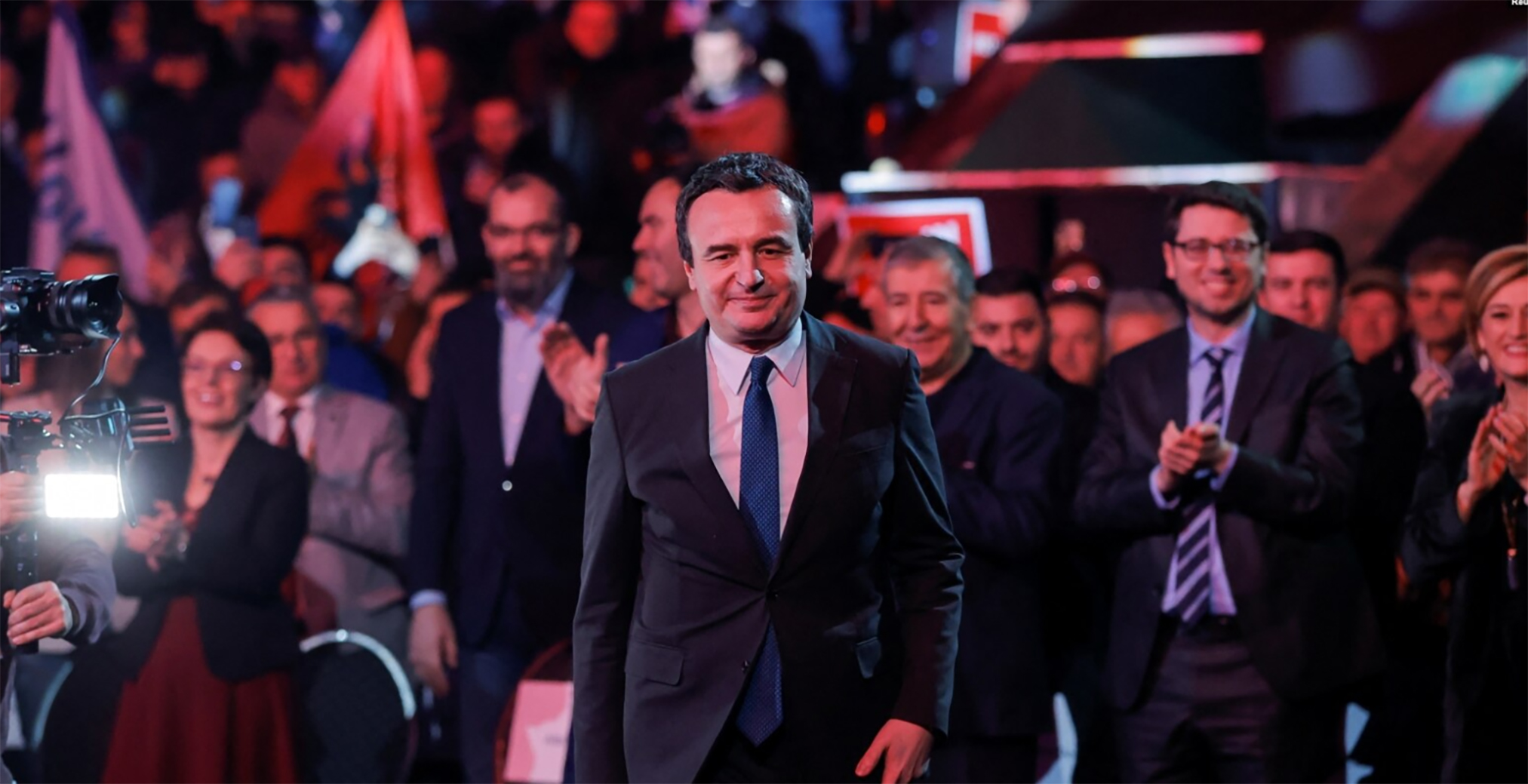
On 28 December 2025, Kosovo will hold early parliamentary elections, which will be the second parliamentary elections within a year. The re-election of the parliament became inevitable after nine months of political paralysis caused by the inability to form a government following the elections of 9 February. President Vjosa Osmani announced the dissolution of parliament on 20 November, when it became finally clear that no political force was capable of ensuring a stable majority and forming an executive.
The December elections will take place amid a deep institutional crisis, a frozen budget, sanctions from the EU and the USA, and a blocked dialogue with Serbia.
Mission Impossible
After the elections of 9 February 2025, the “Self-Determination” Movement (Vetëvendosje, LVV) of Albin Kurti won 48 seats in the 120-seat parliament. Kurti’s party obtained the largest faction but not a majority, and forming a government without a coalition proved impossible. The opposition parliamentary parties — PDK, Partia Demokratike e Kosovës (Democratic Party of Kosovo), LDK, Lidhja Demokratike e Kosovës (Democratic League of Kosovo), and AAK/NISMA, Aleanca për Ardhmërinë e Kosovës (Alliance for the Future of Kosovo) / Nisma Socialdemokrate (Social Democratic Initiative) — refused to negotiate with LVV, accusing Kurti of confrontational policies, centralization of power, and the deterioration of relations with the West.
After the failure of the first attempt to form a government by “Self-Determination” headed by Albin Kurti on 26 October, Kurti proposed transferring the mandate for forming a government to the former Speaker of Parliament Glauk Konjufca, while he himself agreed to become Deputy Prime Minister and Minister of Foreign Affairs. But on 19 November Konjufca received only 56 votes in favour. Thus, the last chance to form a government constitutionally was lost.
The inability to form a government for nine months led to:
- The absence of a budget for 2026,
- The risk of delays in public sector salaries,
- The blocking of international agreements (in particular with the European Investment Bank and the World Bank),
- The freezing of several infrastructure projects due to the absence of external financing,
- The impossibility of receiving EU funds within the new Growth Plan for the Western Balkans.
Acting Minister of Finance Hekuran Murati warned: “If there is no budget by January, we will not be able to finance the basic functions of the state” (Koha Ditore, 5.11.2025).
Twenty-one civil society organizations appealed to President Osmani with an open letter: “The financial future of the country cannot be taken hostage by political blockades” (DW, 31.10.2025).
Elections Ahead of the New Year
President Vjosa Osmani announced the dissolution of parliament on 20 November. “28 December is the date I consider the only possible according to the constitution,” she stated (press conference, Pristina, 20.11.2025).
This date had earlier been proposed by Self-Determination, whereas the opposition wanted the vote to be scheduled for 21 December.
The LVV leader Albin Kurti tried to frame the situation as a normal democratic process: “This is a celebration of democracy. We trust the people, and they will speak again” (statement for Koha.net, 20.11.2025).
The opposition, however, perceived the dissolution of the parliament as a defeat of the government. Bedri Hamza, the head of PDK, declared: “Two failures in forming a government is an official certificate of the complete failure of the Self-Determination Movement. The time for experiments is over” (Albanian Post, 20.11.2025).
Political scientist Ardian Arifaj, former adviser to the President of Kosovo, noted: “LVV could not go beyond its own logic of monopoly. They are not looking for partners; they are looking for subordinates” (Pristina Insight, 21.11.2025).
The Controversial Association
One of the key reasons for the political weakening of LVV was the escalation of tensions with Western partners. The source of misunderstanding with the West was the course of Self-Determination aimed at strengthening Kosovo’s sovereignty, including through the consolidation of state institutions in Serbian municipalities. This political platform did not envisage compromises with the Serbian side on issues of statehood, even if such compromises had previously been agreed under EU mediation.
The central element of the conflict was the government’s refusal to implement the obligation to establish the Association of Serbian Municipalities (Asociacioni i Komunave me Shumicë Serbe, ASM, Serbian name — Заједница српских општина, ZSO).
The Association of Serbian Municipalities is a special status for areas of Kosovo with a predominantly Serbian population, primarily in the north. Its creation was envisaged by the 2013 Brussels Agreement. ASM / ZSO would have received broad competences in the field of local self-government, in effect, autonomy.
Albin Kurti’s Self-Determination Movement consistently opposed the creation of the Association of Serbian Municipalities. The loudest protests occurred in 2015, when LVV — still in opposition — organized mass demonstrations, the blocking of parliament, and the use of tear gas in the plenary hall to disrupt the ratification of agreements with Serbia that envisioned, among other things, the establishment of ASM / ZSO.
In 2015, the Constitutional Court of Kosovo ruled that the principles for forming the Association of Serbian Municipalities partially contradicted the Constitution, but confirmed that its creation is an international obligation of Kosovo.
After coming to power in 2021, Self-Determination did not change its position: Kurti’s government refused to submit a draft law on the Association of Serbian Municipalities to parliament, viewing ASM / ZSO as a threat to Kosovo’s sovereignty. This stance remained unchanged in 2023–2025, despite pressure from the EU and the USA.
Kurti’s party opposes ASM / ZSO, considering the Association of Serbian Municipalities to be:
- An ethnic autonomy that contradicts the unitary character of the Republic of Kosovo,
- An instrument of Belgrade’s influence,
- A threat of repeating the scenario of Republika Srpska in Bosnia and Herzegovina.
Albin Kurti emphasized: “We will not create a structure that can paralyze the state from within. ASM is not a compromise; it is capitulation” (Koha.net, 15.10.2025).
Pristina vs Brussels
The confrontation between Pristina and Brussels escalated in June 2023, when the EU imposed sanctions on Kosovo. The reason was the escalation in the north.
In May 2023, the government of Kosovo, despite warnings from the EU and the USA, appointed Albanian mayors in four municipalities in the north of the country (Zvečan, Leposavić, Zubin Potok, North Mitrovica), after the Serbian population boycotted local elections. This triggered mass protests, clashes between local Serbs and NATO’s KFOR forces in Kosovo, injuries to dozens of peacekeepers, and an overall increase in tensions.
In response to Pristina’s actions, the European Union announced restrictive measures in June 2023:
- Suspension of Kosovo’s participation in regional forums,
- Freezing part of the funding under IPA III (the third stage of the EU’s Instrument for Pre-accession Assistance),
- Postponement of meetings on the Stabilisation and Association Agreement (SAA),
- Limiting high-level political dialogue.
In the EU spokesperson’s statement it was said: “Kosovo has not met the de-escalation requirements. We expect immediate steps to reduce tensions and ensure inclusive governance in the north.”
These sanctions marked the first time the EU had imposed restrictive measures on Kosovo for political reasons, underscoring the seriousness of the crisis in relations between Brussels and Pristina.
In October 2025, President of the European Commission Ursula von der Leyen stated: “The next steps depend on sustainable de-escalation in the north and the implementation of obligations regarding ASM / ZSO” (Pristina Insight, 12.10.2025).
Pristina vs Washington
In September 2025, the United States also resorted to a form of restrictive measures — they suspended the strategic dialogue with Kosovo. This was an unprecedented step that signaled a serious cooling in relations between Washington and Pristina.
The decision was taken in September 2025 after several months of tension between the Donald Trump administration and Albin Kurti’s government. The main reason for such a step was Kosovo’s refusal to implement the Association of Serbian Municipalities (ASM / ZSO). Kurti refused to submit a draft law on ASM / ZSO to parliament, which Washington considered a violation of obligations.
The USA, like the EU, considers the Association of Serbian Municipalities a key element of the Pristina–Belgrade dialogue on the normalization of relations.
Moreover, when the situation in Serbian municipalities escalated again in August–September 2025, the USA believed that Pristina’s actions — in particular, the strengthening of police presence — only deepened the conflict.
Despite repeated calls from the State Department, the government of Kosovo did not show readiness for compromise. This led to the United States temporarily suspending the strategic dialogue — a format that covered issues of security, economy, and Euro-Atlantic integration.
In the State Department’s statement it was said: “We remain committed to partnership with Kosovo, but we expect its government to act responsibly, respecting its international obligations.”
This step became a serious signal for Pristina that even its closest allies are not ready to support a policy of unilateral actions that contradict agreed commitments.
The U.S. Ambassador to Kosovo Jeffrey Grever stated: “We support Kosovo, but support does not mean silent approval of actions that contradict obligations” (Euronews Albania, 18.10.2025).
Conclusions
The early elections of 28 December became the result of a prolonged institutional crisis caused by the inability of Self-Determination after the February elections to create a stable coalition in parliament and form a government. Kurti’s policy, aimed at strengthening Kosovo’s statehood and excluding compromises with Belgrade, primarily regarding the implementation of the Association of Serbian Municipalities, led to conflict with international partners, the loss of external support, and ultimately, the loss of sufficient political support within Kosovo itself.
Regardless of the results of the vote on 28 December, the new parliament will face the same challenges: the need to adopt a budget, unblock international agreements, and resume dialogue with Serbia. Without inter-party compromise, political instability may persist even after new elections, which will have direct destructive consequences for the economy, European integration, and the functioning of Kosovo’s state institutions, and will negatively affect the entire region.
On the other hand, the coming to power in Pristina of the current Kosovo opposition — that is, political forces inclined towards a more compromise-based position in the dialogue with Belgrade and demonstrating greater loyalty in relations with Western partners — may trigger a crisis within Kosovo, because the policy of Self-Determination enjoys significant support among Kosovo’s citizens who are committed to building an independent republic.
CWBS Analytical Group