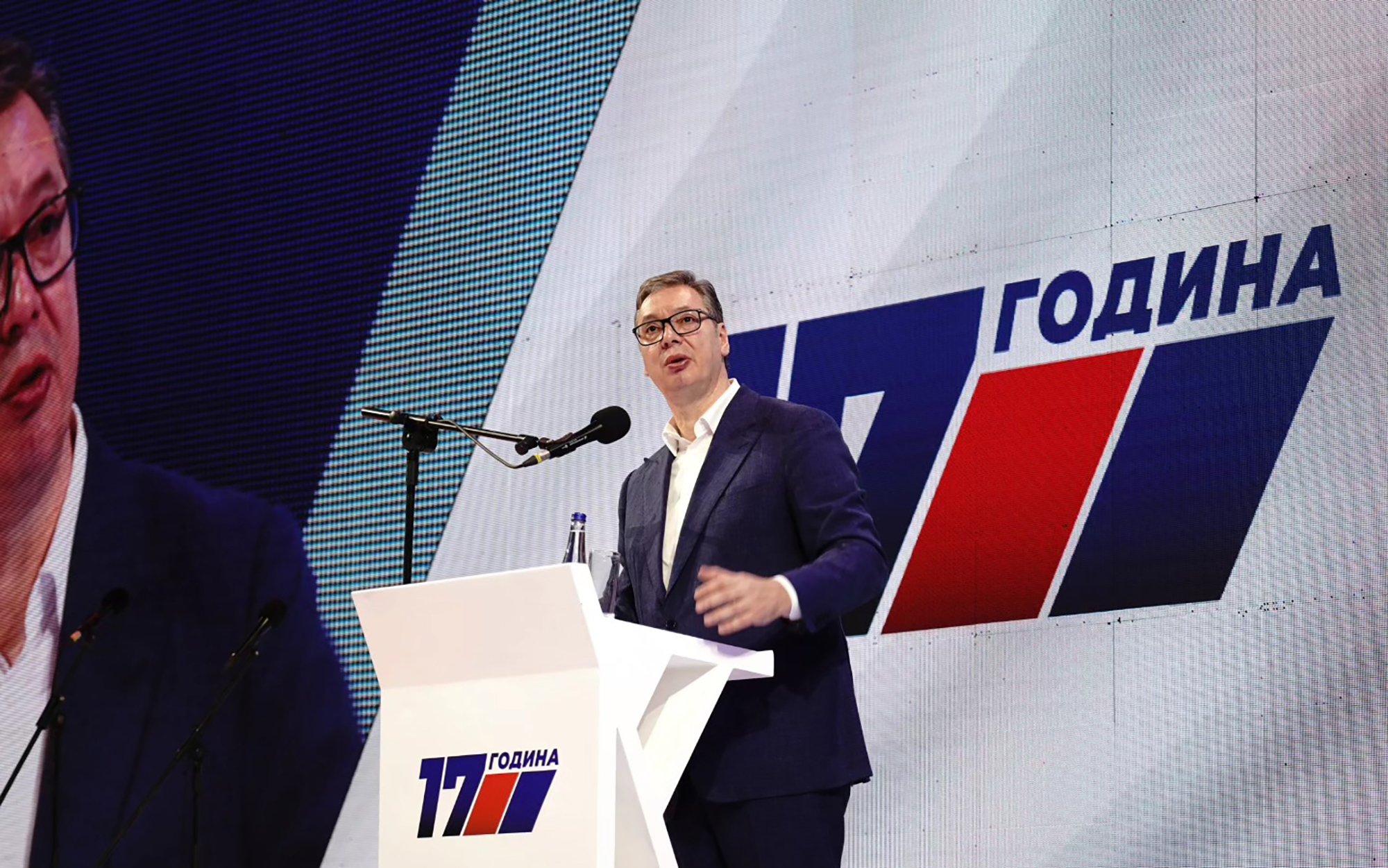
The 2025 European Commission Report arrived at a moment when Aleksandar Vučić appeared to have temporarily consolidated his authoritarian rule after a year of the most severe political crisis of his tenure. Following more than twelve months of protests and intense unrest across the country, triggered by the collapse of the Novi Sad railway station in which sixteen citizens lost their lives, it seemed that by prolonging the political deadlock, exhausting the student movement, and wearing down the broader civic revolt, he had managed to reassert control.
In parallel, he initiated deep structural changes within the army, police, and security services. His most loyal cadres were installed in the key positions, effectively forming a well-organized and well-funded praetorian guard. Those within the security apparatus who had shown even a moment of hesitation during the months of nationwide unrest were systematically removed.
However, precisely at that moment, the European Commission delivered its annual report—one that for the first time struck at the very foundations of his thirteen-year rule: the carefully constructed image of a regime that allegedly guaranteed stability in Serbia and across the Western Balkans.
Even before the report was published, it had been widely announced as exceptionally negative, largely because it followed a strong and highly critical resolution on Serbia adopted by the European Parliament. Vučić’s reaction to that resolution was brazen and openly insulting toward Members of the European Parliament, accompanied by the message that such views did not concern him in the slightest and that the only thing that mattered to him was what would come from the European Commission.
Yet, when the Commission’s report was finally released, it became a political nightmare for him—representing the clearest and most severe blow the European Union has ever directed at Vučić. It was an unmistakable signal that this mode of governance can no longer continue.
This is not merely the most negative report since Serbia began its accession negotiations with the European Union; it is a document that explicitly states Serbia’s regression in democracy, media freedom, the rule of law, the fight against corruption, and the fundamental political rights of its citizens. The report discusses Serbia in the context of Georgia and identifies it as a “Russian proxy” in the Western Balkans.
Vučić quickly understood that the report shattered both his domestic and international reputation as a “stabilocrat,” a status he had cultivated for years to persuade European officials that Serbia was at least nominally on a European path, while regional stability supposedly depended on him personally. It became evident that he could no longer rely on European funds as a mechanism for purchasing social peace.
That realization sent him into a panicked, poorly coordinated tour of European capitals—an effort that, instead of repairing the damage, exposed the critical points at which his system of governance is beginning to fracture.
After the Swedish government decided to halt its financial support to Serbian state institutions due to corruption concerns and redirect those funds to civil society, Vučić launched an urgent rescue mission aimed at preserving access to European funds, once again assuring EU officials—yet again—that Serbia remained committed to the European path.
In that context, he quickly moved to promise European officials the election of new members to the REM (the Regulatory Authority for Electronic Media), one of the most powerful instruments of his autocratic rule and a body that has been central to producing Serbia’s pervasive media darkness. He initiated the process in the National Assembly after the ruling majority had reached an agreement with part of the civil sector, presenting it as a symbolic gesture meant to “restore trust” and create the illusion of renewed momentum in Serbia’s EU integration process.
However, in political terms, the European Commission’s report marks the moment when Aleksandar Vučić’s regime collided with the limits of its own internal logic of staying in power. Serbia has reached a point at which European integration can no longer coexist with a model of personal rule, captured institutions, and politically controlled mechanisms of authority. This became fully visible during the vote on the new members of REM.
The Breaking Point of Serbia’s European Path
As Brussels engaged in a frantic attempt to “revive” Serbia’s European trajectory, Vučić launched his own offensive, promising swift reforms and presenting the resolution of REM as the key symbol of an alleged strategic turn. REM — an institution that for years functioned as a central pillar of political control over the media landscape — was chosen as the move that would, at least superficially, signal readiness to respond to the message contained in the European Commission’s report.
In Brussels, this signal was initially welcomed as an expression of goodwill and as an indication that, in the wake of the scathing report, the regime understood the gravity of a moment in which the European Union, for the first time since 2013, is genuinely reopening the door to enlargement, while Serbia drifts ever further from membership. Vučić’s attempt to demonstrate, through the election of new REM members, that Belgrade wished to avoid another “Swedish scenario” — the withdrawal of state funding due to corruption and the collapse of the rule of law — was perceived as a last possible gesture to preserve minimal credibility in the accession process.
But when the moment came to fulfill the promise, barely forty-eight hours after it was made, everything collapsed.
The outcome of the vote was fundamentally revealing: Vučić could not deliver even the smallest reform, nor could he honor his own commitment. The governing majority voted against what it had itself agreed with the European Union.
Why?
Because this was not merely a tactical maneuver, but evidence that the entire model of power had reached its outer limit.
Every genuine reform, every minimal increase in media freedom, every strengthening of institutions, every slightest indication of independent oversight over REM or the judiciary represents a direct threat to the survival of a system that functions only because institutions are not independent.
By allowing a new composition of REM, Vučić would have opened structural cracks in his own system of rule at a moment when demands for elections are growing louder, weakening what constitutes the central pillar of his political control — the absolute domination over the information space. That is why the governing majority, at the very last moment, reversed its own decision, openly reneging on the promise it had given to the European Union.
In doing so, the regime demonstrated that it is no longer capable — not even theoretically — of remaining on the European path, because every real reform would erode its mechanisms of internal control.
This is the moment at which every authoritarian system encounters the boundary of its own logic, for European integration requires democracy — and democracy dismantles the mechanisms of autocratic rule.
Vučić’s doctrine of “neutrality,” which openly contradicts the European Union’s foreign and security policy and which he triumphantly announced on the first day of Russia’s invasion of Ukraine, is no longer a policy nor a strategy. It has become the curse of his own miscalculation.
He is now trapped inside the system he built. Even if he wished to do so, he can no longer deliver what the European Union has for years politely described as “small but meaningful steps.”
The region moves forward — Serbia becomes a source of destabilization
While Montenegro and Albania rapidly open and close chapters and clusters, and while Moldova and Ukraine enter a new phase of historic rapprochement with the European Union, a new European dynamic is taking shape in the region — one in which Vučić’s regime prevents Serbia from taking part.
Moreover, under this regime, Serbia is no longer the slow-moving train of the Balkans; it has become the principal generator of instability.
Montenegro remains the frontrunner, announcing the closure of key chapters by the end of the year and entering a negotiating phase that reassures European governments. Albania is opening its final remaining clusters and emerging as a model of consistency in reforms. The European perspective of the region has never been more certain — except for Serbia.
In this new landscape, Serbia under Vučić’s rule resembles less and less a country aspiring to integration, and increasingly a regressive center.
The clearest example of this dynamic is Montenegro.
While the government in Podgorica accelerates its European integration agenda, from Belgrade come increasingly aggressive anti-European messages, political pressures, and coordinated propaganda operations inside the country. The pattern mirrors that in Serbia: an attempt to weaken Montenegro’s pro-European orientation, erode trust in its institutions, and generate internal conflicts that could push the country away from its European trajectory. Vučić’s strongest ally in this effort is the pro-Russian Serbian Orthodox Church.
Destabilizing the region has become the central foreign-policy instrument of the Serbian regime because an autocratic system cannot reform itself from within; the only viable path to its survival is the creation of a broader zone of instability in which the European integration of the region appears uncertain and Serbia presents itself as the “indispensable actor” without whom nothing can be resolved. This strategy was deployed not only throughout Vučić’s thirteen years in power, but already in the 1990s under Slobodan Milošević, the butcher of the Balkans. The logic is straightforward: the greater the crisis in the neighborhood, the more indispensable the regime in Belgrade appears to the West.
But today that policy is largely exhausted. For the first time, the European Commission’s report explicitly identifies Vučić’s regime as a source of regional risk, and the destabilizing activities in Montenegro confirm this more precisely than any diplomatic footnote ever could.
This is the moment when the regime stops being merely Serbia’s internal problem and becomes a regional security threat for the European Union.
The analysis offered by Veton Surroi
The analytical insight provided by journalist and political analyst Veton Surroi represents one of the most accurate dissections of the current political situation in Serbia and of the European Union’s evolving posture toward Aleksandar Vučić’s regime. His assessment rests on three fundamental paradoxes of the EU’s policy toward Belgrade, paradoxes that today have become impossible to ignore.
The first paradox, as Surroi observes, is that Serbia is now politically and strategically closer to Russia than it was at the moment when it formally became a candidate for European Union membership. The second paradox is even more alarming: Serbia no longer meets the basic Copenhagen criteria of electoral democracy and the rule of law, and if it were evaluated today, it would struggle to qualify even for candidate status for the Stabilisation and Association Agreement — let alone for membership negotiations. The third paradox is the most dangerous: the European Union’s long-standing policy of investing political trust in Vučić in the name of “stability” has produced the opposite outcome. Belgrade has become the primary generator of regional instability — a threat to Kosovo, to Bosnia and Herzegovina, and especially to Montenegro.
Surroi’s central formulation captures with utmost precision the internal logic of the current regime: “The logic of fear in Serbia has reached its own paradox — the more tightly the government grips, the less it holds.”
Within that paradox lies the explanation both for Vučić’s inability to implement even the most minimal European reforms and for the political reversal now unfolding in Montenegro. The destabilization of Podgorica, the surge of anti-EU narratives emanating from Belgrade, and the systematic attempts to drag Montenegro backwards are the direct consequences of a regime whose political survival depends on preventing Serbia from moving forward — and therefore seeks to pull the entire region backward with it.
International media on Vučić in the context of war crimes – the “Sarajevo Safari”
“Sarajevo Safari” is the name given to one of the most horrifying, most grotesque and most inhumane practices committed during the siege of Sarajevo (1992–1996). These crimes involved individuals — primarily foreign nationals with substantial financial means — who paid members of the Army of Republika Srpska, which held the city under siege, to take them to sniper positions above Sarajevo so they could shoot civilians. It was killing for sheer amusement, a form of “human hunting” in which human life was reduced to a target and murder became an “attraction” available to anyone willing to pay enough. These people were psychopaths, tourists of death, who came solely for the thrill of killing women, children, and the elderly trapped in the besieged city.
The Sarajevo Safari represents one of the most repulsive forms of war crimes against civilians in modern European history. It was first systematically exposed through the 2022 documentary Sarajevo Safari by Miran Zupanič, in which former members of security structures and individuals involved in these operations testify about how wealthy foreigners were escorted to sniper lines, how they paid tens of thousands of German marks for the experience, and how they would return afterwards to Jahorina, Pale, or Belgrade. According to these testimonies, there were even “price lists” for certain types of targets — with children being the most expensive. During the four-year siege of Sarajevo, exactly 1,601 children were killed.
Following the release of the documentary, the public prosecutor’s office in Milan opened an investigation into the participation of Italian citizens in this “sniper tourism.” This is an official criminal investigation concerning acts that do not fall under statutes of limitation: the killing of civilians, war crimes, and crimes against humanity. Italian journalist Ezio Gavazzeni submitted testimonies and documentation to the Milan prosecutor’s office, opening a legal avenue that had never existed before. The Prosecutor’s Office of Bosnia and Herzegovina is also conducting proceedings regarding these crimes.
Within this context, the name of Aleksandar Vučić emerged because Croatian investigative journalist Domagoj Margetić submitted a report to the Milan prosecutor’s office requesting an inquiry into whether Vučić had been present on positions from which this “tourism of death” was organized during the siege. In one video recording he appears at one of these locations. That report alone was sufficient for the global media to begin questioning what Vučić was doing in the vicinity of Sarajevo during the war.
This story was covered by the most influential European media outlets, including The Guardian, The Telegraph, the Italian state news agency ANSA, Le Monde, Bild, and many others.
Vučić’s reaction was to threaten lawsuits against all of these international media outlets — mirroring the way he behaves toward independent media in Serbia. This only demonstrates that he has lost the ability to distinguish between the domestic media environment, which he controls, and the global media landscape, where threats from the leader of a small Balkan state have no impact whatsoever, and often provoke ridicule.
Vučić’s international reputation is now at the lowest point of his political career, and it is increasingly uncertain whether any European leader will be willing to receive him on an official visit as long as he remains in power.
Conclusion
The conclusion is, inevitably, a bleak one. The member states of the European Union always retain the possibility of requesting a suspension of accession negotiations with Serbia — a move that would push the country into political and economic isolation, accompanied by personal sanctions against individuals in power, a measure that is already being seriously considered within European institutions. Serbia is situated in a geostrategic environment in which neither Russia nor China can replace the trade flows, investments or financial instruments provided by the European Union, nor can they offer even a minimal level of economic sustainability to a state whose entire economic structure is tied to the European market and European capital. This means that if Serbia wishes to survive as a politically and economically functional community, there is only one realistic solution: the removal of an autocratic order that is rapidly sliding into open dictatorship — and doing so by democratic means for as long as those means are still available.
Historian Milivoj Bešlin rightly warns that “there is no civilized exit from a dictatorship,” and Serbia has now entered a phase in which the only remaining question is how the regime will fall, and how costly or (un)civilized the transition will be. In this sense, Vučić’s walk along the edge is no longer a metaphor for political balancing; it has become a daily risk of tragedy, a moment in which each new step can be the one that plunges the country into chaos, repression or open political rupture. Serbia has been brought to a ledge where its European future no longer depends on negotiations with Brussels, but on when and how the system that blocks it will come to an end. And in that lies the essence of the entire story: the country is now exposed to the danger that any given day may produce consequences that will be felt by generations long after Aleksandar Vučić leaves power.
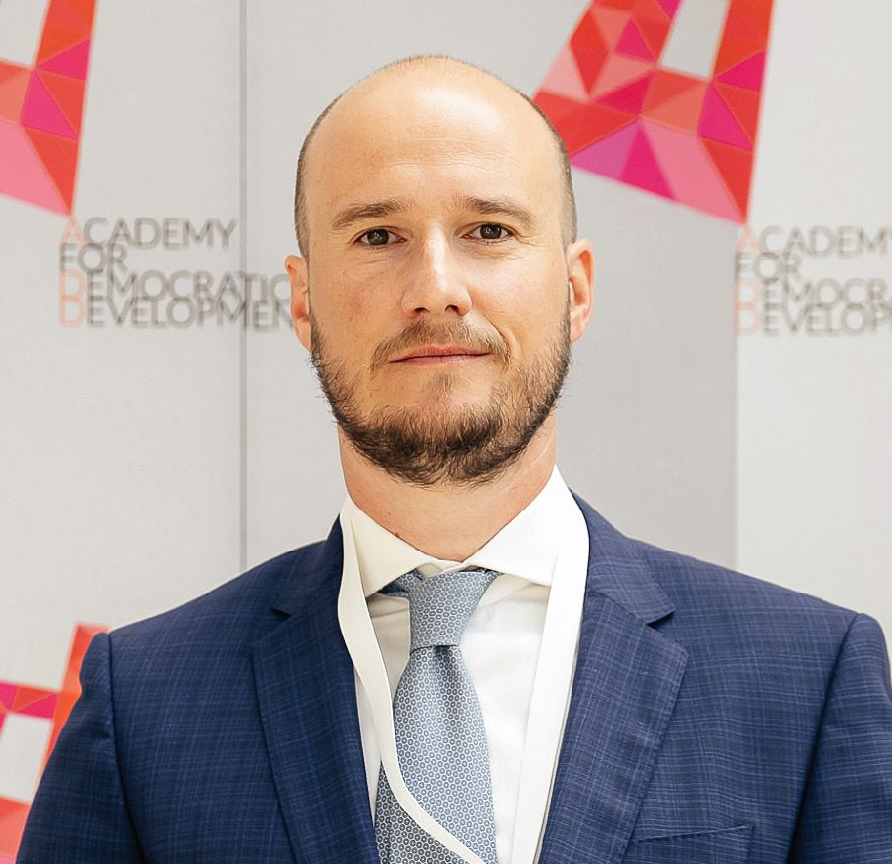
Balša Božović
Chair of the executive committee of the Regional Academy for Democratic Development (Serbia).
The articles published in the “Opinions” column reflect the personal opinion of the author and may not coincide with the position of the Center