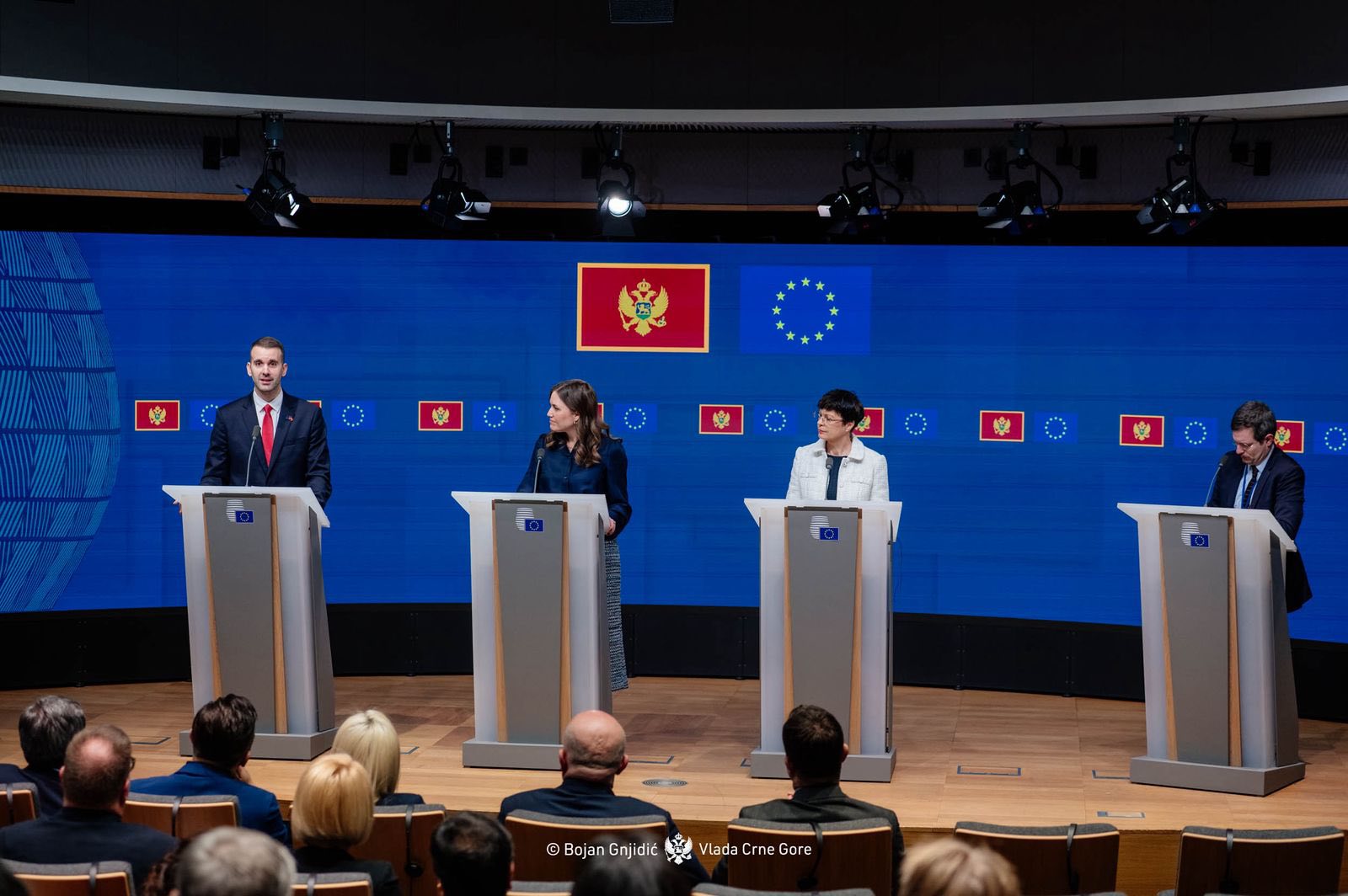
What is currently happening with Montenegro in the context of European integration is qualitatively different from anything we have witnessed over the past decade. After more than twelve years of a de facto pause in the EU’s enlargement policy, signals coming from the leaders of EU member states suggest that Brussels is—at least symbolically—ready to restart the process. This is not about a new grand vision of enlargement, nor about a fundamental strategic shift within the Union, but rather about the need to demonstrate that enlargement policy is not a dead letter.
In this context, Montenegro emerges as an ideal candidate. A country of roughly 600,000 inhabitants poses neither an economic nor a political shock to the Union. Its potential accession does not alter internal power balances, strain the EU budget, or open new systemic questions. Precisely for this reason, Montenegro represents a “low-cost gain” and a good political bargain: admitting a small country that is technically the most advanced in negotiations allows the EU to signal that enlargement remains possible—without taking on significant risk.
A year ago, in a text I wrote at the time, I expressed skepticism about the new government’s genuine commitment to the European path, particularly in light of the political profile and earlier public statements of Prime Minister Milojko Spajić. In retrospect, that concern proved unfounded. Over the past year, the government has clearly accelerated its activities in the negotiation process, institutional dynamics have improved, and political capital has been deliberately invested in the European agenda. This does not mean, of course, that the process has become linear or risk-free. On the contrary, it is precisely in this “photo finish” that the most dangerous potential sources of obstruction are emerging.
Serbia remains the most interested actor in ensuring that Montenegro—or any other country in the region—does not enter the European Union before it does. This is not a matter of emotional frustration, but of rational political calculation. Montenegro’s EU membership would lay bare the fact that Serbia itself does not want membership, or at least not under the conditions set by the Union. Aleksandar Vučić has articulated this position quite clearly in public appearances, and Prime Minister Spajić’s response on X—that Montenegro would be in the EU by 2028 and would wait there for others, including Serbia—was politically correct, but substantively provocative for Belgrade.
The instruments Serbia has at its disposal are not new. They consist of a combination of diplomatic lobbying, media influence, political parties in Montenegro that function as extensions of Belgrade, and a significant segment of the Serbian Orthodox Church. It is precisely this ecclesiastical factor that deserves special attention, as it is often mistakenly treated as monolithic.
In recent years, Vučić has deliberately worked to fragment centers of power within the Serbian Orthodox Church in Montenegro. Granting metropolitan status to Nikšić was not a mere administrative move, but a political decision with long-term consequences. It further weakened the institutional authority of the Metropolitanate of Cetinje, which is often—incorrectly—perceived as an autonomous spiritual center in Montenegro. Today, that thesis is no longer institutionally sustainable.
The result of this fragmentation is the existence of at least two currents within the Serbian Orthodox Church in Montenegro. One is led by Metropolitan Metodije (Ostojić), who openly and enthusiastically supports Vučić, Russian policy, and aggressive Serbian nationalism. The other is led by Metropolitan Joanikije, who is more cautious in his public appearances but remains ideologically consistent with Serbian nationalist narratives.
Metodije’s faction is particularly problematic. Under his authority, a radicalized, militant, and openly pro-Russian network has developed. The recent arrest of a representative of the Balkan Cossack Army in Danilovgrad—with large sums of money, uniforms, and weapons—was not an isolated incident. This is an organization whose parades were previously organized with Metodije’s support, in the presence of Russian ambassadors with whom he maintains close relations. At this point, this is no longer a matter of ideology, but of security.
Interesting changes are also taking place within the political spectrum of Serbian nationalism in Montenegro. Andrija Mandić, as Speaker of Parliament, is showing signs of caution and distancing himself from Vučić. His rhetoric is becoming more moderate and pro-European, while his diplomatic activities are intensifying. It is evident that Mandić is attempting to build legitimacy in the West and present himself as a “responsible” Serbian nationalist who can fit within a European political framework.
By contrast, Milan Knežević remains a destabilizing factor. As the less politically potent member of the coalition duo, he compensates for his lack of institutional power by constantly provoking crises. His recent anti-immigrant rants—which resulted in arson attacks on shops and violence against Turkish nationals—were not random excesses, but part of a broader strategy of manufacturing chaos.
The situation in the municipality of Zeta is particularly alarming. Under Knežević’s political patronage, protests are being organized against the construction of a wastewater treatment plant—a project crucial for meeting EU environmental standards. The spread of panic and disinformation about the alleged harmfulness of the facility has a clear goal: to block European reforms on the ground. The situation is further aggravated by the presence in Zeta of structures linked to former members of the Red Berets and organized crime, including Radojica Božović, whose name is mentioned with fear in Montenegro.
In the final stretch of this year, Montenegro faced yet another challenge: France’s temporary blockage of the closure of negotiating Chapters 10 (agriculture) and 13 (fisheries). These two chapters were part of a package of five planned for closure by the end of 2025, which would have allowed work on the Accession Treaty to begin in 2026, as announced by the German Chancellor.
Suspicions toward France in Montenegro are not without historical and political context. In 1918, France played a key role in the occupation and annexation of Montenegro, strongly supporting Serbia. In more recent history, French ambassadors have often shown open sympathy toward Serbian nationalists in Montenegro. The decoration of the Rector of the University of Montenegro, Vladimir Božović—known for his pro-Russian views and calls for “de-Westernization”—as well as an interview given by the French ambassador to Borba, a media outlet perceived as a propaganda tool of Aleksandar Vučić, further reinforced these suspicions.
Franco-Serbian relations are objectively close: a significant Serbian diaspora in France, links with the French far right, and the fact that Arnaud Gouillon, a former activist from that milieu, is now a senior Serbian government official. Nevertheless, this episode ended favorably for Montenegro. Following direct talks between Prime Minister Spajić and President Macron, and intensive diplomatic engagement, France reversed its position within 24 hours, opening the way for the closure of five chapters and a realistic prospect of membership by 2028.
Despite this positive outcome, risks remain. The first is precisely the closeness between France and Serbia, which could be reactivated at a later stage. The second is the potential deterioration of relations with Croatia, which Serbian nationalists in Montenegro are strategically working to provoke by constantly reopening sensitive issues such as border disputes, the ship Jadran, and the painful legacy of the wars of the 1990s. The third risk is the possibility of coordinated action by Serbia and Albania to slow Montenegro’s progress, with the protests in Botun and the unusual Serbian-Albanian “partnership” on local issues serving as indicative examples.
Despite everything, it is important to highlight the constructive approach of the Montenegrin opposition, which—although not in power—largely supports the European path. This is a key difference compared to Serbia, where support for EU membership stands at around 40 percent, while in Montenegro it exceeds 70 percent.
Montenegro finds itself at a rare historical moment in which geopolitical circumstances, domestic political will, and institutional readiness align. This window will not remain open for long. To seize the opportunity, several clear steps are necessary:
- No compromises on security threats. The state must respond decisively to any form of militant extremism, especially those with foreign links, regardless of ecclesiastical or political cover.
- Clear communication with EU partners. Montenegro must continuously inform key member states about destabilizing actions by regional actors, particularly Serbia, supported by concrete evidence and examples.
- Depoliticization of key infrastructure projects. Projects tied to EU standards, such as environmental protection, must be shielded from local political blackmail and disinformation.
- Proactive regional diplomacy. Relations with Croatia and Albania require active management before they become instruments of obstruction.
- Internal consensus on the EU as a national interest. The European path must remain above day-to-day politics and partisan calculations.
If Montenegro fails to seize this opportunity now, the next one may not come for decades. If it does seize it, Montenegro will become not only an EU member state, but also a precedent—one that will expose who in the region genuinely wants Europe, and who merely uses Europe as an excuse.
Ljubomir Filipović. Montenegrin political scientist
The articles published in the “Opinions” column reflect the personal opinion of the author and may not coincide with the position of the Center