In his recent speech at a meeting of the collegium of the Ministry of Defense of the Russian Federation, President Putin, illustrating the West’s contemptuous attitude toward Russia after the collapse of the Soviet Union, also mentioned the disappearance of Yugoslavia from the political map of the world and, of course, the suffering of the Serbs — “they were scattered out across different state apartments.”
This statement by Putin once again illustrates that in his actions in the post-Soviet space there is not merely a desire to take revenge on someone or to restore “lost” Soviet territory, but also a clear ideological charge — and a corporate one at that. This is precisely how Soviet Chekists perceived the events in Yugoslavia during the final period of the existence of the Soviet Union. That is why Slobodan Milošević became for them an ally who needed to be helped — because he embodied their most furtive dreams.
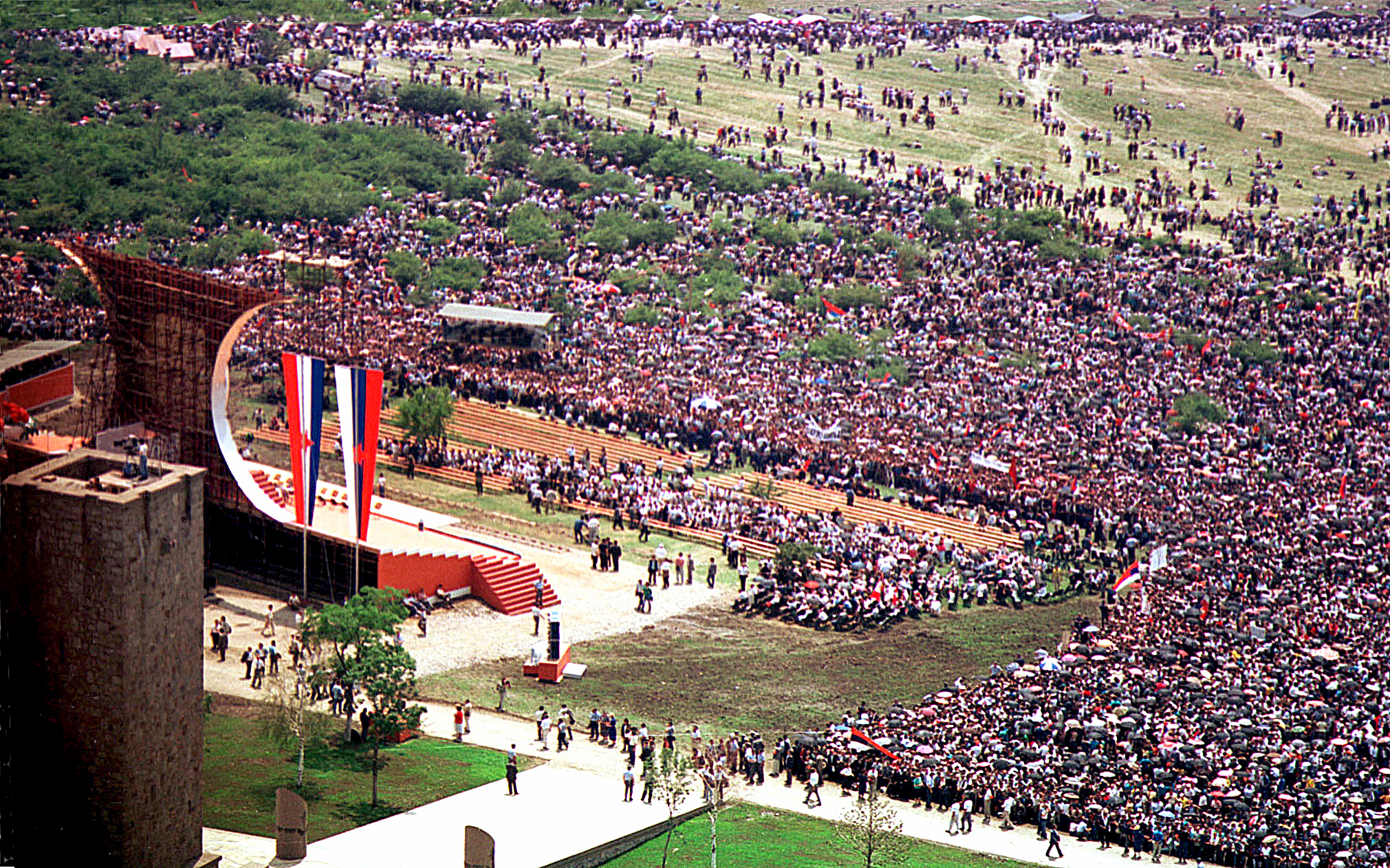
In the Soviet Union, the KGB, at the end of Stalin’s rule cleansed of “cosmopolitans” of Jewish origin, and in the first months after the leader’s death also deprived of the influence of the former head of the Caucasian Chekists Lavrentiy Beria and his associates, became the main bearer of chauvinistic ideology, a new “Union of the Russian People” on Lubyanka Square. And now imagine that in this headquarters they learn about Milošević’s famous speech at Kosovo Polje — the place where the new leader of Serbia promised that “all Serbs will live in one state.”
I remember very well the perception of this speech in Yugoslavia itself at the time — it was a real shock. On the cover of one of the main journals of change — the Slovenian weekly “Mladina” — Milošević was then depicted in medieval armor, rushing with weapons at leaders of other republics dressed in modern suits with computers and notebooks. Everyone realized that the Middle Ages were starting!
But the Soviet Chekists wanted precisely these Middle Ages! After all, the political program of Milošević, who quite consciously intended to seize territories of other Yugoslav republics inhabited by Serbs, from Belgrade’s point of view, almost completely coincided with the political program of the Russian writer Aleksandr Solzhenitsyn. In his clumsy brochure “Rebuilding Russia”, the famous writer, chauvinist, and enemy of democracy proposed creating a new state of Russians from Russia itself, Ukraine, Belarus, and part of the territory of Kazakhstan — that is, he followed the same ethnic principle as Milošević, while denying Ukrainians and Belarusians national subjectivity.
It may seem strange that the Chekists, who harassed Solzhenitsyn and took part in his expulsion from the USSR, received the political views of the author of “The Gulag Archipelago” with such enthusiasm. But by the time of the collapse of the USSR, chauvinistic priorities on Lubyanka Square had been fully formed, and the Chekists were ready to welcome any bearer of these views.
Even more so Milošević. After all, in his political program Moscow also saw an opportunity for revenge for a geopolitical defeat and the “loss” of Yugoslavia after Stalin’s conflict with Josip Broz Tito. In the Chekist picture of the world everything was simple. Tito — not a Serb — tore “brotherly Yugoslavia” away from Moscow, while the Serb Milošević wants to restore this brotherhood. So why not help a new ally in building a “Greater Serbia”?
It can be said that this struggle for a “Greater Serbia,” even before Putin, became one of the first duels of the FSB with the Western desire to preserve international law and “life by rules.” Chekist Russia lacked strength also because its representatives had not yet monopolized power at that time. And there were no economic capabilities in Russia to go into a direct confrontation with the West.
However, one should not forget that the Rubicon in relations between pre-Putin Russia and the United States was crossed precisely when Prime Minister Yevgeny Primakov turned his plane around over the Atlantic and refused to fly to the United States upon learning about the start of the NATO operation in Yugoslavia. Primakov, a former “journalist” closely connected with the FSB and head of foreign intelligence, was precisely one of the figures considered on Lubyanka as potential successors to Yeltsin. But in the end they settled on Putin. And Putin, as we can see, does not forget the Chekist defeat in Yugoslavia and the chauvinistic program of Milošević even decades after the end of the conflicts that turned out to be a prelude to a major war in the post-Soviet space.
Vitaly Portnikov. Ukrainian journalist, political commentator, author and opinion-maker.
The articles published in the “Opinions” column reflect the personal opinion of the author and may not coincide with the position of the Center