The monument to Taras Shevchenko has become a symbol of resistance to Russian influence and propaganda in Serbia
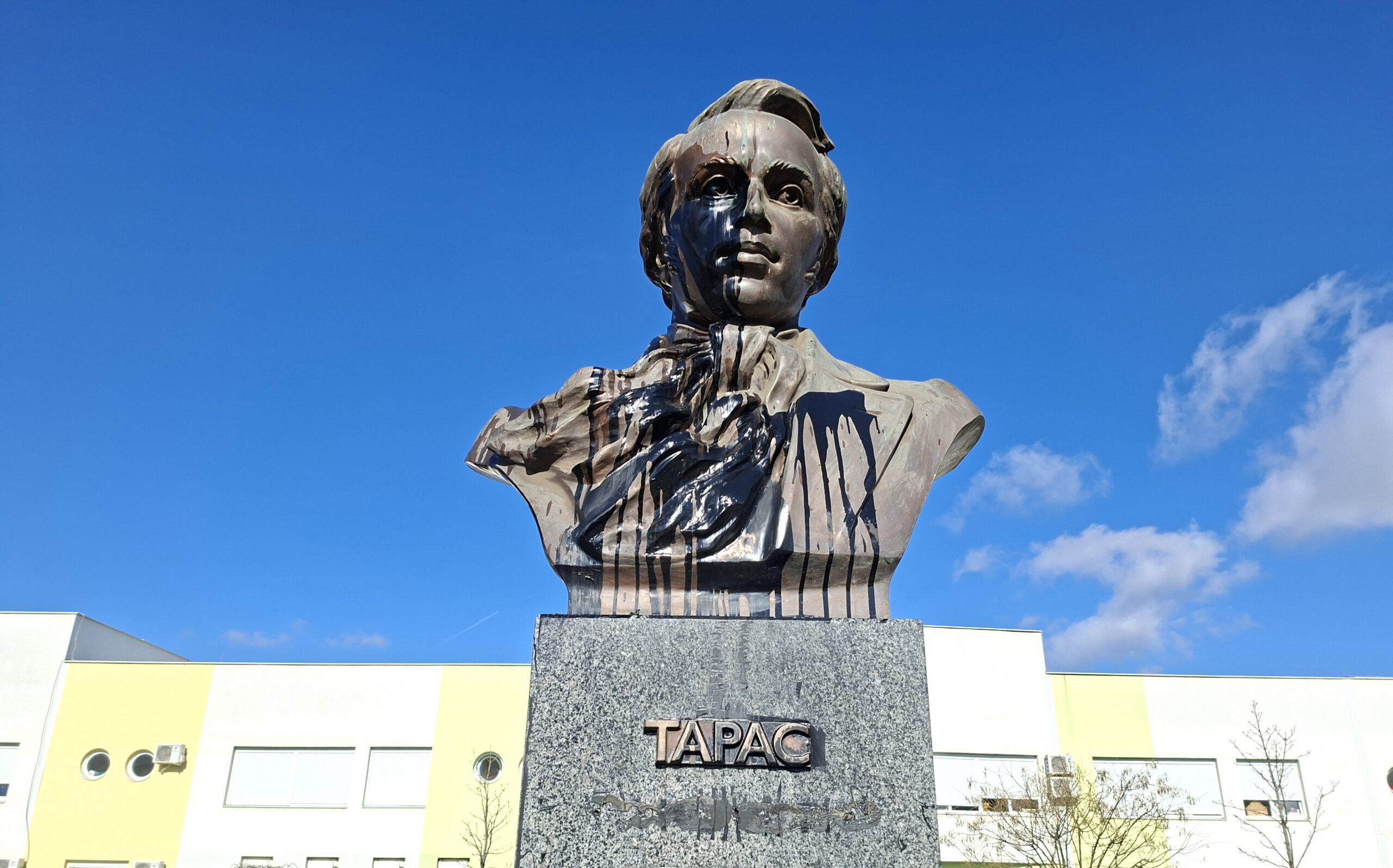
It would not even be known that in Serbia and Novi Sad there exists a monument to the Ukrainian poet, painter and fighter for freedom Taras Shevchenko, had it not been desecrated several times.
The first time was immediately at the beginning of the total Russian invasion of Ukraine, when on the pedestal of Shevchenko the letter symbol of the Russian occupation “Z” was written. The second time it was damaged on the fourth anniversary of the aggression, the bust was poured over with black paint, and the plaque with the surname was torn off. In the meantime, flowers left there by the Ukrainian community and anti-war activists have been scattered several times, for whom the Shevchenko monument in Novi Sad is a steady gathering place.
It is truly a miracle that in 2019 the local authorities in Novi Sad, led by the Serbian Progressive Party, allowed the installation of such a monument. They have surely heard of the footballer Andriy Shevchenko, perhaps also something about the poet Taras Shevchenko at school. And why would an artist from the 19th century even be a problem for “Mother Russia” or irritate the primary electorate of the Serbian Progressive Party – russophiles and putinophiles?
It is precisely Russian and Ukrainian monuments that symbolically follow changes in the political situation in Serbia. The pompous monument to Russian Emperor Nicholas II Romanov in Belgrade was erected in 2014, in the year of the annexation of Crimea and the strengthening of Russian influence in Serbia. That influence has grown over a decade to such an extent that Russian President Vladimir Putin is more popular in Serbia than President Aleksandar Vučić.
The Shevchenko monument in Novi Sad was late in being installed, accompanied by objections from the usual putinophiles of the Serbian Radical Party and the Democratic Party of Serbia. The bust was officially unveiled a year before the total attack on Ukraine.
Representatives of the authorities did not read the main thing in the poet’s biography. Shevchenko was born in Tsarist Russia as a serf, who spent most of his life in bondage, in imperial prisons and in exile. He is a symbol of defiance, rebellion and struggle against Tsarism, feudal oppression and Russian imperialism. Taras Hryhorovych is the embodiment of the Ukrainian nation, but also a fighter for a different free Russia and for the peoples under its boot. In Saint Petersburg he was bought from a Russian colonel and landowner by fellow artists, who enabled him to obtain the status of a free man.
Shevchenko is a witness to the truth that Russia has wanted to destroy Ukraine for two centuries. A historical fact in which the West did not believe until the very last moment before the invasion of Ukraine. And one more fact – that Russia has never renounced its imperialism. After two centuries, we are again here with Shevchenko, who reminds us that the struggle against uniformity of thought, servility, social injustice and the subjugation of other peoples is eternal.
The monument to Taras Shevchenko in Novi Sad has a special architectural feng shui. The Ukrainian sculptor Volodymyr Tsisaryk from Lviv sculpted him to be young. It is located on the green area of the alley of the poet Miroslav Antić. It is close to the Danube and oriented toward the University Campus, where for a year and a half the most brutal police violence against protesting students has been taking place. Shevchenko witnessed how last summer prohibited toxic tear gas was thrown there at students and citizens.
The desecration of the bust and pedestal of Shevchenko this time was accompanied by insulting graffiti, somewhat further in the center of Novi Sad. A large inscription “Litvinenko fascist” refers to the Ukrainian ambassador Oleksandr Litvinenko, who recently took office in the Republic of Serbia.
This is a message from the putinophiles that Serbia must not be a friend of Ukraine. Nervousness in that camp is obvious. At first glance, if you follow the media, television stations with national frequencies and high-circulation tabloids, it appears that Serbia is completely on the side of Russia. However, if you look at voting in the United Nations General Assembly and in other international bodies and peace initiatives, Serbia is mostly on the side of Ukraine, votes in favor of its territorial integrity and condemns the conflict. Perhaps not so much of its own will, as out of fear of losing Western support.
What hurts the Kremlin the most is the ammunition with which Serbia supplies Ukraine through third countries and in the value of several hundred million euros.
Due to the isolation of Russia, official Serbia has by force of circumstances become a closer friend of Ukraine. Kyiv is also now a candidate for membership in the European Union and in the future will share with Belgrade all the challenges of transition in candidacy, regardless of the fact that there is currently an autocratic regime in Serbia.
Opposition and rebellious Serbia has also gained Taras Shevchenko as an ally, and his monument has definitely become one of the newer symbols of resistance in Novi Sad. Resistance to Russian influence and propaganda in Serbia.
Boris Varga. Serbian political scientist and journalist.
The articles published in the “Opinions” column reflect the personal opinion of the author and may not coincide with the position of the Center