
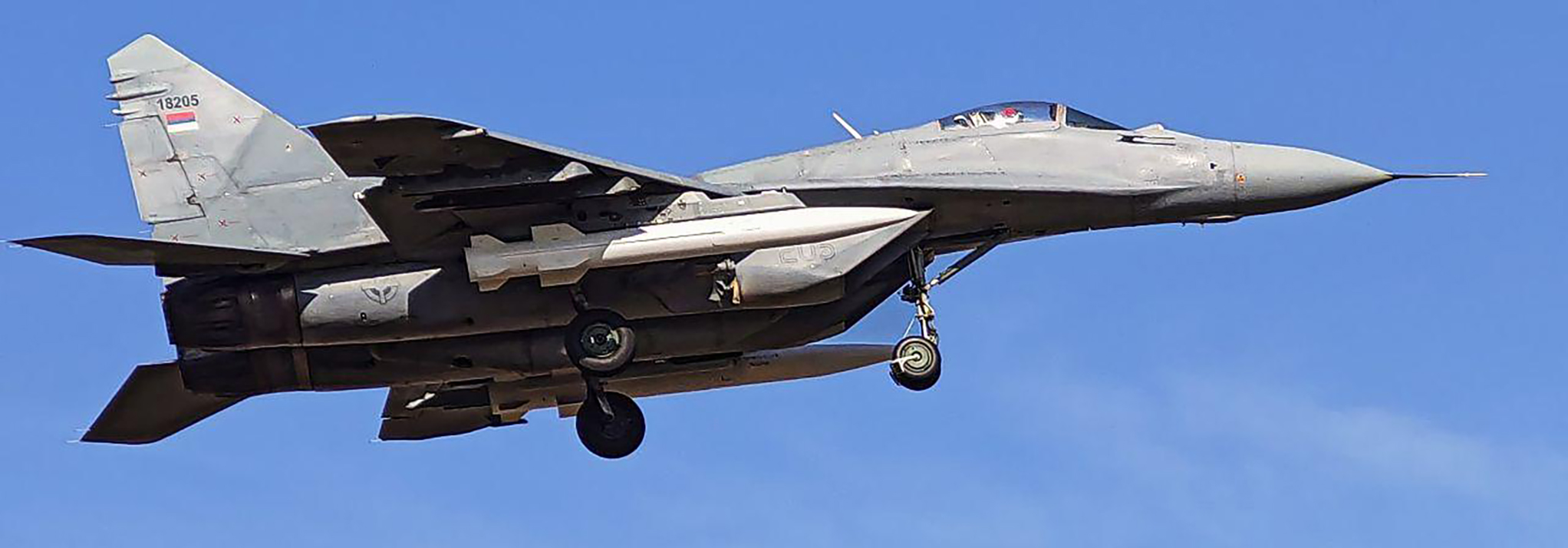
An “accidental” photograph that appeared on military forums at the beginning of March 2026 sparked a heated discussion about the security situation in Southeastern Europe and caused tension in Belgrade’s relations with its neighbors. In the image, a Serbian MiG-29 fighter jet was captured with the latest weaponry that had not previously appeared in the arsenals of any country in Europe.
It concerns Chinese hypersonic CM-400 AKG missiles capable of striking targets at a distance of hundreds of kilometers. The appearance of such weapons in Belgrade not only changed the balance of power in the region but also provoked a nervous reaction in neighboring Croatia.
While official Zagreb appeals to NATO, warning of a new threat, Serbian President Aleksandar Vučić declares preparations for defense against “hostile” neighbors. What stands behind the statements of the Serbian leader: real fear of an attack, the “hand of Moscow,” or a political technology?
The hypersonic “Zagrepčanka”
On 9 March, a photograph of a Serbian Air Force aircraft equipped with some new missiles, whose presence in the Serbian army had previously been unknown, was published on the internet (on the military-technical forum MyCity Military). Later it became known that the photo shows a Serbian MiG-29 fighter jet with two CM-400 AKG air-to-surface missiles mounted on underwing pylons. According to media information, the aircraft belongs to the 101st Fighter Squadron of the 204th Aviation Brigade, which is stationed at the military airfield in Batajnica near Belgrade. CM-400 AKG is a hypersonic ballistic (or, as experts call it, quasi-ballistic) air-launched missile. The manufacturer of the CM-400 is the China Aerospace Science and Industry Corporation (CASIC).
The missiles are already in service with the Air Force of the People’s Liberation Army of China and the Pakistan Air Force. Serbia became the first country in Europe to receive missiles of this type.
The declared range of the CM-400 AKG is up to 240 kilometers, but after the Indo-Pakistani conflict of 2025 representatives of the Pakistan Air Force stated that the CM-400AKG is capable of striking targets at a distance of 400 km. Radio Television of Serbia (RTS) wrote that in the media and social networks the new missile of the Serbian Armed Forces was called the “Zagrepčanka,” since it allegedly can hit Zagreb.
Complaint to NATO
News about the new long-range Serbian weapon, especially in the context of discussions of hypothetical strikes on the capital of a neighboring state, caused concern in Croatia, which is quite understandable. First, Zagreb had already suffered strikes by Serbian missiles during the war in the 1990s. Second, against the background of Russian ballistic strikes on Ukrainian cities and Iranian strikes in the Persian Gulf, which have become a terrible reality of today, even hypothetical discussions of missile attacks are perceived with great caution.
Croatian Prime Minister Andrej Plenković stated on 12 March that Zagreb would warn NATO partners about the new Chinese-made hypersonic missile which, according to media reports, allegedly belongs to the Serbian Armed Forces. Although he emphasized that he does not expect Serbia to be able to use hypersonic missiles against neighboring countries, Croatia or any other, nevertheless, according to him, he will “talk with our NATO partners and warn them about such weapons, which are new in the arsenal of the Serbian Armed Forces.”
The next day Plenković said that he had already informed NATO Secretary General Mark Rutte about the appearance of “very serious weaponry,” which had not previously been seen in Europe, calling this information relevant for the Alliance and its member states.
A sense of threat
President of Serbia Aleksandar Vučić, in his speech on the state television RTS on the evening of 12 March, confirmed the purchase of Chinese hypersonic missiles, although he noted that the aircraft equipped with missiles had been “accidentally photographed.” “We successfully integrated the Chinese missile onto the Russian fourth-generation MiG-29 fighter. And today these are the best-equipped MiGs in all of Europe, I think in the entire world,” he boasted. According to Vučić, the CM-400 can indeed strike targets up to 400 km away. He described the new acquisition as “terribly expensive and terribly effective missiles,” but added that Serbia “received a discount.” “We have a significant number of these missiles, and there will be more,” Vučić noted.
The President of Serbia explained that the reason that prompted Belgrade to purchase this Chinese weapon was the sense of threat caused by the formation of a military alliance of Zagreb, Tirana and Pristina. “This military alliance is directed directly against Serbia. There is no other reason why this military alliance was created. And then they were surprised when they saw that we have missiles,” he said. “Today I would not underestimate the Serbian Armed Forces, which we usually do, but I want even less to underestimate those who conclude military alliances against us,” Vučić stated.
According to the President of Serbia, Croatia, Albania and Kosovo are creating a military alliance in order to attack someday. “They will wait for the moment that will occur in the future, when a bigger split between Europeans and Russians erupts, and when an even bigger split erupts in the Middle East. …I honestly think that these are their only intentions. …They are waiting for a favorable moment when general chaos will occur in the world and when, as they think, they will have the opportunity,” he said. “We are preparing for their attack,” Vučić noted, adding that “Serbia has sufficient deterrent forces,” “and the citizens of Serbia can sleep peacefully.” “Serbia is strong enough to preserve its territorial integrity, sovereignty, freedom and the security of its citizens. And they will not attack us not because they do not want to, but because they know what the response will be,” he emphasized.
War is the past
Official Belgrade had previously stated that it views the military alliance of Zagreb, Tirana and Pristina as a threat. But such a clear and unambiguous statement by the Serbian president about the preparation of neighboring countries (“two countries and one entity,” as Vučić says) for an attack on Serbia was heard for the first time.
Plenković denied Vučić’s statements, saying that cooperation at the level of the ministries of defense of Croatia, Albania and Kosovo is not directed against Serbia at all. “This is a completely fabricated topic that supposedly should support some narrative about some external threat to Serbia at the domestic political level,” the Croatian prime minister said, adding that Croatia does not even think about such things. “You are dealing with neighbors for whom war is the past. The aggression of the Milošević regime is the past,” he emphasized.
Plenković also once again denied Vučić’s accusations about Croatia’s interference in Serbia’s internal affairs (support for student protests and attempts to organize a “color revolution”).
Statements from Belgrade about a Croatian trace in the protest movement have been heard for several months, but now the topic of the “preparation of a military attack” has been added to them. Why is Belgrade’s rhetoric becoming sharper?
Three versions
Version 1. The photo of the Serbian aircraft with China-range missiles was taken accidentally.
After which Vučić, as best he could, justified the purchase of Chinese weapons, and for some reason the story about the threat of aggression from the military alliance of Zagreb, Tirana and Pristina seemed appropriate to him in this context.
Version 2. The topic of the “Croatian-Albanian threat” was “passed” to Vučić from Moscow.
This version is supported by statements by Russians that were heard on those same days, at the beginning of March.
On 11 March the head of the delegation of the Russian Federation at the plenary session of the OSCE Forum for Security Co-operation in Vienna in her speech “drew attention” to “the problem of subregional military blocs that pose a serious threat to peace and stability in the Western Balkans,” reminding that in the spring of 2025 Zagreb, Tirana and Pristina concluded an agreement on cooperation in the fields of defense and security.
A few days earlier, on 4 March, the official representative of the Ministry of Foreign Affairs of Russia Maria Zakharova said that the anti-Serbian charge of the Croatian-Albanian project is obvious. “Belgrade is justifiably sounding the alarm, understanding the entire danger of the growth of a hostile force component on its borders. …We call on Western countries, before it is too late here as well, to stop fueling distrust between the Balkan states, pushing them into an arms race and ultimately increasing the risks of a military clash in Southeastern Europe,” Zakharova said.
Russian officials did not publicly speak about the “preparation of an attack,” but in their statements they drew attention to a “serious threat to peace” and the increase of “the risks of a military clash” due to the creation of what they consider an anti-Serbian military alliance. It cannot be excluded that in some non-public communications they use more radical definitions, convincing the Serbian leadership that neighbors are preparing for an attack.
Version 3. Elections.
Another neighbor of Serbia, Hungary, will soon hold parliamentary elections. The Hungarian leader Viktor Orbán made a very harsh confrontation with Ukraine the main theme of the election campaign. At first he accused Kyiv of interfering in internal affairs and supporting the opposition, including protest actions. Closer to the elections these accusations were supplemented by threatening statements about preparations by Ukrainians for sabotage. There was even a decision to involve the army in guarding energy facilities.
Reading Hungarian and Serbian political news at the same time, one may think that the Serbian authorities could have borrowed some techniques of political technology from their neighbors. Because, most likely, in about a year Serbia will face parliamentary elections, and possibly presidential elections as well.
CWBS Analytical Group