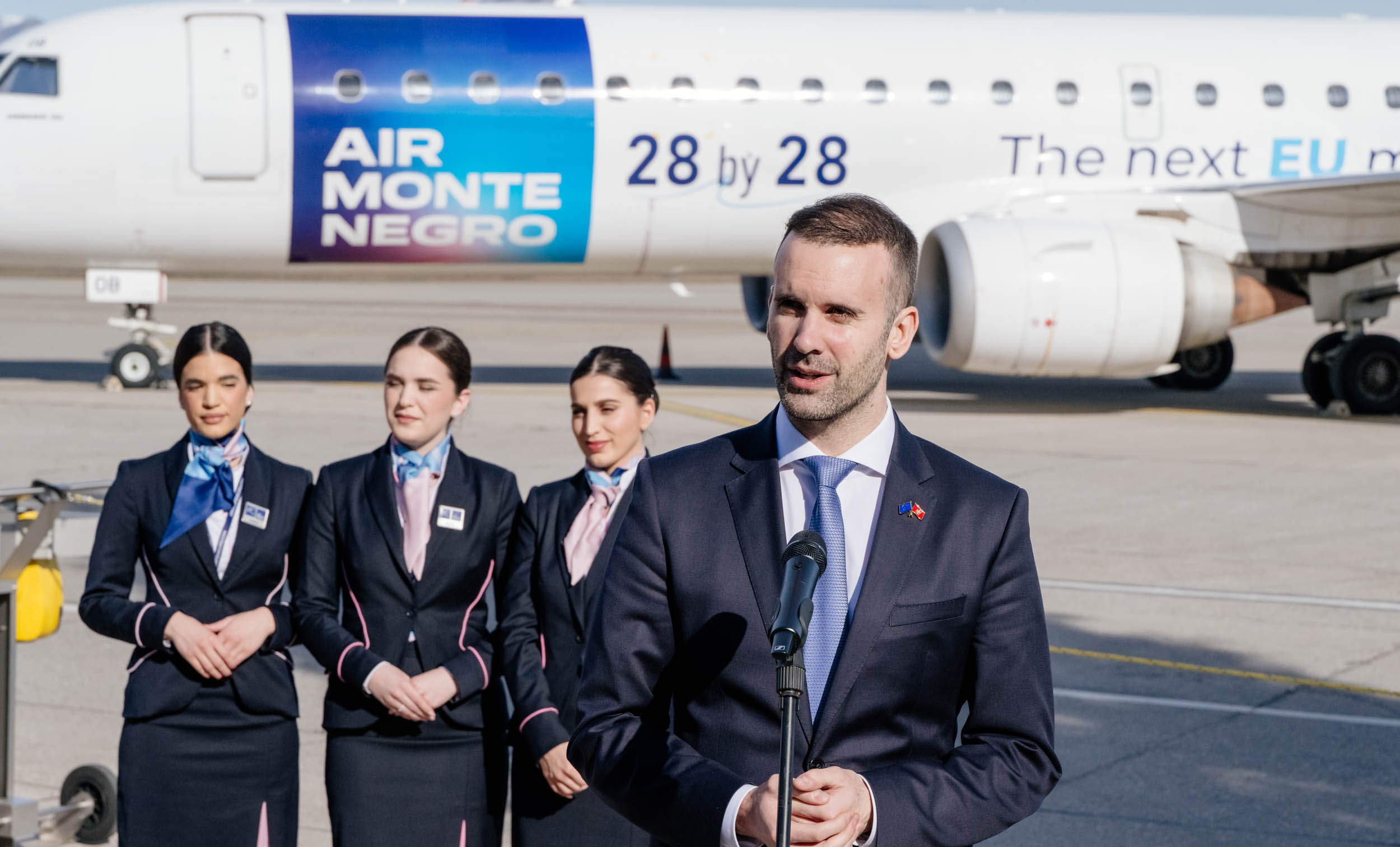
In Montenegro, EU membership is not only promised, but also painted on airplanes: at the end of February, the government launched the campaign “28by28 – The Next EU Member” and literally placed its European integration ambition on the fuselage of an Air Montenegro aircraft. Prime Minister Milojko Spajić called this slogan a “strategic message of the state.” Translated from political language, this means that the authorities are positioning accession to the EU no longer as a dream, but as an almost calendar-based plan: to close the negotiating chapters by the end of 2026 and enter the EU by the end of 2028. The implementation of these deadlines is the key objective of the work of the current 44th Government of Montenegro. At the same time, in the Montenegrin parliament all major political forces — including pro-Serbian and pro-Russian ones such as New Serbian Democracy — support the country’s accession to the EU, even if in some cases only declaratively. This was shown in particular by the adoption on 3 March of a fresh resolution on Montenegro’s European integration.
As of the end of March 2026, reasons for optimism in Montenegro are aplenty. The country’s negotiations with the EU have been ongoing since 29 June 2012. After the positive IBAR — the Interim Benchmark Assessment Report — on Chapters 23 (Judiciary and Fundamental Rights) and 24 (Justice, Freedom and Security) in June 2024, the process, which had stood almost still for years, accelerated rather sharply. In December 2024, Montenegro for the first time in seven years closed three negotiating chapters at once. In June 2025 — Chapter 5 on public procurement. In December 2025 — another five chapters: 3, 4, 6, 11 and 13, mainly from the economic and agricultural block. In January 2026 — Chapter 32 (financial control), and on 17 March 2026 — Chapter 21 (trans-European networks). What is important is not only that chapters are being closed, but also the frequency with which this has begun to happen: over the past 15 months, Podgorica has closed eleven chapters, which in the current Balkan context is a very atypical, effectively breakthrough pace.
But the figures may be misleading, because 14 provisionally closed chapters out of 33 is still rather the entry into the most dangerous part of the European integration marathon. The easier, or at least less complex and resource-intensive topics, have already largely been dealt with by the Government of Montenegro. What remains is not about beautiful presentations in Brussels, but about painstaking bureaucratic work, an extraordinary concentration of effort and resources of the state apparatus. Therefore, the European Commission, even while welcoming Montenegro’s rapid pace, persistently brings Montenegro back to the same word: fundamentals. That is, courts, prosecution, public administration, competition, anti-corruption, the capacity to implement laws already adopted. It is precisely about that part of the negotiation process where it is decided whether the country is ready to become a full member of the EU, and not simply a champion in rapidly adopting laws.
At the same time, it should be taken into account that Montenegro is noticeably ahead on the European path of all the other candidate countries from the Western Balkans region, except that Albania has in the last few years begun actively catching up with its neighbor.
Even Podgorica’s latest success — the closing on 17 March of the “transport” Chapter 21 — was not a flawless story for Brussels. In the published report of the European Commission for last year, the situation with Chapter 21 was commented on relatively cautiously: Montenegro has a level of preparedness between moderate and good, but is showing “limited progress.” The Commission pointed out that Montenegro’s transport strategy needs updating, and that major infrastructure projects run up against weak administrative capacity, staffing difficulties, slow management, and implementation delays. In other words, the chapter was closed not so much because of the brilliant work of the Montenegrin side, but in view of the political will of Brussels, because the EU is politically ready to move Montenegro forward toward membership, even if certain technical shortcomings are still obvious. Thus, Podgorica is currently receiving not only an assessment for its homework, but also a geopolitical credit of trust.
It should be understood that Montenegro’s European integration is currently sustained by two realities at the same time.
The first: after the start of Russia’s full-scale war against Ukraine, the EU has once again become serious about enlargement and very much wants at least one convincing success story in the Balkans. Montenegro’s progress on the negotiating path with the EU owes much precisely to this geopolitical context and, consequently, to the EU’s real desire to enlarge into the Western Balkans in order to block the strengthening in the region of the destructive influence of third parties, primarily that of Russia. And Montenegro is perhaps the most convenient candidate for this: a territorially small country with access to the Adriatic Sea and a population of 623,000, it is easily integrated into the EU’s economic system and is in no way capable of destabilizing the European market.
The second: in Brussels itself there is no desire whatsoever to once again go through a path in which a new member formally entered the Union and then began backsliding in the sphere of the rule of law, the courts, and political standards. Hungary can at least be recalled. That is precisely why EU Commissioner for Enlargement Marta Kos is already speaking both about the possibility of concluding negotiations with Montenegro by the end of 2026 and about future safeguard mechanisms which, in her words, must function strictly if anyone wants, after accession to the EU, to play against the rules of the Union itself. For Montenegro, this means an obvious thing: the window of opportunity for accession to the EU has opened, but control at the entry point has become much stricter.
This is where the risk zone begins. After the already mentioned positive IBAR in June 2024, when the EU recognized that Montenegro had generally fulfilled the interim benchmarks in the chapters on the rule of law, the judiciary, and fundamental rights, the process came back to life. But this was not a decision in the spirit of: “that’s it, the issue is closed,” but rather: “good, now show that you can move further.” In the report for 2025, the European Commission already writes without diplomatic curtsies that full alignment of visa policy with the EU remains a condition for closing Chapter 24. And then follows a very concrete unpleasant detail: Montenegro’s list of visa-free countries still differs from the European one by nine states, and Brussels directly calls seasonal visa-free regimes incompatible with European legal norms. This concerns in particular the need to cancel the visa-free regime between Montenegro and the Russian Federation — the Montenegrin side promised to address this issue by the end of 2026, which is a sensitive matter given the number of Russians who live in the country or visit it as tourists. So this is not a minor detail, but a test of whether Podgorica is capable of placing European logic above situational tourist and political temptations.
Another important knot is Chapter 8, that is, competition. Precisely the chapter that almost never gathers emotional headlines, but very well shows whether the state is ready to live by the rules. The European Commission assesses this chapter as moderately prepared on Montenegro’s side. The European side recognizes some movement — for example, the adoption in July 2025 of the law on state aid control. But at the same time, the European Commission notes that the steps to fulfill the benchmarks of this chapter should be urgently implemented, because it concerns the state’s ability to genuinely limit politically convenient aid to “its own,” to give institutions autonomy, and to stop confusing economic policy with manual control. For the Balkan countries, this sphere is traditionally vulnerable precisely because of this: tight corrupt ties of politicians with business, tenders “won” in advance, and everything of that kind.
And then comes Chapter 27 — environment and climate. With ecology and environmental protection both in Montenegro and in the countries of the Western Balkans generally, everything is still far from ideal. In the region, many governments want to pretend that the problem is reduced to several laws and declarative phrases about a green transition. However, the annual spring picture of mountain rivers full of garbage, and the terrible state of the air in winter in Pljevlja, are eloquent illustrations of the real state of affairs. In the Montenegrin case, the European Commission writes only of “some level of preparedness,” although it recognizes certain progress — in waste management, in the climate plan until 2035, in accession to the LIFE programme. But then the document sets out a clear requirement: “substantially intensify work” in order to achieve the envisaged benchmarks. And that means air, water, waste, nature, climate — and a lot of money, which is always lacking. Chapter 27 is almost nowhere closed on political will alone. Here what is needed is purely the capacity of the central and local authorities, investments, and systematic work.
Over the past two years, the Montenegrin authorities have clearly been betting precisely on the pace of implementation of reforms. At the beginning of February 2026, the Assembly adopted as many as 25 European integration laws at two extraordinary sittings without debate. President Jakov Milatović initially reacted sharply and stated that European reforms are not “simply about raising hands in parliament,” but later nevertheless signed the relevant package. In March of this year, the Montenegrin parliament advanced three more laws for the European track. This can be interpreted in two ways. On the one hand, Podgorica has indeed begun to run. And after years of inertia, that in itself is already news. However, on the other hand, it is very easy to turn European integration into a conveyor belt of urgent voting without reliable mechanisms for monitoring the real implementation of its own laws. And Brussels, as is known, likes speed exactly until the moment when it begins to substitute for quality.
It should be added that the adoption specifically of two fresh laws — on the National Security Agency and Internal Affairs — a week ago caused another political crisis. In particular, this concerns the opposition’s withdrawal from the work of all parliamentary committees and the departure from the ranks of the ruling Europe Now Movement of a prominent figure — Miodrag Laković, chairman of the Security and Defense Committee. The president vetoed them, but parliament overrode the veto on 19 March. The main conflict arose around the compliance of the laws with European standards. The opposition fears the transformation of Montenegro into a “police-spy” state, and the European Commission indicated that the provisions of the laws in the sphere of data protection are still not fully aligned with EU legal norms, and declared close monitoring of implementation.
There is another mine that is clearly visible in Podgorica, but they do not very much like to speak about it aloud. This is bilateral misunderstandings with neighboring Croatia. The irony is that one of Montenegro’s strongest chapters — 31, that is, foreign, security and defense policy — still remains open not because of Moscow, not because of Brussels, and not because Montenegro is poorly aligning its foreign course with the EU. On the contrary: Montenegro has currently aligned its foreign and security policy with Brussels to the maximum, in particular in the sanctions sphere and regarding support for Ukraine. But in December 2024, the closing of this chapter was postponed because of Croatian reservations and a package of bilateral disagreements: the maritime border, ownership rights to the training ship Jadran, questions of historical memory about the 1990s, and more recently — also the property rights of Croats from the Bay of Kotor. Consultations between the foreign ministries of both countries are taking place regularly, but none of the issues has yet been closed. This means an unpleasant thing for Podgorica: even if the country is technically ready, the policy of a neighbor may hinder the negotiation process at the most unexpected moment. And this is yet another reminder that accession to the EU is far from being only a technical process.
That is precisely why the current Montenegrin optimism looks both convincing and risky at the same time. Yes, Montenegro today really is the most advanced candidate. Yes, the government has already moved from cautious diplomacy to an almost pre-election slogan about accession to the EU in 2028. And yes, the country has a strong argument: after many years of Balkan stagnation, it is finally giving the European Union that which it has long not seen from the region — a sense of movement and enlargement. But it is precisely here that the temptation arises to overestimate itself. Because the hardest thing in European integration is not to open chapters and not even to quickly close part of them. The hardest thing is to make it to the finish when it is already beginning to seem that it is almost in your hands.
The most accurate conclusion regarding the prospects of the Montenegrin “European dream” would currently sound like this. Montenegro can complete the negotiations by the end of 2026. It is difficult, but not in the realm of fantasy. Entering the EU in 2028 is also possible, but only without major disruptions or “black swans.” And disruptions are possible in the most difficult sectors: justice, visa policy, competition, ecology, the staffing capacity of the state, the threat of government crises, and the Croatian factor. And it is precisely at the current stage that the country may lose control over the pace and trajectory, because the final phase of accession requires not only political will and slogans, but also the quality of public administration.
For Montenegro, the next few years will be a decisive test of the quality of its statehood. The country is now at the point where the EU is finally ready to believe in its success story, but Podgorica itself still has to prove that this story is not an advertising campaign on the side of an airplane, but a real ability of the state to go all the way to the end. And finally, it should not be forgotten that the agents of influence of Moscow and Belgrade, against the background of the acceleration of Montenegro’s European path, will obviously make considerable efforts to sabotage it and destabilize the internal situation in the country.
CWBS Analytical Group