
- Serbia is the only country in Europe that has Chinese hypersonic quasi-ballistic missiles in service
On 9 March, a photo of a Serbian MiG-29 fighter jet equipped with two Chinese hypersonic CM-400 AKG missiles appeared on a military-technical forum. This was the first confirmation that such missiles are in service with Serbia.
The CM-400 AKG is a quasi-ballistic air-to-surface missile developed by the Chinese corporation CASIC. Before that, it had been in the possession only of China and Pakistan. Serbia became the first country in Europe to receive this weapon.
A few days after the first photo appeared, Serbian President Aleksandar Vučić acknowledged the purchase of the Chinese missiles, stating that the CM-400 AKG is capable of striking targets at a distance of up to 400 km.
The appearance of a weapon regarded as offensive caused concern in Croatia. Prime Minister Andrej Plenković informed NATO Secretary General Mark Rutte of the appearance in Serbia of “very serious weaponry” previously unseen in Europe, calling this information relevant for the Alliance.
- Vučić stated that a “possible attack” on Serbia could come from the military alliance of Croatia, Albania and Kosovo
After the photo of the Serbian MiG-29 with Chinese missiles appeared, Serbian President Aleksandar Vučić made a series of sharp statements in which he directly linked the purchase of the new weaponry with a “sense of threat” from the military alliance of Croatia, Albania and Kosovo. In his appearance on the state broadcaster RTS, he stated that the reason that prompted Belgrade to purchase the Chinese weaponry was a sense of threat caused by the formation of the military alliance of Zagreb, Tirana and Pristina. “This military alliance is aimed directly against Serbia. There is no other reason why this military alliance was created. But then they were surprised when they saw that we have missiles,” Vučić said. In the view of the Serbian president, Croatia, Albania and Kosovo are creating a military alliance precisely for an attack: “They will wait for the moment that will occur in the future, when a greater split erupts between Europeans and Russians, and when an even greater split erupts in the Middle East. …They are waiting for a favorable moment, when chaos will prevail in the world, and when, as they think, they will have the opportunity.” “We are preparing for their attack,” he noted.
Croatian Prime Minister Andrej Plenković denied Vučić’s statements, saying that cooperation at the level of the defense ministries of Croatia, Albania and Kosovo is not directed against Serbia. “This is a completely fabricated topic that is supposedly meant to support some narrative about some external threat to Serbia at the domestic political level,” the Croatian prime minister said.
- Military exercises of the Serbian army caused concern in Pristina
Prime Minister Albin Kurti accused Belgrade of demonstrating “aggression” after the Serbian army conducted military exercises on 18 March in the municipality of Bujanovac. This concerns an area known as the Preševo Valley, located near Kosovo and populated predominantly by ethnic Albanians.
At the government session on 19 March, Kurti stated that through these provocative actions Serbia aims to increase tensions and intimidate Albanians living in Bujanovac.
“These provocations near the border belt in Karačevo by units of the 63rd Serbian Parachute Brigade through exercises with an H125M helicopter and a parachute landing a few meters from the border with the Republic of Kosovo constitute a dangerous manifestation of aggression,” Kurti noted. “Such a demonstration of military force above houses, schools, medical centers constitutes not only pressure, the incitement of tension and an attempt to intimidate the local residents, …but also demonstrates an open provocation against our independent state, the Republic of Kosovo,” he emphasized.
Kurti stressed that Serbia’s demonstrative actions are “even more alarming” “when we recall that this same unit trained and supported the criminal group of Milan Radoičić, which carried out the aggressive terrorist attack in the village of Banjska in Zvečan.”
In addition, the Prime Minister of Kosovo recalled that the exercises are taking place at a moment when Serbia has purchased Chinese missiles (CM-400 AKG hypersonic quasi-ballistic air-to-surface missiles). He emphasized that the exercises conducted on 18 March, “together with the inflammatory rhetoric of President Aleksandar Vučić that Serbia is allegedly preparing for a possible attack by the Croatia–Albania–Kosovo alliance, as well as the purchase of Chinese and Russian weaponry, confirm that Serbia is using the army as a means of blackmail in order to keep the Balkans in constant tension.” Kurti called on the international community to punish Serbia for “this destabilizing approach, which directly threatens peace and regional security.”
Shaip Kamberi, a leading Albanian politician in Serbia, a member of the Serbian parliament, and leader of the Party for Democratic Action (Partia për Veprim Demokratik, PVD), which is based in the Preševo Valley, emphasized in his Facebook post that “the conduct of military exercises by Serbia on the territory of the municipality of Bujanovac, near the border with the Republic of Kosovo, is an issue of important significance for the security situation in the region.” In his view, “such activities, especially when conducted near populated areas and involving an aviation component, affect the security assessment of local communities, in particular Albanians in the Preševo Valley” and “may be interpreted as factors affecting the growth of tensions and the reduction of trust between local actors.” “Maintaining a stable and predictable security environment requires a constant commitment to respecting international norms and strengthening crisis-prevention mechanisms,” Shaip Kamberi believes, proposing for this purpose, first of all, an increase in KFOR forces. In addition, “taking into account the constant provocations of the Vučić regime against Kosovo and Albanians in the Valley,” NATO, in his view, “should consider reviewing the decision on the Ground Safety Zone.”
At the same time, the NATO mission in Kosovo, KFOR, stated on 19 March that Belgrade had informed it in advance about the planned exercises near Kosovo’s southern border in the municipality of Bujanovac, where Albanians make up the majority of the population. KFOR confirmed that the exercises included the deployment of paratroopers from helicopters, but stressed that “this is a routine activity conducted on the territory of Serbia, and it does not pose a threat to security or stability in the region.” The NATO mission added that it continues to monitor the situation closely along Kosovo’s administrative line (border) and remains in constant contact with the Kosovo Security Force and the Chief of the General Staff of the Armed Forces of Serbia.
The mayor of the municipality of Bujanovac, Arbër Pajaziti, also emphasized that there is no reason for panic. “Citizens are concerned by these exercises of the Serbian army, but it should be noted that there is no need to panic, all these army movements were monitored and coordinated with KFOR in Kosovo,” he said in an interview with Kosovo media.
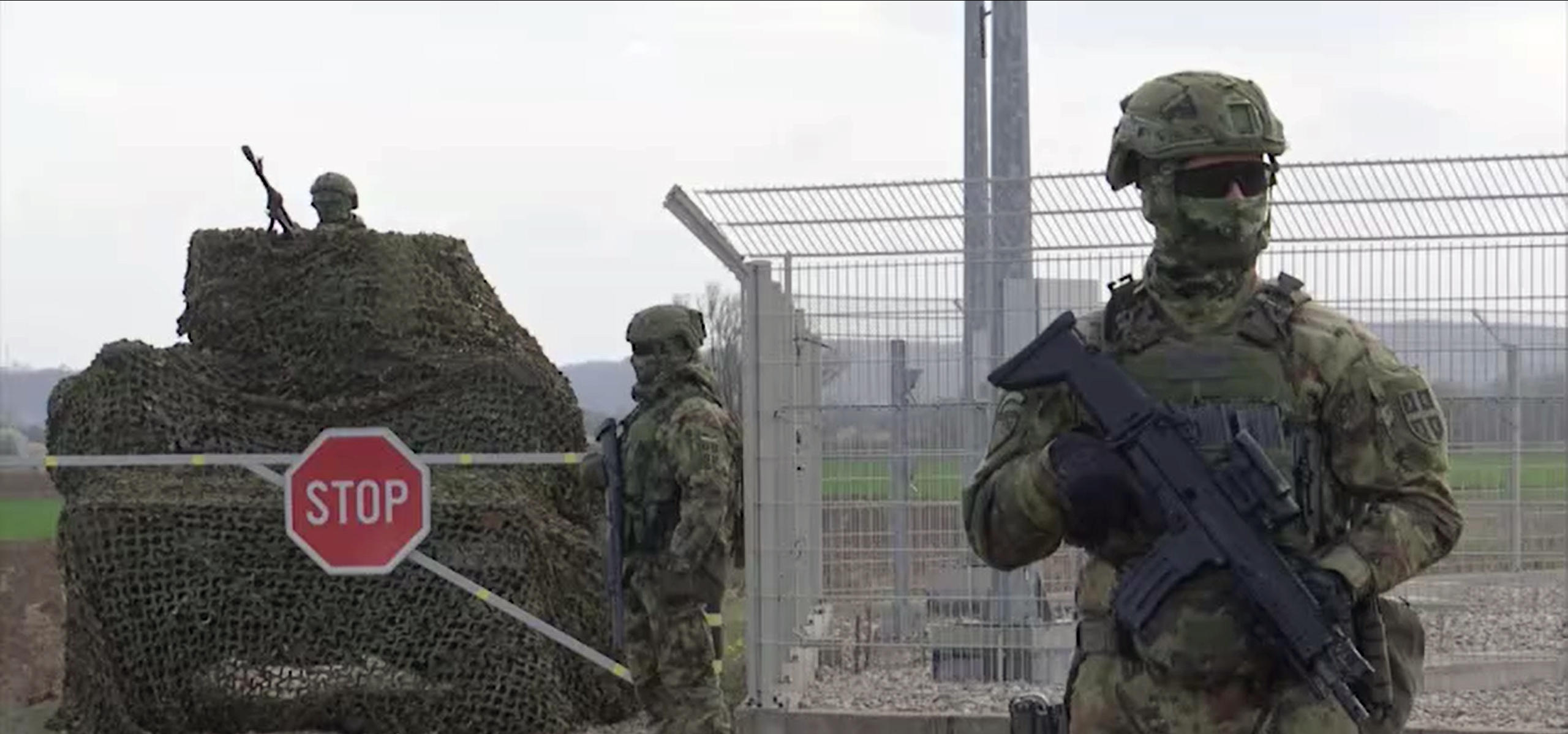
- Serbia deployed the army to protect the gas pipeline supplying Russian gas to Hungary
According to a decision of the President of Serbia and an order of the Chief of the General Staff, units of the Armed Forces of Serbia began reinforced protection of the “Velika Plana” compressor station in the settlement of Žabari. As reported by the Serbian state broadcaster RTS, this facility is critically important for the functioning of the “Balkan Stream” — the main pipeline through which Russian gas is supplied via Turkey and Bulgaria to Serbia and Hungary. Last year, Hungary received around 7.5 billion cubic meters of gas through this pipeline.
The 72nd Special Operations Brigade has been deployed for protection, and it has been tasked with the timely detection of threats and countering them at an early stage. From the air, the facility is covered by the 250th Air Defense Missile Brigade, which has in service the HQ-17AE surface-to-air missile system, the export version of a modern Chinese short-range air defense system. The HQ-17AE is capable of detecting and destroying drones, aircraft, helicopters and cruise missiles.
As the Serbian state broadcaster notes, the decision to deploy the army was made against the background of incidents of “sabotage” at energy facilities in Europe, above all on the “TurkStream,” thereby repeating Russian narratives. RTS also cites the example of neighboring Hungary, where the military guard energy facilities “at 75 different locations.” It should be noted that Budapest’s decision was taken because of unsubstantiated concern regarding the “Ukrainian threat.” Thus, although official Belgrade does not directly state its expectation of threatening actions specifically from Ukraine, de facto the authorities of Serbia are demonstrating a policy of solidarity with Russia and Hungary in the security dimension of the energy issue.
- U.S. intelligence: “Russia’s war against Ukraine revived fears of ethnic conflict in the Western Balkans”
In the declassified 2026 report of the U.S. Intelligence Community (“Annual Threat Assessment of the U.S. Intelligence Community” (ATA)), the Western Balkans are identified as one of the most vulnerable regions of Europe from the point of view of security. In addition, analysts believe that a “fault line” between Russia and the West runs through the region, and that it is deepening.
“Russia’s war in Ukraine revived fears of ethnic conflict and reinforced political fault lines in the Western Balkans between Russia and the West,” the report emphasizes.
The U.S. Intelligence Community also draws attention to Russia’s destructive actions in the region aimed at inflaming conflicts. As stated in the report, “Russia fuels instability between Serbia – which it favors—and Kosovo over Kosovo’s statehood, and backs the separation of Serb entity Republika Srpska from Bosnia and Herzegovina.”
It also concerns the use of so-called “soft power” for anti-European and anti-Euro-Atlantic campaigns. “Russia also uses state-sponsored nongovernmental entities to direct campaigns with the goal of obstructing NATO and the EU, highlighting Serb victimhood and promoting ties to Russia, particularly in Bosnia and Herzegovina, Montenegro, and Serbia, which have large ethnic Serb populations,” the report states.
The Annual Threat Assessment of the U.S. Intelligence Community (ATA) is an annual public report prepared by the Office of the Director of National Intelligence of the United States. It sets out the official assessment of key global threats affecting the national security of the United States and its allies. The ATA is used by the U.S. government and Congress as an analytical framework for determining priorities in foreign policy, defense and the financing of intelligence structures. U.S. partners, including NATO and the EU, use this document as a reference point for coordinating security policy and assessing threats that Washington considers critical. Think tanks, media and academic institutions use the ATA as a basic source for analyzing global trends and the behavior of state actors.
The report has significant political influence, as it defines the global priorities of the United States and affects the distribution of Pentagon resources, diplomatic initiatives and sanctions policy. It shapes the international agenda by setting the framework for discussions in NATO and the EU and also signals to allies and opponents alike which actions and regions are in the focus of American intelligence.
- Le Monde: Serbia is becoming the main hub of Russian hybrid operations in Europe
The French publication Le Monde, in its article of 17 March, emphasizes that Serbia has turned into a key center of Russian destabilizing operations in Europe, and that a number of court rulings and investigations confirm the growing role of the country in coordinating hybrid actions directed against European Union states. One such example was the conviction of three citizens of Serbia who were found guilty of carrying out a series of provocations in France and Germany.
At the end of December, a court in Senta near Belgrade found three Serbian citizens guilty of espionage and racial discrimination. They were accused of placing pig heads in front of nine mosques in the Paris region in September 2025 and of splashing green paint on the Holocaust Memorial and three synagogues in Paris in May 2025. The court materials also state that the group carried out a number of other actions. Among them was the placement of six hundred to seven hundred stickers near the Arc de Triomphe and in Paris’s 18th arrondissement in April 2025, calling for commemorating the victims of the Armenian genocide, as well as the installation of plastic skeletons in front of the Brandenburg Gate in Berlin in July of the same year. The skeletons carried inscriptions addressed to Chancellor Friedrich Merz: “I am still waiting for my pension. Thank you, Merz.”
The accused received sentences of house arrest ranging from six to eighteen months with the use of electronic bracelets.
The ruling of the court in Senta was issued without publicity, as part of a plea agreement, and was published on 6 March by the Balkan Service of Radio Free Europe. The court decision states that the group acted on instructions and with financing from structures linked to the intelligence services of the Russian Federation, Le Monde reports. According to the conclusions of the Serbian courts, the aim of the group was to carry out political destabilization and incite religious and ethnic hostility in France and Germany.
According to journalists, all those convicted come from the small town of Velika Plana, are unemployed, and their professions (workers, lab technicians, waiters) had nothing to do with special services. They were recruited and sent to France for a few thousand euros by a person named in the verdict as “The Hunter.” According to the French media outlet Mediapart, this refers to Serbian citizen A. S.
Le Monde notes that although the use of untrained executors for influence operations has been recorded since the start of the full-scale war in Ukraine, it was specifically 2025 that was marked by the growing role of Serbia as a key center of Russian destabilizing activities. In September 2025, the Moldovan authorities detained more than seventy citizens of Moldova and Romania suspected of having undergone training on the territory of Serbia for participation in unrest ahead of the elections on 28 September, in which pro-European forces won. According to Serbian police, the group numbered more than one hundred and fifty people, who were trained for several weeks in a camp near the border between Serbia and Bosnia and Herzegovina. In this case, two Serbian citizens were also detained, while the whereabouts of the alleged organizer of the camp, whom Radio Free Europe identifies as a citizen of Russia, remain unknown.
The journalists conclude that Serbia, which has the status of a candidate country for accession to the European Union but does not join the EU’s sanctions policy against Russia, creates favorable conditions for such operations. In particular, because Russian citizens do not need visas to enter Serbia, while Serbian citizens can travel visa-free throughout the EU. Researcher of the Belgrade Centre for Security Policy Predrag Petrović explains that this creates optimal conditions for hybrid operations, given that a significant part of Serbia’s population holds pro-Russian views, and that Belgrade and Moscow maintain close contacts at the official level. He also notes that the Serbian judicial system acted quickly in the case of the pig heads because of the indisputable evidence provided by the French authorities, as well as because of the importance of good relations with France for President Aleksandar Vučić.
- The Parliament of Albania declared Iran a state sponsor of terrorism
The Parliament of Albania adopted a resolution declaring the Islamic Republic of Iran a state sponsor of terrorism, as well as declaring the Islamic Revolutionary Guard Corps (IRGC) a terrorist organization.
The draft resolution was proposed by the ruling Socialist Party. The chairman of the Socialist parliamentary group, Taulant Balla, called on deputies to approve the resolution, which, in his words, “is connected with the most important issues of international security and world order, the fight against terrorism and the responsibility of states that support it or tolerate it.”
The parliament supported the document with 79 votes in favor, while 1 deputy abstained. Deputies of the opposition Democratic Party were absent from the plenary session.
“The Albanian parliament declares the Islamic Republic of Iran a state that supports terrorism and a state that uses terrorist means to achieve its foreign policy goals,” the resolution states. The document also condemns cyberattacks by Iranian hackers against Albanian institutions, including the incident of 9 March 2026, when the IT infrastructure of the Parliament of Albania was subjected to unauthorized access. Telegram channels linked to Homeland Justice, a hacker group believed to be Iranian, claimed that they had seized control of the servers of the Parliament of Albania and extracted correspondence of members of the legislative bodies.
The attack on the parliament’s digital infrastructure is the third attack by the Homeland Justice group, after the attack on the “e-Albania” public services portal in 2022 and the attack on the digital infrastructure of the Municipality of Tirana in June 2025. Homeland Justice is believed to act in coordination with the Iranian regime, which is angered by the fact that since 2013 Albania has hosted a group of more than 2,000 Iranian dissidents in exile from the Mujahedin-e Khalq, MEK (People’s Mojahedin Organization of Iran).