
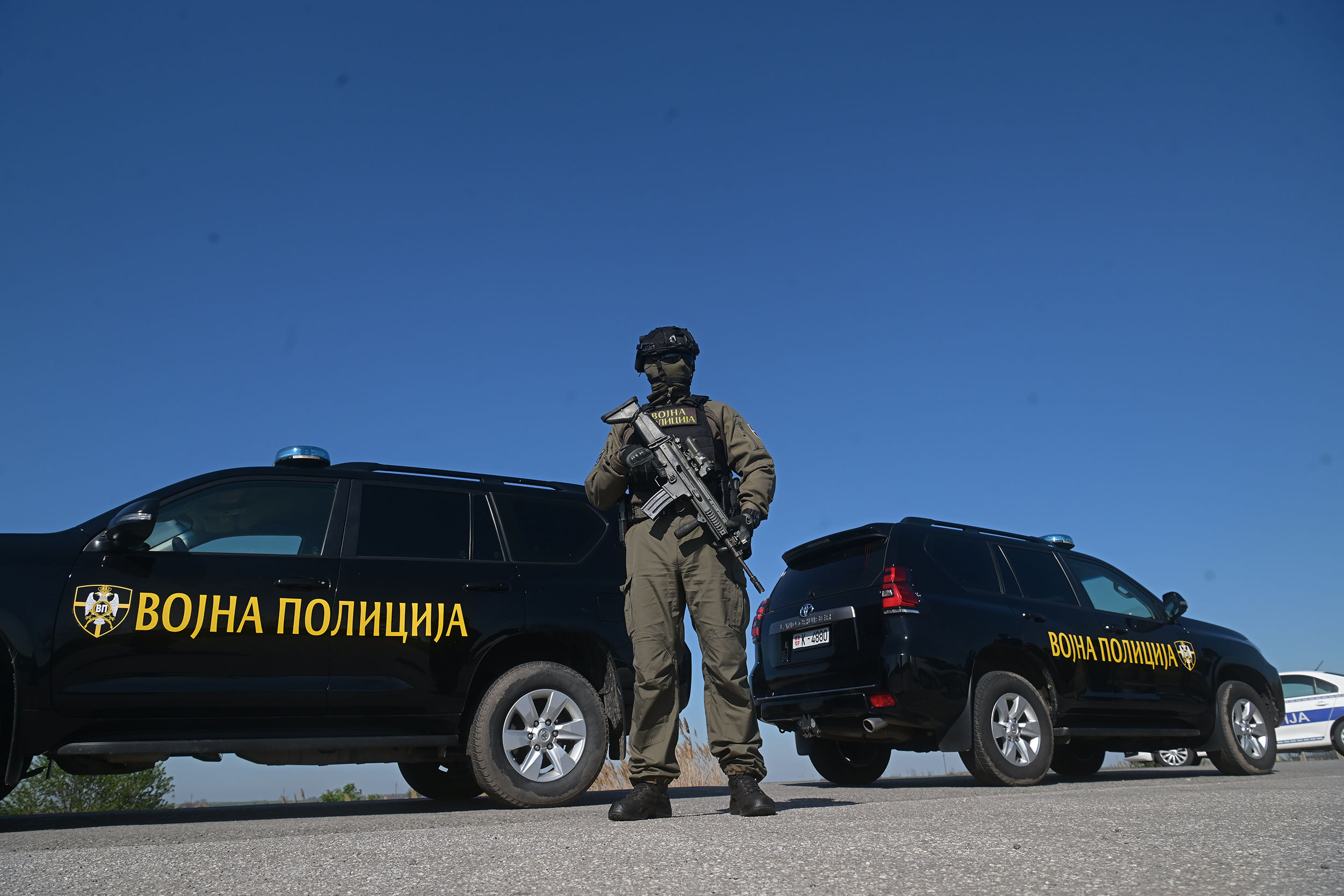
On 5 April, explosives and devices for their activation were found not far from the Balkan Stream gas pipeline (the continuation of TurkStream in the Balkans). Components of the suspected explosive device were discovered during a routine patrol in the municipality of Kanjiža in the autonomous province of Vojvodina, near the border with Hungary. The director of Serbia’s Military Security Agency (VBA), Đuro Jovanić, later reported that “explosives, specially packaged, hermetically sealed, detonator caps, specially prepared and packaged for transport, as well as detonating fuse and the corresponding tools and equipment for preparing these explosives to carry out sabotage” had been found. An anti-terrorist operation was immediately launched in the area with the participation of about 140 members of the special operations brigade and Military Police units.
However, suspects of the sabotage preparation were not detained in the first hours after the dangerous discovery. Nor was convincing evidence found that would point to specific organizers or perpetrators of the suspected sabotage. This, however, did not prevent Hungarian officials from immediately coming forward with accusations against Ukraine.
Prime Minister Viktor Orbán and Foreign Minister Péter Szijjártó, after an extraordinary meeting of the Defence Council in Budapest on 5 April, made it clear that they suspected Kyiv of planning an act of sabotage. Orbán did not directly state that it was Ukrainians who stood behind the pipeline incident, but after the council meeting he once again repeated his usual set of accusations against the Ukrainian side. At the same time, Szijjártó was more direct, stating that the discovery of explosives at the pipeline in Serbia fits into a series of other actions for which Budapest blames Kyiv.
“In recent days and weeks, we have seen everything,” Szijjártó wrote on Facebook. “The Ukrainians organized an oil blockade against us. Then they tried to impose a full energy blockade on us by launching dozens of drones at the TurkStream gas pipeline while it was still on Russian territory. And now we have today’s incident, when Serbian colleagues found explosives capable of blowing up the pipeline.”
The Ukrainian side promptly denied all accusations. The spokesperson for the Ministry of Foreign Affairs of Ukraine, Heorhii Tykhyi, stated that Kyiv had absolutely nothing to do with the incident in Serbia. “We categorically reject attempts to falsely link Ukraine to the incident with explosives found near the Turkstream pipeline in Serbia. Ukraine has nothing to do with this. he wrote on X.
Serbian officials later also stressed that they had no evidence pointing to a “Ukrainian trace.” Moreover, the director of the VBA labelled as disinformation the claim that Serbian law enforcement forces were going to accuse Ukrainians of preparing sabotage. “The disinformation says that the Armed Forces of Serbia and their servicemen will work for some other or third side, finding Ukrainian explosives and accusing Ukraine of this. That is not true. The manufacturer of the explosives does not mean that it is the perpetrator or the one who ordered it,” Đuro Jovanić stressed. According to information from the VBA, the explosives are of American origin, but, as the head of this structure noted, this is sufficient for claims about the involvement of the United States in the incident. “The markings on the explosives indicate that they were manufactured in the United States. Will somebody say that perhaps the United States is arranging something similar at this moment?” he asked rhetorically.
According to the VBA’s version, migrants may be involved in the attempted sabotage. “The information that a person from a group of migrants, who has military training, would attempt to carry out sabotage on gas infrastructure was known,” Đuro Jovanić said. “That person will definitely be detained. The only question is whether the investigation will take three days or longer,” he added.
Despite the statements by Serbian officials, hints at a “Ukrainian trace” continued. On 6 April, Kremlin spokesman Dmitry Peskov made statements about the possible involvement of Ukrainians in the sabotage in Serbia. Although he acknowledged that there is currently no evidence as to who may be behind the attempted attack on the pipeline, he hinted that Ukraine could be responsible. “The situation is potentially very dangerous. This is a vital energy artery that is now operating under an extraordinary load. And before that, as we know, the Kyiv regime was directly involved in such acts of sabotage against critically important energy infrastructure,” Peskov said.
The statement by the Kremlin representative did not surprise anyone, since Russia is waging war against Ukraine and uses any opportunity for information attacks. Hungarian hints at a Ukrainian trace in the allegedly planned sabotage were also expected, since they clearly fit within the framework of the anti-Ukrainian campaign that official Budapest has been conducting intensively in recent months. Experts have long stated that Orbán’s team has decided to secure Fidesz’s victory by inflaming anti-Ukrainian hysteria and frightening voters. For this purpose, according to media reports, the Hungarian ruling party allegedly even enlisted specialists in political technologies from Russia.
After the Druzhba oil pipeline was damaged as a result of Russian shelling and oil transit to Hungary through Ukrainian territory was suspended, the Hungarian authorities intensified the anti-Ukrainian track of their policy even more. The detention of cash collection officers and the seizure of valuables belonging to a Ukrainian state bank became one of the manifestations of the radicalized Hungarian policy. Another sign of the growing tension in relations between Budapest and Kyiv was the deployment of the Hungarian army to guard energy infrastructure on Hungarian territory against hypothetical “acts of sabotage” from Ukraine.
It is important that Serbia also joined this campaign “to prevent attacks on energy facilities,” likewise deploying the military to guard gas infrastructure. After this decision by the Serbian leadership, one could conclude that Belgrade had decided to play on the same team with Budapest and Moscow, helping Orbán in his methods of conducting an election campaign. Accordingly, the Serbian authorities, having thus supposedly demonstrated solidarity with the Hungarian ruling party and the Kremlin, after the discovery of explosives near the gas pipeline should, by that logic, have immediately “exposed” a “Ukrainian trace.” Then this episode would have fitted perfectly into the anti-Ukrainian narrative of the Hungarian election campaign and the broader Russian information war against Ukraine. But Serbian leader Aleksandar Vučić, it seems, decided to play his own game. The explosives were found, the sabotage was prevented, but the Serbian military found no evidence pointing to the involvement of Ukrainians in the suspected attempt to blow up the gas pipeline. Moreover, at this stage Serbia’s Military Security Agency effectively refuted this version.
Later, other officials — Srbijagas Director General Dušan Bajatović and the head of the parliamentary Defence and Internal Affairs Committee, Milovan Drecun — repeated the VBA’s version about the likely involvement of migrants in the planned attack.
Although Drecun stressed that the events were being considered in a broader geopolitical context, especially connected with the conflict between the Russian Federation and Ukraine, as well as the significantly worsened relations between Kyiv and Budapest, no Serbian high-ranking official voiced concrete accusations against Ukrainians during the 24 hours after the sabotage had been prevented. The Serbian Minister of Defence, Bratislav Gašić, was no exception; he did not want to comment at all on the geopolitical context — the elections in Hungary and relations between Hungary and Ukraine — stating on the evening of 6 April that “the Serbian army does not interfere in the internal or political situation in Serbia itself, let alone interfere in the politics of our neighbors.”
If one considers well-founded the suspicions of experts, the Hungarian opposition, and the Ukrainian side that the supposed sabotage of the gas pipeline in Serbia was organized by Moscow with Budapest’s participation in order to help Orbán confidently win the elections, then it can be stated that Belgrade in fact disrupted this Russian-Hungarian “special operation.” Despite close ties with the Kremlin and shared interests with Orbán’s government, Belgrade demonstrated unexpected pragmatism.
The unwillingness of Serbian officials to immediately and unequivocally support the Russian-Hungarian version of a “Ukrainian trace” may indicate Serbia’s unwillingness to radically change its foreign policy. Belgrade clearly is not going to abandon its notorious, but at times beneficial, multi-vector policy, does not want to enter into direct confrontation with Ukraine and the West that supports it, and is trying to preserve its agency in matters of regional politics and security. In the end, Vučić himself will soon face a difficult election campaign, and a “performance” in someone else’s pre-election show in a “supporting role,” without any obvious benefit to his own rating, is clearly not timely for him.
CWBS Analytical Group