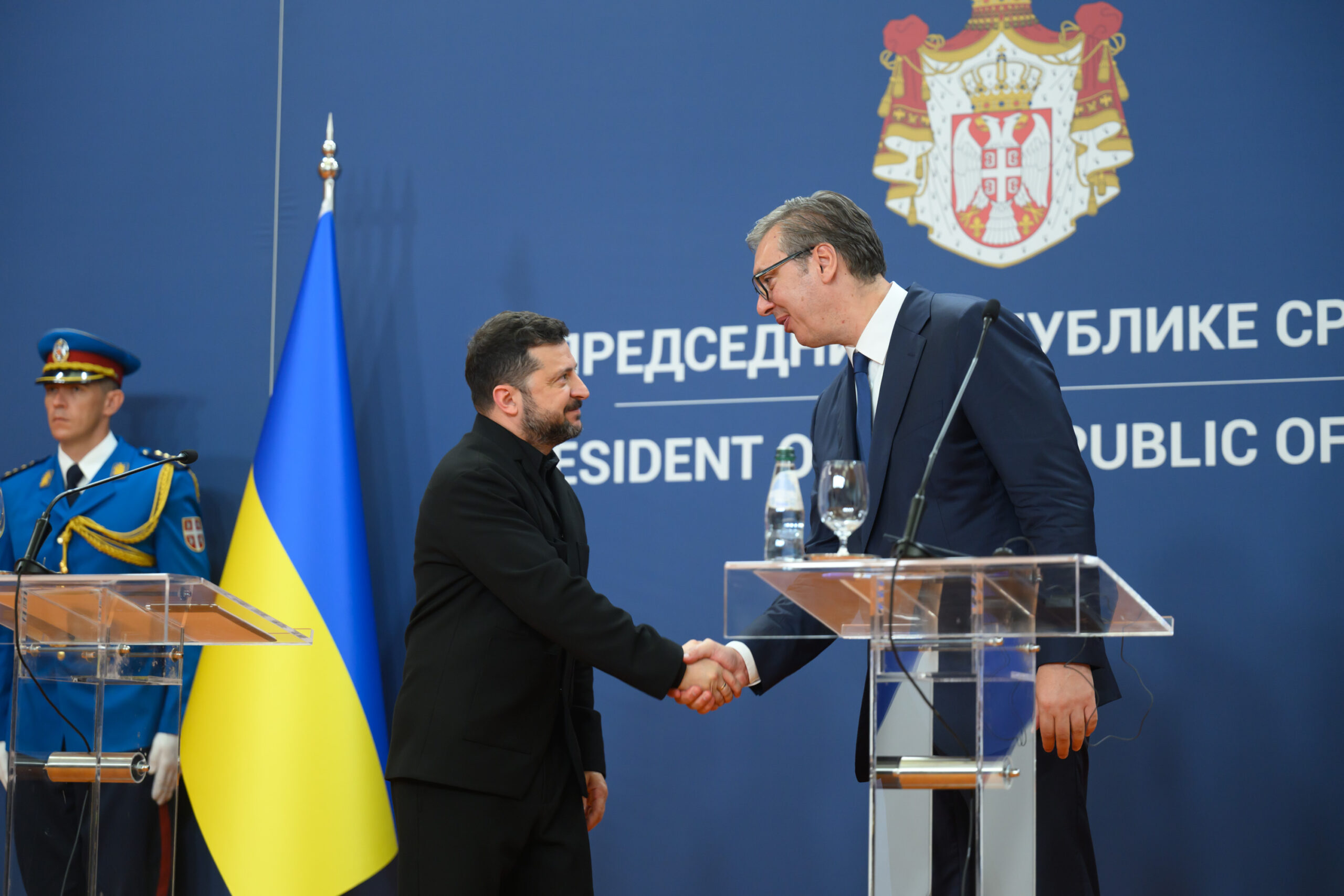
Volodymyr Zelenskyy’s first official visit to Serbia became a notable event not only in relations between Kyiv and Belgrade, but also for the entire region of Eastern and South-Eastern Europe. Overall, the significance of the visit should be assessed as a cautious rapprochement in which each side sought to advance its own interests.
The talks in Belgrade did not eliminate all the disagreements, mainly related to Serbia’s relations with Russia, but the announced “slap in the face to the Russians” envisaged by Kyiv can be considered to have been delivered.
Following the talks, the sides announced their intention to deepen practical cooperation in the economy and on European integration. At the same time, however, the issue of military cooperation remained out of public view.
The Ukrainian President’s visit to Belgrade had been in preparation for quite some time. As early as May, media reports emerged that Volodymyr Zelenskyy was expected to visit Serbia. A Ukrainian delegation did indeed visit Belgrade at that time, but it consisted of representatives of the government’s economic bloc. Following their visit, a Joint Statement was signed on the resumption of negotiations on concluding a Free Trade Agreement between the governments of Ukraine and the Republic of Serbia.
In July, Speaker of the Verkhovna Rada of Ukraine Ruslan Stefanchuk visited Belgrade for the first Conference of Speakers of Parliaments of European Union Candidate Countries. The new format is a joint Ukrainian-Serbian initiative aimed at exchanging the experience of candidate countries on their path towards the EU.
These visits can be regarded as preparatory ones: Kyiv and Belgrade launched concrete cooperation along two tracks — the economy and European integration.
Serbian President Aleksandar Vučić’s visits to Ukraine to participate in the Ukraine–South-East Europe Summit, last year in Odesa and this year in Kyiv, created the political groundwork for the further development of bilateral relations and the intensification of contacts at the highest level.
During his visits to Ukraine, Vučić also emphasised the development of economic cooperation and European integration, while devoting considerable attention to humanitarian assistance as well. Zelenskyy’s current visit to Serbia confirmed that bilateral cooperation would develop precisely along these previously announced lines.
Economy, Humanitarian Assistance, European Integration
Following the talks in Belgrade, an agreement was reached, among other things, to continue work on the free trade agreement, and the signing of the document was announced, most likely later this year.
In addition, Serbia announced that it would provide Ukraine with humanitarian assistance in the fields of medicine, through supplies of medicines, and energy, by allocating €2 million to support Ukraine’s energy system, particularly during the winter period.
European integration was also discussed at the concluding press conference. Judging by Vučić’s remarks, he is rather pessimistic about both Serbia’s and Ukraine’s accession to the EU. “As President of Serbia and as a political veteran, I currently do not see a possibility, above all for Serbia, …to become a member of the European Union in the near future for many political reasons”; “to be completely frank, I do not believe that all Europeans will be favourable even towards Ukraine’s membership,” he said.
In his view, a good alternative to full membership in the more distant future is the idea, proposed by him and Albanian Prime Minister Edi Rama, of gradual integration and accession to the EU without veto rights. This approach envisages access to the single market and the Schengen Area at earlier stages, while limiting the political influence of new members. “I consider this important for our region, and I told President Zelenskyy that it would also be important and useful for Ukraine, Moldova, and other eastern countries. I think this is realistic,” Vučić stated.
The major “elephant in the room” during the visit was cooperation between Kyiv and Belgrade in the military sphere.
Ahead of the visit, the media reported on plans to establish drone production in Serbia, with Ukraine expected to contribute its expertise to the project and the United Arab Emirates to provide the financing. There was no confirmation of this information, but talk of a “drone factory” quickly became very widespread.
The launch of joint Serbian-Ukrainian-Emirati production of military goods could have become a genuine sensation and the main news arising from the Ukrainian President’s visit, but this did not happen. At the concluding press conference, Vučić stressed: “In September, we will open a drone manufacturing plant here, but together with the Israelis — we are doing this with Israeli partners.”
There was also no news following the talks about another aspect of military cooperation between Belgrade and Kyiv — the indirect supply of Serbian ammunition to the Ukrainian army through third countries. At the joint press conference with Zelenskyy, Vučić stressed: “We did not discuss any military cooperation today.”
Nevertheless, despite the absence of any news, there is a widespread view in Ukraine that cooperation on ammunition supplies does exist, that ensuring its continuation was the main objective of Zelenskyy’s visit to Serbia, and that this objective was allegedly achieved. For now, however, these are merely assessments by experts and journalists.
“A Slap in the Face to the Russians”
Another objective of the Ukrainian President’s trip to Serbia, as was unofficially emphasised in Kyiv, was the intention to deliver a symbolic “slap in the face to the Russians.” It can be said that this plan was implemented.
Pro-Russian forces in Serbia perceived the very fact of Zelenskyy’s visit to Belgrade as a major anti-Russian move.
One hundred Serbian public figures, academics, and artists who traditionally support Kremlin policy signed an open letter protesting against the Ukrainian President’s first official visit.
Supporters of the Belgrade football club Crvena zvezda, whose general and title sponsor since 2010 has been the Russian state-owned company Gazprom, staged a display at the stadium with Russian flags and banners bearing insulting messages about the Ukrainian leader.
Nevertheless, despite resistance from pro-Russian circles, Vučić expressed clear and unequivocal support for Ukraine’s territorial integrity. “Serbia, and I as its President have emphasised this, supports the Charter of the United Nations and United Nations resolutions, and this means the territorial integrity of all UN member states. This also means the territorial integrity of Ukraine. …We will continue to pursue this principled policy, and there is no ‘but’ here,” he stressed at the concluding press conference.
Vučić had made similar statements before, but in Belgrade they were made against the backdrop of the warm reception given to the Ukrainian President. In this context, the Serbian leader’s statement appeared to be an even firmer and more unequivocal message to Moscow that Serbia does not agree to recognise Ukrainian territories annexed / occupied by Russia as belonging to Russia. In other words, despite all its “friendship with Russia,” the current Serbian authorities will not support Russian aggression against Ukraine.
However, Belgrade also has no intention of radically changing its foreign policy course or adopting an unequivocally pro-Ukrainian position. Vučić, who has made a multi-vector approach the hallmark of his foreign policy, after Zelenskyy’s departure actively sought to convince the domestic audience and, evidently, Moscow of his intention to continue pursuing an “independent and autonomous” foreign policy and building multi-vector relations, including with Russia.
“I will never serve anyone — not England, not Germany, not America, not Russia. I serve only Serbia,” the Serbian President told journalists two days after the end of Zelenskyy’s visit, rejecting his opponents’ claims that the Serbian authorities had switched “to the other side.” “We have not switched anywhere. I have devoted my entire life and fought my entire life for Serbia to pursue an independent and sovereign policy,” he stressed.
Significantly, Russian media circulated this statement by Vučić under headlines such as “Serbia Did Not Side with Ukraine Against Russia,” seeking to neutralise the negative effect for them of the intensification of cooperation between Belgrade and Kyiv.
The issue of reaffirming territorial integrity was important not only for Ukraine, but also for Serbia.
Responding to a question from a journalist with Serbia’s public broadcaster, Radio Television of Serbia (RTS), “Can Serbia and the citizens of Serbia count on Ukraine maintaining a firm policy of non-recognition of Kosovo’s unilaterally declared independence?”, Volodymyr Zelenskyy stated that Ukraine’s position “on Kosovo’s unilaterally declared independence remains unchanged.”
In his subsequent comments, Vučić singled out Ukraine’s reaffirmation of its non-recognition of Kosovo as one of the important outcomes of Zelenskyy’s visit and one of the successes of Serbian foreign policy. This issue was also the main focus of publications in Serbia’s pro-government media.
At the same time, Ukrainian diplomacy must now address the difficult task of restoring the trust of Pristina, and Tirana, without negative consequences for the Serbian track of its foreign policy.
As is well known, Kosovo has consistently supported Kyiv since the first days of Russian aggression. Kyiv is now facing harsh criticism from Pristina. The Albanian Ministry for Europe and Foreign Affairs also issued a critical statement commenting on Zelenskyy’s remarks regarding Kosovo in Belgrade.
Oleksandr Merezhko, Chair of the Foreign Policy Committee in the Ukrainian Parliament, says that the arguments against Ukraine recognising Kosovo are mainly related to concerns that Russia could use Kosovo as a precedent for the occupation of Ukrainian territories, to Serbia’s support for Ukraine’s territorial integrity, and, to some extent, to the supply of Serbian ammunition to Ukraine. According to him, he personally is sceptical of these arguments; moreover, in his view, recognising Kosovo would not violate international law. At the same time, Merezhko believes that the Kosovo issue could return to the political agenda in Kyiv after the war ends.
***
Zelenskyy’s visit to Belgrade consolidated the trend towards a more active dialogue between Ukraine and Serbia, but did not transform it into a strategic partnership. The sides outlined specific areas of cooperation — from trade and humanitarian assistance to mutual support on the path towards the EU. The issue of military cooperation remained out of public view. Although these matters were not officially discussed, we do not know for certain whether any agreements were reached in this area.
The main achievement for both Kyiv and Belgrade was the mutual reaffirmation of support for territorial integrity. At the same time, against this backdrop, the Serbian authorities are maintaining their multi-vector course and keeping their distance from an unequivocally pro-Ukrainian position.
For Kyiv, further success in its relations with Serbia will depend on its ability to combine the development of relations with Belgrade with the preservation of trusting and open relations with countries friendly to Ukraine in the region.
CWBS Analytical Group