
- Serbian Minister Visits Moscow
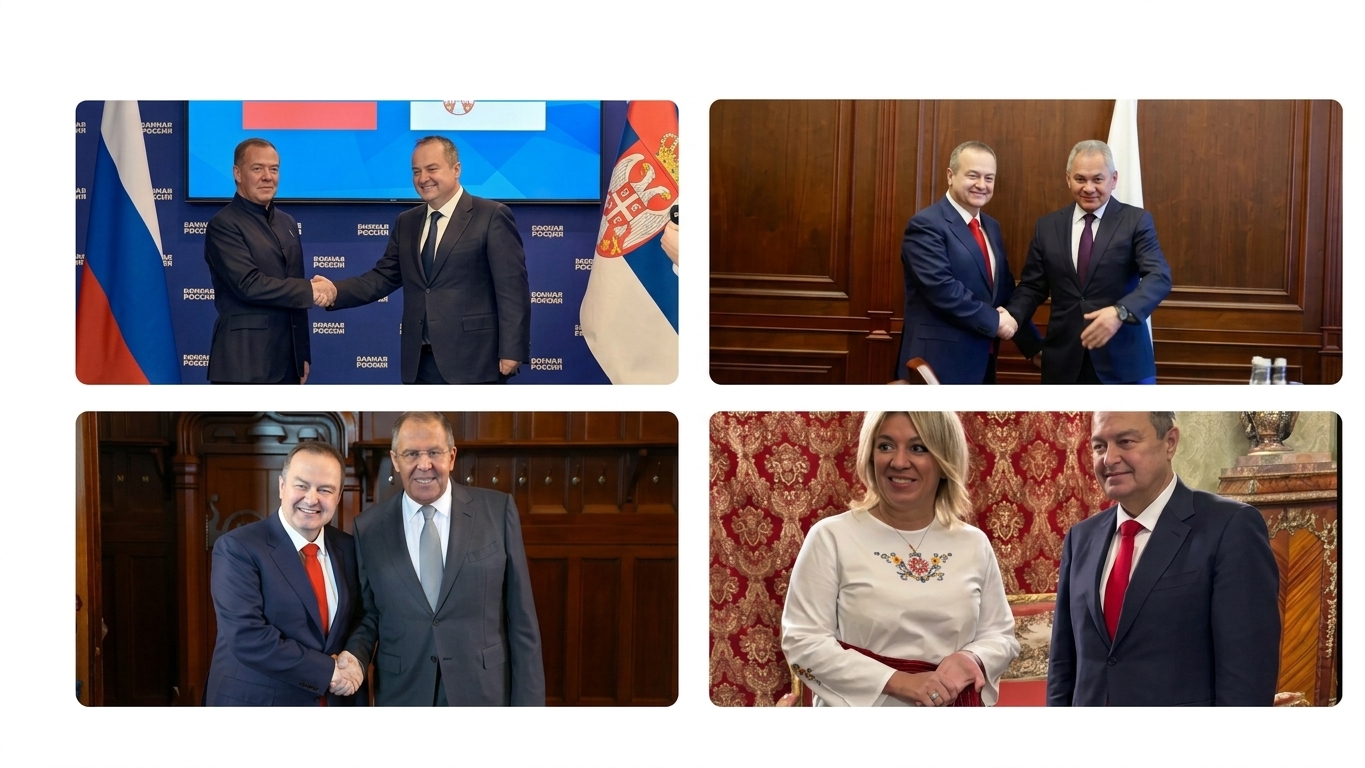
Serbian Deputy Prime Minister and Minister of the Interior Ivica Dačić in a technical mandate paid a visit to Moscow.
On 15 October, Dačić held talks with Deputy Chairman of the Security Council of the Russian Federation Dmitry Medvedev on “current security issues”, “the political situation in the world and regional issues”. In particular, Dačić stressed that “Belgrade’s unwavering position on an independent foreign policy guided exclusively by the preservation of Serbia’s vital state and national interests”.
The Russian side, in turn, reported that one of the topics of the conversation with the Serbian official was the elections in Serbia scheduled for 25 October. Medvedev’s office stressed that it was closely following the election campaign in Serbia, where, according to it, there were “attempts by the West to interfere in the electoral processes as part of the snap parliamentary elections and to destabilise the situation by means of radical destructive forces”.
Secretary of the Security Council of the Russian Federation Sergei Shoigu, whom Dačić met the following day, wished “the Serbian people the successful conduct of these elections, which would strengthen the country’s economy, its political standing and the course currently pursued by the Serbian government”.
Dačić, in turn, assured Shoigu that the country would maintain its course of cooperation with Russia after the parliamentary elections as well.
During his stay in Moscow, Dačić also met with Minister of the Russian Federation for Civil Defence, Emergencies and Elimination of Consequences of Natural Disasters Alexander Kurenkov. The Serbian official thanked Russia for its assistance in fighting wildfires, noting the participation of an Il-76 aircraft, which was involved in extinguishing fires in Serbia from 20 August to 18 September this year. With Kurenkov and Shoigu, Dačić discussed the further development of the Russian-Serbian Humanitarian Center in Niš. In particular, according to the Serbian minister, the permanent stationing of a Russian Il-76 firefighting aircraft in Niš from next year is currently under discussion.
Head of Serbia’s Ministry of the Interior also held talks with Deputy Minister of the Interior of the Russian Federation Igor Zubov. Following the talks, Dačić stressed that cooperation between the two ministries includes interaction between criminal police units, the fight against organised crime and terrorism, as well as joint exercises in these areas. “We agreed that 10 joint exercises would be held this year, half of which have already been conducted,” he said.
Cooperation with other security agencies will also be developed. During the visit, Dačić held talks with Director of the Federal Protective Service of the Russian Federation Dmitry Kochnev on cooperation between Serbia’s Ministry of the Interior and Russia’s Federal Protective Service.
The Serbian interior minister also met with Russian Foreign Minister Sergei Lavrov. At the meeting, which took place on 16 October, they discussed “the state of Russian-Serbian cooperation and prospects for interaction in key areas”, “the situation in the Balkans” and, “with particular emphasis, the current situation in Kosovo and Metohija”. “The parties expressed great mutual satisfaction with the dynamic development of bilateral relations and cooperation in the multilateral arena,” the Serbian government said in a statement.
***
Dačić’s visit, which took place 10 days before the elections in Serbia, was made by one of Aleksandar Vučić’s closest political allies. The Serbian minister was clearly seeking to assure the Russian authorities of Belgrade’s loyalty and provide guarantees that the pro-Russian course would continue after the elections if the current governing coalition remained in power.
For Aleksandar Vučić’s Serbian Progressive Party and Ivica Dačić’s Socialist Party to succeed in the elections, Russian support is evidently necessary. The list of meetings and the topics of the talks in Moscow indicate that Belgrade continues to rely on assistance from the Russian intelligence services, including in matters concerning the preparation and conduct of elections.
- Albania Has Now Closed Its Fourth Chapter in EU Negotiations
At the 10th Accession Conference with the EU, Albania provisionally closed negotiating Chapter 20 — “Enterprise and Industrial Policy” — on 13 October, which concerns the development of small and medium-sized enterprises, the creation of new jobs, as well as the alignment of Albania’s industrial policy with EU standards, including in the areas of clean technologies, new materials and the environment.
Albania began negotiations in 2022 and has since opened all 33 chapters and provisionally closed four of them. The closure of Chapter 20 came after the country successfully completed negotiations on three other chapters in July 2026: Chapter 25 (“Science and Research”), Chapter 26 (“Education and Culture”) and Chapter 30 (“External Relations”).
European Commissioner for Enlargement Marta Kos highlighted Albania as one of the leaders of EU integration progress in the region. Marta Kos and Ireland’s Minister of State for European Affairs and Defence Thomas Byrne (Ireland currently holds the Presidency of the Council of the EU) said that Brussels supports Tirana’s goal of completing all accession negotiations by the end of 2027. At the same time, the European Commission stressed that, in order to achieve this goal, Albania must continue rapid reforms in the key “Fundamentals” cluster, involving the government, the opposition and civil society.
- Youth Protests Continue in Albania
The protests began on 13 October, when students dissatisfied with the cost of education, conditions at universities, the lack of financial support and employment prospects after graduation took to the streets in Tirana demanding the government’s resignation. High-school students subsequently joined them.
The protests spread from the capital, Tirana, to other cities, including Durrës, Shkodër, Korçë and Elbasan.
During the protests, young people threw stones and pyrotechnic devices at government and commercial buildings and attacked police cordons, while the police responded with tear gas and water cannons.
Many protesters and law-enforcement officers were injured in the clashes. Around two hundred people required medical assistance.
Police detained more than one hundred and fifty people for participating in violent actions.
The opposition supported the students’ political demands. The leading opposition party, the Democratic Party of Albania, is demanding the resignation of the current authorities, the dissolution of parliament, the formation of an interim government and the holding of snap elections. “This movement is not merely a protest against the government,” the party said. “It is a revolt against the model of governance created by Edi Rama, which has stolen hope from young people, undermined citizens’ trust and is increasingly distancing Albania from its European future.”
Albanian Prime Minister Edi Rama, meanwhile, stresses that he will not make concessions to those who resort to violence and has ruled out the possibility of his resignation, saying that a change of government must take place “through democratic elections”. In his statements, he blamed the opposition and “foreign actors” allegedly behind the protests for the escalation of violence, describing the ongoing unrest as an attempt to obstruct Albania’s progress towards the European Union.
Edi Rama, who leads the governing Socialist Party, has served as prime minister since 2013. During those years, he has weathered several powerful waves of public discontent. However, the current student protests intensified the so-called “Flamingo Revolution”, which has been under way for several months and is directed against the development of protected areas by a company belonging to Trump’s son-in-law, are one of the most serious challenges to his rule.
- Montenegro Hopes to Resolve Outstanding Issues with Croatia
At the Accession Conference in Luxembourg on 12 October, Montenegro closed three negotiating chapters: 17 (Economic and Monetary Policy), 18 (Statistics) and 19 (Social Policy and Employment).
Thus, to date, Montenegro has already closed 21 of the 33 chapters in its negotiations on accession to the European Union.
“Together with our European partners, we are moving resolutely towards Montenegro’s full membership in 2028,” Montenegrin Prime Minister Milojko Spajić wrote on Facebook.
Responding to a journalist’s question about outstanding issues with Croatia, Spajić expressed optimism. “We are NATO partners and have been working together for a long time. We conduct active negotiations every day. We use every opportunity to close all issues. There are many issues and problems, but I am confident that Montenegro and Croatia will look towards a better future for Europe and resolve these issues to the satisfaction of all parties,” Spajić stressed.
However, during those same days, Croatian diplomatic sources revealed that Croatia is demanding that Montenegro resolve eight outstanding issues, most of which are consequences of the wars of the 1990s.
In particular, Croatia is demanding that the issue of compensation for Croatian citizens who were held at the Morinj camp in Montenegro be resolved; more than 300 Croatian citizens, mostly from the Dubrovnik area, were imprisoned there between October 1991 and August 1992. It also demands the preservation of the memorial plaque installed at the site of the former camp. The plaque was jointly unveiled by Croatian and Montenegrin ministers in October 2022, but Montenegrin officials have since repeatedly called for its removal.
The third demand concerns renaming the municipal swimming pool in Kotor, which bears the name of water polo player Zoran Gopčević. According to the Croatian side, he was a guard at Morinj in 1991 and 1992. Croatia considers it unacceptable for a sports facility to bear the name of a person associated with the ill-treatment and torture of Croatian prisoners.
In addition, Zagreb is demanding the full cooperation of the Montenegrin authorities in establishing the fate of 14 missing Croatian citizens, including the exchange of information, the continuation of the work of the relevant commissions and access to archives and documents that could assist in locating them and determining their fate.
Croatia is also demanding that those responsible for war crimes be brought to justice. In the Morinj case, four Yugoslav People’s Army (JNA) servicemen were finally convicted of war crimes and sentenced to a combined total of 12 years in prison, but those convictions did not cover crimes against civilians held at the camp.
The demands also include resolving the property rights of Croatian families in Montenegro. Croatia notes that the unresolved cases include 51 families from Tivat and other families from the Bay of Kotor whose claims, according to the Croatian document, have not been resolved despite court rulings.
The remaining two demands concern Chapter 31 of the EU negotiations. Montenegro fulfilled all EU requirements for closing Chapter 31 (“Foreign, Security and Defence Policy”), but the decision at EU level was postponed at Croatia’s request at the end of 2025. Zagreb is demanding that Podgorica return the training ship Jadran, which has been under Montenegrin control since 1991. The Croatian side considers the vessel to belong to Croatia and says it must be returned.
Another demand concerns the final determination of the border between the two states in the area of the Prevlaka Peninsula.
In December 2023, Croatia presented Montenegro with an informal document listing the outstanding issues, which it also shared with EU member states and the European Commission. Bilateral consultations took place in January and May 2025, followed by intensive diplomatic engagement, including around ten meetings between the foreign ministers of the two countries during 2026. All of this took place at the initiative of the Croatian side, but none of the remaining issues has yet been resolved.
- Russia Abolishes Visa-Free Regime with Montenegro
Montenegrin citizens will have to obtain visas for travel to Russia, Russian Foreign Ministry spokesperson Maria Zakharova said.
Zakharova confirmed that, at the end of September, Montenegro’s Ministry of Foreign Affairs informed Moscow of the termination of the 2008 Agreement between the two governments on the conditions for mutual travel by citizens. “In practice, this means that from 1 November our citizens will be able to enter Montenegro and stay in the country only with a visa. Accordingly, Montenegrin citizens will also have to obtain visas for travel to Russia,” the Russian Foreign Ministry spokesperson said.
The 2008 agreement provided for visa-free entry for citizens of both countries for stays of up to 30 days. Since the EU suspended its visa facilitation agreement with the Russian Federation back in 2022 and significantly restricted entry for Russians, Montenegro, which hopes to join the European Union within the next few years, had to fulfil one of the mandatory conditions — fully align its visa regime with the European Union’s common policy.