After Months of Deliberation, Kosovo’s Parliament Speaker Seat Remains Empty.
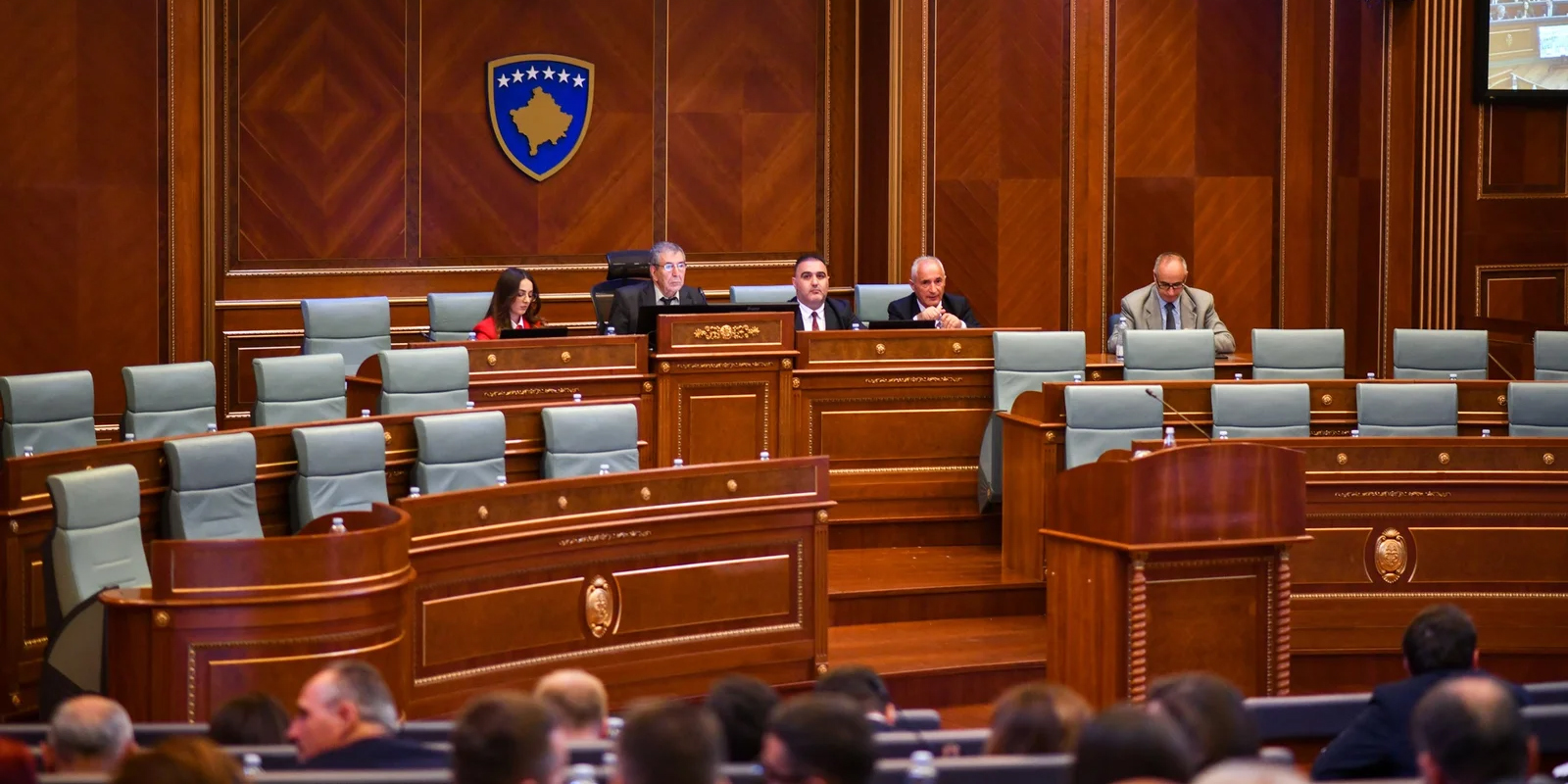
Since Vjosa Osmani called the constitutive session of the Assembly on April 15th, Kosovo’s Parliament has attempted and failed the same assignment for the 57th time in a row: to elect the Parliament Speaker. To recap, the Self-Determination Movement (LVV, Vetëvendosje) secured the largest share of seats in the most recent parliamentary elections but fell short of the majority required to elect the Speaker of the Assembly—Albulena Haxhiu being their nominated Parliament Speaker.
Repeated attempts to elect Haxhiu have failed more than 50 times, with opposition parties refusing to compromise, resulting in a complete parliamentary standstill. As a consequence, Kosovo cannot form a government, pass laws, or ratify international agreements. This institutional paralysis has even been described as an “undeclared state of emergency,” since without a functioning Assembly, Kosovo lacks a unified voice on the international stage. Ordinary citizens bear the most immediate and damaging consequences, as essential services, municipal funding, and public sector projects remain in limbo.
Constitutional Court Steps In
Because of this impasse, the Constitutional Court ordered that the Assembly elect the new Speaker of Parliament within the next 30 days (from August 18th), but the same candidate can only be nominated a maximum of three times. All MPs must also be physically present to vote.
This decision has been much-debated by the LVV, who considers this order unconstitutional and state that the Court is stepping outside of its constitutional role by issuing such a broad, far-reaching order. However, the opposition – with parties such as the Democratic Party of Kosovo (PDK), the Democratic League of Kosovo (LDK) and the Alliance for the Future of Kosovo (AAK) – have welcomed this turn of events, calling it a win for democracy.
Political Deadlock: Part 2
LVV’s previous nominated Speaker, Albulena Haxhiu, received 57 votes pro – when she needed 61 or more -, 56 against, and 3 abstentions.
However, after failing to elect Haxhiu for months, LVV has put forward three other candidates.
Their most recent nominees include Hekuran Murati (55 for / 46 against / 5 abstentions), Arbërie Nagavci (55 for / 47 against / 4 abstentions) and Dimal Basha (57 for / 25 against / 24 abstentions). All three failed to secure the required 61 votes.
LVV has claimed that this proves the opposition is trying to hold the Parliament hostage in this state of nonfunctioning.
In fact, some parties in the opposition have made their own statements about the situation. Some of them are overt, like Lumir Abdixhiku of the Democratic League of Kosovo (LDK) stating that they won’t be supporting any of LVV’s nominees.
Memli Krasniqi of the Democratic Party of Kosovo (PDK) also stated plainly that they won’t be voting for any nominee that was at one point part of Albin Kurti’s cabinet (LVV’s founder and leader). Just as a reminder, Albulena Haxhiu served as Minister of Justice; Hekuran Murati as the Minister of Finance, Labor and Transfers and Arbërie Nagavci as the Minister of Education. Dimal Basha is a member of LVV party, though he has not held ministerial positions within neither of Albin Kurti’s cabinets.
New Nominees, Another Defeat
Despite LVV’s visible tactical shift — replacing repeat cabinet figures with a candidate who has not held ministerial office — the situation in the Assembly remained unchanged and the nominees failed to win the necessary support. LVV framed the candidate changes as a conciliatory gesture intended to remove objections; in practice it did not convert into additional votes due to a difference in principles between political parties and their representatives.
Eugen Cakolli of the Kosovo Democratic Institute (Instituti Demokratik i Kosovës) described LVV’s substitution as “a positive step and a move toward a solution — at least nominally”. “It may not fully satisfy the Constitutional Court’s demand for constructive consultation with other parliamentary groups, but it nonetheless moves in the right direction. On the other hand, PDK and several deputies did not adhere to their prior statements. Although they had publicly set as a criterion support only for non-ministerial candidates, they did not vote for one today. The inconsistency with previous positions is a fact. In this atmosphere of mistrust and nerve-testing, the solution is not necessarily far, but it depends on LVV’s willingness to engage in real, constructive consultation and on other groups’ readiness to honour their public commitments”.
Ehat Miftaraj of the Kosovo Law Institute (Instituti i Kosovës për Drejtësi) criticised PDK’s conduct as “unprincipled” and urged that a constituted Assembly is indispensable to end the institutional deadlock.
Though LVV’s tactical flexibility removed one obstacle, it did not resolve political tensions that ultimately determine outcomes in the Assembly.
Wider Implications
The deadlock has repercussions beyond parliamentary procedure. Without a functioning Assembly, Kosovo cannot pass legislation, ratify international agreements, or approve municipal budgets. Pristina, for example, faces a frozen budget, delaying public projects and municipal services. Public sector employees and contractors remain uncertain about payment schedules. This institutional paralysis risks weakening citizen trust in government institutions at a time when Kosovo is pursuing EU integration and international recognition.
The economic consequences are now being articulated by business representatives and analysts in concrete terms. Lulzim Rafuna, president of Kosovo’s Chamber of Commerce, told Reuters that “there are projects and loans worth 700-800 million waiting to be voted in the parliament that are hanging because of the crisis,” adding that “Businesses are in limbo without knowing what reforms, fiscal politics and what taxes they will have from the new government”.
Commentators focusing on EU relations emphasize the stagnation of the country’s engagement with Brussels. Helena Ivanova, Research Fellow at the Henry Jackson Society, told Kosovo Online: “As long as Kosovo lacks a functioning Assembly and government, we can expect its engagement with the EU to remain completely frozen. The EU has expressed its wish—and issued a call—for the government to be formed swiftly so that the country can resume operations and begin implementing the reforms the EU expects. Until the crisis is resolved, neither the awaited funds will be released, nor the reforms implemented, nor will Kosovo–EU relations function normally”.
Industry groups have been explicit about immediate fiscal damage. Agim Shahini, President of the Kosovo Business Alliance (AKB), in commentary to Kosovo Online said that the failure to form institutions and ratify EU funding agreements is costing Kosovo “€3 million per day”. Shahimi has also stressed the stakes tied to the Growth Plan: “When we consider the total €880 million waiting to be ratified in the Kosovo Assembly under the EU Growth Plan, the stakes are clear”.
Independent reporting and analysis also place sizeable sums at risk across multiple channels: estimates of funds and projects affected range from several hundred million to over a billion euros—examples invoked include EC allocations of around €900 million linked to the reform agenda and over €220 million associated with the Millennium Challenge Corporation.
Public services have already felt the consequences. The public broadcaster RTK has been reported as short of funds due to the stalled parliamentary budget process, heightening the risk to salaries and operations. Several municipalities—including Pristina, Gjilan and Zubin Potok—have reportedly not been allocated this year’s budgets, jeopardising local projects and payrolls.
Taken together, these observations portray a crisis that affects the whole society: immediate liquidity and payroll risks at municipal and institutional level, suspended or frozen international project funding and stalled integration into European Union. Kosovo may also suffer longer-term reputational cost that deters foreign direct investment and complicate regional diplomacy.
If the Assembly still fails to constitute by the Constitutional Court’s deadline, Kosovo’s short-term options narrow: further judicial or presidential interventions, a widened political crisis leading to new elections, or incremental, ad hoc administrative fixes that will be insufficient to unlock major international funding. The practical costs are tangible now; the political costs will compound if the stalemate persists.
Conclusion
With each failed vote, the space for compromise contracts and the contest for the Speaker’s yields further costs to the whole nation. Political actors on all sides must therefore honour their public commitments, but they must also weigh those commitments against the real and mounting toll the deadlock inflicts on everyday life—municipal services, public-sector pay, international funding, business confidence and Kosovo’s standing abroad. The Constitutional Court’s 30-day deadline intensifies that imperative: adherence to promises and a readiness to translate nominal concessions into effective solutions are now the only credible routes out of paralysis. If the parties fail to act with that responsibility, Kosovo risks not only further institutional regression but also prolonged economic and social harm that will dismiss the worth of any short-term political gain.