Around the New Year, things have stirred up in Montenegro once again. Threats of sabotage, blockades of the most important traffic arteries, and a media campaign conducted by Montenegrin and Serbian media close to the authorities in Serbia. All of this is put in the context of ethnic and identity differences in Montenegro. This is a well-coordinated and well-known pattern that has burdened Montenegro since the political changes of 2020. The actors are well known to the local and regional public, as are their open and undisguised ties with Belgrade and Moscow.
The first and loudest actor is the Democratic People’s Party, led by Milan Knežević. The party emerged from the split of the former conservative wing of the Democratic Party of Socialists, which remained loyal to Slobodan Milošević after the split between the leaderships of Montenegro and Serbia in 1997. Today, the DNP is part of the coalition For the Future of Montenegro, the former Democratic Front, which participates in the ruling coalition and controls parliament and several strategic ministries in Montenegro, as well as several important public enterprises, including the Elektroprivreda Crne Gore, the state monopolistic company for electricity supply. They also control several important cities where they have mayors, including the Municipality of Zeta, where the latest protests are taking place.
And while taking part in the government and receiving significant concessions from Prime Minister Milojko Spajić, this faction of the Montenegrin parliament constantly generates instability. In cities such as Pljevlja, the mayor behaves like a secessionist and as if the northernmost Montenegrin municipality were part of Serbia. Montenegrin state holidays are not celebrated, but Serbian ones are, accompanied by provocative messages and symbolism that many residents of Pljevlja perceive as unnecessary and harmful. The city faces major infrastructural problems, pollution from the local thermal power plant is enormous, and sinecures in the local Coal Mine and the thermal power plant of the Elektroprivreda sustain the mentioned parliamentary faction.
In the Municipality of Zeta, power is exercised by Knežević’s DNP, and for its latest activities it does not have the support of the broader coalition. This is a local issue and a local topic, in which the long-standing dissatisfaction of residents of the village of Botun due to pollution from the now-closed Aluminum plant is being used as fuel for protests against the planned construction of a wastewater treatment plant for the capital Podgorica, where nearly one third of Montenegro’s citizens live. This facility has financial and political support from the European Union, and its construction would help the accession process, as Montenegro must meet environmental protection standards.
Although Knežević’s DNP, at the level of the Podgorica parliament and at the state level, together with its partners, voted for all plans and documents that enabled the preparation and development of the project documentation, the protests were organized at the moment when works were supposed to begin and when machinery was expected to enter the construction site.
Many attribute this change in Knežević’s position to pressure from Serbia, which for some time has been publicly and openly expressing dissatisfaction with announcements that Montenegro could independently join the European Union. This is contrary to the policy of Aleksandar Vučić, who wants the region to enter the EU as a whole. As Serbia has numerous unresolved problems and as support for EU membership is at its lowest level since the start of negotiations, such expectations appear difficult to realize, although Vučić has friends, allies, and like-minded figures in the EU, such as Viktor Orbán and Robert Fico, as well as signals of encouragement from France. Serbia’s problems with Kosovo, as well as its close ties with Russia, are the main obstacles due to which Vučić unrealistically expects the entire region to be held hostage to these issues.
Knežević is a close associate and friend of Aleksandar Vučić. He has appeared at almost all party gatherings of Vučić’s Serbian Progressive Party and often boasts photographs of private meetings with Vučić and his family. He supported him after the protests in Serbia, and in return he has access to a large network of Vučić’s television stations and media in Montenegro, such as Prva TV, Adria TV, the portals Borba, Alo, and IN4S, as well as part of the public broadcaster RTCG, which promote narratives about the alleged harmfulness and corruption behind the wastewater treatment plant project.
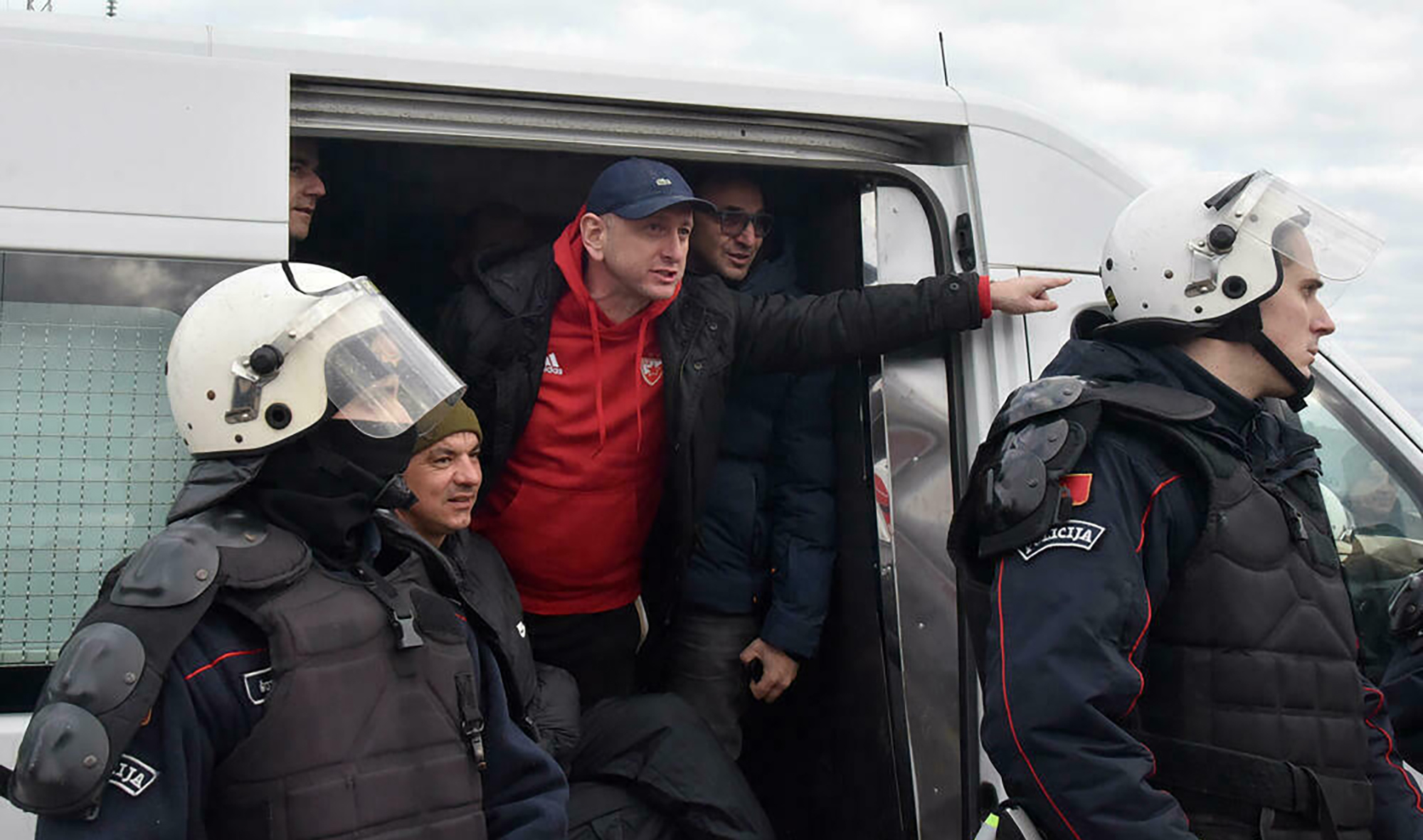
Just before the New Year, Knežević, together with party associates and representatives of the Municipality of Zeta, blocked the entrance to the construction site, after which the mayor of Zeta and several dozen citizens were detained by the police. The police deliberately avoided arresting Knežević, aware that he would use this for the purpose of further destabilization, after which he himself entered a police vehicle in order to stage an arrest. Belgrade media close to Vučić then conducted a weeks-long campaign about the allegedly terrible position of Serbs in Montenegro.
Knežević threatened to leave the government and, as expected, shifted the focus from the environmental issue to the terrain of identity differences, demanding that the Serbian language be introduced as an official language in Montenegro, that the Serbian tricolor be introduced as an official state symbol as a “people’s flag,” and that a law on dual citizenship be put into procedure, which would enable a large number of citizens of Serbia to obtain Montenegrin citizenship by descent.
These are well-known demands of Serbian nationalist politics in Montenegro, which are also supported by the Serbian Orthodox Church, and in which critics see the goal of placing Montenegro in a subordinate position vis-à-vis Serbia and distancing it from regional and European political currents.
It is interesting that Knežević’s “senior” partner Andrija Mandić, the speaker of parliament and leader of New Serbian Democracy, the largest partner of the DNP in the coalition For the Future of Montenegro, although advocating the same political goals, believes that remaining in power and pursuing them through calm, strategic work is a more effective approach. Many, including structures close to Vučić, are becoming impatient with Mandić’s behavior, so chants accusing him of betrayal could be heard at the protests in Botun. For now, the conflict does not have an open character, but it is obvious that it exists and that it is carefully concealed.
Although Vučić’s policy enjoys very little support in Montenegro, including among Serbs, this does not mean that Serbian nationalism, in its aggressive Montenegrin version, is not strongly present and deeply rooted within the structures of power in the country.
Ljubomir Filipović. Montenegrin political scientist
The articles published in the “Opinions” column reflect the personal opinion of the author and may not coincide with the position of the Center