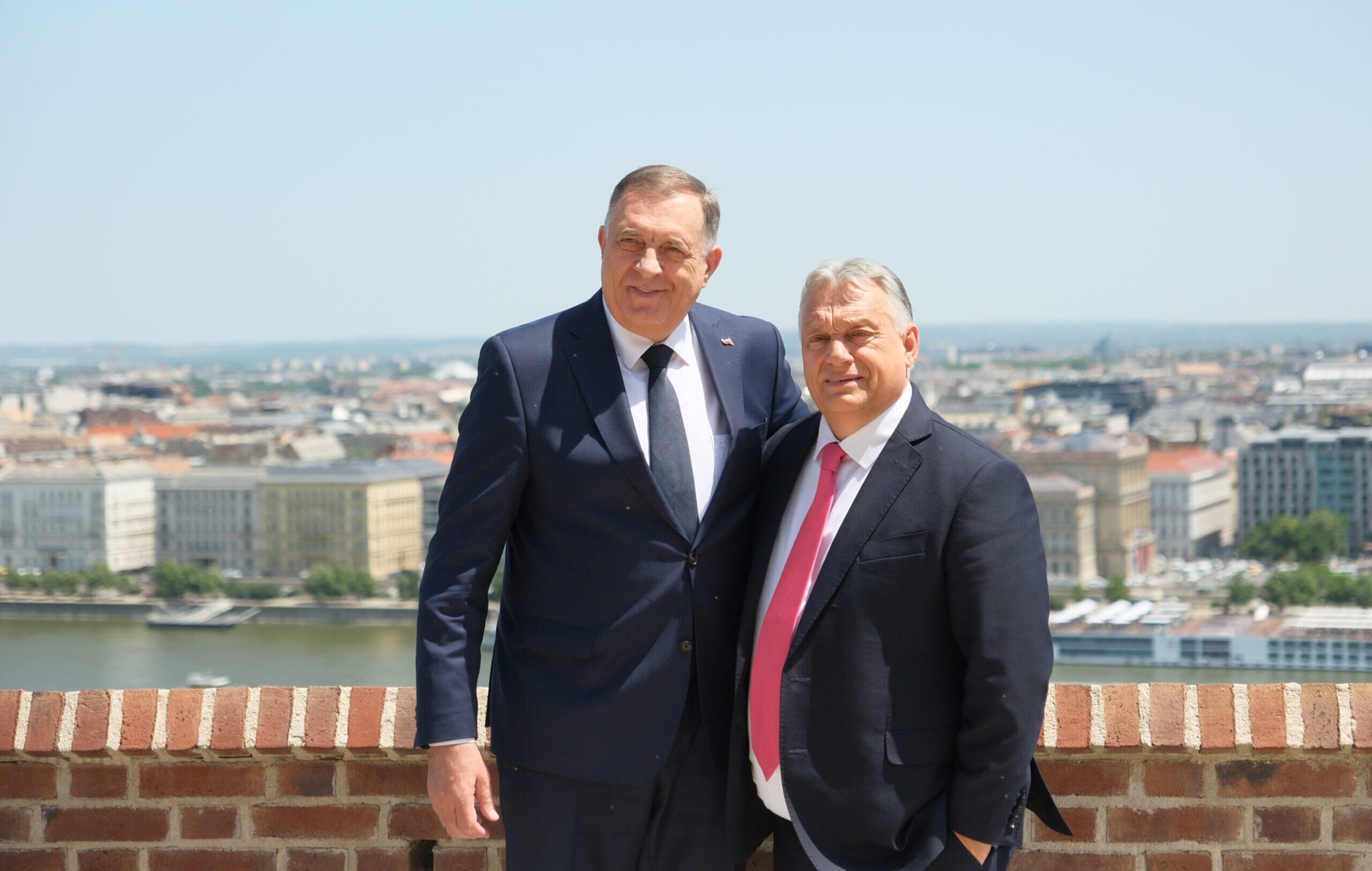
In the Republika Srpska, at the Training Center of the Ministry of Internal Affairs of RS, at the end of January this year a representative office of the Counter Terrorism Centre of the Ministry of Internal Affairs of Hungary was opened. The official purpose of the activity is described as the exchange of information to prevent terrorist threats, the conduct of joint trainings (including in tactical medicine), and scientific and technical support for the special units of the Ministry of Internal Affairs of RS. But is the opening of the TEK office merely narrow professional cooperation between the security structures of Budapest and Banja Luka?
A unique office
The opening of the representative office of the Counter Terrorism Centre of the Ministry of Internal Affairs of Hungary (TEK) at the Training Center of the Ministry of Internal Affairs of RS in Zalužani near Banja Luka took place on 28 January 2026 with the participation of the Minister of Internal Affairs of Republika Srpska Željko Budimir and the Director of the Counter Terrorism Centre of the Hungarian Ministry of Internal Affairs János Hajdu.
Minister Budimir stated that the purpose of opening this office is cooperation in information exchange and training, which should contribute to the fight against terrorism. “We can fight terrorism only through the exchange of information, which is important for prevention, but also, when necessary, by using special counter-terrorist units,” he said. “The migration crisis has brought us new challenges, the common goal of which is to strengthen regional cooperation, and the basis of this is cooperation with TEK, who have experience, and we can learn a lot from them.”
Director of the Hungarian Centre Hajdu noted that the cooperation consists in creating an effective system that will contribute to the security of states and citizens. “In order for law enforcement agencies, especially counter-terrorist services, to be able to respond adequately to all the challenges arising from terrorism, simple cooperation is not enough; it is necessary to exchange different approaches and experiences, study each other’s areas of competence and discuss professional issues that are of common interest,” he said.
Hajdu emphasized that the opening of the office is a practical implementation of the Memorandum of Understanding on strengthening police cooperation between the Ministry of Internal Affairs of Republika Srpska and the Counter Terrorism Centre of the Hungarian Ministry of Internal Affairs from February last year. The memorandum includes the fight against terrorism, exchange of information and best practices, technical and scientific cooperation, as well as cooperation in the field of joint training for carrying out the most complex tasks in the field of security.
According to available information, Hungary has no similar TEK representative office anywhere else.
Emergency “training”
Active cooperation between the Hungarian Counter Terrorism Centre and Republika Srpska began with a scandal. Almost a year ago, several dozen TEK officers arrived in RS during the court proceedings against Milorad Dodik in order, as Bosnian and Hungarian opposition media claimed, to prevent the arrest of the political leader of the Serbs of Bosnia and Herzegovina and to organize his escape to Hungary.
The initial plan allegedly was to transfer Dodik across the Croatian–Hungarian border in the area of Beli Manastir – Mohács without informing the Croatian authorities. Under “plan B,” Dodik was to be transported through Serbia along a longer route, crossing the Serbian–Hungarian border near the city of Szeged.
However, no one detained Dodik, and the Hungarian special forces returned home without him.
Later the Counter Terrorism Centre stated that these were joint exercises that had been prepared long in advance. But journalists emphasize that this cannot be true, because everything was organized in great haste, which does not happen in the case of planned exercises of police units.
For example: the Embassy of Hungary in Sarajevo informed the Border Police of Bosnia and Herzegovina and the Ministry of Foreign Affairs of Bosnia and Herzegovina only on the day of the arrival of the TEK officers that 78 unarmed members of the counter-terrorist unit would enter the country. Bosnian officials then claimed that the first special forces from Hungary entered Bosnia and Herzegovina as civilians, without uniforms and without weapons, in civilian vehicles and through several border crossings, and in fact were already in Bosnia and Herzegovina when official Sarajevo was informed of their arrival.
It should be noted that, despite its name, the Counter Terrorism Centre of the Hungarian Ministry of Internal Affairs from the very beginning of its establishment has been associated primarily with politics rather than with counter terrorism.
After the opening of the TEK office in Republika Srpska, Bosnian media recalled that the structure was established immediately after Orbán came to power in 2010, and its head was appointed János Hajdu, who for years had been Orbán’s personal bodyguard when he was still in opposition. Journalists describe TEK as a “private army” and even as Orbán’s “praetorians.”
Media publications cite a whole series of the Centre’s cases that have a political character. An example from recent days is the participation of TEK in the scandalous detention of cash-in-transit vehicles of a Ukrainian state bank that were traveling from Austria to Ukraine with a large volume of cash and precious metals. There is no complete view of the incident at present, but there is an interesting detail — as journalists found out, the Prime Minister of Hungary visited the Centre’s headquarters several hours before the “special operation.”
The unprecedented case of the detention of the bank vehicles not only further intensified the conflict between Budapest and Kyiv, but once again raised the question of the role and place of TEK in the system of power that Orbán has built.
In a broader context
The official opening of the representative office of the Hungarian Counter Terrorism Centre in Republika Srpska, although presented as an element of departmental, narrowly professional cooperation between police institutions, should be considered in a much broader context.
For Banja Luka and the current political leaders of RS, political and security cooperation with Budapest is an instrument for developing the entity of Bosnia and Herzegovina in the direction of greater autonomy; a way of asserting a foreign policy independent of official Sarajevo; ensuring guarantees of support from an important regional player; lobbying the interests of RS in the EU, NATO, as well as in Washington and Brussels (as media write, it was the Hungarian leader who contributed to the lifting of American sanctions from RS officials and was one of those who blocked the introduction of sanctions against Dodik at the level of the European Union).
The TEK representative office, in addition to performing possible specific tasks related to personal agreements between Orbán and Dodik, has the possibility to perform a kind of role of an alternative “center of power” — actual or purely symbolic, depending on what was requested in Banja Luka and what Budapest agreed to.
For Hungary, cooperation with RS is even more multi-purpose.
The opening of a permanent representative office of the Counter Terrorism Centre in Republika Srpska is aimed, first of all, at strengthening the security component of the strategic partnership between Budapest and Banja Luka. The government of Viktor Orbán has for a long time acted as an “advocate” of Republika Srpska and personally of the leader of the Serbs of Bosnia and Herzegovina (journalists claim that it was he who blocked the issuance of an Interpol notice for Milorad Dodik), and the institutionalization of support in the security sphere looks like a logical continuation and consolidation of such a policy. In addition, instead of emergency reaction, as in the case of the “plan for Dodik’s evacuation,” permanent support in crisis situations now becomes possible. Naturally, TEK in RS will act in accordance with Orbán’s instructions, not those of Sarajevo or EUFOR.
Behind Orbán’s back
“Hungary under the leadership of Viktor Orbán in recent years has been intensively strengthening special ties with Republika Srpska, combining political, economic and security cooperation. This is not only a partnership in the field of security, but also strategic positioning — Budapest is thus expanding its influence in the Balkans, while at the same time sending a signal of support to leaders of entities that promote separatist narratives, and in this case the influence of Russia should not be excluded,” noted Zijad Bećirović, director of the International Institute for Middle-East and Balkan Studies (IFIMES) in Ljubljana, in an interview with media in Sarajevo.
The opening of the office of the Hungarian Counter Terrorism Centre in Republika Srpska is a symptomatic step that goes far beyond purely law-enforcement activity. Although formally the project is presented as technical cooperation, in fact it demonstrates the deepening of the political alliance between Budapest and Banja Luka.
By cooperating separately with Banja Luka and personally with Dodik, Orbán strengthens his influence in the Western Balkans; implements political and security strategies that do not coincide with the official course of the EU; and builds a network of geopolitical like-minded actors who are sympathetic to Moscow.
By creating a permanent presence of his most loyal special unit in the entity of Bosnia and Herzegovina, Viktor Orbán not only consolidates his geopolitical influence in the Western Balkans, but also creates a mechanism of direct security intervention bypassing the central authorities in Sarajevo and the post-war mechanisms. Such institutionalization of relations between Banja Luka and Budapest creates new risks for the fragile stability of Bosnia and Herzegovina and opens the way for hybrid influence of third actors standing behind Orbán.
CWBS Analytical Group