
Introduction
In the modern era, where the boundaries between peace and war have become increasingly blurred, a new concept of conflict has emerged that dominates strategic thinking and global security policy—this concept is known as Hybrid Warfare.
This term, now widely used by scholars, security analysts, and international institutions, represents a new way of understanding warfare. At its core, it is an undeclared war—a battle fought simultaneously across multiple fronts: on the ground, in cyberspace, in the media, and within public consciousness.
This form of warfare has become symbolic of our digital age, where information, perception, and influence are just as important as military power. Hybrid warfare has fundamentally changed how states perceive security and how they defend themselves against threats that are not always visible.
In recent decades, the concept of hybrid warfare has become one of the most sophisticated challenges to international security. Instead of classic military confrontations, state and non-state actors increasingly employ a combination of political, economic, informational, and cyber instruments to achieve strategic objectives without direct confrontation.
Definition of the concept of “Hybrid Warfare”
The term hybrid warfare describes a form of interaction in which the boundary between peace and war becomes blurred.
In simplified terms, Hybrid Warfare refers to a combination of traditional means of warfare (such as armored vehicles—tanks, military aircraft, heavy artillery, warships and submarines) and non-traditional means (such as cyber warfare, artificial intelligence, communication satellites, directed-energy weapons, biotechnology, etc.). It merges conventional military operations with non-conventional tactics, including cyber attacks, disinformation campaigns, economic pressure, political interference, and the use of non-state actors.
In this form, warfare does not take place solely on the battlefield but also in the virtual space, social networks, and the economy.
Frank G. Hoffman (2007) defines hybrid warfare as a “combination of conventional and irregular tactics, terrorism, organized crime, and information operations” aimed at achieving strategic objectives without entering open conflict.
Unlike traditional wars, hybrid warfare is difficult to identify and counter because it is not formally declared. It operates in the grey zone, creating a constant state of uncertainty. This makes hybrid warfare one of the greatest international security challenges of the 21st century.
In today’s context, hybrid warfare includes:
- The use of media to manipulate perceptions;
- Cyber interference in critical national infrastructure;
- Political influence through parties or non-governmental organizations; and
- Economic pressure aimed at weakening independent institutions.
These instruments create a “fog of ambiguity,” where aggression is difficult to identify, yet its consequences for national security are profound.
NATO (North Atlantic Treaty Organization) defines Hybrid Warfare as follows:
“Hybrid warfare is the use by state or non-state actors of a combination of military and non-military means, overt and covert, synchronized or parallel— including regular and irregular forces, cyber attacks, disinformation, economic influence, and other disruptive forms—aimed at achieving strategic objectives by creating ambiguity, exploiting vulnerabilities of the target, and often operating below the threshold that would trigger a full military response.” The use of the term Hybrid Warfare in academic literature is attributed to William J. Nemeth, who in 2002 defended his doctoral dissertation at the Naval Postgraduate School in California entitled “Future War and Chechnya: A Case for Hybrid Warfare.” Nemeth analyzed how Chechen rebels combined traditional guerrilla tactics with modern technology, propaganda, and digital communication.
The concept was later developed and systematized by Frank G. Hoffman between 2005 and 2007. In his work “Conflict in the 21st Century: The Rise of Hybrid Wars,” Hoffman described hybrid warfare as a coordinated blend of conventional military operations, terrorism, organized crime, and propaganda campaigns.
An earlier contribution was made by Thomas Huber in “Compound Warfare: That Fatal Knot” (2002), which, although not using the term hybrid warfare, provided the theoretical foundation for its later development.
Some scholars argue that hybrid warfare is not a new phenomenon, as similar tactics have appeared throughout history. Unconventional methods were evident as early as the Punic Wars, when the Romans employed demoralization, attrition, supply-line attacks, and avoidance of direct confrontation against a superior Carthaginian army (Carr & Walsh, 2022).
Development of the concept from 2000 to the present
After 2000, the concept of hybrid warfare became part of U.S. and NATO strategic analyses. It gained particular attention following the 2008 war in Georgia, when Russia combined military action, cyber attacks, and media propaganda to influence the conflict’s outcome—widely regarded as the first practical example of hybrid warfare.
The 2014 Ukraine crisis marked the moment when hybrid warfare gained global prominence. Russia employed “unmarked soldiers,” large-scale disinformation campaigns, economic pressure, and cyber operations to annex Crimea without formally declaring war. NATO analysts referred to this strategy as the “Russian hybrid warfare playbook.”
In the past decade, the term has also been used to describe the actions of North Korea, China, and Iran, as well as how non-state actors such as Hezbollah and ISIS combine terrorism with modern military capabilities. Wars of the 21st century are no longer fought solely for territory, but for information, influence, and public perception.
Contemporary relevance and application
In the digital era, hybrid warfare has become the most sophisticated form of international confrontation. It operates continuously and often invisibly through disinformation campaigns, political manipulation, economic pressure, and cyber interference in elections or public institutions.
Organizations such as NATO and the European Union have established specialized centers to study and counter hybrid threats, including the European Centre of Excellence for Countering Hybrid Threats in Helsinki.
At its core, the importance of this concept lies in its ability to explain how states and other actors achieve political objectives through non-military means that nevertheless produce war-like consequences.
The modern understanding of hybrid warfare has been heavily influenced by real-world conflicts, such as the 2006 Israel-Hezbollah war (which Hoffman used as a key example) and the Russian annexation of Crimea in 2014.
Hybrid Warfare in Kosovo and the Western Balkans forms, actors, and consequences
Kosovo, as a young state in the geopolitically sensitive Western Balkans, has become a clear target of hybrid actions. From disinformation and external propaganda to political and cyber influence, the country has faced various forms of interference aimed at weakening its sovereignty and state legitimacy.
In the Western Balkans—and particularly in Kosovo—hybrid warfare efforts primarily include:
- Disinformation and propaganda campaigns (anti-U.S., anti-NATO, anti-EU narratives, and pro-Kremlin messaging);
- Political influence and support for local proxy actors;
- Economic leverage and cultural influence; and
- In some cases, cyber activities.
Actors most frequently cited in institutional reports include Russia (directly and through disinformation networks), Serbia (as a state actor using political and influence tools), and China (through economic and infrastructure projects). NATO, the EU and their anti-disinformation mechanisms have identified and countered these threats.
The beginnings of hybrid influences in Kosovo (2008–2013)
After declaring independence on 17 February 2008, Kosovo quickly became the target of attempts to delegitimize it in the international arena. Serbia launched a broad diplomatic and propaganda campaign to prevent international recognition of the new state. During this period, the first elements of hybrid warfare emerged: covert lobbying in international organizations, influence through regional media, and the use of parallel structures in northern Kosovo.
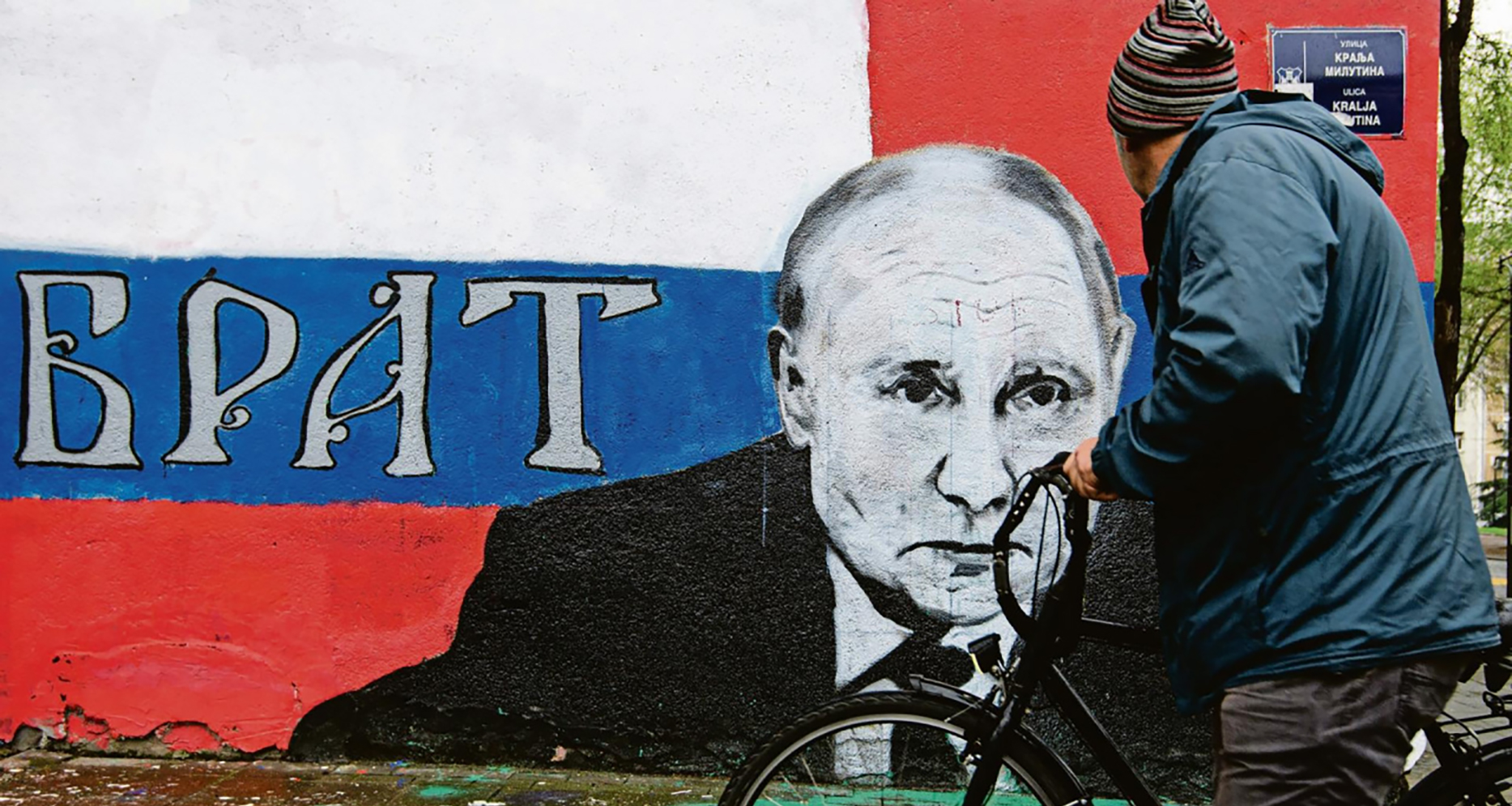
Russia consistently supported the Serbian narrative, presenting Kosovo as a “failed state” and using international forums to influence global public opinion. This Serbia–Russia tandem created an environment of constant political and informational pressure on Kosovo’s institutions, which constitutes the classic form of a diplomatic and psychological hybrid warfare.
Intensification of hybrid actions (2014–2020)
After the annexation of Crimea by Russia in 2014, the concept of hybrid warfare took on a new global dimension. During this period, the impacts of similar strategies began to be clearly observed in the Balkans, especially through online media and social networks.
In Kosovo, after the establishment of the army (Kosovo Security Force) and the consolidation of state institutions, the number of disinformation campaigns aimed at discrediting these processes increased significantly.
In 2017, during the negotiations in Brussels, attempts were made to influence public opinion through portals that spread the narrative that “Kosovo is losing sovereignty”. In the same year, during the crisis of the “Serbian train” that attempted to enter Kosovo, an attempt at controlled provocation was demonstrated — a typical tactic of hybrid warfare to test institutional and public reaction.
Meanwhile, Russian influence in the Balkans expanded through cultural representations, “humanitarian” foundations, and information networks operating in a disguised manner.
Who is waging “hybrid warfare” in Kosovo and the region — who are the main actors?
1. RUSSIA — the main actor mentioned for using hybrid tools in the Balkans is Russia.
Russia Uses disinformation networks, satellite/internet media and narratives that convey anti-NATO/anti-EU messages, and tries to reinforce ethnic and political divisions. Russia is also used to lobby for political interests through contacts with local politicians and religious groups or pro-Russian media. Reports by the European Parliament, EUvsDisinfo and NATO analyses clearly mention this for the region.
2. SERBIA — a dual-influence actor:
The Serbian state has been described by some sources as using political and military tools to maintain influence over Serbian communities in northern Kosovo (parallel structures, tension management, rhetoric and international lobbying). Some elements (including the tactic of creating/supporting parallel structures or pro-Belgrade information) can be considered part of influence strategies that have a hybrid effect.
3. CHINA — economic and political influence (more like “soft/hard power” rather than typically military “hybrid warfare”):
Investments, infrastructure (BRI) and economic and political relations are a form of influence that can have its own hybrid effects (e.g. economic dependence as a means of political influence). Academic and institutional reports list China as an actor that uses economic instruments for strategic influence in the region.
4. PRO-KREMLIN actors / disinformation networks (domestic and international):
Through portals, social media channels and media narratives, they attempt to mobilize public opinion against the West, presenting European integration as a threat and linking local events to global events (e.g. Kosovo-Ukraine comparisons). EUvsDisinfo documents concrete examples of these narratives in its reports.
5. NON-STATE ACTORS and organized crime: Criminal networks, interest groups and sometimes paramilitary/social groups can collaborate with state actors or intermediaries to undermine stability (criminal routes, information trafficking, clandestine lobbying). These networks often serve as “operational facilities” for actions that have a destabilizing effect (a common element of hybrid strategies).
Concrete examples in Kosovo and the region
Disinformation around the crises in northern Kosovo (December 2022 and beyond): EUvsDisinfo and local media analysis show narrative campaigns accusing the West of provocation and downplaying the role of Russian interference in the escalation. These campaigns aimed to channel anger, radicalize opinions, and undermine trust in Western institutions.
Use of “soldiers without uniform” and coordinated narratives: a practice observed in conflicts such as Crimea/Ukraine, but referred to in reports for the roles of actors that help to create confusion and avoid direct responsibility. Analysts link similar narrative and tactical modalities to provocative actions in the region.
Platforms and local media as channels for disinformation: Reports from NATO and other organizations show that many portals, social media accounts, and video channels are used to spread fake or manipulated news that serves the political goals of external actors.
Economic influence/invitations for partnerships from China: Investments and economic agreements are perceived as two-way — bringing development, but also the risk of dependency and political influence. Academic and institutional reports put this in the context of strategic influence.
Hybrid Warfare in the contemporary context (2021–2025)
The post-COVID-19 pandemic and the Russian aggression in Ukraine (2022) marked a clear intensification of hybrid operations in the Balkans.
During this period, pro-Russian and anti-NATO narratives were amplified on regional portals that also operate in the Kosovo media space. These efforts sought to create confusion about Kosovo’s Euro-Atlantic orientation and to instill distrust in security institutions.
In late 2022 and throughout 2023, reports by the Kosovo Security Council and EUvsDisinfo identified dozens of cases of the spread of fake news related to:
• NATO’s role in Kosovo,
• The dialogue process with Serbia, and
• KFOR’s presence in the north.
These narratives often present Kosovo as a “failed experiment of the West”, aiming to weaken civic trust and polarize public opinion.
A special case is the disinformation against the war of the KLA (Kosovo Liberation Army), especially against its leaders. This disinformation has also penetrated a part of the citizens of Kosovo, accusing the KLA leaders, who ruled Kosovo for years, as criminals and corrupt. This constitutes an orchestrated effort by Belgrade to accuse the West of collaborating with the KLA.
Conclusions and recommendations
Hybrid warfare in Kosovo represents a permanent strategic reality. It is not an open war, but a continuous process of influence that requires institutional and societal vigilance.
Kosovo should therefore:
- Develop a national strategy to counter disinformation and foreign influence;
- Strengthen cybersecurity and the protection of critical national infrastructure; and
- Invest in media literacy and civic education to enhance societal resilience.
A coordinated approach among security institutions, media, and academia is essential to building national resilience against hybrid warfare—one of the central challenges of the 21st century.
Reflective conclusion
In conclusion, hybrid warfare is a reflection of the new global reality – a reality where conflicts do not begin with a declaration and do not end with a ceasefire. It is a war for perception, for narrative and for the control of information. Unlike the wars of past centuries, where the winner was seen on the battlefield, today the winner is the one who controls minds, networks and the flow of information.
In this sense, understanding and studying hybrid warfare is no longer simply an academic matter, but a national and international need. Because in the 21st century, power is not measured only by weapons and armies, but also by the ability to influence, manipulate and control global perception.
Thus, the term ‘Hybrid Warfare’ remains one of the most important concepts of modern security policy – a reminder that even in times of peace, the world can still be at war.
Orhan Çeku. Associate professor for the subject of National Security at the public Haxhi Zeka University in the Republic of Kosovo

The articles published in the “Opinions” column reflect the personal opinion of the author and may not coincide with the position of the Center