In European politics, it is difficult to find an example of such a long, exhausting, and nerve-wracking path as that of North Macedonia. The raw figures here speak for themselves: the country applied for EU membership back in 2004, received candidate status in 2005, and the first intergovernmental conference between Skopje and Brussels was held only 17 years later — in July 2022. As of spring 2026, North Macedonia has completed the screening of all negotiating clusters, but has not yet moved to the next real phase of negotiations. This is precisely the main paradox of the Macedonian European integration case: formally, the process continues, but politically the country has for a long time been in a state of stagnation and deep standstill.
Today, North Macedonia resembles a state that has been standing for years in the European corridor but cannot pass through the first truly difficult turnstile. The main obstacle is well known: constitutional changes regarding the status of the Bulgarian national minority, provided for by the 2022 EU Council framework, have still not been adopted. Without them, the transition to the key cluster Fundamentals (“Fundamentals”) remains impossible. Skopje’s problem now is essentially that the country is painfully stuck in a “grey zone” between completed screening and a de facto closed negotiating gate.
Against the background of its neighbors, the situation looks particularly bitter. While Skopje remained tied to the Bulgarian knot, neighboring Albania, which just a few decades ago was many times poorer, made a rapid leap in 2025 by opening all negotiating clusters. What until recently seemed unlikely has become reality: Brussels has de facto separated the Albanian and Macedonian tracks, allowing Tirana to move forward independently. For Skopje, this was quite a tangible political blow. A country that for many years had been considered one of the favorites of European integration in the Western Balkans now risks cementing itself in the role of a state that is constantly late to its own European chance.
The simplest explanation sounds like the following: everything is blocked by a demanding Sofia. But this is only partly true. The requirement to include Bulgarians in the Constitution as one of the recognized national communities has become a red line for the current government. Prime Minister Hristijan Mickoski and President Gordana Siljanovska-Davkova — representatives of the formally pro-European, center-right and patriotic party VMRO-DPMNE, for which the issue of protecting Macedonian national identity is extremely important — demand additional guarantees that the rights of Macedonians in Bulgaria will also be protected in a similar manner and that this concession will be the last. Skopje clearly fears new demands regarding language, history, and national identity. Macedonian society well remembers how in June 2018, after the conclusion of the historic Prespa Agreement, the previous liberal government of Macedonian Social Democrats resolved a long-standing dispute with Greece by renaming the country from the Republic of Macedonia to the Republic of North Macedonia. Among other things, this allowed Skopje to fairly quickly obtain membership in NATO.
The problem is that Brussels shows no desire to revise the already agreed negotiating framework. The official EU line remains unchanged: the same constitutional changes previously agreed between Skopje and Sofia are required. This stalemate is further reinforced by internal fatigue — even if the Bulgarian factor disappeared, Skopje would hardly demonstrate lightning-fast readiness for reforms in the most sensitive areas.
It is precisely here that it becomes clear that North Macedonia’s problem has long ceased to be limited only to relations with neighboring Bulgaria, which traditionally perceives Macedonians as “younger brothers” or even as “former Bulgarians.” Behind the external barrier there is also chronic internal weakness. Political polarization in parliament persists, important reforms are slowed down, and postponed appointments are accumulating. The ethnic factor should not be ignored either — the Albanian community constitutes about 30% of the country’s population, and at the same time Macedonian Albanians are traditionally strongly West oriented. Macedonian stagnation is not only a consequence of the Bulgarian blockade, but also a symptom of a deeper problem: a deficit of trust, a weak culture of political compromise, and insufficient capacity to produce broad consensus around the European course.
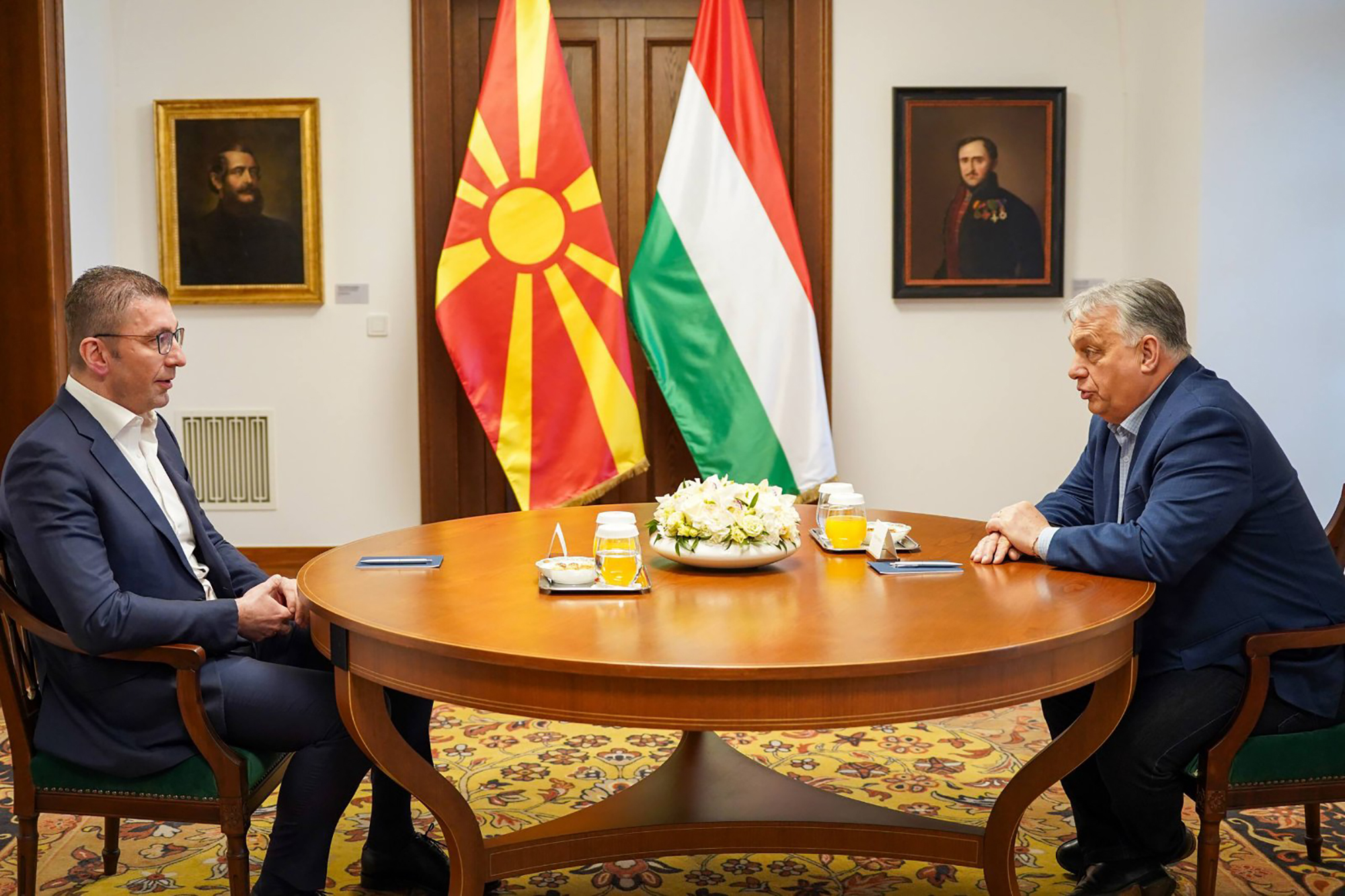
Another important factor should be added to this picture — Viktor Orbán and Hungary. For the current Macedonian government, Budapest has turned not just into a friendly European voice, but almost into a political rear. A Hungarian loan of €500 million on favorable terms has become not only an economic but also a political signal. Viktor Orbán openly criticized the EU decision to separate the Albanian and Macedonian tracks and offered mediation in the dispute with Bulgaria. For Skopje, such support is undoubtedly useful. However, this friendship also has a reverse side.
The full complexity of relations between Skopje and Budapest was clearly demonstrated by the visit of the Macedonian delegation led by the prime minister to Hungary at the end of March. Although the visit agenda, which included a Macedonian-Hungarian business forum, was primarily aimed at developing economic cooperation between the two countries, the content of Mickoski’s public statements beared more resemblance to pre-election campaigning ahead of parliamentary elections in Hungary. At a meeting organized by the host side at an educational institution, Hristijan Mickoski spoke about Hungary as an example of a country that, thanks to “strong leadership, manages to ensure economic development, stability, and preservation of identity,” and cited Viktor Orbán as an example of “a leader who has the courage to make decisions in the interests of his country and who contributes to the stability of the region and Europe.” In conditions where in Brussels Orbán has a reputation as a politician who neglects European values, weakens European unity, and systematically conflicts with the EU on issues of the rule of law, it is difficult to describe the Macedonian prime minister’s statements as contributing to the country’s European integration.
In fact, the Hungarian factor for North Macedonia is both a resource and a problem: it strengthens the foreign policy position of the authorities in Skopje, but does not resolve the main issue with Sofia and does not increase trust in keydecision-making centers of the EU. The shadow of former Macedonian prime minister Nikola Gruevski, also from VMRO-DPMNE, who found refuge precisely in Hungary after fleeing, remains a symbolically important reminder of the specific nature of this political closeness.
Behind the veil of geopolitics lie much more down-to-earth, but no less critical problems. In the Fundamentals cluster, where the real quality of the state is determined, progress remains minimal. The fight against organized crime and corruption often does not go beyond declarations, and judicial reform is stalling due to a lack of political will and institutional consistency.
A similar picture exists in other strategically important sectors. Regulators in the economy and media sphere require greater independence, the state aid system — greater transparency, and the institutional architecture overall — greater predictability. The Macedonian problem is not only resentment toward Bulgaria, but also a chronic disease of a Balkan state that has learned to speak well the language of reforms, but has not been able to finally ensure their irreversibility at the institutional level.
Despite this, North Macedonia retains important trump cards. It is fully aligned with EU foreign policy, particularly on the issue of support for Ukraine, and remains a geopolitically reliable partner of the West. The country is integrated into new financial mechanisms such as the Growth Plan for the Western Balkans and is gradually being embedded into certain European instruments. In other words, North Macedonia has not yet been excluded from the European process. But this no longer answers the main question: when exactly will this process move once again rather than wait.
The conclusion regarding the European future of Macedonians appears rather harsh. After decades of compromises — from changing the country’s name to concessions on identity issues — Macedonian society is increasingly hitting a wall of fatigue. The main question for Skopje now no longer sounds like: “Do we want to join the EU?” The question is rather different: is the Macedonian state machine capable of breaking out of the model of perpetual waiting without further tearing apart its own society?
If the answer is not found in the near future, North Macedonia risks remaining for a long time not on the path to Europe, but in the endless anteroom of integration, where each next step requires a new political compromise but does not guarantee any real progress forward.
CWBS Analytical Group