The dispute between Budapest and Zagreb over the possibility of transporting Russian oil through the JANAF Adriatic oil pipeline goes far beyond commercial relations. Geopolitics, global energy policy, European foreign and security policy, domestic political struggle in Hungary — all of this is not merely the background, but also the substance of the dispute between two neighbours and two long-standing partners in the oil business.
Longing for Fiume and “war speculation”
The exemptions for Hungary and Slovakia regarding the import of Russian oil were introduced as part of the EU’s sixth sanctions package in 2022. The main reason was their critical dependence on supplies through the Druzhba oil pipeline (which runs through the territory of Ukraine) and the lack of a rapid alternative. It was assumed that after some time the oil-refining industries of these countries would be able to restructure their logistics chains and technological processes, after which the path to imposing sanctions would be open.
However, 2026 has arrived, and the Hungarians and Slovaks are not planning to give up Russian oil. According to published data, Hungary’s total annual oil needs amount to 5.75 million tonnes, of which 87% comes from Russia, while Slovakia imports a total of 4.66 million tonnes, of which 86% is from the Russian Federation.
As of today, Budapest and Bratislava are not thinking about diversifying sources of oil imports, but about ensuring stable supplies of Russian oil, and are fighting those who prevent them from doing so.
Kyiv has become the focus of attention for the Hungarians and Slovaks, whom they accuse of a malicious stoppage of the Druzhba oil pipeline, not accepting the explanation that the pipeline system has been damaged by Russian shelling. But another neighbour, Croatia, is also under fire from Hungary’s criticism.
The first escalation of rhetoric between Budapest and Zagreb occurred back in May 2022, when sanctions against Russian energy resources were only being prepared. Hungary’s Prime Minister Viktor Orbán then stated that his country could not agree to the introduction of an embargo on Russian oil because the Hungarians had been “deprived” of seaports. “Those who have the sea and ports have the opportunity to bring oil in tankers. If they had not taken the sea away from us, we would have ports as well,” Orbán emphasized.
Everyone understood that the head of the Hungarian government was hinting at Fiume—now Rijeka, Croatia—a seaport of the Kingdom of Hungary on the Adriatic during the time of Austria-Hungary. Budapest was forced to officially renounce all rights to Fiume after the signing of the Treaty of Trianon in 1920.
At the official level Croatia sharply condemned the statement by Hungary’s prime minister, and Hungarian politicians did not raise this topic again, focusing on other claims against their neighbours.
In the autumn of last year, a scandalous dispute flared up over the tariffs for pumping oil through the Croatian Adriatic pipeline (JANAF).
In September of last year, Hungary’s Minister of Foreign Affairs Péter Szijjártó accused Croatia of “war speculation.” “The Croats are profiting from the war situation. The Croats are now also charging us war reparations, because since the beginning of the war the Croats have raised the price of transit transport through the pipeline to five times above European reference values. So the Croats are exploiting the situation when there is a war and the fact that Hungary needs oil that comes through the Adriatic pipeline, and are charging us war reparations,” he stated.
Croatian Prime Minister Andrej Plenković immediately rejected these accusations. “I indignantly reject the false theses of Hungary’s foreign minister that Croatia is profiting from the war,” Plenković said at the time. “A speculator can be called the one who is now receiving cheaper oil and gas from Russia,” he emphasized.
JANAF instead of Druzhba
Budapest has not removed claims regarding tariffs from the agenda to this day, but aggressive rhetoric has almost disappeared, and in general this topic, although it has not lost relevance, has receded into the background. Hungary’s main demand at present is to preserve access to Russian oil, no matter what. In conditions where this cannot be ensured using Druzhba, the Hungarians are trying to use the Croatian JANAF pipeline.
In Budapest there is confidence: together with Bratislava, they have the right to receive oil from Russia, and Zagreb must fulfil their demand.
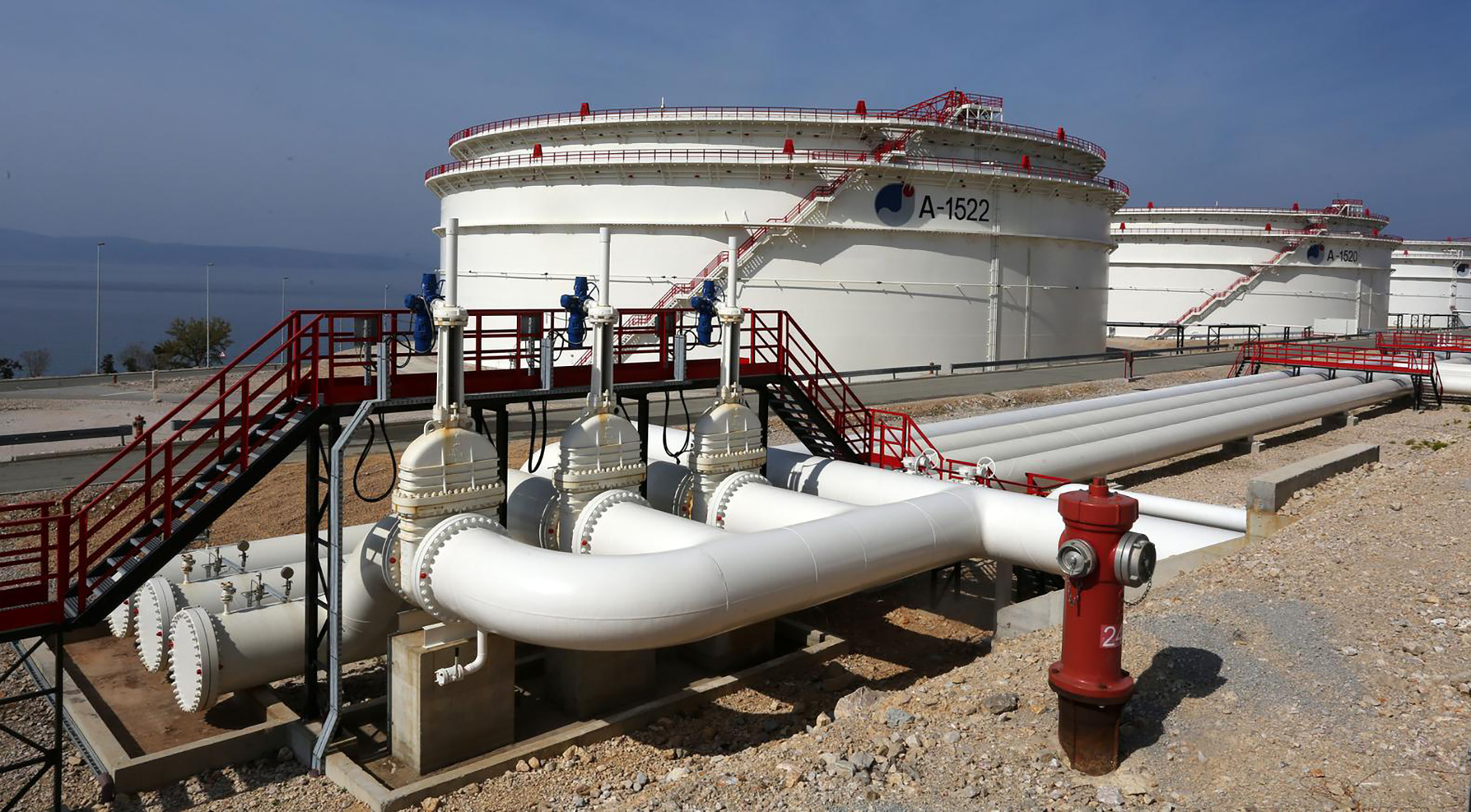
In mid-February, Hungary and Slovakia approached Croatia with a request to urgently allow the transportation of Russian oil through JANAF, from tankers in the Croatian port of Omišalj on the island of Krk to the refineries of the Hungarian company MOL in Hungary and Slovakia. In a joint letter to Croatia’s Minister of Economy Ante Šušnjar, the Hungarian and Slovak sides emphasized that their exemption from EU sanctions makes it possible to import Russian oil by sea in case of disruptions to pipeline supplies.
Minister Šušnjar confirmed the country’s readiness to help Hungary and Slovakia, but spoke out against continuing the import of specifically Russian oil. “We are ready to help resolve acute disruptions in accordance with EU legislation and EU and OFAC (the U.S. Office of Foreign Assets Control) rules,” he emphasized. According to him, Croatia acted responsibly and transparently from the standpoint of regional energy security and will do so again for Hungary, with full respect for its Ukrainian allies and the daily suffering they endure. “A barrel bought in Russia may seem cheaper to some countries, but it helps finance the war and attacks on the Ukrainian people,” the minister noted, emphasizing that the Adriatic pipeline is capable of ensuring supplies, and that there are no longer any technical justifications for any European Union member state to continue importing Russian oil.
Practically at the same time, the Bulgarian Center for the Study of Democracy (CSD) published a report in which it stated that Hungary does not need Russian oil because it has access to other sources. “There are no technical or economic grounds for continuing the sanctions exemption for Russian oil in Central Europe. Hungary’s persistent dependence is a political choice that weakens EU unity and undermines confidence in the sanctions regime. A gradual phase-out of Russian crude oil by the end of 2026 is both feasible and necessary for Europe’s long-term energy security,” emphasized Martin Vladimirov, Director of CSD’s Energy and Climate Program.
But in Budapest, the arguments of Croatian government officials and Bulgarian experts were not taken into account.
The Hungarian ultimatum
On 26 February, MOL issued an ultimatum to JANAF, demanding that it immediately provide guarantees for the transit of Russian oil and threatening to turn to the EU and file damages claims.
“MOL Group calls on JANAF to immediately provide guarantees for the transit of non-sanctioned consignments of Russian crude oil arriving by sea. Under EU and U.S. sanctions, the Croatian pipeline operator must do so. MOL expects a direct response from the Croatian company no later than 27 February 2026. In the event of refusal, MOL may turn to the European Commission and file a claim for damages,” the Hungarian company’s statement said.
“Under the relevant EU and U.S. sanctions, JANAF has no other choice but to allow through consignments of Russian crude oil arriving by sea. Accordingly, MOL urgently requests that JANAF confirm that it will accept sea shipments of crude oil of Russian origin, legally imported in accordance with EU and U.S. sanctions,” MOL emphasizes.
A refusal to provide the necessary transportation services may, in the Hungarian company’s view, be interpreted as an abuse of a dominant position under EU competition law. If JANAF continues to refuse to provide confirmation, MOL warned that it “will have no other choice but to turn to the relevant EU bodies, including the Directorate-General for Competition of the European Commission.”
MOL also notes that JANAF will bear legal and financial responsibility for any financial losses caused by a delay in obtaining confirmation of consent to transport Russian oil. “MOL reserves the right to submit a claim to JANAF for compensation for damages,” the statement said.
In its response to the Hungarian ultimatum, on 27 February JANAF stated that it operates in full compliance with the current sanctions regimes of the European Union and the United States and noted that it had already transported significant volumes of oil for Hungary’s MOL that are not subject to sanctions restrictions. “As for the ultimatums sent to JANAF, we consider it important to announce that negotiations between partners and allies are conducted with dignity, with arguments and on the basis of facts,” the statement said.
The Croatian company added that the security of supplies for Hungary and Slovakia is not under threat, as the transport route via JANAF exists, is already being used, and has sufficient capacity to cover their oil needs. It is noted that significant volumes of oil not subject to sanctions restrictions have already been transported for Hungary’s MOL last week and this week, and that by the beginning of April another seven tankers are to arrive “for the same user.” “Decisions on procurement and transportation to Hungary and Slovakia will be made on the basis of legality and compliance with sanctions, and not under pressure or ultimatums. If there are requests related to oil of Russian origin or entities linked to Russia, they may be considered exclusively within the strict framework of EU and OFAC sanctions criteria, with full legal due diligence, clear accountability and maximum transparency,” JANAF emphasized.
In conclusion, the Croatian company added that Croatia is not refusing supplies and is not politicizing energy.
Putin’s cheap oil
Minister of Economy Ante Šušnjar, in response to the Hungarian ultimatum, in turn stated that the country is a reliable partner, but will not allow itself to be pressured. “We are a sovereign state and we will not bow to anyone’s pressure, but we will respect international law. We will not agree to any blackmail,” Šušnjar emphasized. “Nowhere in international law does it say that we must do anything with the supply of Russian oil,” Šušnjar said, recalling the sanctions regimes of the United States and the European Union.
In the EU, in turn, it is believed that the decision on oil transportation should be taken independently by Zagreb, but with due regard to sanctions. “The main principle is that member states are responsible for the implementation and application of sanctions,” European Commission spokesperson Anna-Kaisa Itkonen said in response to a journalist’s question about whether Croatia can supply Russian oil through the Adriatic pipeline.
However, the authorities of Croatia emphasize that they will make decisions exclusively in cooperation with the United States and the EU.
Prime Minister Andrej Plenković, commenting on MOL’s request to JANAF regarding the transportation of Russian oil, explained that JANAF had already transported for MOL oil from several tankers with “non-Russian oil,” and the process “is proceeding normally.” But at the end of February, “one tanker with Russian oil was announced, and therefore at this moment our services, relevant ministries and all those dealing with sanctions regimes are talking both with the services of the European Commission and with the American administration,” Plenković noted on 28 February. “There are two sanctions regimes — one European and the other American — in order for us to see whether the oil that MOL would declare for its needs falls under restrictions under these sanctions regimes,” the head of the Croatian government said, emphasizing that only after this will a decision be made. “At this moment we are assessing the situation,” he stated.
He emphasized that, apart from the cheaper price, “Russian oil in essence is not needed by either Slovakia or Hungary.” “It is their political choice — to buy cheaper Russian oil from Putin,” Plenković emphasized.
The prime minister’s statement clearly demonstrates Croatia’s position: the reason for the dispute lies in Hungary’s political unwillingness to abandon cheap Russian raw materials, despite the availability of alternatives.
Orbán’s pre-election game
Croatian Member of the European Parliament Tonino Picula considers this entire story about Russian oil and JANAF to be Orbán’s pre-election game.
Speaking about Hungary’s ultimatum to Croatia regarding the supply of Russian oil via the JANAF pipeline, he called it rather a political, or even geopolitical, than a technical problem. In his opinion, Croatia should not agree to such pressure from Budapest, because, first of all, this would call into question its own foreign policy orientation.
Speaking about possible consequences for Croatia due to the Hungarian ultimatum, in particular about possible negative consequences for Croatia’s leading oil company INA, in which Hungary’s MOL has 49%, Picula did not rule out such a development, but noted: “I think that now we simply need to endure this type of Orbán’s activity until the elections, because everything he is doing now is about surviving politically.”
Meanwhile, according to a Median poll conducted from 18 to 23 February on behalf of HVG, among all citizens who have the right to vote, Péter Magyar’s opposition party “Tisza” leads with an 11 percent advantage over Viktor Orbán’s “Fidesz.” And among those who have already definitely decided on their electoral preferences, the advantage is even more convincing — 20 percent.
CWBS Analytical Group