This year’s election campaign in Slovenia was unprecedentedly scandalous, but the sensational revelations failed to lead to fundamental changes on the country’s political map.
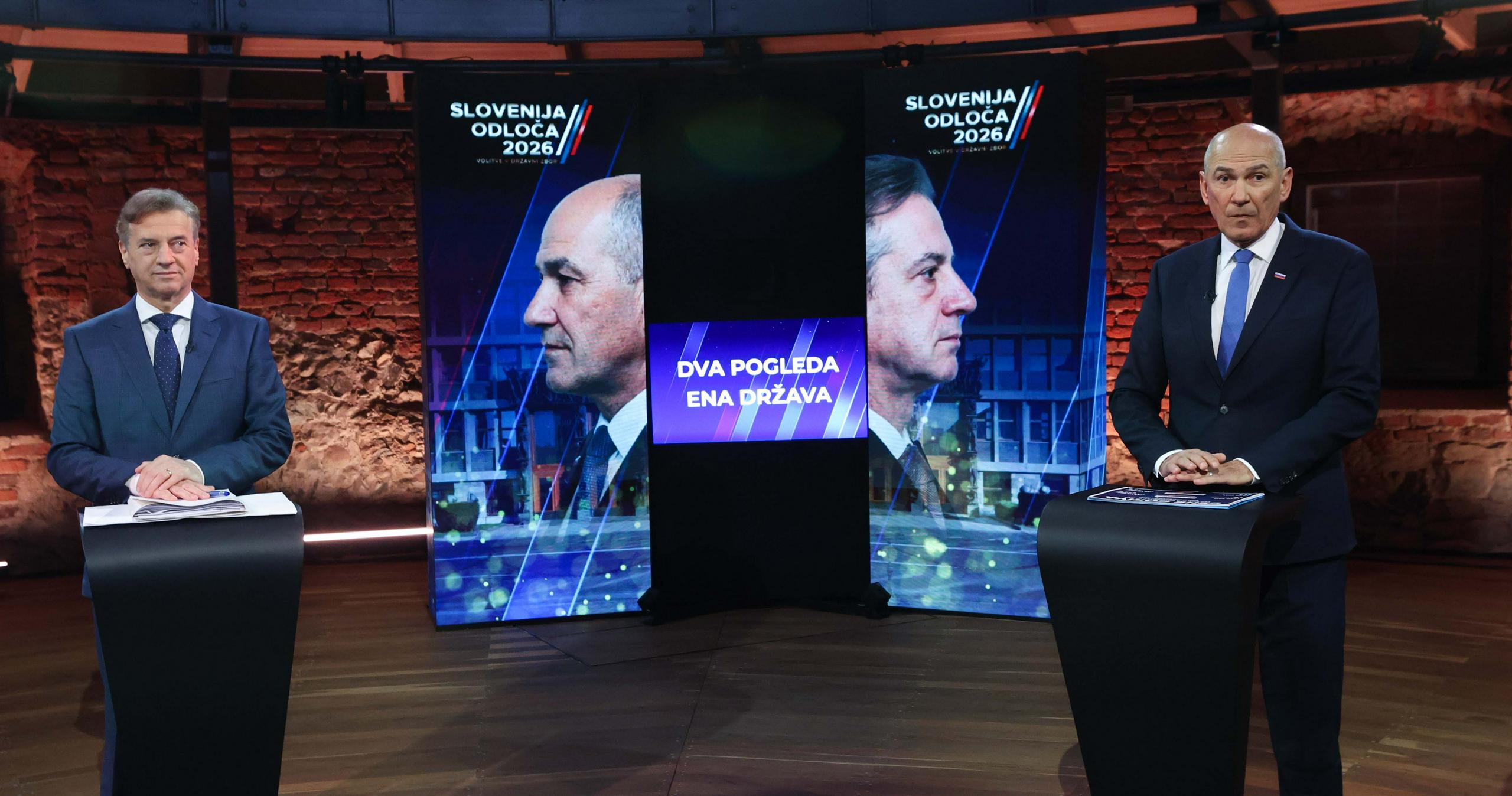
After the parliamentary elections on 22 March, the party of Prime Minister Robert Golob, Gibanje Svoboda (“Freedom Movement”), is leading by a minimal margin. According to preliminary counts, the opposition Slovenska demokratska stranka — SDS (Slovenian Democratic Party) of Janez Janša is trailing the leader by tenths of a percent. At the same time, as analysts note, both political forces received more votes than forecast, although neither will be able to form a government on its own.
This is not yet the final result, but the main conclusion can already be drawn: Slovenian society remains polarized, and the two leading parties of Slovenia have stable supporters whom the pre-election scandals only motivated to support their “own” political force even more actively.
The biggest scandal in Slovenia’s history
At the final stage of the parliamentary elections, the campaign, which had already been marked by fierce competition and uncertainty regarding the future coalition configuration, underwent a sharp change in dynamics. Less than two weeks before the elections, video and audio recordings, allegedly made with a hidden camera, began to appear on various online platforms, in which current and former political figures close to the ruling political force allegedly discuss possibilities of corrupt influence on the authorities. As one Slovenian media outlet wrote, a “red thread” running through all the conversations is Prime Minister Robert Golob “and his omnipresent behind-the-scenes political influence.”
Janez Janša, commenting on the recordings, stated that Slovenia is governed by a “criminal organization,” and that “in a decent country any government would have resigned.”
Prime Minister Golob described these events as “a gross interference in the foundations of European democracy” and the biggest scandal in Slovenia’s history.
The individuals appearing in the recordings rejected either their authenticity or their interpretation, stating, in particular, that the statements were “taken out of context” and that the editing was manipulative.
The official security services of Slovenia did not manage to confirm or refute the authenticity of the recordings before the elections, while at the same time deploying resources for examination both within Slovenia and by sending the video and audio recordings to a forensic laboratory abroad. Law enforcement officials stated that the verification requires substantial time and procedural requirements, therefore the investigation cannot be completed “overnight.”
Macedonian masks
The recordings very quickly acquired central importance for the campaign, not only because of their content, but also because of the specifics of the campaign for their dissemination.
The main channels for publishing the recordings were the website anti-corruption2026.com and the Facebook page Maske padajo (“The masks are falling”).
According to media reports, the website anti-corruption2026.com was created on 9 March of this year and is hosted on a server managed through the Icelandic company OrangeWebsite, which provides services for anonymous website creation.
The page Maske padajo was created several years ago under the name Dvogled, but it became active in March 2026, when it received its present name. According to Facebook data published by Slovenian media, the page is administered from North Macedonia.
The presence of a “Macedonian trace” makes the events in Slovenia on the eve of the elections even more interesting, given the long-standing experience of specialists from this country in creating and promoting political online tabloids. It should be recalled that during the 2016 U.S. presidential elections, teenagers from the Macedonian city of Veles spread fake news among millions of Americans on Facebook, earning tens of thousands of dollars in advertising revenue.
At present, the security services of North Macedonia have reacted very cautiously to the involvement in the campaign in Slovenia of information resources administered by citizens of the country. The Macedonian National Security Agency (ANB) told journalists that due to data confidentiality they cannot share specific details, but confirm that they are taking measures within their jurisdiction.
Black Cube
Even greater resonance was caused by details related not to the channels of dissemination, but to the alleged “managers” of the anti-corruption campaign.
According to an investigation by the Slovenian magazine Mladina, representatives of the Israeli private intelligence company Black Cube visited Slovenia four times starting from November 2025. According to this data, representatives of Black Cube stayed in Ljubljana near the official office of SDS, where, as Mladina journalists stated, they could have met with the party leader Janez Janša. Thus, according to media reports, one of the hotels where they stayed is located literally a few dozen meters from the SDS office.
On 18 March, the State Secretary of Slovenia for National and International Security Vojko Volk stated that at a meeting of the National Security Council a report was presented in which the Slovenian Intelligence and Security Agency (SOVA) effectively confirmed suspicions of Black Cube’s interference in the election campaign. “The director of SOVA informed us of facts indicating direct foreign interference in the elections in Slovenia,” Volk said. According to him, the information campaign, in which representatives of the firm Black Cube are likely involved, “follows a set of tools and methods used in other countries,” and its goal is “political discreditation” and “influence on democratic elections.”
On the same day, the office of Prime Minister Robert Golob reported that due to the seriousness of the information about the influence of a private intelligence firm from Israel on electoral processes in Slovenia, the head of government traveled to Brussels in order to hold talks with key European political parties on the protection of democratic processes in Slovenia.
In addition to meetings with other leaders of EU member states, Robert Golob also wrote a letter to the President of the European Commission Ursula von der Leyen and the President of the European Council António Costa, in which he stated that “such interference by a foreign private company creates a clear hybrid threat to the European Union and its member states, negatively affecting and potentially undermining our common values, procedures and political processes.”
The leader of SDS Janez Janša, in turn, stated that the meeting with the guests from Israel did indeed take place, but that the purpose of the meeting was to discuss the situation in the Middle East. Janša also stated that the discussion of the recordings should focus on the content, and not on the way in which they were obtained. “What do you think is the reason why Slovenians live worse — because of the exposed corruption or because of the person who exposed this corruption?” asked the SDS leader.
After the vote on 22 March, Janez Janša expressed the view that the elections were a “referendum on corruption.” The results of the vote, thus, showed a high degree of tolerance among citizens for corrupt actions of the authorities. “You can interpret the result however you like, but, certainly, in Slovenia corruption is clearly not something that the majority of voters would unanimously condemn,” the SDS leader stated.
The elections are over, the scandals are not
Despite the completion of the vote, political turbulence in Slovenia is only gaining momentum. The scandals that erupted on the eve of the elections will not disappear from the agenda — they will become an instrument of political struggle for both camps.
The SDS of Janez Janša will insist on accountability of representatives of the ruling coalition, while the Freedom Movement and its allies will focus on investigating possible foreign interference, attempts to manipulate public opinion, and calls to punish Slovenian politicians who may turn out to be involved in the influence campaign. “The police and the prosecution are investigating this, and I believe that they will continue their work accordingly and bring the case to an end,” Robert Golob emphasized after the elections, responding to a question regarding the possible activity of Black Cube in Slovenia.
At the same time, the scandals did not shake the positions of the two leading parties, demonstrating that society remains deeply polarized. Neither the idea of fighting corruption nor the threat of foreign interference in the electoral process became consolidating factors. Slovenian politics is increasingly turning into a struggle between two stable electoral blocs, which react to sensational revelations not by changing positions, but by strengthening internal solidarity. In this situation, the preservation, or even more so the intensification, of confrontational rhetoric by political leaders may lead not to a decline in the ratings of opponents, but to even greater divisions in society — political, ideological, and worldview.
Thus, despite the end of the election campaign, Slovenia is entering a difficult period of political turbulence, which, against the backdrop of unprecedented security risks and the global energy crisis, is becoming a real test for the country.
CWBS Analytical Group