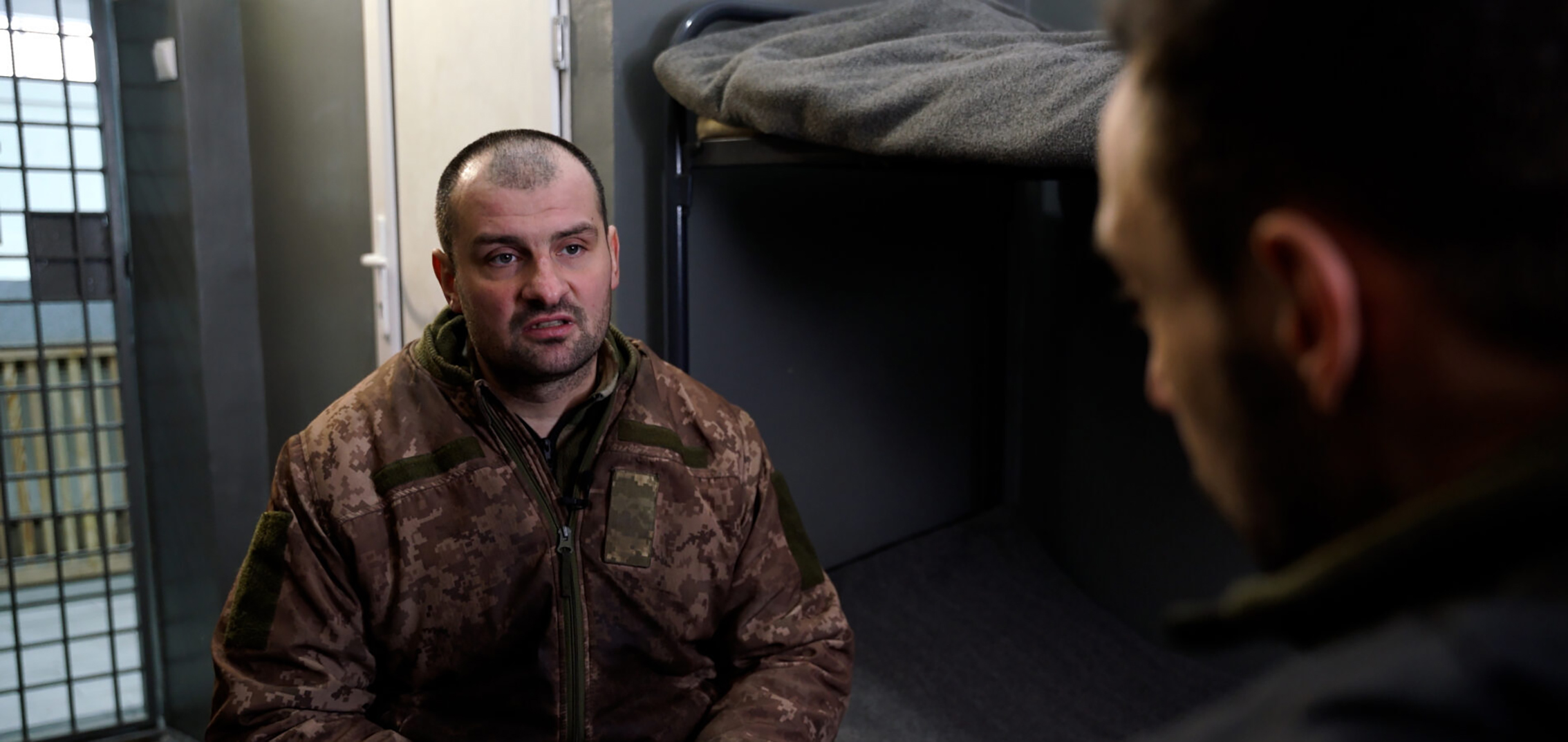
It is September 2025 and Selver Hrustić, a man from Zenica, a Bosnian and a Muslim, as he describes himself, is traveling to Moscow. He has decided to fight in the Russian army—ideologically motivated, at least according to his own testimony in front Detektor cameras, which interviewed him during his three-month captivity in Ukraine. Captured at the front, this 35-year-old recounts his story and the reasons behind joining the Russian military and going to the front lines.
Hrustić explains that he arrived in Moscow on September 4, landing at Sheremetyevo Airport late at night.
“There, I told the police—I already knew how the process goes—you tell the police at the airport that you want to join the army,” he claims. According to him, the procedure was straightforward: declare your intent, undergo checks, and sign a contract.
Hrustić is not the only volunteer or mercenary from Bosnia and Herzegovina, raising broader questions about citizens of BiH traveling to fight in foreign conflicts. His story, shared in an interview for Detektor, traces a path from Germany, through Moscow, to the Ukrainian front—and ultimately to a prison cell.
“A woman approached us—she was a captain, a psychologist—and calmly said: ‘You are people who came here to kill others for money. Like us, we are paid killers,'” Hrustić begins, recounting his testimony from a Ukrainian prison.
That single statement encapsulates the central dilemma: are foreign fighters ideologically motivated volunteers or mercenaries participating in someone else’s war?
He says he did not complete formal training, and that everything took place at a children’s military school near Moscow.
According to Hrustić, the transition from civilian to military status occurred quickly and without complicated procedures. Upon arrival, he stayed at a facility where FSB officers checked documentation. In the meantime, a short training course could be completed, after which recruits were sent to a location on Yablochkova Street to sign an official contract with the Russian Ministry of Defense.
“I went there on September 19 to sign the official contract. From that moment, you are a soldier,” he recalls, emphasizing that the administrative process was relatively simple.
His interest in going to Russia, he says, was sparked by a promotional video from the organization “Kosovo Front,” led by Aleksandr Kravchenko, a volunteer linked to military structures in Republika Srpska and Russia. Initially, he claims, he was rejected because of his ethnic and religious background but later established contact with Dejan Berić, a well-known volunteer on the Russian side.
According to Hrustić, Berić emphasized that everything proceeded according to the law and Ministry of Defense regulations, without special promises or guarantees. “He said that war is not a game,” Hrustić recalls, adding that he was warned of the extremely dangerous conditions on the front in recent months.
On the Ukrainian side, Tamara Kuruškina from the Department for Treatment of Prisoners notes that foreign citizens are frequently among detainees, some claiming they were unaware they were going to fight. “Even those foreign citizens who signed contracts under coercion or deception mostly want to return to their countries,” says Kuruškina.
The fate of BiH citizen Hrustić, currently a prisoner of war in Ukraine, raises a host of legal and political questions. This is the first known case of a Bosnian citizen in such a status in Ukraine, complicating issues of jurisdiction and potential extradition.
The case recalls an earlier example of Darijo Ristić, who was injured fighting in the Russian army and faced charges upon returning to Bosnia and Herzegovina. Unlike Ristić, Hrustić remains outside the reach of Bosnian authorities.
According to Mirza Buljubašić, assistant professor at the Faculty of Criminal Justice, Criminology, and Security Studies, the key issue in such cases is proof.
“We face major difficulties in gathering evidence in these cases. If Ukrainian authorities do not wish to extradite and want to prosecute him—that’s fine. If they want to extradite and have evidence to prosecute but choose not to and instead send it to us via international legal assistance, then we have concrete evidence,” explains Buljubašić.
His words point to the complex mechanism of international legal assistance, requiring cooperation between the institutions of two countries, exchange of evidence, and clearly defined jurisdiction. Otherwise, the process may remain blocked between political and legal procedures.
The Ministry of Foreign Affairs of Bosnia and Herzegovina has not provided specific information about further steps. Minister Elmedin Konaković stated that BiH authorities currently have no access to Hrustić.
“The situation is, as you can imagine, very complex (…) and for now, we do not have access. The good thing is that he is alive and well,” Konaković said at a press conference.
While the family and the public await clearer answers, the question remains whether Hrustić will be prosecuted in Ukraine or extradited to Bosnia and Herzegovina. In the meantime, his case sets a precedent likely to shape future BiH judicial responses to similar situations.
The legal aspect of the case is highlighted by Sarajevo lawyer Senad Bilić, who notes that joining foreign armed forces is a criminal offense under BiH law. “It is contrary to the Defense Law and the Armed Forces Service Law of BiH. Whether it is the Russian, Ukrainian, Turkish, Croatian, Slovenian army, any—citizens of BiH may not serve in foreign armed forces,” Bilić emphasizes. The minimum sentence for such an offense is three years in prison.
In his interview from captivity, Hrustić speaks not only about his fate but also about experiences that, he claims, profoundly changed his view of war. He openly criticizes the Russian army in which he fought.
“I asked him how he explains this, as he is a Muslim. I asked about religion, whether he believes in God. He said yes. I asked, how did you go fight on the side of the aggressor? He answered that for him, this war was very distant,” recalls Barkush.
As Hrustić speaks of altered perspectives and new opportunities, public opinion remains divided between understanding, doubt, and moral condemnation. His story, told from a prison cell, becomes more than a personal account—it reflects the complexity of war, identity, and responsibility.
He claims that the organization was below expected standards and that contracted soldiers were not treated as “their own people.” At the front, he says, they lacked even basic resources. “There wasn’t enough water—neither drinking nor for basic hygiene,” he emphasizes, describing a daily life far from what he had expected.
A particularly striking part of his testimony concerns interactions with Ukrainian soldiers. In these encounters, he says, he was reminded of Bosnia and Herzegovina’s painful past.
“The Ukrainian army told me that, for example, in the town of Žepa, they helped our people who were trapped and could have faced the same fate as in Srebrenica. And they asked: why did you side with the Russians? I explained to them, and they understood,” Hrustić says.
He also made a statement that drew the most reactions—he now believes it would be “more realistic to fight for the Ukrainian side.” He claims that the Ukrainian army has already contacted him regarding possible engagement.
Such developments raise numerous ethical questions. Can switching sides in a war be an act of redemption, or is it a pragmatic attempt to survive captivity?
Ukrainian journalists from the platform United24, who also interviewed him, expressed skepticism. Amira Barkush notes that she did not detect deeper moral reflection in his answers.
According to Yevheniia Melnyk, a large number of foreign fighters are among the prisoners. She notes that around 10,000 Russian soldiers were captured during the war, seven percent of whom are foreigners. Detainees in Ukrainian prisons come from about 40 countries, mostly post-Soviet states, but also Africa and the Middle East.
Kuruškina adds that, according to her organization, volunteers from over 42 countries are in Ukrainian prisons, while estimates of foreign fighters on the Russian side reach up to 21,000, with the real number likely higher.
Selver Hrustić’s family is facing an emotional dilemma. His father, Fahrudin, openly disapproves of his son going to war but admits: “I am proud of my son.” This internal tension reflects a broader societal confusion—between legal prohibition, moral condemnation, and personal attachment.
The case of Selver Hrustić is not just his personal story. He represents the issue of foreign fighters and highlights the challenges facing Bosnia and Herzegovina, a country familiar with the return of its citizens from war zones. His future now depends on the decisions of Ukrainian authorities, possible extradition, and the ability of the domestic judiciary to assess his actions, while his family and community wait in uncertainty.
Nino Bilajac. Journalist, Detektor.ba

The articles published in the “Opinions” column reflect the personal opinion of the author and may not coincide with the position of the Center