The project for the reconstruction of the former General Staff complex in the center of Belgrade, which the Serbian government planned to implement together with the son-in-law of U.S. President Donald Trump, has become a true test for Aleksandar Vučić. The agreement between the Serbian government and Jared Kushner’s company, instead of becoming an example of successful foreign-policy lobbying and well-considered economic pragmatism, has turned into a reason for yet another wave of public discontent, an escalation of internal political confrontation, and even the beginning of an investigation into high-ranking officials.
An architectural monument as a construction site
The complex of buildings of the State Secretariat of National Defense, known as the General Staff, was designed by architect Nikola Dobrović in the modernist style. The structure was a symbol of post-war socialist Yugoslavia. In the spring of 1999, the building was struck by NATO missiles during Operation “Allied Force” and partially destroyed. In 2005, the Serbian government declared the General Staff complex a cultural heritage. But now the buildings in the center of Belgrade must make way for a luxurious hotel-residential complex that will be built by Jared Kushner’s company. The lobbyist for this deal was Richard Grenell, former special envoy of Trump to the Balkans, which underscores the political nature of the investment.
The agreement on the “revitalization” of the “General Staff” complex (“Generalštab”) was signed in May 2024 between the Serbian Ministry of Construction, Transport and Infrastructure, headed at the time by Goran Vesić, and Affinity Global Development. Under the terms of the contract, the land in the center of Belgrade, with a total area of more than 3 hectares, is transferred on a 99-year lease free of charge.
At the end of 2024, the government revoked the cultural heritage status for the General Staff buildings. In November 2025, the Serbian parliament voted for a special law (lex specialis), which created a special procedure for developing the site of the former General Staff.
However, already in May 2025, the Prosecutor’s Office for Organized Crime launched an investigation on suspicion of falsifying the documents on the basis of which the protection of the “General Staff” complex was revoked. According to the prosecution, the proposal to terminate the cultural heritage status, which Goran Vasić, acting director of the Republican Institute for the Protection of Cultural Monuments, sent to the Ministry of Culture, was falsified. Now the prosecution suspects him of abuse of office.
One of the suspects in the case is also the Minister of Culture Nikola Selaković. He is suspected of allegedly influencing the Republican Institute for the Protection of Cultural Monuments, while he was serving as Minister of Justice at the time, in order to remove the General Staff complex from the register of cultural properties. Selaković has already been charged with two crimes: abuse of office and falsification of an official document.
The minister rejects these accusations, and President Aleksandar Vučić says that this is political persecution. According to the Serbian president, employees of the prosecutor’s office participated in anti-government protests, and now they are persecuting the official for political reasons. Selaković went even further and accused the prosecutors of attempting to overthrow the state leadership. “Aleksandar Vučić is their main obstacle, and everything they do, they do in order to ultimately strike at him,” the minister said after his visit to the prosecutor’s office.
An unnecessary ruin or an important symbol?
The President of Serbia emphasizes that the project with Kushner’s company is beneficial for the country. A few days ago, Vučić stressed: “It is important that we attract investments; they would amount to over 600 million dollars, this is important for Serbia, not to mention how the city center would change and how many more tourists we would attract.”
But far from all citizens share his opinion. First and foremost, the reason for this is that initiating a grandiose redevelopment in downtown Belgrade amid mass protests against the deadly collapse of the canopy of the Novi Sad station was a very risky move by the Serbian leadership.
Let us recall that the tragedy in Novi Sad, which occurred in November 2024 and took the lives of 16 people, led to the resignation and charges against minister Goran Vesić — the same person whose signature is on the agreement with Kushner. The investigation is not yet completed, those responsible for the tragedy, which was believed to have been caused either by negligence or unprofessionalism or corruption of state officials, have not yet been punished, and now a new large-scale reconstruction begins. Once again there are special conditions for the developer, a lack of transparency in decision-making, and possible abuses. It could have been predicted that the new development plan of the authorities would trigger public distrust. But the revitalization of the General Staff complex is problematic not only for that reason.
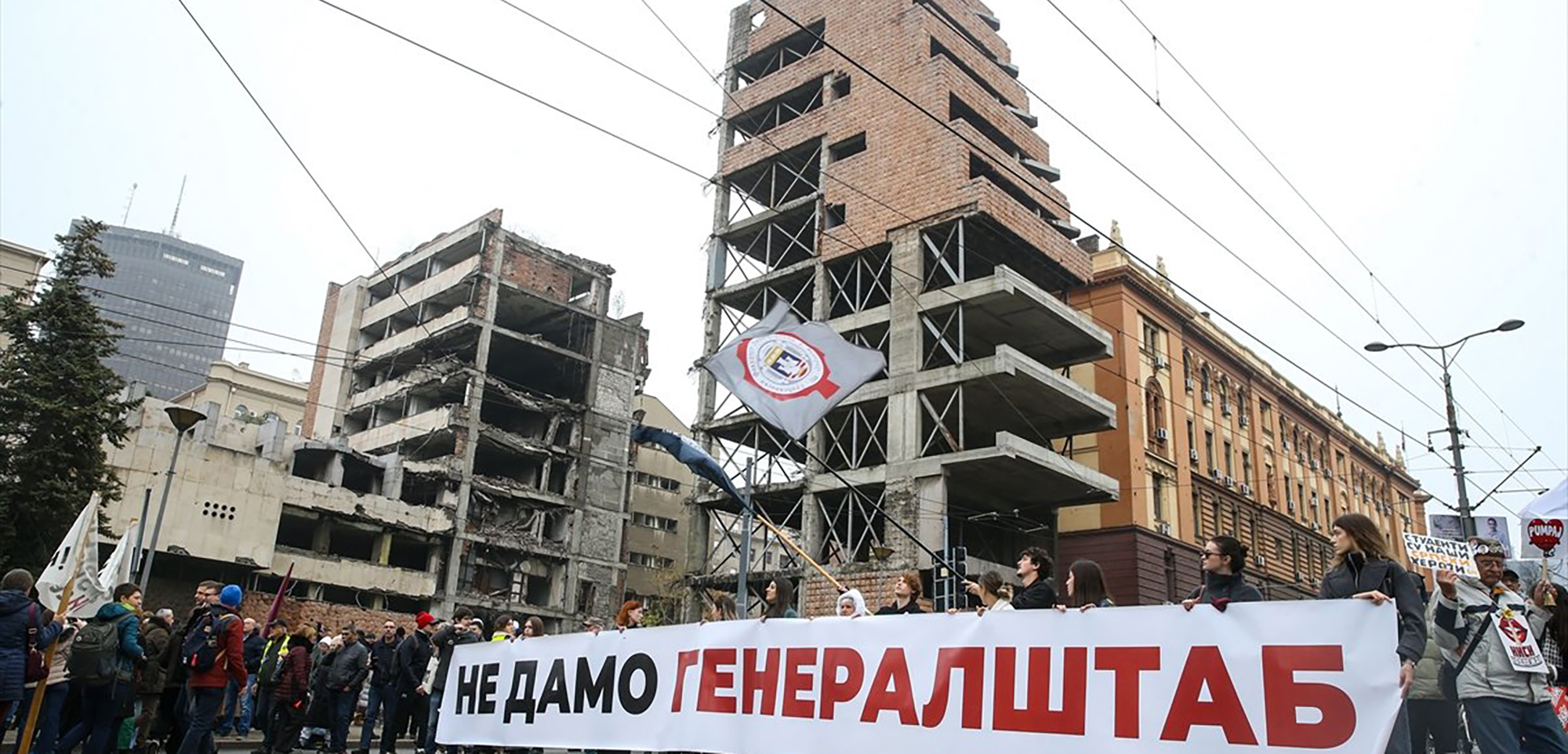
After the parliament approved the special law, a rally was held in front of the former General Staff building in Belgrade, organized by students of several Belgrade faculties. The protesters carried banners reading “We will not surrender the General Staff,” emphasizing that the protest is a warning to the authorities and that there will be new actions unless the planned revitalization of the complex is abandoned.
“To hand over the symbol of our people’s suffering to those who inflicted that suffering — this is not an investment, this is a spit in the soul of everyone who lived through 1999,” stressed the leader of the Kreni-Promeni movement, Savo Manojlović, who is actively opposing the redevelopment of the General Staff.
It is telling that on the anniversary of the start of the NATO operation, students and citizens who support their position also held protests for this reason. Although on that same day official commemorations of the bombing victims were held with the participation of the state leadership, the “General Staff” issue had the authorities and the protesters on opposite sides of the barricades.
For a significant number of Serbs, regardless of whether they support the government or the opposition, the shelling of Belgrade left a deep trauma, and the ruins of the General Staff have turned not only into a cultural but also a historical monument, a symbol of suffering. Therefore, a strong emotional reaction to any attempt to destroy the site is expected, especially when the investor is a company linked to the American establishment. The Museum of NATO Bombing Victims, whose creation was announced by the authorities as part of the reconstruction, cannot in any way be an equivalent substitute for the real building destroyed by missiles.
“We are not going to keep these ruins for another 300 years, will we?” emphasizes Vučić, highlighting the expediency of the American project. However, this position of the Serbian president contradicts not only the sentiments of a significant number of citizens but also his own policy.
Pragmatism vs the past
The policy of President Vučić is characterized by a constant conflict between incompatible strategic goals. This ambivalence in foreign relations is known as the “many chairs” policy, when Belgrade simultaneously joins the EU, befriends Moscow, develops cooperation with Beijing, and tries to build mutually beneficial relations with Washington.
The “General Staff” project is part of this multidirectional activity of Vučić. No one doubts that the purpose of this revitalization is to establish mutually beneficial interaction with Trump’s closest circle to promote Serbia’s interests in Washington. The irony is that, so far, the Serbs have not felt any benefit from this contact — the most urgent problem today, ensuring the operation of the “Oil Industry of Serbia” (NIS), has not been resolved. Because of its special relations with Moscow (another foreign-policy vector), the Serbian authorities did not want to nationalize NIS to get rid of the Russian owner of the company, and the Russians did not want to voluntarily sell an important asset to the Serbs. As a result, U.S. sanctions against the Russian company came into force, the NIS refinery is shutting down, fuel stations are effectively ceasing operations… The support for Kushner’s project in Belgrade has not helped here in any way.
Of course, one may assume that the Serbian authorities decided to demolish the “ruins” without any political context or lobbying objectives, simply based on the calculation of attracting large investments and renewing the city center. But few believe this. The reason for this distrust lies not only in external but also in internal politics under Vučić, where he and his team also try to pursue a “multi-vector” policy.
On the one hand, Serbia has made the strengthening of the economy and improving the well-being of citizens a priority. During his mandate the current Serbian president constantly emphasizes his commitment to the peaceful path of the country’s development and focuses on economic growth. “I believe that next year may be the best in our history in terms of improving the standard of living, completing the construction of infrastructure projects, and changing the face of Serbia. I believe that it will be the best year in our history, but we will have to work hard, strive hard, fight hard; we will have to make many difficult decisions… we in Serbia are not preparing for war. We are strengthening our military to deter someone. But you know that as long as I lead Serbia, the chances of war are very small,” he stated in a recent TV interview.
But a policy of peace and sustainable economic development a priori should imply the abandonment of narratives that fuel revanchism and chauvinism. However, the facts indicate the opposite. The categorical denial of the genocide in Srebrenica; the framing of the Croatian military operation “Storm” as a pogrom of Krajina Serbs (without reference to all the circumstances of the war); the assessment of NATO’s “Allied Force” operation against Yugoslavia as aggression (without analyzing the immediate causes that compelled the North Atlantic Alliance to use force); the moral justification of criminals convicted by the Hague Tribunal — all these are the realities of today’s Serbia.
Vučić’s government, although proclaiming a pragmatic policy of economic development focused on the future, in practice glorifies lost battles, cultivates a sense of injustice, and immerses citizens in reflection on the recent past. In this atmosphere, a peculiar political and mental split emerges — peaceful pragmatism goes hand in hand with sentiments in which Vučić’s critics see threatening signs of a desire to take revenge for the military defeats of his predecessors.
The “General Staff” case demonstrated the full paradox and inconsistency of the political equilibristics of the Serbian authorities in domestic politics. It is impossible to care for the economic development while implementing non-transparent investment projects accompanied by suspicions of corruption. It is impossible to speak about the “unjust NATO aggression,” cultivate the image of martyrs, and attempt to demolish the symbol of the people’s suffering to the benefit of essentially the same NATO members. This combination of the incompatible naturally provokes disappointment, indignation, and resistance among citizens.
It is clear that personally and through pro-government media the president and his team will attempt to explain their position and still secure the support of the electorate. The next elections, which, according to Vučić, should take place already in May or December of next year, will show whether the current Serbian leadership will succeed.
CWBS Analytical Group