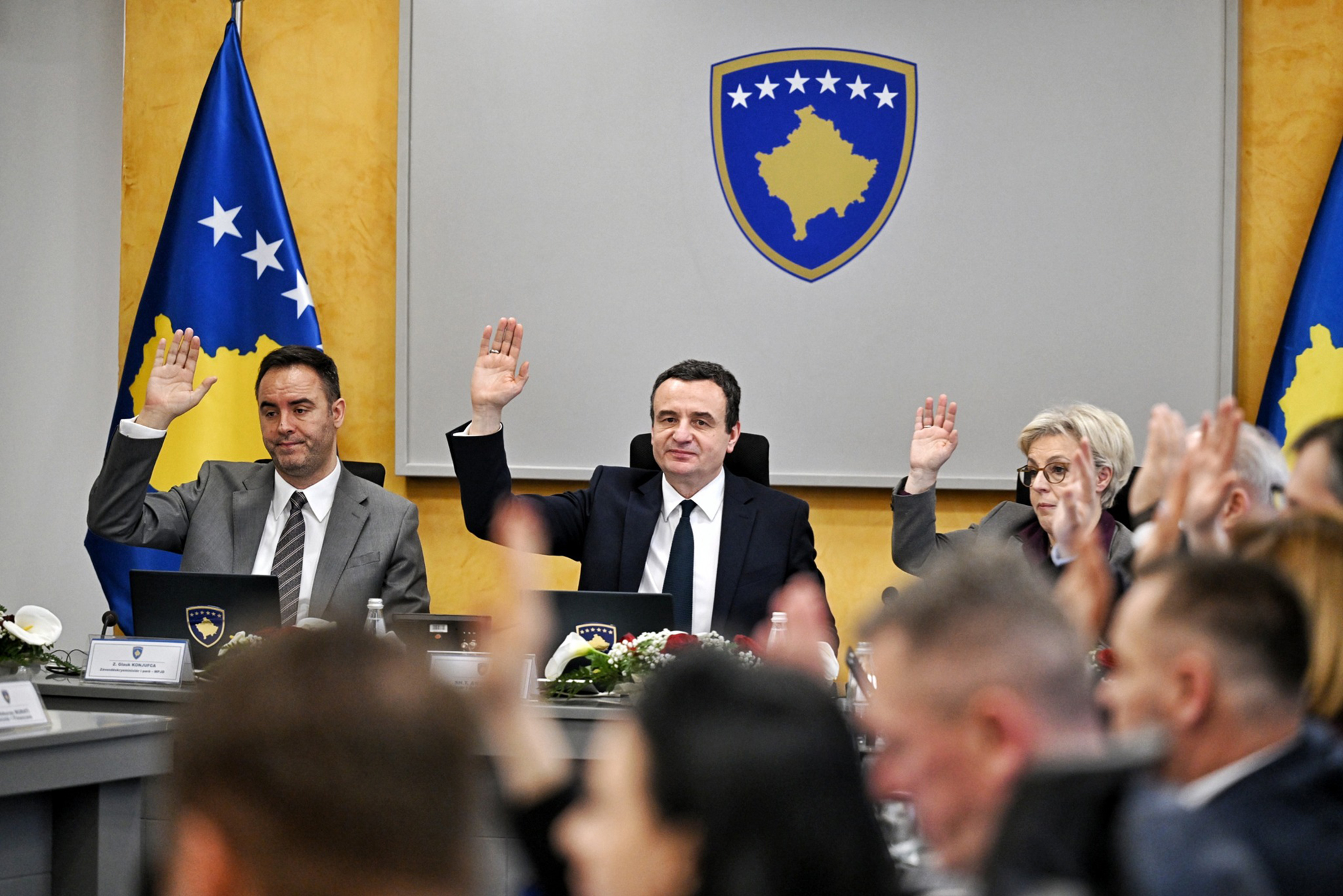
On 11 February 2026, the Assembly of Kosovo approved the formation of the new government led by Prime Minister Albin Kurti, marking the official start of Kurti Government III. In an extraordinary evening session, 66 deputies voted in favour and 49 against, enabling the swift establishment of a cabinet composed of 19 ministries. This vote followed the constitutive session of the new legislature formed after the December 2025 elections and ended the post‑electoral uncertainty, allowing institutions to move forward with governing responsibilities
Introduction
The December 2025 parliamentary elections gave Kosovo a clear political result: the Lëvizja Vetëvendosje – VV (Self-Determination Movement) secured around 51% of the vote, creating the possibility of forming a government without numerical obstacles and without the need for fragile coalitions. In a political reality that has historically produced government instability, this result represents a significant exception. However, a clear parliamentary majority does not exclude the need for careful political and institutional management. On the contrary, it shifts the focus from the question of “Can it be governed?” to the most important dilemma: “How will it be governed?”
The main post-election challenges relate to the formation of the government, the relations between the executive and legislative branches, and the preservation of institutional stability in a polarized political context. At this stage, the real test for the political class is not just parliamentary arithmetic, but the ability to deliver accountable governance, transparent decision-making, and public policies that address the country’s structural problems, including economic development, the rule of law, and citizens’ trust in institutions.
In parallel with the internal challenges, Kosovo’s institutional expectations remain closely linked to the international environment. Relations with strategic partners, the dialogue process with Serbia, Euro-Atlantic integration and the country’s geopolitical positioning require internal political stability and institutional coherence. Any delay or post-election crisis risks weakening Kosovo’s negotiating position and international credibility.
I. Governing with a full majority: political advantage and increased responsibility
The victory of the VV with 51% simplifies the process of government formation, but at the same time significantly increases the burden of political responsibility. In the absence of the justifications usually associated with heterogeneous coalitions, any success or failure of governance will be directly attributed to the winning entity. This situation creates high expectations for stability, efficient decision-making and concrete results in key areas such as the rule of law, economic development and institutional reforms.
Analytically, the main challenge is not the numerical functionality of the government, but avoiding the risk of excessive centralization of power and preserving democratic balances. A strong parliamentary majority must be accompanied by transparency, accountability and respect for the opposition, so that political stability does not turn into institutional stagnation.
II. The election of the new president: the test of political consensus
One of the most important institutional challenges on the horizon is the election of the new President of the Republic of Kosovo. Although the parliamentary majority of the VV makes this process technically possible, the political and symbolic dimension of the institution of the president requires a more comprehensive approach. The president, as a unifying and representative figure of the state, should not be perceived only as a product of the momentary majority, but as the result of a minimum of political consensus.
The election of the President of the Republic of Kosovo constitutes one of the most consensual procedures provided for by the Constitution, requiring not only a qualified majority of votes, but also a high parliamentary quorum. The jurisprudence of the Constitutional Court has emphasized that these requirements are not formal, but substantial, with the aim of guaranteeing the democratic legitimacy and unifying role of the President.
According to the Constitution, the President of the country is elected by the Assembly of the Republic of Kosovo by secret ballot no later than thirty (30) days before the end of the term of office of the current President. The current President, Vjosa Osmani, was elected President of the Republic of Kosovo on 4 April 2021. Legally, the new President of Kosovo must be elected by 5 March 2026.
The election of the President is carried out by two-thirds (2/3, which is equal to 80 deputies) of the votes of all deputies of the Assembly. If no candidate receives a two-thirds (2/3) majority in the first two ballots, a third ballot is organized between the two candidates (if 2 or more candidates have been nominated) who received the highest number of votes in the second ballot and the candidate who receives the majority of votes of all deputies (61 votes) is elected President of the Republic of Kosovo. If in the third ballot, no candidate is elected President of the Republic of Kosovo, the Assembly is dissolved and new elections are announced, which must be held within forty-five (45) days (Article 86 of the Constitution). The election procedure with a simple majority of 61 votes seems simple, but in reality it is practically difficult to reach the quorum to start the procedure for electing the President. The Constitutional Court, with Judgment No. ref.: AGJ 107/1, 30.03.2011, has declared the election of President Behxhet Pacolli unconstitutional. According to this judgment, the presence of 2/3 of the deputies of the Assembly of Kosovo on the occasion of the election of the President of the Republic is a necessary condition in all rounds. The lack of a quorum makes the process unconstitutional, regardless of the result of the vote. In this context, the election of the president represents a maturity test for the Kosovar political spectrum. Reaching a broader agreement would send a positive signal for institutional stability and democratic culture, while the lack of consensus risks excessively politicizing an institution that should essentially stand above party divisions.
President Osmani has taken as a personal credit the invitation from President Trump to become a member of the Peace Board, and as an advantage to be elected for another term as President of the Republic of Kosovo.
III. The international dimension and symbolism of the invitation to President Osmani
Beyond domestic developments, Kosovo’s international positioning remains a key element of its political stability. In this perspective, President Donald Trump’s invitation to President Vjosa Osmani to join the Peace Board has a multiple significance. It is not only a personal or institutional assessment, but also a political signal for the role and perception of Kosovo on the international stage. This development strengthens the narrative of Kosovo as a constructive factor of peace and stability, but at the same time increases expectations that domestic policy will be in line with this image. Institutional stability, democratic functioning and coherence of foreign policy are prerequisites for international symbolism to not remain only at a declarative level.
US President Donald Trump has invited the Republic of Albania and the Republic of Kosovo to become founding members of the “Board of Peace” at the signing ceremony held by Trump in Davos, while other Western Balkan countries: Serbia, North Macedonia, Bosnia and Herzegovina and Montenegro were not invited to become a member of this Board. Kosovo and Albania accepted the invitation and became founding members of the Peace Council.
The invitation to Albania and Kosovo is seen as a clear sign that President Trump’s administration perceives these countries as strategic partners of the United States in the region, especially in the context of global security and stability. The invitation is often described by officials from both countries as an appreciation of their historical or ongoing role in promoting peace and cooperation. The invitation to these two countries was also perceived as an opportunity to raise the international profile. Participation in such an international initiative — gives Albania and Kosovo a largest diplomatic platform and the opportunity to present itself in a global context of peace and cooperation, beyond regional issues or EU/NATO integrations. On the other hand, non-inclusion of states like Serbia or North Macedonia can be interpreted as a change to the traditional dynamics of involvement in international initiatives, but it also shows that American politics — as run by Trump — can be selective and rapid in selecting regional partners, emphasizing countries that are perceived as US allies.
In the next four years, Kosovo’s international challenges will remain closely linked to its international status, the Euro-Atlantic security architecture, and the European integration process. Despite internal institutional consolidation, Kosovo’s foreign policy will continue to face structural constraints stemming from the non-universal recognition of statehood and geopolitical dynamics in Europe and beyond.
The biggest strategic challenge remains membership in the United Nations. Kosovo continues to face active opposition from Serbia and its allies, especially Russia and China, which have veto power in the Security Council. In this context, UN membership is not just a diplomatic issue, but a problem of global balances of power. Without a comprehensive and legally binding agreement with Serbia, or without a major shift in the international balance of power, the prospect of UN membership remains uncertain. The main challenge for Kosovo will be to maintain and expand the number of international recognitions.
In the security field, the aspiration for NATO membership faces political rather than technical obstacles. The transformation of the Kosovo Security Force into a force with defense capabilities and increased interoperability with NATO have marked progress, but the five NATO member states that do not recognize Kosovo remain a key blocking factor. In the coming years, the main challenge will be to maintain internal and regional stability, avoid escalations in the north of the country, and deepen the strategic partnership with the US and key Alliance countries, as a political prerequisite for any step towards membership.
Membership in the Council of Europe presents a more achievable challenge, but not without risks. Although Kosovo has made significant progress in the field of human rights and the rule of law, the process remains politicized and directly influenced by the dialogue with Serbia. Kosovo is the only country that has directly incorporated international human rights instruments (Universal Declaration of Human Rights; European Convention for the Protection of Human Rights and Fundamental Freedoms and its Protocols; International Convention on Civil and Political Rights and its Protocols; Council of Europe Framework Convention for the Protection of National Minorities; Convention on the Elimination of All Forms of Racial Discrimination; Convention on the Elimination of All Forms of Discrimination against Women; Convention on the Rights of the Child; Convention against Torture and Other Cruel, Inhuman or Degrading Treatment or Punishment – Article 22) into its Constitution.
The European integration process remains a complex and long-term challenge. Although visa liberalization has marked a positive symbolic moment, Kosovo remains in the early stages of the EU accession process. The main challenge will be to advance from a contractual relationship to candidate status, at a time when the European Union itself is facing enlargement fatigue, internal polarization and new security challenges. Normalization of relations with Serbia remains a key political condition, often unclear in content and standards, making the process unpredictable for Kosovo.
More broadly, Kosovo will have to maneuver in an international environment characterized by great power rivalry, the war in Ukraine, and the rise of Russian and Chinese influence in the Western Balkans. The challenge will be to maintain a clear Euro-Atlantic orientation, without becoming diplomatically isolated and without being perceived as a destabilizing factor in the region.
The next four years could be decisive for Kosovo’s international positioning. Success will depend not only on internal reforms, but also on the ability for active diplomacy, building strategic alliances and wisely managing international political pressures. In this context, Kosovo’s main challenge remains the transformation of existing political support into concrete membership in key international mechanisms.
IV. Kosovo – Serbia Dialogue: Achievements, Failures and Expectations for the Future
The dialogue between Kosovo and Serbia, facilitated by the European Union, began in 2011 with the main goal of normalizing relations between the two states and ensuring regional stability. For more than a decade, the dialogue has produced a series of agreements, but has also revealed deep structural and political failures.
The most important achievement remains The Brussels Agreement of 2013, which laid the foundations for the integration of illegal Serbian structures in northern Kosovo into the constitutional order of Kosovo, including the police and the judicial system. Technical agreements have also been reached on:
· Freedom of movement,
· Recognition of diplomas (which is not being implemented by Serbia),
· Integrated border management,
· Energy and telecommunications.
These agreements have contributed to reducing tensions at certain periods and have made life easier for citizens, especially in practical and technical terms. However, the dialogue has failed to produce a final, legally binding agreement that would lead to mutual recognition. One of the main failures is selective implementation of agreements, especially from Serbia, which continues to not recognize Kosovo and prevent its membership in international organizations.
The dialogue has also been criticized for: lack of transparency, exclusion of parliaments and the public, lack of punitive mechanisms for non-implementation, asymmetrical treatment of the parties by the EU. The issue of Association of Serb-Majority Municipalities has remained the most sensitive and contentious point, producing constant political crises and security tensions.
On 18 March 2023, the parties agreed on a new agreement, which was called the Ohrid Agreement. This agreement represents the implementation (Implementation Annex) of Basic Agreement for the Normalization of Relations mediated by the European Union. It aims at the de-facto normalization of relations between Kosovo and Serbia, without definitively resolving the issue of formal recognition.
The agreement provides for several key principles:
· Respect for territorial integrity and sovereignty of the parties;
· Non-use of force and the peaceful resolution of disputes;
· Not blocking Kosovo in international integration processes;
· Mutual recognition of documents, state symbols and institutions;
· The establishment of Association of Serb-Majority Municipalities, in accordance with the constitutional order of Kosovo;
· Protection of Serbian cultural and religious heritage in Kosovo.
Although it caused a great stir in public opinion, this agreement was never implemented and tensions between the two countries continue to remain high. In this context, the EU has failed to reach a reconciliation between the two countries. The US has supported the dialogue facilitated by the EU, but this dialogue has not yielded the expected results. Political parties but also the Kosovar public demand US integration and leadership in the dialogue process, since it is considered that the EU has failed to be impartial and fair in Serbia-Kosovo relations. In this context, citizens are outraged by the financial sanctions imposed by the EU against Kosovo and the appointment of people with a history of anti-Kosovo as facilitators of the dialogue. The most well-known case is the former EU envoy Miroslav Lajcak. Lajcak as Minister for The Slovak Ministry of Foreign Affairs has been against Kosovo’s independence, just as his own country – Slovakia – refuses to recognize Kosovo.
For these reasons, it is required that the United States be strongly involved in reaching a final legally binding agreement and ending the centuries-old conflict in the Balkans between these two peoples.
V. Challenges of economic development and migration
Kosovo’s new government will face a much more challenging economic and demographic reality than official statistics reflect. Despite the economic growth of recent years, the structure of the economy remains fragile, dependent on consumption and remittances, while domestic production, exports and strategic investments continue to be below potential. This creates a false sense of stability, which does not translate into quality jobs and long-term economic security.
The problem of unemployment, especially among young people and qualified professionals, is not only a lack of jobs, but also a lack of prospects. The labor market offers low wages, insecure contracts and few opportunities for professional development, making migration not a choice, but a survival strategy. In this context, the massive exodus of labor is turning into a structural crisis, which is gradually emptying the country of its most valuable capital – its people.
Migration is directly affecting the functioning of the economy. Key sectors such as healthcare, construction, information technology and education are already facing serious staff shortages. Meanwhile, an aging population and shrinking working age population are increasing pressure on the state’s pension and financial systems, putting long-term fiscal sustainability in question.
Remittances from the diaspora, although they play a stabilizing and social role, are keeping the economy in a cycle of dependency, where consumption replaces development. They are not being systematically channeled into productive investments, innovation or technology, which could create jobs and stem the tide of migration. This situation makes the state less motivated for deep reforms, as social pressure is temporarily amortized by the money coming from abroad.
The new government will also face the challenge of trust. Mass migration is not only an economic indicator, but also a political one. It reflects a lack of trust in institutions, in the rule of law and in equality of opportunity. Without a real fight against corruption, without legal certainty for businesses and without clear development policies, any economic strategy will remain declarative. If the new government fails to turn the economy into a source of hope and stop the perception that the future is built only outside of Kosovo, then migration will continue to be the clearest form of citizens’ vote against their state. The challenge is not only economic development, but the demographic and functional survival of Kosovo as a state.
Conclusion
Kosovo, after the December 2025 elections, finds itself in a relatively favorable political moment, but not without risks. The clear parliamentary majority, the presidential election process, and developments on the international stage create a window of opportunity for institutional consolidation. The essential question remains whether this period will be used to build a stable and inclusive government, or will it be lost like so many previous moments in the country’s political history.
The period after the December 2025 elections represents a crucial moment: it will either serve as an opportunity for democratic and institutional consolidation, or it will deepen the cycle of political uncertainty and civic disillusionment. The answer to this dilemma depends on the political maturity of institutional actors and their ability to transform electoral will into functional governance and a long-term vision for the state.
Orhan Çeku. Associate professor for the subject of National Security at the public Haxhi Zeka University in the Republic of Kosovo
The articles published in the “Opinions” column reflect the personal opinion of the author and may not coincide with the position of the Center