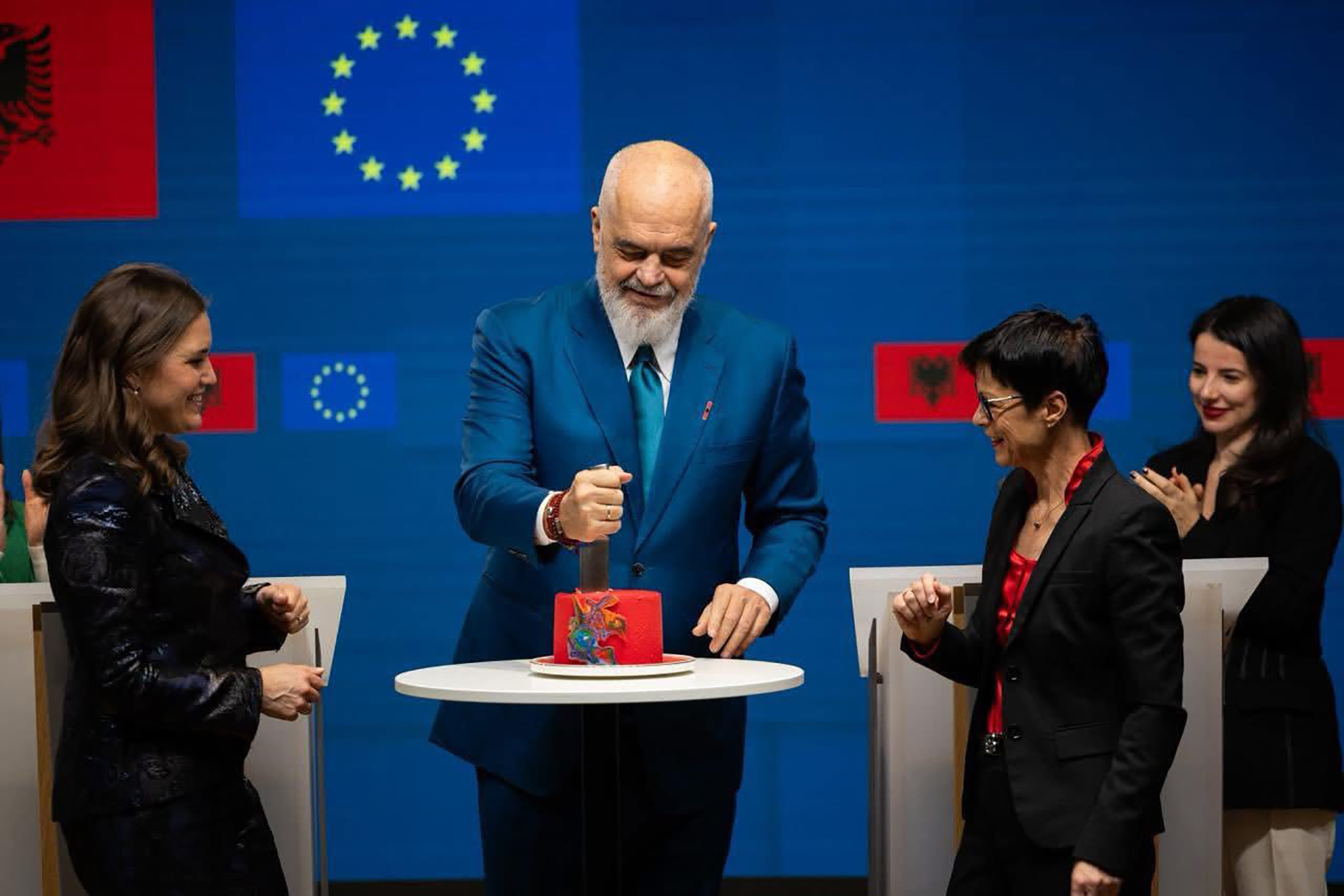
In Albania — which just three decades ago was one of the poorest countries in Europe and which at one time experienced one of the harshest communist regimes of Enver Hoxha — the topic of EU accession has long ceased to be a typical regional political mantra about a “European future.” In Tirana, the European path is already presented as a political timetable: Albanian Prime Minister Edi Rama declares the intention to complete negotiations by the end of 2027 and bring the country to EU membership by 2030. Quite recently this would have sounded like a typical set of ambitious promises for domestic consumption, but today the situation is different. Behind this rhetoric stands a real acceleration of the negotiation process, and this is precisely why in Brussels the Albanian track is increasingly less perceived as a protracted Balkan story without a clear horizon.
In this case, chronology matters more than political slogans. Albania applied for EU membership back in 2009, obtained candidate status in 2014, and the first intergovernmental conference took place only in July 2022. Yet just a few years later, significant shifts began, not least motivated by the geopolitical context — Russia’s full-scale aggression against Ukraine and the real threat to the entire security architecture of Europe. Thus, in October 2024 the EU opened Cluster 1 — Fundamentals with Albania, in December of the same year — Cluster 6, in April 2025 — Cluster 2, in May — Cluster 3, in September — Cluster 4, and in November 2025 — the last, fifth cluster. In fact, by the end of last year Albania had opened negotiations on all six clusters, that is, across the entire body of negotiation chapters. For the Western Balkans this is indeed an atypical pace. As of today, Albania is beginning to breathe down the neck of the traditional regional leader in the field of European integration — Montenegro, which is also currently demonstrating noticeable success on the negotiation path with Brussels.
And this is where the most important part begins, because the aforementioned Albanian success can easily be misread. Opening all clusters does not yet mean entering a regime of systematic closing of chapters. Unlike Montenegro, which for several years has already been operating within the logic of gradually closing negotiation chapters, Albania is only entering the phase where it will have to demonstrate to European partners not the ability to move quickly through the negotiation corridor, but the capacity to pass its most difficult and most responsible segment. In Brussels this is well understood. It is no coincidence that they constantly repeat: the Fundamentals cluster is opened first and closed last. This means that the real test for Albania is only beginning.
Tirana’s strongest argument before the Europeans is judicial reform. For a country where precisely justice for many years was the main reason for skepticism on the part of the EU, the current state of affairs represents a truly serious shift. Brussels positively assesses the course of judicial reform, and the process of vetting and re-evaluating judges and prosecutors has already approached completion at the appellate level. No less important is another point: Albania has managed to demonstrate not only new legislation, but also tangible practical anti-corruption results. SPAK — the Special Anti-Corruption Structure — has in recent years become perhaps the most convincing symbol that the Albanian state is at least attempting to dismantle the old system of impunity for high-ranking officials. For a country which just a few decades ago was totally impoverished, experienced the chaos of the transitional post-communist period and the flourishing of organized crime — with a serious, importantly, transnational component, given the scale and cohesion of the Albanian diaspora in the West — this is indeed a noteworthy result.
However, the EU, while assessing the progress of a candidate country, simultaneously very clearly reminds: the independence of the judiciary still has to be maintained. This is an important nuance. Brussels does not yet consider the Albanian story a completed and indisputable triumph of the rule of law. Rather the opposite: the more visible the successes of Albanian anti-corruption bodies become, the sharper becomes the issue of political pressure and attacks on the judicial branch, as well as the risk of turning justice into a continuation of major domestic political struggle by other means. For Albania this is a very sensitive issue, because its European integration today largely rests precisely on Brussels’ trust in judicial reform.
The mentioned problem is also clearly visible in the broader political context. Formally, Albania demonstrates high negotiation discipline, but beneath this discipline there still lies a system that does not function very well without political tension. For example, the parliamentary elections of 11 May 2025, which brought Edi Rama’s Socialist Party a fourth consecutive government mandate, were generally competitive, but were accompanied by problems quite familiar to the region. International observers spoke of unequal conditions of competition, abuse of state resources, and incomplete implementation of previous recommendations regarding the electoral system. And this is not a minor issue. For the EU, electoral reform in Albania is one of the tests of whether the country is capable of moving from a post-socialist, corrupt and far-from-democratic model of personalized control toward mature and functioning institutional rules, strong and independent institutions.
This is precisely one of the main contradictions of the Albanian case. The country is moving forward quickly, but it is doing so not under conditions of political harmony, but against the backdrop of a system that still suffers from polarization, a weak culture of dialogue, and a deficit of trust between the government and the opposition. Physical fights between deputies in the Albanian parliament are not that rare. Therefore Brussels constantly emphasizes to Tirana the need for inclusive political dialogue. This may sound like a standard Euro-bureaucratic formula, but in reality it refers to a quite concrete and practical matter: the EU does not want another scenario in which the attractive speed of reforms on paper coexists with instability of the political system and weakness of state institutions.
If one looks at less spectacular but strategically important chapters, the Albanian picture becomes even more sober. In the field of competition and state aid, the country is still quite far from the comfort zone required for Brussels’ approval. For the EU this is one of those topics that rarely make headlines, but very clearly show how ready a state is to live without manual distribution of preferences, politically convenient exceptions, nepotism, rigged tenders, and favoritism for “ours.” For the countries of the Western Balkans and more broadly Southeast Europe, this is traditionally a painful area. Albania is no exception here.
An even more difficult story for Tirana concerns the chapters on environment and climate. It is precisely here that European integration usually shifts from the realm of declarations to the realm of finances and real institutional capacity of the state. Albania does not yet give the impression of a country ready to pass this block easily. Problems in waste management, water policy, air quality, implementation of climate targets — all this looks very familiar in the Balkan context. In this respect, the situation in Albania is significantly worse than in neighboring Montenegro, where the situation is also far from ideal. Anyone who travels along the picturesque Albanian roads immediately sees a specific local contrast: luxurious new villas, restaurants, hotels and banquet halls border enormous spontaneous dumps directly on riverbanks. Additional concern is caused by decisions in the field of land use, which may seriously affect the ecological balance. In short, the environmental block may well become one of those areas where Albanian Euro-optimism runs into a basic shortage of material and institutional capacity of the state. At the same time, it should be acknowledged that Albanians are diligently and actively working to improve the situation.
No less sensitive is the issue of media and freedom of speech. Here the Albanian path to the EU looks much less comfortable than in government reports. The problems are well known: concentration of ownership, opaque financing, intertwining of business and political interests, nepotism, pressure on journalists, weak guarantees of editorial independence. For a country that wants to complete negotiations already in 2027, this is by no means a peripheral issue. This is another indicator of how genuinely democratic institutions in Albania function, rather than merely formally correspond to European dictionary.
At the same time, it would be a mistake to reduce the Albanian story solely to a list of problems. Tirana has quite real advantages. The country is geopolitically convenient for the EU: clearly pro-Western, without ambiguity in its attitude toward Russia — one of the very few countries in Southeast Europe where Russophilia is practically absent as a phenomenon in public and political life. It is a country with an utmost high and, importantly, genuine level of alignment of its foreign policy course with the EU and NATO. Albania has been a member of the Alliance since 2009. In addition, the country is already gradually being integrated into the broader European economic and regulatory space even before formal accession. This is an important point. European integration here increasingly looks less like an abstract promise of a distant future and more like a practical process of entering European rules already now.
The current state of Albania’s European integration is most accurately described not as a triumph and not as an illusion, but as a tense transitional phase. Albania has already proven that it can move quickly. It has proven that it is capable of opening clusters almost without pauses and giving Brussels the pace that has long been expected from the Western Balkans. But then a different game begins — no longer about speed for the sake of speed, but about the maturity of the state.
Now Albania’s success will depend not on the number of loud pro-European statements, but on whether the country can pass the Fundamentals without serious disruption — in the judiciary, anti-corruption, electoral rules, media, protection of competition, and the environment. In other words, Tirana today is closer to the EU than ever before. But it is not yet at the finish line. It has only entered the phase where speed will for the first time have to be transformed into the quality of statehood. At the same time, there are all grounds to expect that Tirana will manage to board the “European train” in the fairly near future. Considering the very weak state Albania was in as recently as the last decade of the twentieth century, this is indeed a very significant success.
CWBS Analytical Group