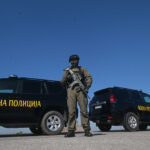
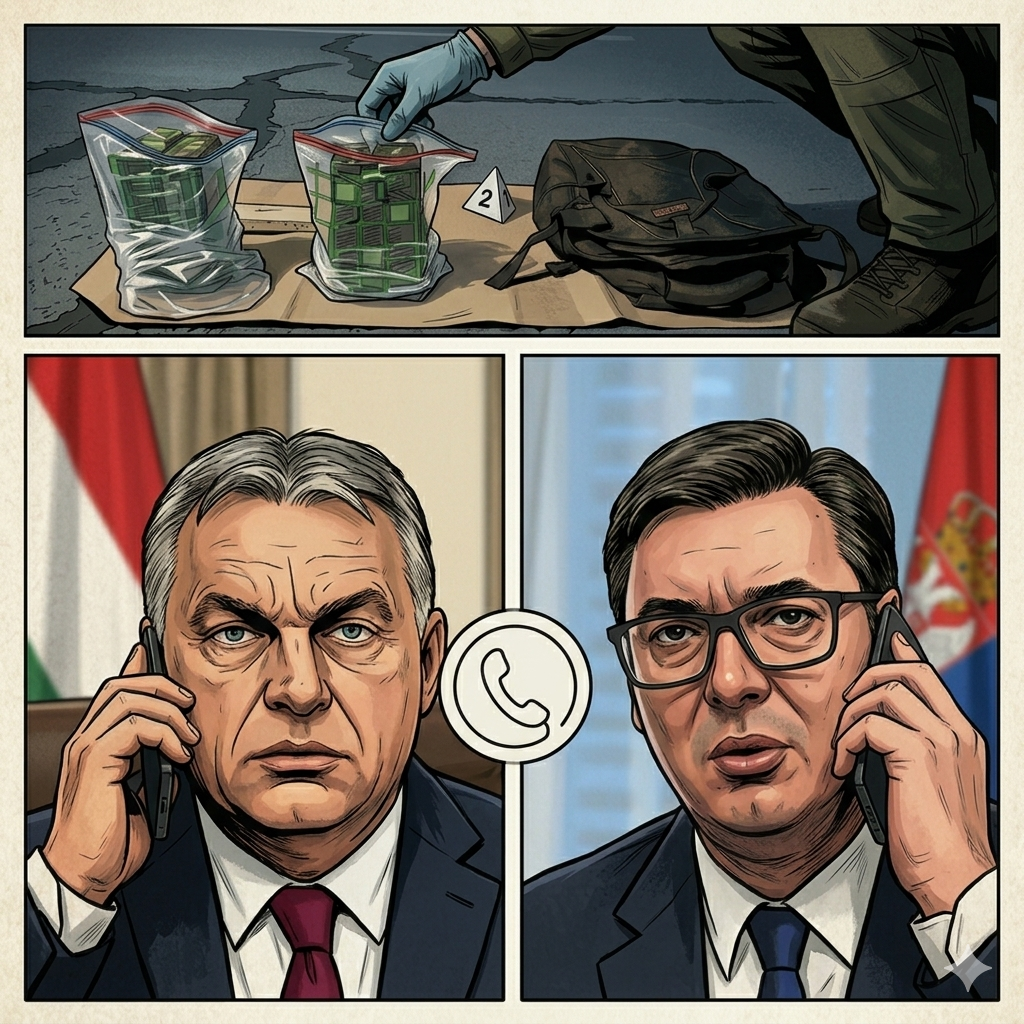
- Explosives found near a gas pipeline in Serbia
Two backpacks containing explosives and detonators were found on 5 April during a patrol a few hundred meters from the Balkan Stream gas pipeline, the continuation of TurkStream, near the town of Kanjiža in the autonomous province of Vojvodina in northern Serbia, not far from the border with Hungary. It is through this pipeline that Russian gas is transported to Hungary.
Serbian President Aleksandar Vučić immediately called Hungarian Prime Minister Viktor Orbán to inform him of the dangerous discovery. After that, the head of the Hungarian government convened an emergency meeting of the Defence Council.
In a video address published on his official channels, Orbán stated: “According to the available information, an act of sabotage was being prepared.” The Hungarian prime minister also added: “Ukraine has been trying to cut Europe off from Russian energy for years.” He made no direct accusations.
Hungarian Foreign Minister Péter Szijjártó called the incident “an attempted terrorist attack” and stated: “This fits into the Ukrainians’ efforts to disrupt the supply of Russian energy resources.”
The head of Serbia’s Military Security Agency (Vojno-bezbednosna agencija, VBA), Đuro Jovanić, rejected the version of Ukraine’s involvement, calling it disinformation. He also added that the markings on the explosives are American, but this does not mean that the manufacturer is the one who ordered or carried out the operation.
The spokesperson for the Ministry of Foreign Affairs of Ukraine, Heorhii Tykhyi, stressed that Ukraine “has absolutely nothing to do” with the events in Serbia, suggesting that this could be “a Russian false-flag operation” in the context of Moscow’s interference in the elections in Hungary.
The incident involving the discovered explosives occurred a week before the parliamentary elections in Hungary on 12 April. Hungarian opposition politician Péter Magyar is convinced that the attempted sabotage “looks like a provocation.” He also added that “several people publicly warned that something would ‘accidentally’ happen on the gas pipeline in Serbia at Easter, a week before the elections.”
The Serbian authorities officially stated that the investigation is considering the version of the involvement of “individuals from a group of migrants” who “have military training.” The investigation is ongoing.
- Serbia’s ruling party won the local elections
The Serbian Progressive Party (SNS) won the local elections in all ten municipalities where voting took place. President Aleksandar Vučić called the “10:0 result” confirmation of stability and trust in the authorities.
The ruling party received its strongest support in Kladovo, where 72% of voters cast their ballots for it. In Majdanpek the result was 66%, in Lučani 64%, and in Sevojno 52%.
Despite the overall victory of the pro-government party, several strategically important municipalities recorded a noticeable rise in support for opposition forces. In Kula, the pro-government list received 50.5%, while the opposition alliance received 48%, indicating a minimal gap. In Bor, the “Student List” achieved an unexpectedly high result, receiving 40.3%, while the SNS got 49.2%. In Smederevska Palanka, the youth movement “Youth for Palanka, alone against everyone” became the second political force with a result of about 30%, while the bloc around the SNS won 58%.
According to reports by independent Serbian and international observers, the electoral process was accompanied by numerous violations. In various municipalities, cases were recorded of organized transportation of voters, pressure on them, and the use of administrative resources. Observers also reported schemes involving pre-marked ballots, known as the “Bulgarian train.” In Kula, groups of masked people were recorded obstructing the work of journalists and observers, as well as incidents involving the use of force. In Belgrade and Novi Sad, illegal call centers linked to voter mobilization were discovered, which, according to analysts, may have affected turnout and the results.
For his part, the day after the vote President Vučić stated that the authorities possess evidence of interference by “one of the neighboring countries” in the electoral process. He said that he receives daily reports from the security services regarding the activities of foreign intelligence agencies on Serbian territory and promised to publish detailed findings soon. Commenting on journalists’ questions about the alleged presence of vehicles with Croatian license plates on voting day in Kula, Vučić said that the “logistics of the neighboring country” had become clear to him and that he expected an expanded report from the Military Security Agency (VBA) and the Security and Intelligence Agency (BIA).
- Croatia canceled the regional summit
On 30 March, Croatian President Zoran Milanović announced the cancellation of this year’s Brdo-Brijuni summit, which was supposed to take place in May in Croatia, because, as he said, there were no conditions for Serbian President Aleksandar Vučić to come. There are no conditions for the Serbian president’s visit to Croatia, Milanović said, explaining this by saying that Vučić’s recent statements undermine peace and stability in the region.
Croatia and Slovenia, as members of the European Union, initiated the Brdo-Brijuni process 13 years ago with the aim of strengthening mutual cooperation and accelerating the European integration of the Western Balkans. But, as the office of the Croatian president stated, the recent political statements and actions of Serbian President Aleksandar Vučić “completely contradict the goals of the Brdo-Brijuni process, undermine interstate relations, and threaten peace and stability in South-East Europe,” and therefore under such circumstances “the visit of the President of the Republic of Serbia Aleksandar Vučić to the Republic of Croatia is impossible.”
In response to Zagreb’s decision, the President of Serbia said that Milanović could have called “his friends from Pristina and Tirana” instead of canceling the summit, hinting at the military agreement concluded last year by Croatia, Albania, and Pristina. As reported, Vučić recently accused Croatia, Albania, and Kosovo of preparing an attack on Serbia, and before that repeatedly claimed that the trilateral agreement on cooperation in the field of defense amounted to a military alliance against Serbia.
The Serbian president also accuses Croatia of interfering in Serbia’s internal affairs — of supporting the opposition, preparing a “color revolution,” and also of “possible influence” on the local elections.
The European Union expressed regret over the cancellation of the Brdo-Brijuni summit. “Good neighborly relations are the foundation of the European integration process and an important part of Serbia’s path to the EU,” said Guillaume Mercier, spokesperson for the European Commission. He added that they contribute to stability, reconciliation, and a climate conducive to resolving outstanding bilateral issues.
- Serbia extended its gas contract with Russia
On 30 March, Serbian President Aleksandar Vučić announced that Belgrade had received another three-month extension of its gas contract with Moscow on very favorable terms. According to Vučić, he discussed this by phone with Russian President Vladimir Putin. “We spoke literally about all areas, and what was extremely important for me… was that we got another three-month extension of the gas contract, under very favourable conditions,” Vučić said in an address. According to him, Serbia receives gas “under flexible conditions,” and the price will continue to be determined according to the oil formula. Vučić stressed that the country “will probably be second in Europe with the lowest gas price after Belarus.”
The president drew a comparison with prices on the market: “Today gas costs somewhere around 645 dollars per 1,000 cubic meters on the stock market… and we are essentially paying from 320 to 330 dollars.” He specified that the extension provides for the delivery of six million cubic meters of gas per day, with the possibility of increasing the volumes in case of cold weather or emergencies.
Vučić’s announcement of the contract extension came a day before the previous gas agreement expired.
At present, Russian gas accounts for more than 80% of Serbia’s market. Belgrade buys Russian gas from Gazprom. In May 2022, the parties agreed on a new three-year contract with a price bound to the so-called “oil formula.” After the end of that period, Belgrade and Moscow moved to the practice of short-term extensions — usually for three months. Experts believe that this approach is explained by the Kremlin’s desire to retain leverage over the Serbian leadership.
- Early elections in Serbia may take place on 31 May
Serbian President Aleksandar Vučić announced the possibility of holding snap parliamentary elections in the country as early as late spring 2026. According to the head of state, under current legislation the nearest possible date for voting could be 31 May. At the same time, he stressed that the latest possible date for the vote is March next year, but in that case the elections would already be considered regular.
Vučić said that he seeks to fulfill his previous promises to citizens regarding the renewal of the parliament composition. He argued his position as follows: “The earliest parliamentary elections can be scheduled for the end of May, 31 May, and no later than March next year. If they are scheduled for March next year, then they will not be snap elections, but regular ones. I promised people that I would call them earlier, and I will make sure that they take place by the end of the year.”
The process of preparing for a possible vote is accompanied by active consultations with the country’s political forces. Vučić stressed that he initiated these talks in order to discuss the demands of the protesters and the opposition for early voting, as well as to coordinate Serbia’s foreign policy course against the backdrop of global instability.
Explaining the need for dialogue, the Serbian leader stated: “I am once again giving parties the opportunity to come and express their views, and perhaps also hear something about the current global situation and everything we are facing. I invited political parties to consultations because I believe that humanity stands on the edge of the abyss and because Serbia needs serious decisions.”
Despite the calls for dialogue, part of the opposition, in particular the Green-Left Front, refused to take part in the meetings. Opposition representatives claim that the president’s proposal is not a sincere attempt to overcome the social divide, and that consultations should take place within the walls of parliament, not in the residence of the head of state.
- Kosovo headed by an interim president
On 4 April, Kosovo President Vjosa Osmani officially transferred powers to Speaker of Parliament Albulena Haxhiu, who will serve in an acting capacity until a new head of state is elected. The ceremony took place after the completion of Osmani’s five-year term and against the backdrop of parliament’s inability to elect a new president.
The latest political crisis in Kosovo began on 5 March, when parliament failed to elect the head of state. For the vote to succeed in the first two rounds, the presence of at least 80 deputies out of 120 is required for a quorum, but the opposition forces — the Democratic Party of Kosovo (PDK, Partia Demokratike e Kosovës) and the Democratic League of Kosovo (LDK, Lidhja Demokratike e Kosovës) — boycotted the session. The opposition is demanding that a compromise candidate for president be nominated, someone capable of uniting society, rather than a representative of the ruling party.
On 6 March, Vjosa Osmani signed a decree dissolving parliament, stating that the legislature had failed to fulfill its constitutional duty. However, Prime Minister Albin Kurti and his party Self-Determination (LVV, Lëvizja Vetëvendosje) challenged this step. On 25 March, the Constitutional Court ruled that Osmani’s decree had been premature. The judges took into account that the current composition of parliament had only been elected on 28 December 2025, and that deputies must have sufficient time to exercise their functions. The Court set a new deadline for the presidential election — 28 April 2026.
At present, intensive consultations are underway between the ruling coalition and the opposition regarding the candidacy of the future president. If the president is not elected by 28 April, parliament will be dissolved, and Kosovo will face another snap general election.