- The United States did not grant permission for NIS to continue operating
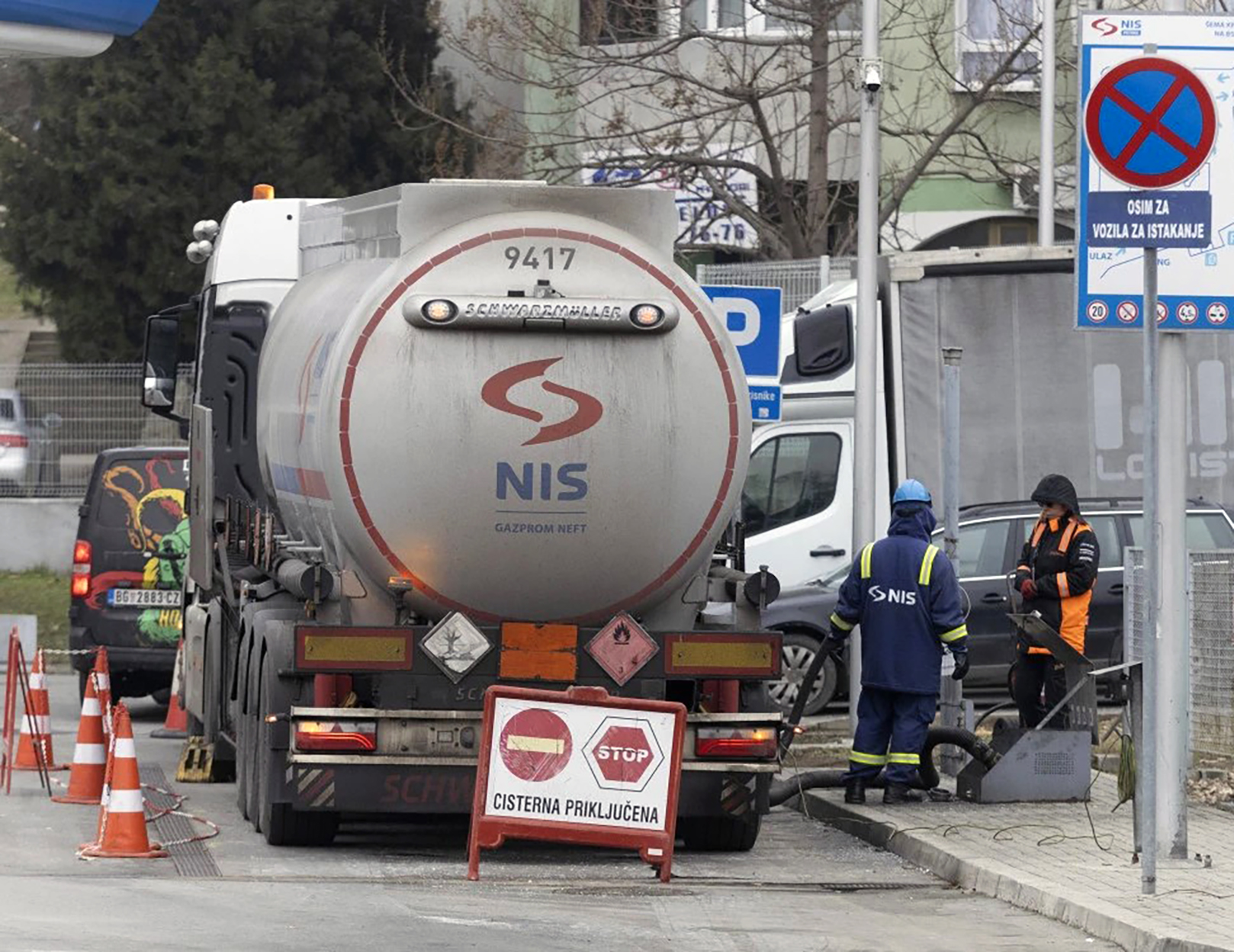
The sanctioned “Oil Industry of Serbia (NIS), whose majority stake is owned by Russian companies, failed to receive a positive response to its request to the Office of Foreign Assets Control (OFAC) of the U.S. Department of the Treasury regarding the issuance of a special license intended to ensure the uninterrupted operation of the company, primarily the oil refinery in Pančevo. “I am disappointed. We did not receive a positive decision from the United States,” President of Serbia Aleksandar Vučić stated on 2 December.
Due to the lack of permission from the United States, the Pančevo refinery has begun shutting down operations. More than 300 NIS petrol stations, accounting for more than one-fifth of all petrol stations in Serbia, are under threat of closure.
However, Vučić urged citizens not to panic, because, according to him, the state had prepared for the crisis in advance. He noted that stocks of all types of fuel (petrol, diesel, etc.) would last until the end of January.
Official Belgrade has given Russia time until 15 January to sell NIS, after which “the state of Serbia will intervene,” Vučić said, without specifying what actions Serbia would take.
The Secretary General of the Association of Oil Companies of Serbia, Tomislav Mićović, told RTS that any solution for NIS must lead to the activation of processing at the oil refinery in Pančevo. “This is an excellent opportunity to return ownership of the refinery to Serbian hands,” Mićović said.
One of the opposition leaders, the President of the Party of Freedom and Justice, Dragan Đilas, believes that the state must immediately establish control over NIS. “Serbia should not wait any longer and must immediately take over the management of NIS,” he stated.
- Foreign assets of Lukoil continue operating, including in the Balkans
The U.S. administration has extended permission (a license) for foreign subsidiary companies of Lukoil to operate until 29 April next year.
The United States imposed sanctions on Lukoil and Rosneft on 22 October 2025 as part of its policy of pressure on Russia’s energy sector. The goal is to reduce the Kremlin’s ability to finance the war against Ukraine and to undermine its revenues. The sanctions were announced due to the “lack of serious Russian commitment to the peace process.”
The U.S. Department of the Treasury (OFAC) explained its decision to extend the license by the need to “mitigate harm to consumers and suppliers” around the world who rely on Lukoil’s retail network, and to provide the company with time to carry out the sale of its international assets to non-sanctioned parties, which would facilitate Lukoil’s “orderly exit” from regional markets while preventing the transfer of any profits to Russia.
The continuation of operation of Lukoil petrol stations became good news for Serbia, which faced an energy crisis following the shutdown of the only oil refinery in Pančevo due to U.S. sanctions against the Oil Industry of Serbia (NIS), controlled by Russian companies. President of Serbia Aleksandar Vučić stressed that now “112 petrol stations on the territory of Serbia will be able to operate with petroleum products imported from abroad.”
In Croatia and Montenegro, Lukoil has a less critical but notable presence in the retail fuel market, which relies heavily on imports. In Croatia, the network numbers around 50 petrol stations, and in Montenegro – 10 petrol stations.
Branches in both countries import fuel mainly from Greece and – in Montenegro – from Croatia, rather than from Russia. Thanks to this, they are protected from secondary sanctions targeting Russian energy products to some extent, but their ability to conduct international financial transactions had been at risk.
- Bosnia and Herzegovina prepares to diversify gas supply sources and routes
At the beginning of December, the EU Council and the European Parliament reached a preliminary agreement on a regulation for the gradual cessation of imports of Russian natural gas. In this way, a legally binding phased ban is introduced on the import of both liquefied natural gas (LNG) and pipeline gas from Russia, with a full ban from the end of 2026 and autumn 2027 respectively.
The preliminary agreement must be approved by the EU Council and the European Parliament before it is formally adopted.
The regulation is a central element of the EU’s REPowerEU roadmap to overcome dependence on Russian energy after Russia turned gas supplies into a weapon, which had a significant impact on the European energy market, according to the official press release.
The EU decision will have an indirect effect on Bosnia and Herzegovina, which for almost half a century has been completely dependent on imports of Russian gas. In the near future, BiH will face the necessity of diversifying sources and routes of natural gas supply.
Since April 2021, Bosnia and Herzegovina has been receiving gas from Russia through TurkStream / Balkan Stream. According to the EU regulation, Bulgaria, as a transit country, must in two years’ time cease the transportation of Russian gas through its territory.
Currently, the main project for building alternative gas import routes is the Southern Gas Interconnector, through which Bosnia and Herzegovina will be connected to the Croatian network and the liquefied natural gas terminal on the island of Krk, where approximately 60 percent of the gas comes from the United States, and the rest – from the Middle East. The project’s cost is estimated at 2 billion euros.
Over the past two months, U.S. officials, including Deputy Secretaries of State, Ministers of Energy and Natural Resources, as well as members of Congress, have held a series of meetings with the authorities of Bosnia and Herzegovina to discuss the project.
Construction of the Southern Interconnector, which will become the first major direct American investment in the energy sector in this part of Europe, could begin as early as next year.
John Ginkel, Chargé d’Affaires at the U.S. Embassy in Bosnia and Herzegovina, expressed full support for the project.
“The Trump administration has emphasized two critical truths: the world will continue to run on oil, gas, and coal; and every molecule of Russian gas purchased in Europe funds Russia’s war machine.
Bosnia and Herzegovina depends on Russia for 100 percent of its gas, and this supply is not reliable. The European Union is banning Russian gas on its single market, and Bulgaria has announced that it will stop the transit of Russian gas through its territory by 2028. When that happens, BiH will need a new source of gas, while its neighbors will be trying to do the same. With only one current connection for receiving gas imports, BiH will find it difficult to secure alternative gas supplies or to book pipeline capacity. But there is a definite solution – the Southern Interconnector pipeline. This project will enable Bosnia and Herzegovina to purchase reliable and affordable liquefied natural gas (LNG). …The Trump administration is ready to act quickly to support the Southern Interconnector. Now the leaders of Bosnia and Herzegovina must advance this vital project. Let us work together to bring it to the finish line,” Ginkel wrote in an article published by the U.S. Embassy on social media.
- The European Commission has approved the Reform Agenda of Bosnia and Herzegovina
“The Commission concluded that the Reform Agenda, submitted on 30 September 2025, is aligned with the objectives of the Regulation on the Growth Facility,” the press release states.
This decision makes it possible to allocate up to 976.6 million euros to Bosnia and Herzegovina under the EU Reform and Growth Facility.
“It is now for Bosnia and Herzegovina to swiftly sign and ratify both the Facility Agreement and Loan Agreement. The allocation of funding to Bosnia and Herzegovina, including pre-financing, can only start once these agreements enter into force and all conditions are fulfilled.,” the press release states.
Bosnia and Herzegovina was the last country in the region to submit its Reform Agenda, and it has already lost access to 108 million euros due to failure to meet the initial deadline. After a prolonged delay, the Council of Ministers of Bosnia and Herzegovina adopted the document on 30 September.
- The return of Serbian mayors to northern Kosovo did not secure the lifting of EU sanctions against Pristina
On 5 December, in the four northern municipalities of Kosovo – North Mitrovica, Zvečan, Zubin Potok, and Leposavić – newly elected mayors representing the Serbian community officially took office. This was the result of local elections held in October 2025. After the elections, the leading party of Kosovo Serbs, the Serbian List, regained control over the northern municipalities. In this way, a two-year period of tension ended, during which the municipalities in the north had been governed by Albanian mayors elected amid a Serbian boycott and extremely low turnout.
The return of Serbs to municipal offices was one of the key demands of the international community for de-escalation in Kosovo and one of the reasons for the EU’s sanctions against Pristina. However, despite the fact that the official transfer of power to the elected representatives of the Serbian community finally took place in the north, the European Union did not lift the restrictive measures. The European External Action Service notes that the restrictive measures were introduced not only because of the issue of local mayors, but as a response to the overall lack of progress in the normalization of relations with Belgrade. The EU emphasizes that the sanctions are comprehensive, and that in order for them to be fully lifted, the government of Albin Kurti must demonstrate systemic steps: from the return of Serbs to the police and the courts, to the beginning of real work on the Association of Serbian Municipalities.
Behind the scenes in Brussels, intense debates continue on this issue, as EU unity on the Kosovo question has somewhat weakened. The EU High Representative for Foreign Affairs and Security Policy, Kaja Kallas, together with a group of more than ten member states, advocates for the immediate lifting of restrictions, believing that Pristina fulfilled its commitments regarding the holding of elections. However, this decision is actively opposed by an influential bloc of countries led by France and Italy, supported by Spain, Hungary, and Slovakia. These states insist on a “phased” approach, fearing that premature lifting of pressure would encourage the Kosovo authorities to take new unilateral steps in the north, which could provoke escalation.
The further fate of the sanctions will likely depend on the results of the EU Council meeting in the second half of December. For now, Brussels has chosen a wait-and-see approach in order not to grant the government of Albin Kurti additional pre-election advantages ahead of the upcoming parliamentary elections in Kosovo, scheduled for 28 December.