- Kosovo Parliament leadership elected and Kurti-3 government appointed
Albulena Haxhiu was elected Speaker of the Parliament of Kosovo. The candidate from the Self-Determination Movement (Lëvizjes Vetëvendosje) received 66 votes “in favour” and 44 “against.” 8 deputies out of the 118 present abstained from voting.
The elected Deputy Speakers of Parliament are Ardian Gola from the Self-Determination Movement (Lëvizjes Vetëvendosje), Vlora Çitaku from the Democratic Party of Kosovo, Kujtim Shala from the Democratic League of Kosovo, Emilja Rexhepi from the multi-ethnic group, and Slavko Simić from the Kosovo Serb party “Srpska lista.”
The decisions were adopted on 11 February, on the first day of work of the Parliament of Kosovo elected in the snap elections of 28 December 2025.
On the same day, the Parliament of Kosovo elected a new government, headed for the third time by Albin Kurti, the leader of the Self-Determination Movement. 66 deputies voted in favour, 49 against, and nobody abstained.
Last year, the Parliament of Kosovo elected in February 2025 failed to form a government, which led to the announcement of snap elections.
“After more than a year of political deadlock, the formation of Kosovo’s new government is encouraging news. Congratulations to Albin Kurti! What matters now that it moves swiftly on reforms. This is the fastest way to unlock EU support worth hundreds of millions of euros and have progress on its EU path. This is a new momentum to advance on EU-Kosovo relations and the Belgrade-Pristina dialogue.,” wrote Kaja Kallas, the EU High Representative for Foreign Affairs and Security Policy, on the X platform.
- A repeat vote in Republika Srpska brought a final victory to Dodik’s party’s presidential candidate
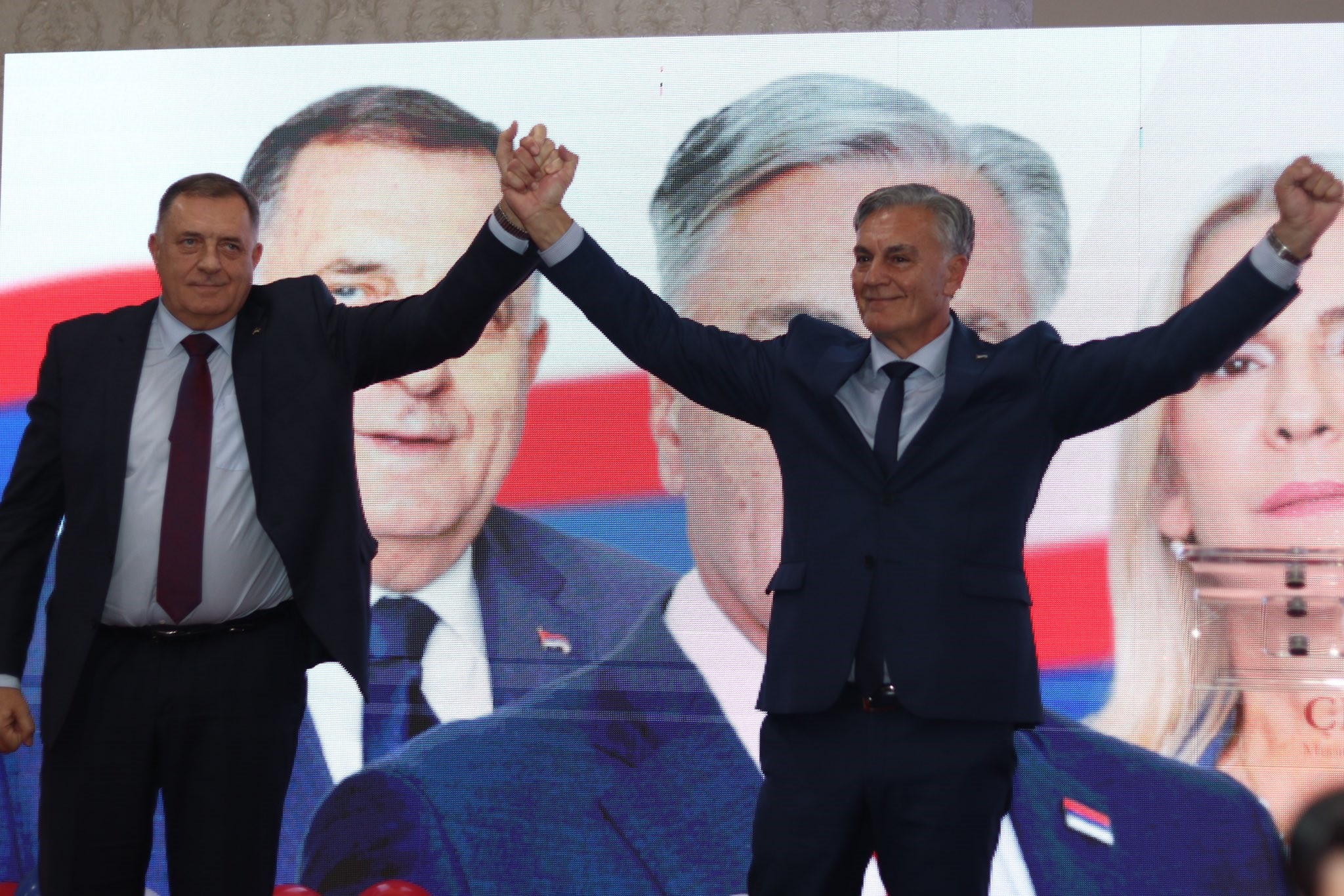
Siniša Karan, the candidate of Milorad Dodik’s Alliance of Independent Social Democrats (SNSD), became the winner of the early election for President of Republika Srpska.
According to data from the Central Election Commission of Bosnia and Herzegovina, Karan received more than 50.5 percent of the vote. The candidate of the opposition Serbian Democratic Party (SDS), Branko Blanuša, received nearly 48.1 percent.
The early election for President of Republika Srpska was called after Milorad Dodik was stripped of the RS presidency mandate in August 2025 due to a court verdict that barred him from holding public office for defying the decisions of the High Representative. The vote took place on 23 November 2025, and, according to the preliminary results, Karan won the RS presidential election with a margin of more than 9,500 votes over Blanuša. However, opposition parties filed a number of complaints about violations, which the Central Election Commission of Bosnia and Herzegovina upheld, scheduling repeat voting at some polling stations. The repeat vote took place on 8 February at 136 polling stations in 17 municipalities of Republika Srpska and in the Brčko District.
Karan’s victory changes practically nothing in the political reality of Republika Srpska — Dodik’s team remains in power, and Dodik himself retains control over all political processes in RS.
Siniša Karan will remain in the position of President of RS until October this year — until the end of Milorad Dodik’s term. New elections for President of Republika Srpska will be held simultaneously with the general elections in Bosnia and Herzegovina in October this year.
- North Macedonia and the United States agreed on a Framework Trade Agreement
The United States and North Macedonia agreed on a Framework Agreement on reciprocal, fair and balanced trade. “The Agreement will strengthen our trade relationship, support shared strategic interests, promote economic growth, and deepen our transatlantic partnership,” a White House statement on 12 February said.
According to the agreement, North Macedonia will abolish tariffs on all industrial and agricultural goods from the United States. On the other hand, the United States will keep tariffs at the level of 15%, but will identify goods for which tariffs with a zero rate will be introduced.
“It is important to be precise: the United States will keep the reciprocal tariff of 15 percent on goods originating from our country, while — and this is the essence of the success — goods will be identified to which reciprocal tariffs with zero percent will apply. In other words, for certain key industries and goods, tariffs will be reduced to zero,” explained North Macedonia’s Minister of Foreign Affairs Timčo Mucunski.
The Framework Agreement also states that North Macedonia will begin purchasing American liquefied natural gas after the construction of a new gas interconnector with Greece is completed. North Macedonia began construction of its section of the gas pipeline in July 2025.
In a Facebook post, Minister Mucunski called the agreement an important and significant step forward in economic cooperation with the United States, which is of great importance for the Macedonian economy and from which Macedonian companies will benefit.
Ambassador Jamieson Greer, the U.S. Trade Representative, said after the publication of the Framework Agreement that “President Trump’s trade agenda is deepening transatlantic ties with a key partner in the Balkan region.”
In April 2025, when Trump introduced reciprocal tariffs, North Macedonia was among the countries hit the hardest. Initially, the United States introduced a 33-percent tariff on goods from North Macedonia, but after Skopje announced a plan to fully abolish tariffs on imports from the United States in order to win Trump’s favour, it was reduced to 15 percent.
- Croatia, Albania and Kosovo are planning the first trilateral exercises
In Shkodër (Albania) on 11 February, a meeting took place between the Commander of the Kosovo Security Force (KSF) Bashkim Yashari and the Chiefs of the General Staff of the Armed Forces of Albania Arben Kingji and of Croatia Tihomir Kundid. Croatia, Albania and Kosovo agreed on military cooperation in March of last year, signing a memorandum.
The meeting in Shkodër “was an important step in strengthening regional cooperation and strategic coordination in the field of security and defence” and “confirmed a shared commitment to peace, stability and sustainable security in the region,” the KSF said. “General Yashari, General Kingji and General Kundid held an open and constructive discussion on current security challenges, deepening military cooperation, increasing interoperability and developing defence capabilities in line with Euro-Atlantic standards,” the Kosovo Security Force stressed.
The KSF called the trilateral defence initiative “an example of a strong partnership and a shared vision of a safer and more stable region.” At the meeting, “readiness to expand cooperation through joint exercises and training, exchange of experience and strategic coordination” was emphasized “to counter security challenges and hybrid threats.”
Albania’s Minister of Defence Pirro Vengu (Pirro Vengu) emphasized that after the meeting in Shkodër he expects more military cooperation, more interoperability, and more operational readiness.
According to Vengu, “in 2026 the first trilateral exercises will take place in accordance with NATO’s Strategic Concept and Euro-Atlantic objectives.”
***
The Ministry of Defence of the Republic of Serbia “strongly condemned” the trilateral meeting of representatives of Tirana, Zagreb and Pristina, “aimed at deepening military cooperation and coordination, including specific plans and measures of a security nature.” “Such actions are blatant disregard and a gross violation of UN Security Council Resolution 1244 and the Kumanovo Military-Technical Agreement. Kosovo and Metohija is an integral part of the Republic of Serbia under temporary UN administration, and KFOR is the only legitimate armed formation on the territory of Kosovo and Metohija with a clearly defined mandate,” the statement emphasizes.
Serbia’s Ministry of Defence also emphasized that “attempts to further institutionalize and strengthen the so-called Kosovo Security Force through regional military arrangements are a direct blow to the international legal order and a serious threat to peace and stability in the region.” Such steps, the ministry notes, “may lead to long-term security consequences and destabilization of the situation in the Western Balkans.” “The Republic of Serbia considers this military alliance a factor of pressure and a security challenge for Serbia and the Serbian people in Kosovo and Metohija,” the statement stresses.
***
NATO Deputy Secretary General Radmila Šekerinska, answering journalists’ questions about the recent meeting of representatives of the defence institutions of Croatia, Albania and Kosovo and the announcement of the first joint military exercises, as well as about the reaction of Serbia’s Ministry of Defence, said that Albania and Croatia contribute to regional stability. “Albania and Croatia are not only reliable and valuable Allies within the Alliance. They are also important contributors to regional peace and stability,” Šekerinska said, recalling that Albanian and Croatian troops participate in NATO’s mission in Kosovo, KFOR.
She added that NATO did not take part in discussions or consultations regarding the declaration on cooperation in the field of defence that Zagreb, Tirana and Pristina signed in March of last year, but NATO membership does not prevent countries from having additional defence agreements with third parties.
- Court in The Hague seeks 45-year prison sentences for each of four former Kosovo Liberation Army leaders
The final stage of the trial of the former leaders of the Kosovo Liberation Army, known as the KLA (Ushtria Çlirimtare e Kosovës, UÇK), began at the Specialist Chambers in The Hague.
Before the court are former President of Kosovo Hashim Thaçi, former Speakers of parliament Kadri Veseli and Jakup Krasniqi, as well as former MP Rexhep Selimi, who during the 1998–1999 war were leaders of the KLA.
The Specialist Prosecutor’s Office insists that the former leaders of the Kosovo Liberation Army are guilty on all counts. The Chief Prosecutor is seeking 45 years of imprisonment for each of the four accused.
All four defendants plead not guilty. Throughout the process, they claimed that their actions were aimed at protecting the civilian population from Serbian repression, and that the KLA structure was not so centralized that they could bear responsibility for every individual incident on the ground.
The Kosovo Specialist Chambers in The Hague (Kosovo Specialist Chambers) are a court and prosecution office that formally belong to Kosovo’s justice system. The institution’s work is funded by international donors, and the positions of judges and prosecutors are held exclusively by foreigners.
The Specialist Chambers were created under pressure from the country’s Western allies, who believed that Kosovo’s justice system was not sufficiently reliable to handle cases related to the KLA and to protect witnesses. Many Kosovo Albanians believe that the court is biased. In Pristina and Tirana, rallies in support of the accused KLA leaders have been held repeatedly.
***
On 12 February, the parliaments of Kosovo and Albania adopted declarations in support of the former leaders of the Kosovo Liberation Army.
The Parliament of Kosovo appealed to the Specialist Chambers in The Hague with a request to “ensure strict implementation of constitutional and international standards relating to a fair and impartial trial, while adhering to the principles of transparency, accountability and strengthening public trust in justice” and to ensure “full implementation of constitutional and international rights related to the protection of the fundamental rights of the defendants, including obligations arising from the European Court of Human Rights.”
In its resolution, the Parliament of Albania emphasized that the punishment proposed by the Specialist Prosecutor’s Office “risks creating a dangerous distortion of history, equating the legitimate struggle of a people for survival and freedom with the crimes of the Serbian Milošević regime, which committed ethnic cleansing and crimes against humanity against the people of Kosovo.”
- Sentences handed down to participants in hybrid “Balkan training camps”
A court in Moldova’s capital delivered a verdict on 6 February against three citizens of the country for participation in training camps that operated in 2024 on the territory of Bosnia and Herzegovina and Serbia.
During the announcement of the verdict at the Chișinău City Court, it was reported that Aliona Goțco, Liudmila Kostenko and Volodymyr Kharchevnikov received prison terms ranging from four to almost five and a half years.
None of them was present in the courtroom. Arrest warrants were issued for all three.
An appeal against the verdict may be filed within two weeks, and the court has two months to issue a decision on the appeal.
In September 2024, Moldovan security services obtained data indicating that citizens of the country were undergoing training in camps in Bosnia and Herzegovina and Serbia. At a joint press conference, the police and the Information and Security Service (SIS) stated that the camps were allegedly run by Russian instructors.
According to representatives of the security services, the purpose of the trainings was to create unrest during the presidential elections and the referendum on Moldova’s accession to the EU — a vote whose positive outcome would run counter to Russia’s interests.
A month after these data were made public, Moldovan police carried out a large-scale operation during which they detained several hundred persons linked to training in the Balkans and in Russia.
The accused first appeared before the court in spring 2025. Although they did not admit guilt in preparing unrest, all three confirmed that they had been in a camp in Bosnia and Herzegovina.
Despite testimonies and evidence, politicians from Republika Srpska — in particular Milorad Dodik, Nenad Nešić and Nenad Stevandić — continue in their statements to deny the existence of such camps. The Embassy of Russia in Bosnia and Herzegovina adheres to the same position.
Meanwhile, the investigation into Russian training camps in Bosnia and Herzegovina being conducted by the country’s prosecutor’s office continues.