- Albania and Kosovo plan to send troops to Gaza as part of Trump’s Board of Peace plans
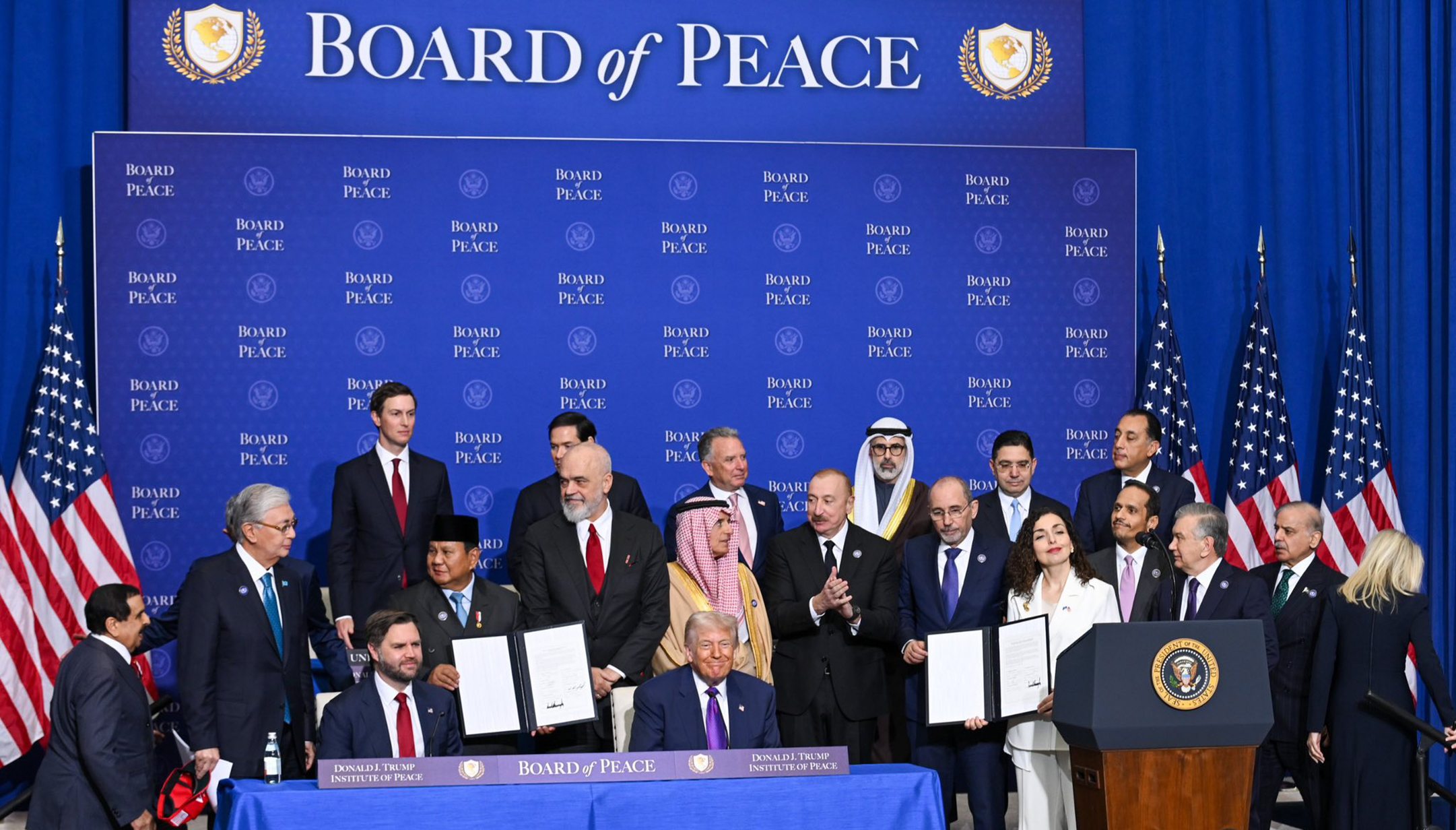
On 19 February in Washington, the inaugural meeting of the “Board of Peace” was held under the chairmanship of Donald Trump, attended by representatives of more than 40 countries and observers from a dozen others.
At the meeting, the launch of international stabilization forces was discussed, whose task will be to monitor borders, support security, and demilitarize Gaza. Albania and Kosovo, together with Indonesia, Morocco, and Kazakhstan, were among the five countries that agreed to send their military contingents to the Gaza Strip.
President of Kosovo Vjosa Osmani noted that participation in the Board side by side with countries that have not yet recognized Pristina’s independence (in particular, Morocco and Kazakhstan) is a historic chance to strengthen the country’s international status. In addition, the participation of the Kosovo Security Force (KBS) in the mission together with the United States and other allies “will be an extraordinary opportunity for their professional growth,” Osmani emphasized in an interview with journalists.
EU Commissioner for the Mediterranean Dubravka Šuica (Dubravka Šuica), a member of the Croatian Democratic Union (HDZ), was in Washington as an observer.
France, Belgium, Spain, Ireland, Slovenia, Sweden, and Portugal were among the EU member states that objected to the participation of the Commissioner in the meeting.
The Social Democratic, liberal, and “green” groups of the European Parliament, in a letter sent on 20 February to Commission President Ursula von der Leyen, called the European Commission’s decision to send an EU Commissioner to the Peace Board meeting “a serious mistake,” adding that the Commission did not have a mandate to take such a decision. The leaders of the parliamentary groups stated that the Commission’s presence gave the Peace Board visibility and legitimacy, while weakening the authority of the United Nations.
However, European Commission spokespersons emphasized that Šuica was present to take part “in a broader discussion to ensure a safe future for Gaza and the Palestinians,” and that the EC “has the right to accept invitations of this kind.”
Albanian Prime Minister Edi Rama, commenting on critical remarks from Europe, said: “Many in Europe say that the Board of Peace aims to replace the United Nations. It does not look to me like an attempt to replace the UN, but if it helps shake this giant that is in agony and wake it up — then God bless the Board of Peace.”
Trump used the meeting in Washington to talk about his success in mediating peace talks between hostile states, citing Kosovo and Serbia as an example. “One example: Kosovo and Serbia. I did that,” Trump said, calling on Belgrade and Pristina to call him in case that they do not get along with each other. (During Trump’s first term as President of the United States, the leaders of Serbia and Kosovo signed the Washington Agreement at the White House, which was intended to establish economic cooperation and put an end to the conflict).
- Hungary and Slovakia demand that Croatia allow the transportation of Russian oil through the JANAF pipeline
Hungary and Slovakia have officially appealed to Croatia with a request to urgently allow the transportation of Russian oil through the Adriatic oil pipeline (JANAF). In a joint letter to Croatia’s Minister of Economy Ante Šušnjar, the Hungarian and Slovak sides emphasized that their EU sanctions exemption makes it possible to import Russian oil by sea in the event of disruptions in pipeline supply. Later, the Hungarian oil company MOL and its Slovak subsidiary Slovnaft, in a joint statement, emphasized that JANAF “must allow” the passage of Russian oil.
Hungary and Slovakia are the last EU countries that use Russian oil supplied by pipelines, and seek to continue doing so, given its lower price.
After, on 27 January, following a Russian strike, the transportation of oil through the Druzhba pipeline via the territory of Ukraine was stopped, the Hungarian oil company MOL concluded contracts to supply a large amount of oil from various countries, including Russia, by sea. The tankers are to deliver the cargo to a Croatian port, from which the Croatian pipeline operator JANAF has the ability to transport the oil to MOL refineries.
Croatia’s Minister of Economy Ante Šušnjar, on the eve of the MOL and Slovnaft statement, expressed the country’s readiness to help Hungary and Slovakia, but spoke out against continuing imports of specifically Russian oil. “We are ready to help resolve acute disruptions in accordance with EU legislation and EU rules and OFAC (the U.S. Office of Foreign Assets Control). No one should be left without fuel,” he emphasized, adding that Croatia has acted responsibly and transparently from the standpoint of regional energy security and will do so again for Hungary, with full respect for its Ukrainian allies and the daily suffering they are experiencing.
“A barrel bought in Russia may seem cheaper to some countries, but it helps finance the war and attacks on the Ukrainian people,” the minister noted.
- A second ministerial meeting dedicated to Corridor VIII was held in Tirana
The pan-European transport Corridor VIII, with a total length of 1,300 km of railway and 960 km of roads, begins in the Albanian port of Durrës on the Adriatic Sea (where ferries arrive from the Italian ports of Bari and Brindisi). From Durrës, the route passes through Tirana (Albania), Skopje (North Macedonia), and Sofia (Bulgaria). The final point is Bulgaria’s Black Sea ports — Varna and Burgas.
Following the meeting, representatives of Albania, Italy, Bulgaria, North Macedonia, and Romania signed a joint declaration that defines Corridor VII as a strategic “East–West axis connecting the Adriatic and Black Seas” and as key “for economic integration, military mobility, and security in South-Eastern Europe.”
On the eve of the meeting in Tirana, at the NATO defense ministers’ meeting on 12 February, Corridor VIII was included in the list of the Alliance’s critical infrastructure facilities. • The Declaration emphasizes that Corridor VIII is a priority for strengthening military mobility within EU–NATO cooperation, which directly contributes to the security of the “south-eastern and eastern flanks of the Alliance.”
A special place in the Declaration is given to the mention of Ukraine. Representatives of Albania, Italy, Bulgaria, North Macedonia, and Romania strongly condemned Russia’s aggressive war against Ukraine and reaffirmed support for international political and diplomatic efforts aimed at establishing a just and lasting peace.
- In Montenegro, all defendants in the 2016 “coup attempt” case were acquitted, including Russian citizens
The Apellate Court of Montenegro rejected the appeal of the Special State Prosecutor’s Office (SDT) and upheld the acquittal verdict of the High Court in Podgorica with regard to all defendants in the attempted coup of 2016. The court found that during the retrial in the High Court in July 2024, when the acquittal verdict was issued, no significant violations of criminal procedure were committed. After a lengthy consideration and secret deliberation, the Apellate Court concluded that the prosecution failed to prove the guilt of the defendants. Thus, the judges left in force the acquittal verdict that was issued after the change of power in Montenegro in 2020, when the politicians accused of organizing the coup attempt became part of the ruling coalition.
The verdict confirms the innocence of all figures in the case:
– Russian citizens Eduard Shishmakov and Vladimir Popov, whom the investigation called GRU officers;
– political figures Andrija Mandić, Speaker of the Parliament of Montenegro, and Member of the Parliament of Montenegro Milan Knežević, who in 2016 were leaders of the pro-Russian Democratic Front (DF),
– several citizens of Serbia, including former Serbian gendarmerie general Bratislav Dikić.
In its appeal, the Special Prosecutor’s Office insisted that Shishmakov and Popov organized a criminal network to finance and coordinate the coup. The prosecution argued that seized tactical equipment and the testimony of cooperating witness Saša Sinđelić are irrefutable evidence of preparations for a terrorist attack on 16 October 2016. The alleged aim of the conspiracy was to seize parliament and eliminate the then prime minister and leader of the Democratic Party of Socialists (DPS) Milo Đukanović, in order to stop Montenegro’s integration into NATO.
After the acquittal of all figures in the “coup attempt” case, the Democratic Party of Socialists, which is now in opposition, issued a harsh criticism of the decision of the Apellate Court.
“The acquittal verdict for all defendants in the case known as the ‘coup attempt’ is one of the most serious blows to the integrity of Montenegrin justice and raises a fundamental question — why Montenegrin courts assumed the main role in politically motivated distortion of the truth,” the DPS said, adding that “only Montenegrin justice did not see the attempted coup on the day of the 2016 parliamentary elections, on the eve of Montenegro’s accession to NATO.”
“Neither the nine defendants who pleaded guilty; nor the statement of the President of Serbia, who saw with his own eyes that great evil was being prepared in Montenegro; nor data from Western intelligence services about Russian agents Shishmakov and Popov, who ran the entire operation; nor the presence of former commander of the Serbian gendarmerie Bratislav Dikić in Montenegro immediately before the elections, on whose phone photos of state institutions and facilities of significance were found during his arrest; as well as the fact that the head of all Russian special services, Nikolai Patrushev, arrived in Serbia a few days after the elections in Montenegro to ‘shut up’ Aleksandar Vučić and ensure the evacuation of Shishmakov and Popov to Moscow — all of this was not enough for Montenegrin courts to see what scenario was being prepared for Montenegro in 2016,” the party statement said.
The DPS added that it does not intend to assess any individual responsibility, including the responsibility of Andrija Mandić and Milan Knežević. “Even when they were convicted at first instance, we did not comment on the decision of the High Court. But the fact that all the other defendants are acquitted, including two Russian agents, about whose activities world media wrote during upheavals in Moldova, Georgia, and Poland, and who are still active in service, is a dangerous signal. This will undoubtedly encourage tomorrow new terrorist groups to try to overthrow the constitutional order and forcibly seize the institutions of our state, expecting that in the end they will not bear responsibility for it,” the statement emphasizes.
- Prime Minister of Sarajevo Canton Nihad Uk resigned amid mass citizen protests after a deadly tram accident
The tragedy occurred on 12 February in the very center of Sarajevo near the National Museum of Bosnia and Herzegovina. A tram at high speed derailed and flew directly into a tram stop where passengers were at that moment. The impact was so strong that the protective fence of the stop was completely destroyed. As a result of the accident, a 23-year-old student from Brčko, Erdoan Morankić, was killed, and several more people sustained injuries, including heavy ones — doctors were forced to amputate the leg of a 17-year-old girl.
On 14 February, a day of mourning was declared in Sarajevo.
The tram driver was detained. The prosecution requested one month of detention for the tram driver, claiming that the cause of the accident was the “human factor.” During the hearing, the driver did not plead guilty and stated that the accident occurred due to a technical malfunction of the tram. The Cantonal Court of Sarajevo rejected the request of the Sarajevo Canton Prosecutor’s Office to remand him in custody.
The next day after the accident, hundreds of citizens, mainly young people, came out to a protest action at the site of the tragedy. Participants held photos of the deceased Erdoan and posters with the inscriptions: “It could have been us,” “We do not feel safe,” “Focus — safety, not politics.” Protesters are outraged that despite the recent reconstruction of the tracks, old, technically faulty trams (some of them over 50 years old) are still put on the line. Activists demanded not just punishment for the driver, but the resignation of the management of the transport company GRAS and concrete steps from the government of Sarajevo Canton regarding the renewal of rolling stock. In the following days, the protests continued.
Against the backdrop of the protests, Prime Minister of Sarajevo Canton Nihad Uk resigned. The director of the municipal public utility enterprise that provides urban public transport services also resigned. However, the organizers of the protests say that this is not enough.
On 21 February, the seventh civic protest over the deadly accident took place in Sarajevo, with several thousand citizens participating, among whom a large number of students and upper-grade school pupils. The protest participants, among other things, demanded the disclosure of the names of responsible persons and specific measures, including deadlines for resolving the problem of tram transport.
- The Italian side is optimistic about the prospects of cooperation between Rome and Tirana in the military-industrial sphere
Italy’s Ambassador to Albania Marco Alberti, in an interview with Albanian journalists, emphasized that after the agreement between KAYO and Fincantieri on the reconstruction of the Pashaliman naval base for the purpose of building naval vessels fully enters into force, new jobs will be created and an impetus will be given to the development of related industrial sectors. Although, according to the ambassador, “many are skeptical and ask whether this agreement will work,” he is confident that KAYO and Fincantieri will gradually achieve success.
The Albanian state defense company KAYO and the Italian shipbuilding giant Fincantieri, whose main owner is the state, signed an agreement to establish a joint venture specializing in naval production in November 2025. The agreement was formally concluded in the Albanian port of Durrës in the presence of Prime Minister Edi Rama and the defense ministers of Italy and Albania.
The agreement provides for the reconstruction of the Pashaliman naval base in the Bay of Vlorë, and its transformation into a modern shipyard where the production of naval vessels will be established.
The Pashaliman base was created in the 1950s by the Soviet Union as a submarine base. In the 1960s the facility was passed to Albania. In the early 1990s the base was in decline, but it was partially restored with Turkey’s assistance and is currently used by the navies of Albania and NATO.