- Operation against Iran in the comments and assessments of regional leaders
Against the backdrop of full-scale hostilities by the United States and Israel against Iran, the countries of the region are cautious in their assessments, although there are exceptions in the form of accusations of “violations of international law.” Some Western Balkan countries remain silent altogether.
Albania: Designation of the IRGC as terrorists
Prime Minister Edi Rama emphasized that Albania’s position is not only to support Israel or Arab countries seeking peace, and not merely aligned with the position of strategic allies, but also reflects the need for concrete action at a moment when, according to him, “actions are needed, not just statements.” In this context, he wrote on the X network that Albania will add the Islamic Revolutionary Guard Corps (IRGC) to the list of terrorist organizations, calling on other countries to follow the same course.
Rama recalled that Albania has directly suffered aggression from the Iranian regime, referring to cyberattacks directed at Albanian state institutions in recent years.
Kosovo: Unanimous support for the United States
The leadership of Kosovo unanimously supported the United States and strategic allies in efforts to maintain international peace, security, and stability. This was stated by the President of Kosovo Vjosa Osmani and the office of Prime Minister Albin Kurti.
North Macedonia: Cautious support for allies
Minister of Foreign Affairs Timčo Mucunski wrote on social media: “We stand together with our American allies in confronting destabilizing threats in the Middle East.”
Croatia: Different views within the government
President of Croatia Zoran Milanović sharply criticized the operation against Iran.
“Any unilateral use of military force that violates the international legal order is dangerous, as it threatens peace and global security not only today but also in the future. Military intervention without a mandate of the United Nations, which we are witnessing today in Iran, will not contribute to resolving the crisis, but provokes further escalation of the conflict and long-term instability,” he noted in his statement on 2 March.
In view of the escalation of the situation, Milanović issued an order for the immediate withdrawal of Croatian servicemen from missions in Iraq and Lebanon.
At the same time, Prime Minister Andrej Plenković, responding to journalists’ questions as to whether the U.S.-Israeli attacks on Iran comply with international law, noted that the United States and Israel stated at a meeting of the UN Security Council that peaceful negotiations regarding Iran’s nuclear program have been exhausted, and also that Israel perceives Iran and its nuclear program as an existential threat. He also condemned the retaliatory attacks carried out by Iran against Persian Gulf countries, aimed not only at military but also at other targets that are in no way involved in military operations.
Montenegro: Support for de-escalation
The Ministry of Foreign Affairs of Montenegro and Prime Minister Milojko Spajić condemned Iran’s attacks on neighboring Persian Gulf countries, in particular on the United Arab Emirates (UAE). “Montenegro supports the views and efforts of allies and partners aimed at calming tensions, protecting the civilian population, and preserving stability,” the statement of the Ministry of Foreign Affairs of Montenegro says.
Bosnia and Herzegovina: Absence of a unified position
The leaders of Bosnia and Herzegovina did not express a clear position regarding the operation of Israel and the United States against Iran.
“At a time when the global order is being reshaped, and the key security ally of Bosnia and Herzegovina enters into an open military conflict with the regime in Tehran, the absence of a clear position sends a message of strategic disorientation” (“U trenutku kada se globalni poredak preslaguje, a ključni sigurnosni saveznik Bosne i Hercegovine ulazi u otvoreni vojni sukob s režimom u Teheranu, izostanak jasne pozicije šalje poruku strateške dezorijentacije”), noted publicist Danijal Hadzovic in his column for the newspaper Dnevni avaz.
Serbia: Demonstrative neutrality
The leadership of Serbia demonstrates neutrality on the Iranian issue. President of Serbia Aleksandar Vučić denied accusations against him that he is a “pro-Jewish lobby” or a “pro-Iranian lobby.” “I am a Serb who defends the interests of Serbia and who will not ingratiate himself and flatter Washington, Brussels, Moscow, anyone in the world, but will express the views of a sovereign and independent country. And nothing more,” he stated on social media on 2 March.
- Serbia did not join the new EU sanctions against Iran.
Serbia did not implement the two latest decisions of the European Union (EU) regarding sanctions against Iran, which concern the situation inside the country, as well as Iran’s military support for Russia’s war against Ukraine and armed groups and formations in the Middle East and the Red Sea region.
These refer to the European Union’s decision of January this year to update the list of sanctioned persons and organizations from Iran.
All other countries of the region with candidate status for EU membership supported the latest decisions of the European Union.
The same situation applies to Brussels’ demand to join sanctions against Russia, which Belgrade categorically rejects.
The refusal to align its foreign policy with that of the EU, and first of all to introduce sanctions, is one of the reasons why Serbia has not opened any negotiation chapter since December 2021 and has lost its status as a leading country in the accession process.
- Reshuffle in the Government of Albania
On 26 February, Prime Minister of Albania Edi Rama dismissed Deputy Prime Minister and Minister of Infrastructure Belinda Balluku amid a large-scale corruption investigation. Balluku is accused of manipulating state tenders worth hundreds of millions of euros. The Constitutional Court had previously suspended her from office in November 2025, and this decision was confirmed in February 2026.
Despite strong initial support from Edi Rama, who viewed the investigation as political interference, her removal nevertheless took place during a broader cabinet reshuffle. As part of the reshuffle, Balluku was replaced as Deputy Prime Minister by Albana Koçiu, who previously served as Minister of the Interior. Enea Karakaçi will become the new Minister of Infrastructure and Energy.
Minister of Foreign Affairs Elisa Spiropali was replaced by former Ambassador of Albania to the UN Ferit Hoxha.
Ermal Nufi replaced Pirro Vengu as Minister of Defense.
Besfort Lamallari was transferred from the Ministry of Justice to the Ministry of the Interior, and Toni Gogu was appointed Minister of Justice. Erjona Ismaili was appointed Minister for Parliamentary Affairs instead of Gogu.
Prime Minister of Albania Edi Rama announced large-scale changes in the government during a meeting of the parliamentary group of the Socialist Party, held on 26 February in Tirana. In his address, Rama stated that the government needs “renewal and reset,” after which he presented a package of seven staff decisions.
However, the opposition states that the changes in the government do not resolve the political crisis, but only demonstrate that the government is trying to retain control amid the intensification of opposition protests.
- Unrest during protests in Tirana
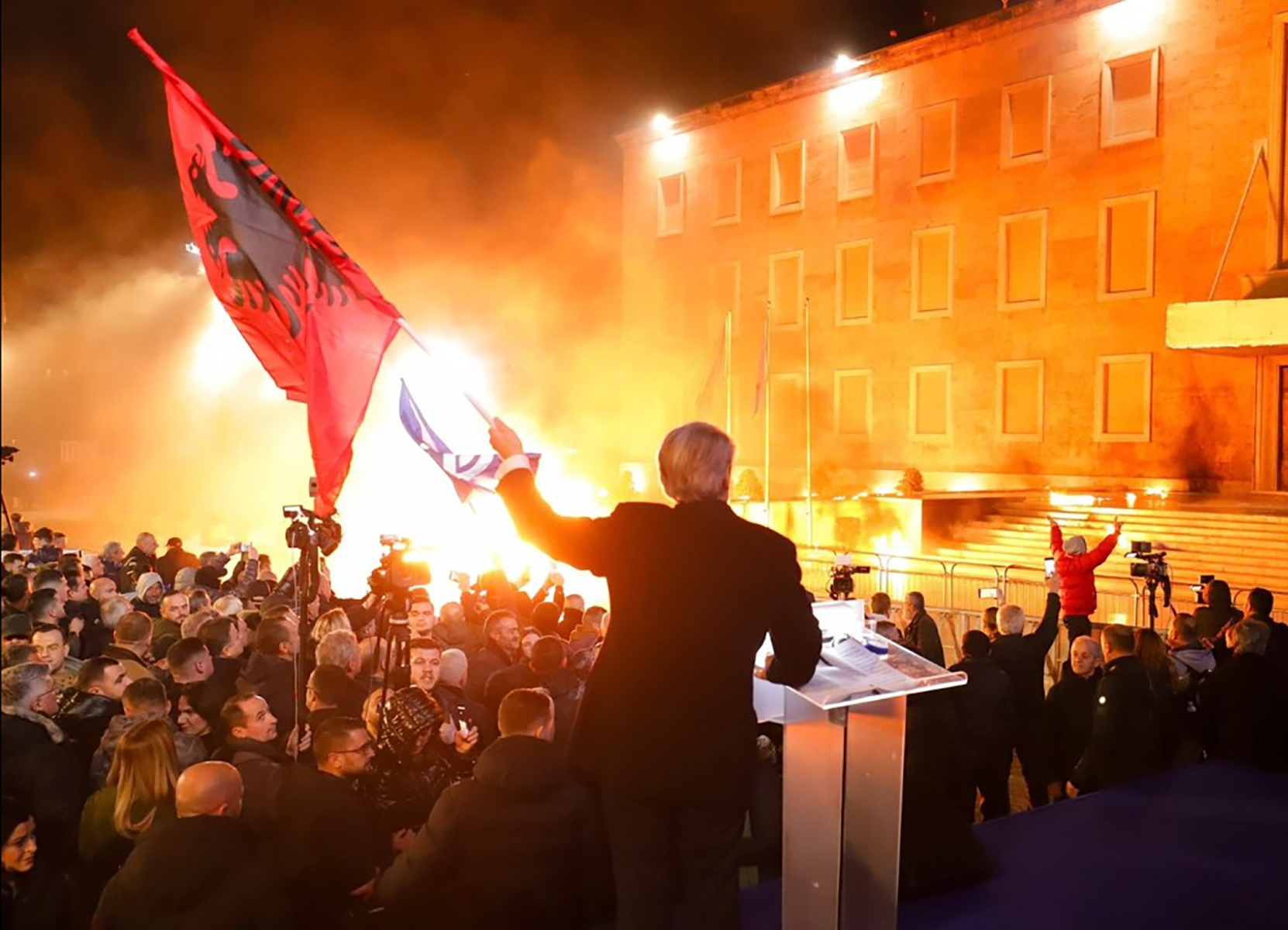
The General Director of the State Police of Albania Ilir Proda and the Director of the Tirana Police Elton Alushi were dismissed after protests organized by the opposition on the evening of 28 February ended in unrest. In particular, protesters threw Molotov cocktails and fireworks at the former residence of dictator Enver Hoxha.
After the protest, four opposition supporters were arrested. In addition, the police transferred case materials to the Special Structure against Corruption and Organized Crime (SPAK) regarding Democratic Party MP Klevis Balliu, whom the authorities call the organizer of the protest.
The Delegation of the European Union in Albania, following the opposition protest in Tirana, called on politicians for restraint. In a statement on social media on 1 March, the EU Representation stated that “the right to peaceful assembly is a fundamental pillar of any democratic society,” “it must be exercised responsibly, with full respect for the rule of law and the safety of all persons.” “In this context, the EU Delegation expresses concern over the recent acts of violence in Tirana that endanger human lives,” the Delegation added, calling on political actors for restraint.
In recent weeks, Albania has been experiencing an intensification of anti-government protests organized by the Democratic Party and other opposition forces. Thousands of people have taken to the streets of Tirana after the Special Structure against Corruption and Organized Crime (SPAK) launched a criminal investigation against Deputy Prime Minister and Minister of Infrastructure Belinda Balluku. The opposition calls the case proof of “systemic corruption,” demands the resignation of the government, the formation of a transitional cabinet, and early elections.
- Chinese company to continue building the motorway in Montenegro
Montenegro signed a commercial contract with the Chinese consortium PowerChina-Stecol-PCCD for the design and construction of the 22-kilometer Mateševo-Andrijevica section of the Bar-Boljare motorway.
The contract was signed on 28 February by Montenegro’s state road company Monteput and PowerChina at a ceremony in Podgorica attended by Minister of Transport and Maritime Affairs Filip Radulović, Minister of Finance Novica Vuković, and the Ambassador of China to Montenegro Chen Xufeng.
The value of the contract is 693.9 million euros. Unlike the first section of the motorway, this project will be financed with EU funds rather than loans from China. According to Monteput, the construction will be financed by a 200 million euro loan from the EBRD, a 150 million euro grant from the European Union, and the remaining funds will come from Montenegro’s own budget.
Monteput General Director Milan Ljeljanić stated that the Chinese contractor was selected through an international tender conducted under the rules of the European Bank for Reconstruction and Development (EBRD), adding that it submitted the most competitive offer while meeting all technical requirements. Speaking at the ceremony, he emphasized that his company trusts PowerChina’s engineering expertise and expects close cooperation to overcome technical challenges and ensure timely and high-quality completion of the project.
The CEO of Monteput noted that the project’s financing structure reflects cooperation between Montenegro and Western financial institutions, despite Chinese companies remaining key builders of the motorway.
According to project details, the motorway section will be designed for a speed of 100 km/h and will have two lanes in each direction with emergency shoulders. Due to the mountainous terrain, the route will include a significant number of bridges and tunnels, consisting of 36 main structures with a total length of approximately 6.6 km. The section will include two tunnels with lengths of 3,895 meters and 3,945 meters respectively.
The Chinese company will have five years to complete the design and construction of the section, followed by a two-year defect liability period.
The Bar-Boljare motorway is a strategic infrastructure project aimed at improving connectivity in Montenegro and connecting the Adriatic port of Bar with the border with Serbia as part of a broader European transport corridor.
The total length of the motorway is planned to be approximately 165 km. Its first completed section, the 41-kilometer Smokovac-Mateševo section costing approximately 1 billion euros, was opened to traffic in July 2022. Last year Montenegro still had a debt to China’s Exim Bank in the amount of 655 million euros for the construction of the first section.
The first phase of the construction of the Bar-Boljare motorway drew sharp criticism both domestically and from Western officials due to its high price and financing model, as well as possible Chinese influence in a NATO member state.
In addition, some international media mocked the Smokovac-Mateševo route, calling it a road “from nowhere to nowhere,” because although it crossed mountainous terrain, it did not connect any urban and business centers.
Now the authorities of Montenegro state that the new Mateševo-Andrijevica section will contribute to the development of the economy of underdeveloped areas in the north of Montenegro and improve internal and regional connectivity.
- Brother of Milo Đukanović arrested
On 2 March, the investigating judge of the Basic Court in Nikšić issued a decision on the detention of Montenegrin businessman Aco Đukanović, brother of former President and former Prime Minister of the country Milo Đukanović, for up to 30 days. According to the judge, “there are circumstances indicating that the suspect, if at liberty, may hide and be unavailable to the state authorities of Montenegro in the further course of the proceedings.”
Aco Đukanović was detained on 28 February after searches of his premises in Podgorica and Nikšić. During the searches, several pieces of firearms, ammunition, and other items were found. At the proposal of the Basic State Prosecutor’s Office in Nikšić, Aco Đukanović was remanded in custody “due to reasonable suspicion of committing the criminal offense of illegal possession and carrying of weapons and explosive materials.”
Aco Đukanović is considered one of the richest people in Montenegro. At the end of 2006, he purchased shares in Nikšićka banka, which a year later changed its name to Prva banka Crne Gore. From the beginning of its operation until the Democratic Party of Socialists (DPS) lost power in August 2020, this bank held deposits of state-owned companies, numerous ministries and other state institutions, local self-government bodies, and businessmen close to the then ruling party.
After the change of power in Montenegro in 2020, Aco Đukanović left the country. According to available information, he returned to the homeland only a few days ago, after which law enforcement authorities initiated procedural actions.