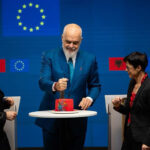

- The decree on the dissolution of the Parliament of Kosovo declared invalid
The Constitutional Court of Kosovo declared invalid the decree of the current President Vjosa Osmani on the dissolution of parliament, ruling that the document has no legal force.
The Court decided that due to the specific circumstances of the formation of the current composition of parliament, which was elected on 28 December 2025 and began its work on 11 February 2026, the deputies objectively did not have the full 60 days (until 5 March) provided by the procedure for electing the president.
According to the Court’s decision, parliament receives 34 days to complete the procedure for electing the president. If within this period the head of state is not elected, parliament is dissolved automatically, and new elections must take place within 45 days.
The decision of the Constitutional Court was adopted after a dispute between the executive branch and the president, which arose after parliament failed to elect the president.
The attempt to elect the president on 5 March failed due to the lack of a quorum. The opposition boycotted the vote for candidates from the ruling party “Self-Determination,” demanding a political compromise and the nomination of a consensus figure. The next day, Vjosa Osmani immediately signed the decree on the dissolution of parliament, arguing that the deputies failed to elect a new president within the legally defined timeframe (no later than 30 days before the expiration of the mandate of the current head, that is, by 5 March). Prime Minister Albin Kurti and deputies from the “Self-Determination” party assessed the decree as unconstitutional and appealed to the Constitutional Court.
Following the decision of the Constitutional Court, parliament plans to continue its work, beginning with the consideration of several draft laws on the ratification of international agreements with the European Union, the European Investment Bank, the EBRD, and other financial institutions, which are primarily necessary for Pristina to receive funds provided under European grant and loan programmes.
- Pro-Iranian hackers attacked the “Post of Albania”
Hackers suspected of links to Iran stated on 26 March that they had penetrated the system of “Post of Albania” (Posta Shqiptare). The hacker group Homeland Justice published information about the attack on several Telegram pages.
According to the hackers, they hacked the internal mail system of the Albanian postal service personnel and published emails containing data on postal deliveries and other internal information. At the same time, Albania’s Minister of Local Government Ervin Demo told journalists that “postal services continue to operate normally.”
Homeland Justice stated that it opposes granting asylum in Albania to the Iranian opposition organisation “Mujahedin-e Khalq” (MEK). More than 2,000 members of this group have been relocated to Albania since 2013 through mediation by the United States and the United Nations.
The attack on 26 March took place several days after a cyberattack on the digital infrastructure of the Albanian parliament, which Homeland Justice reported at the beginning of this month. In 2025, pro-Iranian hackers attacked the digital infrastructure of the municipality of Tirana, and in 2022 — the public services portal e-Albania.
After the 2022 attack, Albania expelled employees of the Iranian embassy and severed diplomatic relations. In mid-March 2026, after the start of the operation by Israel and the United States against Iran, the Albanian parliament adopted a resolution declaring the Islamic Republic of Iran a state sponsor of terrorism, and the Islamic Revolutionary Guard Corps (IRGC) a terrorist organisation.
- The Western Balkans remain a priority region for NATO
On 26 March at NATO headquarters in Brussels, NATO Secretary General Mark Rutte presented his annual report for 2025.
The Report emphasizes that the Western Balkans remain a region of strategic importance for the Alliance and a priority direction of activity.
NATO’s presence in Kosovo is described as “crucial to the stability of the Western Balkans region.” “In 2025, KFOR continued to ensure stability amid heightened tensions in northern Kosovo and the evolving strategic context. As of October 2025, 33 Allies and partners provided approximately 5,200 troops to KFOR, including deployed reserve forces,” the Report states.
In addition to the tasks carried out by KFOR, the NATO Advisory and Liaison Team continued its long-standing work on building the capacity of Kosovo’s security organisations in crisis and emergency situations, explosive ordnance disposal, and civil protection.
It is noted that the Alliance continues to support the normalization of relations between Serbia and Kosovo through EU-facilitated dialogue: “NATO continues to support the normalisation of relations between Belgrade and Pristina, notably through the EU-facilitated Belgrade-Pristina Dialogue, which is key to building lasting peace in the region.”
The Report also provides information on cooperation with countries in the region that are not parties to the North Atlantic Treaty.
In particular, it is reported that during 2025 the Secretary General (in March) and the Deputy Secretary General (in September) visited Bosnia and Herzegovina, which, as noted in the Report, was “a strong signal of NATO’s enduring commitment to the country and to regional stability.”
In October 2025, the first Individually Tailored Partnership Programme (ITPP) for Bosnia and Herzegovina was approved and the first support package under the Defence and Related Security Capacity Building Initiative (DCB) was provided.
It is emphasized that NATO’s support for the EU-led EUFOR Althea operation helped maintain a safe and secure environment in Bosnia and Herzegovina. In addition, NATO’s enhanced presence in Bosnia and Herzegovina, through NATO Headquarters Sarajevo and the Political Engagement Support Cell, continued to provide support at the local level, promoting defence and security reforms and strengthening relations with the country.
The Report also states that NATO continues to engage with Serbia to address issues causing regional concern and to advance initiatives for future military cooperation. In addition, the NATO Military Liaison Office in Belgrade supported Serbia’s continued participation in activities under the Partnership for Peace programme.
Thus, in the 2025 Report, NATO emphasizes that despite all existing challenges, the Alliance is not reducing its presence in the Western Balkans, keeping the region in focus.
- A Russian minister under EU and US sanctions visited Belgrade
Russia’s Minister of Economic Development Maxim Reshetnikov visited Belgrade, where he met with Serbian President Aleksandar Vučić and Minister without portfolio Nenad Popović.
The visit of the Russian official took place on the eve of the expiration of the contract for the supply of Russian gas to Serbia (31 March). President Aleksandar Vučić, after talks with Maxim Reshetnikov, stated that disruptions in the global energy market require long-term sustainable agreements. However, following the negotiations, no information was disclosed regarding agreements on the gas issue. It was only announced that a meeting of the Intergovernmental Committee for Cooperation between Serbia and Russia is planned for April in Belgrade. Popović and Reshetnikov are co-chairs of this committee, which did not convene during 2025.
Maxim Reshetnikov is under sanctions of the European Union and the United States. After the visit of the Russian minister to Serbia, EU officials reminded Belgrade that relations with Russia cannot be normal under the current regime and in the context of Russia’s aggression against Ukraine. “This includes refraining from high-level meetings with Russian officials,” a European Commission spokesperson said in a statement to Radio Free Europe (RSE). “Serbia has applied for EU membership. The EU wants to rely on Serbia as a reliable European partner that shares common principles, values, security, and prosperity, and we need Serbia to convince us of its strategic direction,” the spokesperson of the European Commission emphasized.
The EU regularly calls on Serbia to align its actions with the Union’s foreign and security policy. However, Serbia has not implemented any EU decisions on restrictive measures against Russia in response to the aggression against Ukraine. This is one of the reasons for the slowdown of Serbia’s European path, which has not opened a single negotiating chapter in EU accession talks since the beginning of 2022.
Bojana Selaković, coordinator of the National Convention on the EU, believes that the visit of the Russian minister to Belgrade will also have consequences. “Of course, this will be reflected in all reports,” she told RSE.
Bojana Selaković says that over the past four years a situation has been repeating in which one part of the Serbian government communicates with European officials, while another part communicates with Russian ones. “They show that they still plan to sit on multiple chairs.”