- Hungary and Serbia strengthen energy cooperation
Against the background of U.S. sanctions against the company “Naftna Industrija Srbije” (NIS), controlled by Russia’s Gazprom Neft, Budapest has taken on a key role in supplying Serbia with petroleum products.
On 26–27 November, Hungary’s Minister of Foreign Affairs and Trade Péter Szijjártó paid a visit to Belgrade. During the visit, he announced that the Hungarian company MOL had doubled its deliveries of petroleum products to Serbia in November and would increase them 2.5 times in December. All possible routes are being used for this: road transport, railways, and river transport along the Danube. “We are doing everything so that Serbia has no problems with energy supplies,” Szijjártó emphasized.
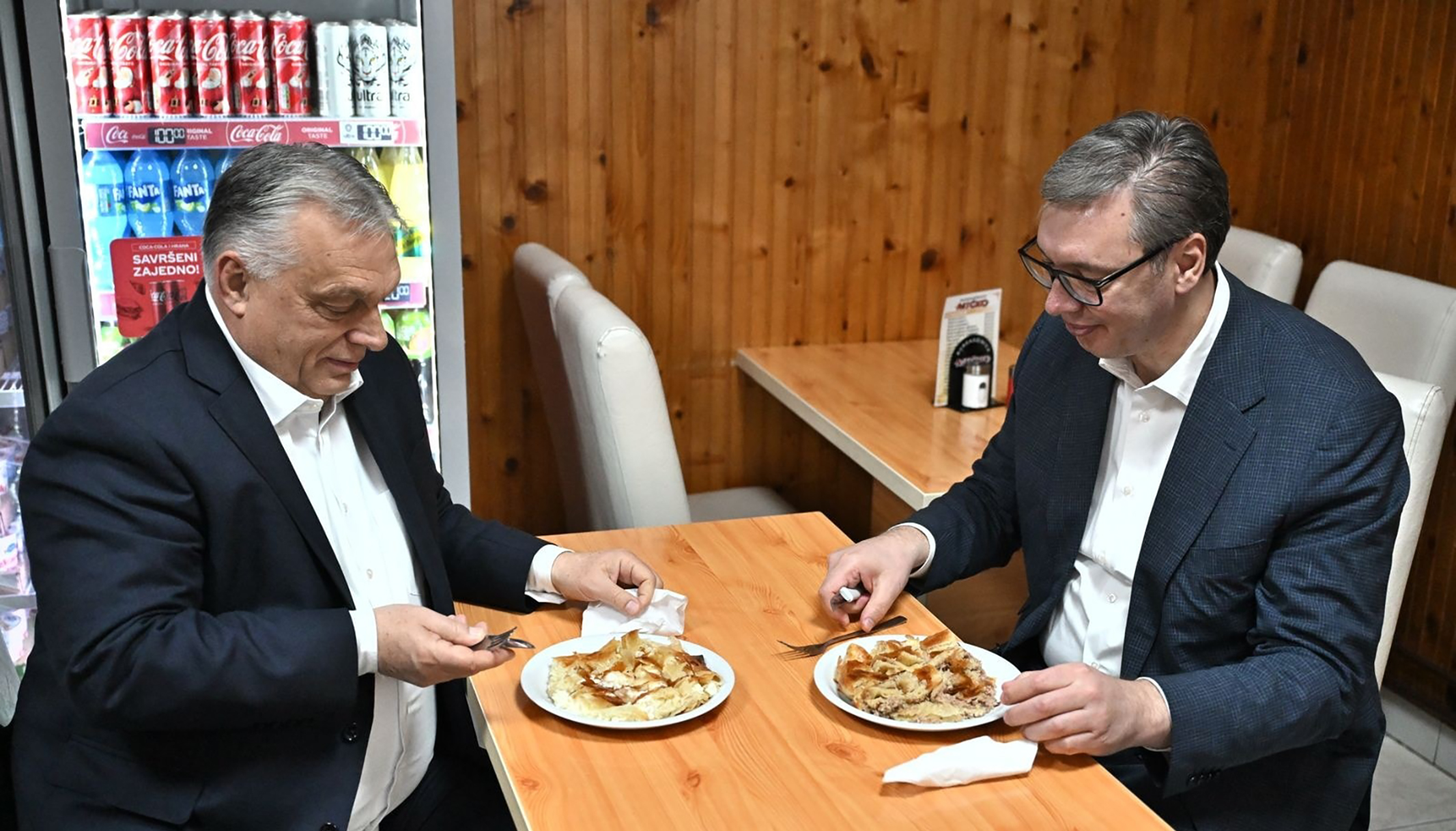
On 27 November, the Prime Minister of Hungary Viktor Orbán arrived in Subotica, where he met with the President of Serbia Aleksandar Vučić.
“Our Serbian friends are having problems because of the sanctions policy,” Orbán wrote on Facebook before his visit to Serbia. “I assure President Vučić: Hungary will do everything to help Serbia with fuel supplies.”
At a joint press conference, Vučić and Orbán announced the acceleration of the construction of the Serbian-Hungarian oil pipeline, which had originally been planned for completion by 2028. The Hungarian Prime Minister stressed that the gas pipeline already connects the two countries, but without an oil pipeline, the energy infrastructure remains incomplete.
“We have received an exemption from sanctions from the United States, and now I will negotiate – in the coming days, that is, tomorrow – to ensure the arrival of Russian oil and gas. And when we have them,” Orbán promised Vučić, “you will have them as well. What we have, we share with you.”
On 28 November, Orbán travelled to Moscow, where he met with Vladimir Putin. The purpose of the visit was to secure oil and gas supplies to Hungary.
On 29 November, the President of Serbia Aleksandar Vučić announced that he had held a telephone conversation with Orbán following his return from Moscow. He stated that Hungary would support Serbia’s energy stability in fulfilment of the promise given during their meeting in Subotica.
- Candidate backed by Dodik wins the most votes in the early presidential election
Siniša Karan, Minister of Scientific-Technological Development, Higher Education and the Information Society, former Minister of Internal Affairs of Republika Srpska, nominated by the Alliance of Independent Social Democrats (SNSD) of Milorad Dodik, won the 23 November early presidential election of Republika Srpska by a narrow margin.
After processing data from 99.91% of polling stations, the Central Election Commission of Bosnia and Herzegovina reported that Siniša Karan received 9,745 more votes than his main competitor, Branko Blanuša, candidate of the Serb Democratic Party (SDS).
According to the preliminary results of the CEC of BiH, Karan received the votes of 222,110 voters, or 50.41%, while Blanuša received 212,365 votes, or 48.20%.
According to CEC data, on 23 November, 439,897 voters, or 34.79% of the 1,264,364 registered citizens on the electoral roll, exercised their right to vote in the early elections.
In the previous presidential election of 2022, turnout exceeded 50%.
Dodik stated that many SNSD voters did not come to the elections because they considered them illegitimate.
The early elections were called after the Central Election Commission revoked Milorad Dodik’s mandate as President of Republika Srpska. Earlier, Dodik had been convicted by the High Court of Bosnia and Herzegovina for refusing to implement decisions issued in 2023 by the High Representative in Bosnia and Herzegovina Christian Schmidt, and he was banned from holding political office for six years.
Karan, if ultimately confirmed as the winner, will serve as President of RS only until the end of Dodik’s term in office, and new presidential elections will take place in less than a year, simultaneously with the general elections in Bosnia and Herzegovina in early October 2026.
Meanwhile, the opposition and independent observers consider that the 23 November elections were marked by violations and accuse the RS authorities of rigging the vote in favour of the SNSD candidate.
Transparency International Bosnia and Herzegovina called on the Central Election Commission of BiH to investigate alleged fraud in the presidential election in Republika Srpska. According to the organisation, the concerns relate to 40 polling stations in Doboj, Laktaši and Zvornik, where the voting data raise questions. “At most of these polling stations, the candidate of the ruling coalition received over 80% of the votes, and in some cases – over 97%,” the TI statement said. At nine of the 40 disputed stations, turnout was so high that, if evenly distributed throughout the entire election day, one voter would have had to vote every 90 seconds, which is highly unlikely.
Jovica Radulović, leader of the opposition Serb Democratic Party (SDS), which nominated Branko Blanuša, said immediately after the vote that the SDS would not recognize Karan’s victory and accused the ruling parties of electoral fraud.
The SDS, in its statement, announced that it would demand repeat voting in Doboj, Laktaši and Zvornik, where, in their view, fraud occurred.
- Cooperation between Budapest and Banja Luka strengthens
Hungary’s Minister of Foreign Affairs Péter Szijjártó, who planned to visit Republika Srpska on 26 November, was unable to land at Banja Luka Airport because Bosnia and Herzegovina’s Minister of Defence Zukan Helez denied permission for the Hungarian aircraft to land.
“I refused to grant landing permission for a Hungarian military aircraft at Banja Luka Airport, on which the Hungarian Minister of Foreign Affairs Péter Szijjártó was to arrive.
For many years, Hungary’s Prime Minister Viktor Orbán and Minister Szijjártó have openly supported the former president of the administrative entity of BiH, RS, Milorad Dodik, in his actions that undermine the sovereignty, territorial integrity, and unity of Bosnia and Herzegovina.
Also, the Hungarian side did not provide any clear explanation as to why the Minister of Foreign Affairs was arriving on a military aircraft.
My duty as Minister of Defence of BiH is to protect the constitutional order, the laws, and the interests of Bosnia and Herzegovina. That is why I decided not to approve this flight until full transparency and respect for our state are ensured,” Helez wrote on Facebook.
The next day, 27 November, Szijjártó nevertheless arrived in Banja Luka, but on a civilian aircraft. During the visit, he received the title of honorary doctor from the local university.
At a press conference, Szijjártó stated that Hungary would develop cooperation with Republika Srpska in the field of higher education. “Starting next year, Hungary will provide 50 scholarships for students who wish to study and enrol at Hungarian universities,” he said.
Szijjártó also emphasized that Budapest would continue its programme of support for the agriculture of Republika Srpska. “We will launch a new programme worth up to 4 billion forints, under which small and medium-sized enterprises will be able to purchase agricultural machinery from Hungarian manufacturers,” the minister said.
The leader of the Alliance of Independent Social Democrats (SNSD) Milorad Dodik, during his meeting with Szijjártó, stressed that excellent cooperation between Republika Srpska and Hungary in all areas would continue.
In the same week, on Wednesday, 26 November, a delegation of Republika Srpska headed by Dodik and Siniša Karan, who received the most votes in the 23 November early presidential election in RS, visited Budapest, where they met with Hungarian Prime Minister Viktor Orbán.
Orbán wrote on platform X that the meeting discussed further steps in strategic cooperation between Hungary and Republika Srpska. He emphasized that he was “looking forward” to continuing joint work after Siniša Karan’s election victory.
Dodik said that the meeting was “very successful” and thanked Orbán for being the first world leader to congratulate Siniša Karan on his victory.
The exchange of visits confirmed the strengthening of the political and economic axis between Budapest and Banja Luka and the continuation of their strategic cooperation.
- Montenegro will abolish visa-free travel for Russians next year
Montenegro will introduce visas for citizens of Russia no later than September next year, the Ministry of Foreign Affairs reported.
As the MFA stressed, this measure is part of the obligations the state has assumed within the process of accession to the European Union.
“Alignment with the EU’s visa policy is being carried out gradually and with careful consideration of national economic and other interests that are important for preserving the stability and long-term development of the country,” the Ministry noted. The MFA emphasized that “Montenegro must align its visa policy with the EU by the end of the third quarter of 2026, which, among other things, means introducing a visa regime for citizens of Russia.”
Earlier, Prime Minister Milojko Spajić, announcing a stricter regime for citizens of Russia, stated that Montenegro fully complies with the EU’s foreign and security policy, including measures regarding Russia. In particular, in 2022 Montenegro introduced sanctions against Moscow, but the European Commission constantly warns that visa policy is also crucial for progress in negotiations and for the use of funds from the EU Growth Plan for the Western Balkans. According to the latest report of the European Commission, Montenegro is still not aligned with the EU visa regime, which, in their opinion, is “a matter of urgent importance.”
According to official data, more than 21,100 citizens of Russia reside in Montenegro, mostly on the coast, primarily in Budva.
Under the current mutual travel agreement, Russian citizens may enter and stay in Montenegro for up to 30 days without a visa. In practice, Russians residing in Montenegro leave Montenegro briefly after this period, and upon returning, receive a new 30-day visa-free stay. This procedure, used by Russian citizens living in Montenegro, is called a “visa run.” The number of such “visa runs” is currently unlimited; the stay can be continuously extended because Montenegro’s agreement with Russia does not set limits on the total duration of stay within a given period.