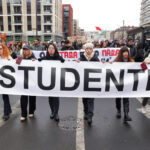
- The Parliament of Serbia Adopted Controversial Laws on the Judiciary
On 28 January, the Parliament of Serbia adopted amendments to a number of laws concerning the judiciary, proposed by a member of parliament from the ruling Serbian Progressive Party (SNS), the chair of the parliamentary Committee on the Judiciary, Uglješa Mrdić. On 30 January, the President of Serbia, Aleksandar Vučić, signed the “Mrdić laws.”
The opposition and experts in the field of justice emphasize that the consequences of the adopted laws will be increased government control over the judicial system and the paralysis of the Public Prosecutor’s Office for Organized Crime (TOC). According to the new legal provisions, more than half (11) of the TOC prosecutors will lose their mandates within 30 days.
Experts consider the investigations conducted by the TOC against current government officials to be the reason for the legislative changes. “There is only one reason for this: Over the past year, the Public Prosecutor’s Office for Organized Crime has launched investigations into two former ministers and filed an indictment against a sitting government minister. This is retaliation,” Sofija Mandić from the Centre for Judicial Research (CEPRIS) told DW.
As is known, the TOC is conducting resounding cases against the Minister of Culture Nikola Selaković (who is suspected of falsifications in the process of removing protected heritage status from the former General Staff complex in order to implement a development project by Jared Kushner, the son-in-law of U.S. President Donald Trump) and former Ministers of Construction, Transport and Infrastructure Goran Vesić and Tomislav Momirović (the case concerning the collapse of a canopy at the Novi Sad railway station, which resulted in the deaths of 16 people).
At the same time, MP Mrdić claims that the legislative changes are intended to “return” judicial power to the state. “As the author of the law, I am grateful to all MPs who voted for the adoption of the package of judicial laws, because they made a historic contribution to returning to Serbia a stolen judiciary, which was part of a colour revolution and a way of seizing legally elected power in our country,” he stressed. According to him, “they” began arresting ministers from the Serbian Progressive Party and “ultimately wanted to arrest President Vučić, let us be honest.” “They wanted to carry the colour revolution through to the end, to overthrow the state,” Mrdić said.
The adoption of the amendments to the laws on the judiciary did not receive a positive reaction from the European Union. European Commissioner for Enlargement Marta Kos stated that “the vote of the Serbian parliament to limit the independence of the judiciary is a serious step backwards on Serbia’s path to the EU.” “At a time of great progress in enlargement, when Montenegro and Albania are advancing rapidly, Serbia risks moving in the opposite direction. This is not what we want,” Kos wrote on X immediately after the vote in the Serbian parliament.
The following day, Kos called on MPs to review the newly adopted laws as soon as possible and bring them into accordance with European standards. “We really urge the Serbian parliament to review these laws as soon as possible and harmonize the laws on the judiciary with European standards,” Kos said upon arrival at a meeting of EU foreign ministers in Brussels. She added that this was “a serious step backwards,” as the amendments were adopted very “hastily and non-transparently, without any consultations.”
Serbia’s Minister for European Integration, Nemanja Starović, stated that the new package of laws on the judicial system fully complies with constitutional principles that were previously agreed with the EU. However, according to him, the government will address the Venice Commission of the Council of Europe and, after receiving its opinion, amendments will be made to the laws if necessary.
- Pro-Serbian Democratic People’s Party Leaves Montenegro’s Ruling Coalition
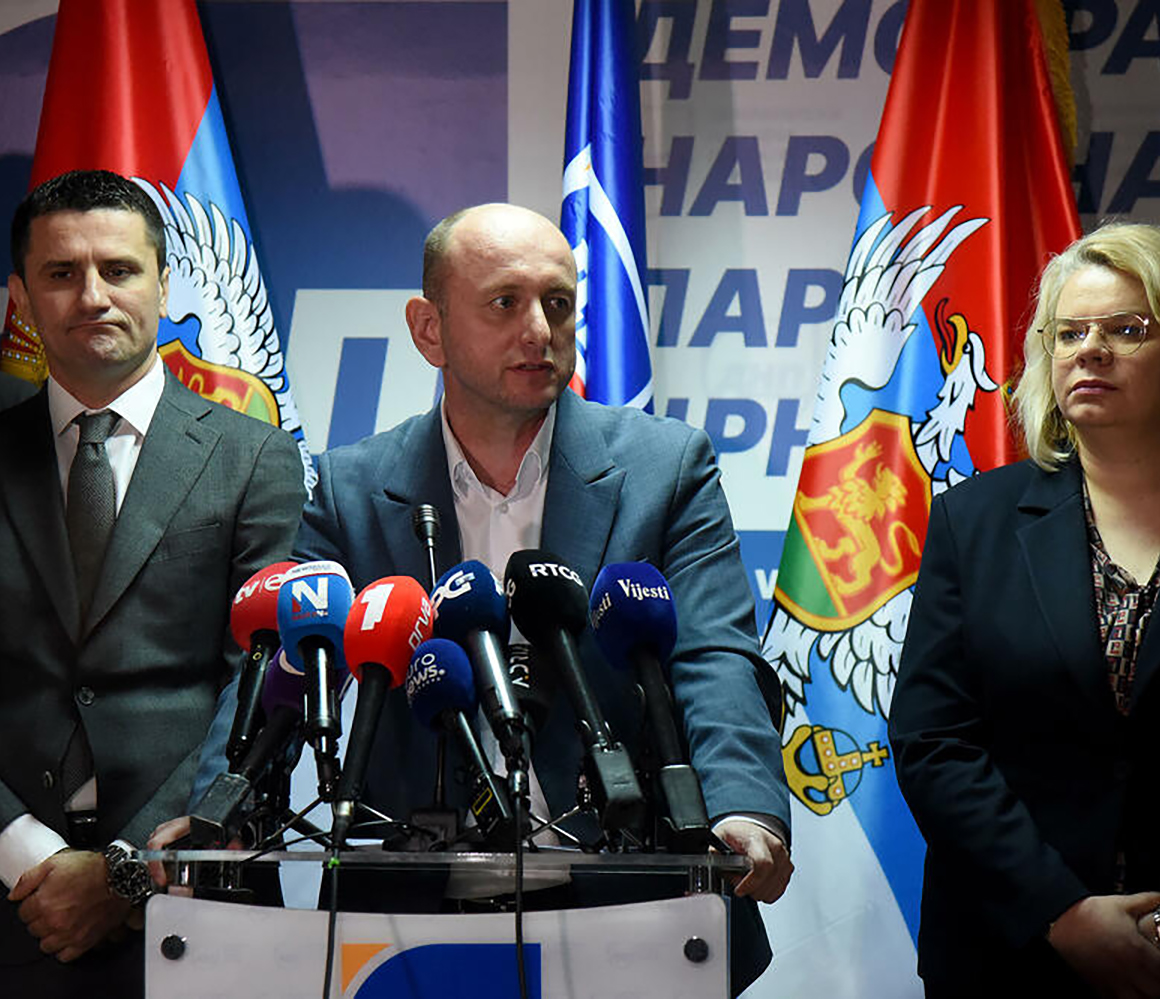
The Democratic People’s Party (DNP), close to official Belgrade, has left Montenegro’s ruling coalition at both the state and capital levels. DNP representatives in the Montenegrin government, Deputy Prime Minister for Infrastructure and Regional Development Milun Zogović and Minister of Transport Maja Vukičević, announced their resignations from their positions in the executive.
The decision was made after Prime Minister Milojko Spajić refused to consider, at a government session, the proposals of the Democratic People’s Party to grant the Serbian language official status alongside Montenegrin; allow dual citizenship; and grant state-symbol status to the historical tricolour alongside Montenegro’s current national flag. The fourth DNP demand is to initiate a comprehensive dialogue based on the results of a referendum on the construction of wastewater treatment facilities in Botun, “which would take into account the opinions” of the citizens of Zeta, who said “no” to the construction of the collector (the DNP supports local residents’ protests against the construction of an object important for Podgorica).
Prime Minister of Montenegro Milojko Spajić, in turn, stated on X that no political force in the current majority would allow a “blackmail model” of cooperation, and that only the state would decide on Montenegro’s vital interests. He emphasized that the proper place to propose and consider initiatives regarding the Serbian language is the Parliament of Montenegro, with the participation of all interested circles—not only parliamentary, but also social, professional, and academic. Spajić also stressed that the issue of building wastewater treatment facilities in Botun is a civilizational and environmental issue and should not be linked to cultural and identity questions.
The leader of Montenegro’s Democratic People’s Party, Milan Knežević, acknowledged that Milojko Spajić’s government still has a majority after the DNP left the coalition, but he expects “turbulence.”
The President of the Managing Board of the Centre for Monitoring and Research (CEMI), Zlatko Vujović, believes that the exit of Milan Knežević and the Democratic People’s Party from the ruling coalition should be viewed as a tactical and politically calculated move, the main goal of which is to create an institutional crisis and open space for snap parliamentary elections, which would make it practically impossible for Montenegro to complete EU accession negotiations by the end of 2026.
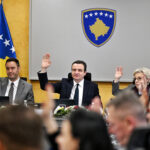
- Kosovo Constitutional Court Declares the Election of Nenad Rašić as Deputy Speaker Unconstitutional
By five votes “for” and two “against,” the Constitutional Court of Kosovo ruled that the decision of the Kosovo Assembly to elect Nenad Rašić as Deputy Speaker is contrary to the Constitution.
The constitutionality of the parliamentary decision of 10 October 2025, at which Nenad Rašić was elected Deputy Speaker, was challenged by representatives of the leading Kosovo Serb party, Serb List.
Nenad Rašić, an ethnic Serb, a member of the government of Albin Kurti and leader of the party “For Freedom, Justice and Survival,” was elected Deputy Speaker of the Kosovo Assembly after none of the candidates from the Serb List—nine in total—managed to secure the required sufficient number of votes for election. Rašić received the support of 71 MPs, while 9 voted against and 24 abstained.
The Speaker of Parliament put Rašić’s candidacy to a vote even though the Serb List had not nominated him, and this was recognized as a violation of the Constitution.
In its explanation, the Constitutional Court stated that the Constitution clearly distinguishes between the procedure for electing Deputy Speakers from among the largest parliamentary groups and those representing national communities. Three Deputy Speakers are proposed by the largest parliamentary groups, while the right to nominate a Deputy Speaker from among the Serbian and other communities belongs to the majority of representatives of those communities. The Court found that Rašić’s election was not the result of a proposal by that majority, i.e. the Serb List, and therefore contradicts the Constitution.
At the same time, the Constitutional Court decided that the verdict has no retroactive effect; thus, Rašić’s election remains valid. In addition, the Constitutional Court’s decision was adopted after the dissolution of parliament in November 2025 and the early parliamentary elections held on 28 December of the same year.
- Political Scandal in Zagreb over the Reception of the European Championship Bronze Medalists
Tens of thousands of fans welcomed the Croatian national handball team on the evening of 2 February at Zagreb’s main square—Ban Josip Jelačić Square—after the team won bronze at the European Championship. However, the reception of the athletes became not only a celebration, but also a political scandal.
Initially, the official celebration was organized by the City of Zagreb. However, after the city authorities banned the performance on the square by singer Marko Perković Thompson, the Croatian Handball Federation announced that there would be no celebration at all under such conditions.
The government intervened in the situation and, together with the Croatian Handball Federation, organized the celebration on the capital’s main square against the will of the city authorities. Thompson was able to perform several songs on stage, including the unofficial anthem of the Croatian handball team, the song “If You Don’t Know What Happened” (Ako ne znaš šta je bilo) about the Croatian War of Independence (Domovinski rat).
The Mayor of Zagreb, one of the leaders of the opposition left-green political platform “We can!” (Možemo!), Tomislav Tomašević, stated that by organizing the reception for the handball players without the consent of the city authorities, the government violated the Constitution, “which in Article 4 guarantees the right to local self-governance.”
Croatian President Zoran Milanović called the government’s decision “an unconstitutional, illegal and piratical act.”
Prime Minister and leader of the ruling centre-right Croatian Democratic Union (HDZ), Andrej Plenković, rejected accusations of allegedly illegal actions by the government regarding the decision to take over the organization of the handball team’s reception. Several government officials sharply criticized the politicization of the event by the left.
Political scientists described the political dispute surrounding the reception of the handball team as the premature start of the parliamentary election campaign, noting that upcoming public opinion polls will show who ultimately managed to increase their rating.
- First Suspect Identified in the “Sarajevo Safari” Case
The Milan Prosecutor’s Office has taken the first procedural step in the investigation of the “Sarajevo Safari” case. The case concerns allegations against foreigners who, during the war in Bosnia and Herzegovina (1992–1995), allegedly came to Serbian positions around besieged Sarajevo in order to pay for the opportunity to shoot at civilians.
The first person against whom proceedings have been officially opened and a suspicion raised is an 80-year-old former truck driver who lives near the city of Pordenone in northeastern Italy. The investigation suspects the man of conspiring with other, as yet unidentified persons to carry out a criminal plan that led to the deaths of unarmed civilians, including women, elderly people, and children.
During a search of the suspect’s home, Carabinieri found seven firearms that he legally owned: two pistols, a rifle, and four shotguns. Documents from the company where he previously worked record that the man traveled several times to the former Yugoslavia in the early 1990s.
The Milan Prosecutor’s Office is working to identify other potential participants; one additional specific name already appears in the case.
The siege of Sarajevo lasted from 1992 to 1996. During the blockade of the city, more than 11,000 people were killed by shelling, including 1,601 children. Snipers in Sarajevo killed between 300 and 350 people, almost all of them civilians.