The regime is trying to restore the rule of fear, but repression only further increases public dissatisfaction
The protest has worn out, students are tired, they are giving up… – can be heard from pessimists. Serbian President Aleksandar Vučić is satisfied, cynically counting demonstrators, offering young people cooked beans to go back out onto the streets. There are no frequent and massive protests, blockades, or marches. Has the student revolt truly faded, or has it entered a new phase?
Usually, protests have the dynamics of a match – an outbreak, mass mobilization, and a final achievement of goals or the dispersal of demonstrators. Protests in Serbia, for the first time in a multiparty system, have the nature of a social marathon and a continuity of attrition tactics.
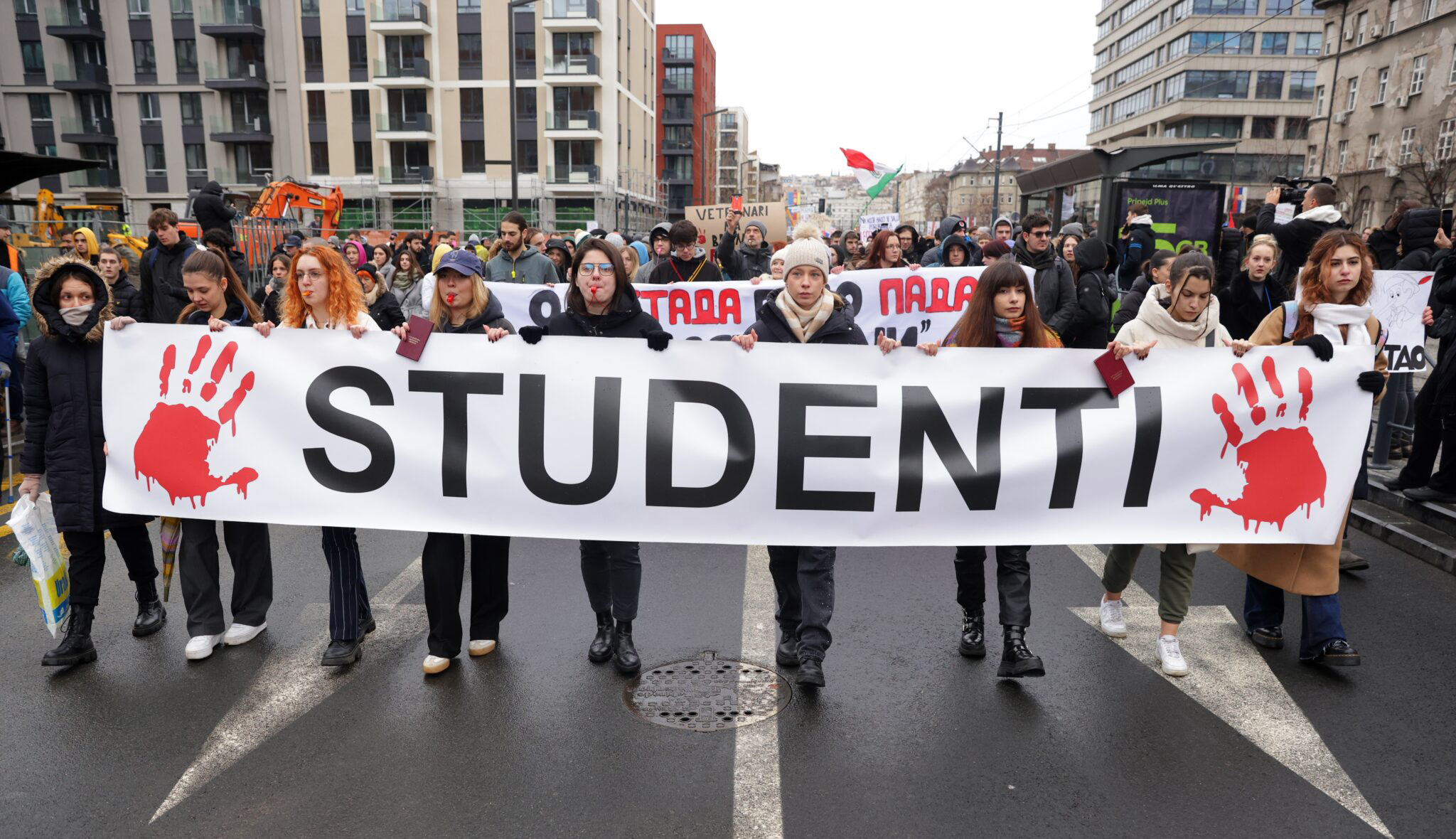
The protest marking the anniversary of the collapse of the canopy in Novi Sad showed that the number of those willing to take to the streets has not decreased. The protest in Novi Pazar in December last year showed that the revolt exists, although it is not massive, and that there is no need to return to the phase of “awakening Serbia” from last winter.
While waiting for the President of Serbia, who claims that he defeated a “colored revolution,” to call early parliamentary elections, students and the authorities have focused on elections that will certainly take place this year, namely local elections in ten municipalities.
Young People Are Not Leaving Serbia
The self-confident government does not change its proven election-winning tactics – sowing fear and blatant election fraud. All these local elections are important to Vučić in order to present an image of victory, delay the calling of parliamentary elections, and exhaust the student movement.
However, students are also learning. Pushing against police cordons is a tactical move of protest, but not a way to gain power. This is literally the bitter taste of tear gas and a school of violent regime traps from last year.
Elections are strategy and mathematics; this is now a new exam for youth that will be passed, but the question is whether on the first attempt. Students and the opposition cannot agree on a joint electoral performance, and the sure formula for the victory of an autocratic regime is – unity.
That is why it is good that student practice takes place in local elections, and not immediately in parliamentary elections. After all, judging by everything, Aleksandar Vučić’s second presidential term is nearing its end, and he is likely preparing for the position of prime minister in parliamentary elections in order to preserve the complete structure of power.
At the same time, Serbia is experiencing repression against dissenters unprecedented since the early 1990s. There is no official record of victims of repression in Serbia in 2024–26, but wherever the state has influence, the regime of the Serbian Progressive Party is carrying out mass dismissals, firings, and contract terminations. Not only are heads of public institutions who supported student protests being removed, but also those who did nothing to suppress the revolt. All of this is happening in an atmosphere of targeting, public lynching, and humiliation.
Serbia is a new Belarus. But young people are not leaving the country as before, because they believe in their victory.
It has long been known that the regime of the Serbian Progressive Party controlled everything from the national project Expo 2027 to village cultural and artistic associations. Methods of pressure, blackmail, and vote-buying are becoming less and less covert. State officials from the ranks of the Serbian Progressive Party coordinate lists of supporters and enemies of the government and, with detailed plans, visit local communities and carry out previously well-rehearsed actions of violent election-winning. Serbia has not had experience with Stalinism, but Putinophilia has become the social foundation for the implementation of such neo-totalitarian methods.
Caution – the “Iranian Scenario”
Students are also preparing for local and parliamentary elections. Many complain about them because they do not want to publish a list of candidate names from the main student list for parliamentary elections. They are also angry at students for not wanting to cooperate with many, for not wanting to unite the Serbian party opposition, and for being narcissistic. But all these are characteristics of youth.
Opposition parties in Serbia should not make drama out of this, but should prepare for elections independently of students. Cooperating with students where and as much as they can.
Citizen assemblies that students called for a year ago and the tactic of “a student in every village” have produced organizational results. Slowly and quietly, municipal and local headquarters for student lists in local elections are being formed.
With an inevitable dose of paranoia, young people are aware that the undemocratic regime is wiretapping them, following them, and seeking compromising material on them and their close ones.
The persecution of university professors, journalists, artists, and the destruction of cultural institutions and festivals will not lead to the social collapse of Serbia, but to a faster replacement of a criminalized regime. The regime is trying to restore the rule of fear, but the people are already free from it. Repression only increases dissatisfaction and rage.
Local communities are under such strong political pressure that resistance is growing even among older generations who, in some Vojvodina villages with minority communities, collectively defend their priests who supported student protests and blockades.
Serbia is more divided than ever into “ćacije” (supporters of the government) and “blockaders” (supporters of students), and after the fall of Aleksandar Vučić’s regime, the consequences of repression will inevitably raise the issue of lustration, which did not occur after “October 5” in 2000. Serbia was then at war with its neighbors, and now with itself.
After 15 months of protests, it is clear that changes in Serbia will not follow the pattern of the “October 5 Revolution.” Trends of Generation Z worldwide point to their unpredictability and impulsiveness, which could cause chaos during the transfer of power.
What is certain is that electoral authoritarianism in Serbia cannot even theoretically be defeated in rigged or violently stolen elections. Vučić has stated that he is not Slobodan Milošević and has expressed readiness to defend power by force, which means, if necessary – with many victims. The current lull may be, as folk wisdom says, the calm before the storm. As a metaphorical warning – global red lines of violence have shifted, and the uprising in Serbia could fall somewhere between the “Nepalese” and the recent “Iranian scenario,” in which thousands of people were killed.
Boris Varga. Serbian political scientist and journalist.
The articles published in the “Opinions” column reflect the personal opinion of the author and may not coincide with the position of the Center