
Energy is increasingly becoming one of the main instruments of geopolitical influence in the Western Balkans. For the United States, strengthening its presence in this sector means not only economic expansion, but also an attempt to reduce the region’s dependence on Russian energy resources, limit Moscow’s political influence, and strengthen its own strategic positions in Southeast Europe.
Throughout 2026, Washington has already taken a number of steps indicating the systemic nature of this policy: from supporting new infrastructure projects to promoting American liquefied natural gas on regional markets. At the same time, the practical implementation of these plans is facing political, institutional, and geo-economic obstacles, which is particularly evident in the cases of Serbia and Bosnia and Herzegovina.
Energy as a Priority
At the end of 2025, the U.S. Congress adopted the Western Balkans Democracy and Prosperity Act as part of the National Defense Authorization Act (NDAA) for Fiscal Year 2026. The document defined the energy sector as a priority area for U.S. policy in the region.
“The new NDAA establishes a long-term US strategy for the region with energy at its center. It mandates cooperation with Balkan countries to diversify energy sources, reduce reliance on Russian energy, accelerate the transition to renewables, and modernize infrastructure to withstand cyberattacks and external interference. It also strengthens sanctions measures that can be used against individuals and entities that employ corruption — often through energy deals — to threaten regional stability,” wrote David J. Kostelancik of the Center for European Policy Analysis (CEPA) in January of this year.
“The Western Balkans sit at a geopolitical crossroads between Euro-Atlantic institutions and sustained Russian and Chinese influence. For years, energy dependence has been an effective tool used by unscrupulous powers to exert pressure. Control over supply, opaque infrastructure deals, and corruption linked to energy contracts have undermined democratic governance and regional stability. Congress recognized a basic reality: countries that lack control over their energy are easier to pressure, manipulate, and destabilize,” he noted, emphasizing: “When Congress passed the Western Balkans Democracy and Prosperity Act as part of the 2026 National Defense Authorization Act (NDAA), it sent a clear signal: energy security in Southeastern Europe is no longer a peripheral economic issue — it is a core U.S. national security concern.
Practical Steps by the United States
During the first months of 2026, the United States significantly strengthened its presence in the Western Balkans energy market, effectively turning this area into a key element of its regional strategy. The U.S. government and private companies are concentrating efforts on large-scale projects aimed at developing energy infrastructure and diversifying energy supplies, thereby reducing the region’s dependence on Russian deliveries.
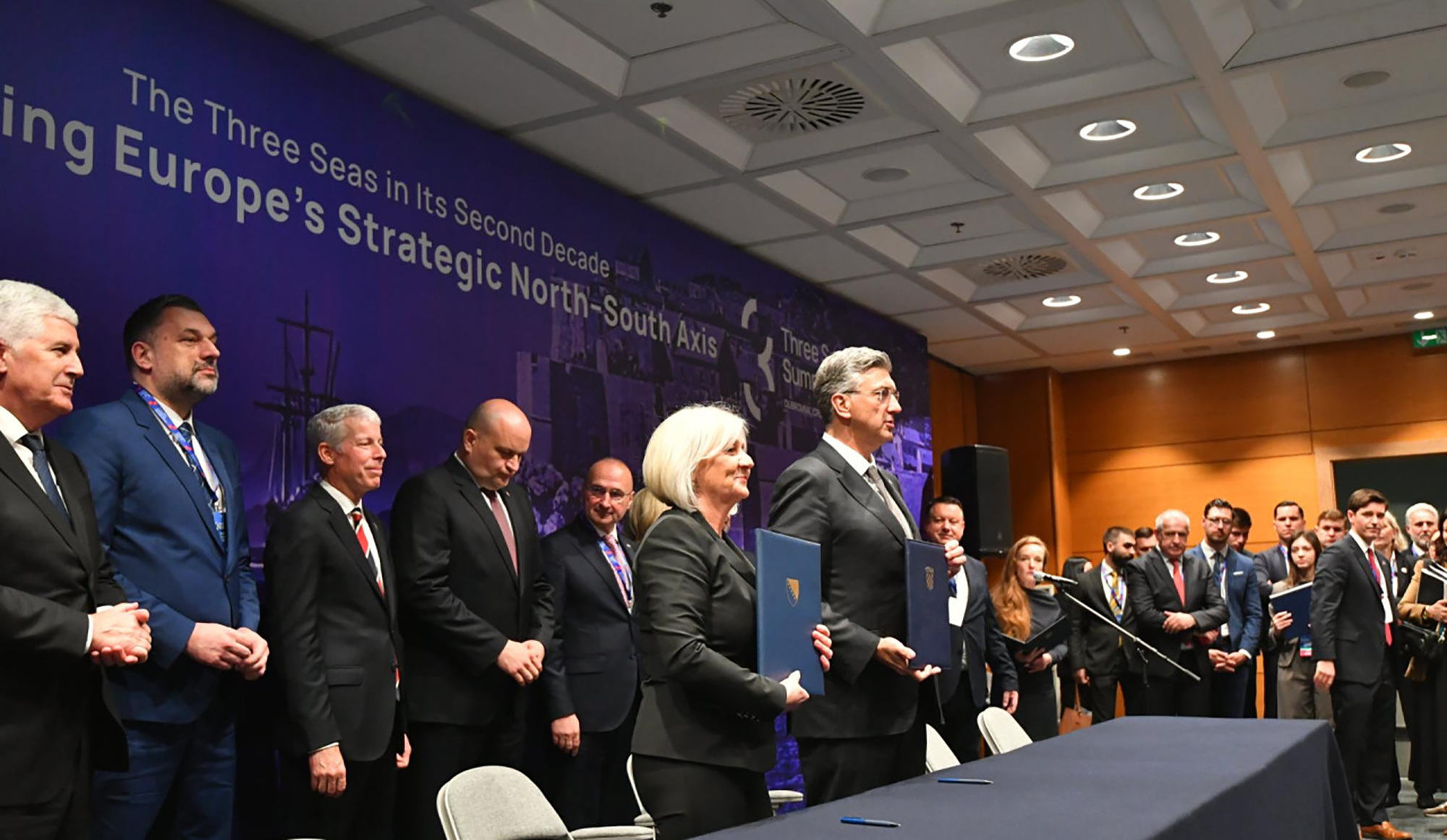
At the end of April, during the Three Seas Initiative summit in Dubrovnik, an intergovernmental agreement was signed between Croatia and Bosnia and Herzegovina on the construction of the “Southern Interconnection” gas pipeline. The project provides Bosnia and Herzegovina with access to the LNG terminal on the island of Krk and is expected to become a key element in diversifying gas supplies for BiH, which has been fully dependent on Russian imports since 1979.
U.S. Secretary of Energy Chris Wright attended the signing ceremony in Dubrovnik. The American company AAFS Infrastructure and Energy, linked to former members of Donald Trump’s legal team, is expected to provide financing for the project and become the operator of the section of the pipeline running through Bosnia and Herzegovina.
On April 28, Albania signed a 20-year contract with American and Greek partners for the import of liquefied natural gas (LNG) from the United States. The agreement was signed by the Albanian state-owned company ALBGAZ, the American company Venture Global LNG, and the Greek company Aktor LNG USA. The total value of the contract is approximately $6 billion. The document provides for long-term LNG supplies from the United States and the creation of an energy hub in Vlorë.
The signing took place in the presence of U.S. Ambassador to Greece Kimberly Guilfoyle, who arrived in Tirana specifically for the occasion. She stated that the agreement “advances President Donald Trump’s energy agenda” and “strengthens the region’s energy and national security.”
In May, Serbia and North Macedonia joined the Vertical Gas Corridor during a meeting of heads of energy ministries from Greece, Serbia, North Macedonia, and Bulgaria in Athens. The Vertical Corridor connects the infrastructure of Southeast European countries, enabling the transportation of gas from non-Russian sources. Above all, this refers to American LNG supplied through Greek LNG terminals.
Thus, the new American policy in the region is being implemented actively and, seemingly, quite successfully. However, there are serious pitfalls.
First, there are no similarly successful cases on the oil market, primarily because the deadline for the sale of sanctioned Russian assets — Lukoil International, Oil Industry of Serbia (NIS) — has been extended, and as of mid-May the process had still not been completed.
Second, there are also signs in the gas sector that the process of pushing Russia out of the regional energy market will not be quick or easy.
The “Eastern Interconnection” and the Limits of Diversification
On April 17, a contract was signed in Banja Luka for the construction of a gas pipeline that will connect Republika Srpska to Serbia’s gas network near Zvornik. Earlier, the government of Republika Srpska approved the allocation of more than one billion marks (€500 million) in the budget for the construction of the pipeline known as the “Eastern Interconnection”.
Although theoretically this project could ensure supplies from alternative sources (for example, from Azerbaijan), at present only Russian gas from the TurkStream/Balkan Stream route is transported through this corridor.
At the moment, the “Eastern Interconnection” appears to be a pro-Russian alternative to the Southern Interconnection supported by the United States. The leaders of Republika Srpska have repeatedly stressed that Russian gas would be supplied through the Eastern Interconnection and continue to do so now.
The leaders of Republika Srpska (including Milorad Dodik) visited Moscow for the celebrations marking May 9 (Victory Day). The coverage of the visit focused primarily on historical, political, and geopolitical themes, although other issues were also discussed. As Republika Srpska President Siniša Karan stated, special attention during the meeting with Vladimir Putin was devoted to “the implementation of infrastructure and development projects,” such as the development of gas infrastructure and the “Eastern Interconnection” project.
Of course, it cannot be ruled out that after Serbia joins the Vertical Gas Corridor plans (from 2028 onward), American gas delivered through Greek LNG terminals could eventually be transported to Republika Srpska, and thus to Bosnia and Herzegovina. However, there is currently no confirmation of this scenario.
The Serbian Factor and the Resilience of Russian Influence
The Serbian authorities are also showing no signs of actively working toward genuine diversification of gas imports. On the contrary, Belgrade’s policy is aimed at close cooperation with Moscow to secure Russian gas supplies.
Two revealing facts illustrate this.
The General Director of the state-owned company Srbijagas, Dušan Bajatović, was appointed Honorary Consul of the Russian Federation in Vojvodina in September last year. This clearly demonstrates whose interests the top manager of Serbia’s state gas company openly lobbies and intends to continue lobbying.
One year ago, Aleksandar Vulin, considered Serbia’s most pro-Russian politician, was appointed Chairman of the Supervisory Board of Srbijagas. On May 9, he also attended the parade in Moscow and held a number of meetings with representatives of the Russian authorities.
A notable detail: in 2023, the United States imposed sanctions on Aleksandar Vulin, who at the time was Director of Serbia’s Security Information Agency (BIA). “Today’s action against Aleksandar Vulin demonstrates the United States’ commitment to holding accountable individuals engaged in corrupt activities that advance their own political agendas and personal interests at the expense of peace and stability in the Western Balkans. These corrupt activities facilitate Russia’s malign activities in Serbia and the region,” the U.S. Treasury Department’s Office of Foreign Assets Control (OFAC) stated at the time.
Of course, the United States may lift restrictive measures against Vulin, as it previously did in the case of Dodik. However, it is unlikely that this would transform pro-Russian Serbian politicians into lobbyists for American energy companies or help Washington implement its plans for energy expansion in the Western Balkans.
It should be recalled that the current U.S. administration has recently sought in every possible way to develop relations with the leaders of the Bosnian Serbs. In addition to lifting the “Biden sanctions” against Dodik and his associates, there was also the visit of Donald Trump Jr. to Banja Luka. However, this in no way prevented the Bosnian Serb leadership from continuing cooperation with Russia in the energy sector, particularly in the gas sphere.
Nevertheless, the main obstacle to implementing the priorities of U.S. policy in the Western Balkans outlined in NDAA-2026 is not the position of individual regional actors, but rather the fact that Russia has no intention of leaving the region. While the Russians will most likely lose the oil market, they have no intention of “surrendering” the gas sector. This is confirmed by Moscow’s recent steps and statements, including Putin’s negotiations with the Republika Srpska delegation. Ultimately, Washington is not the only place where it is well understood that energy resources are among the most powerful instruments of geopolitics — Moscow understands this perfectly as well.
CWBS Analytical Group