
The High Representative of the international community in Bosnia and Herzegovina, Christian Schmidt, was forced to unexpectedly leave his seat after five years of crisis management — under conditions in which his activities were effectively blocked by two permanent members of the UN Security Council: Russia and China. Unlike his predecessors, Schmidt was never approved in his position by the UN Security Council, which allowed Russian and Chinese diplomats, as well as the leadership of Republika Srpska, not to recognize his authority and to question the legitimacy of the High Representative — although they still could not ignore his decisions. Schmidt, with whom the leadership of Republika Srpska refused to deal, secured the resignation of the pro-Russian Milorad Dodik from the post of president of this part of Bosnia and barred him from political activity for six years. The court that issued this ruling based it precisely on the fact that Dodik had ignored the decisions of the High Representative.
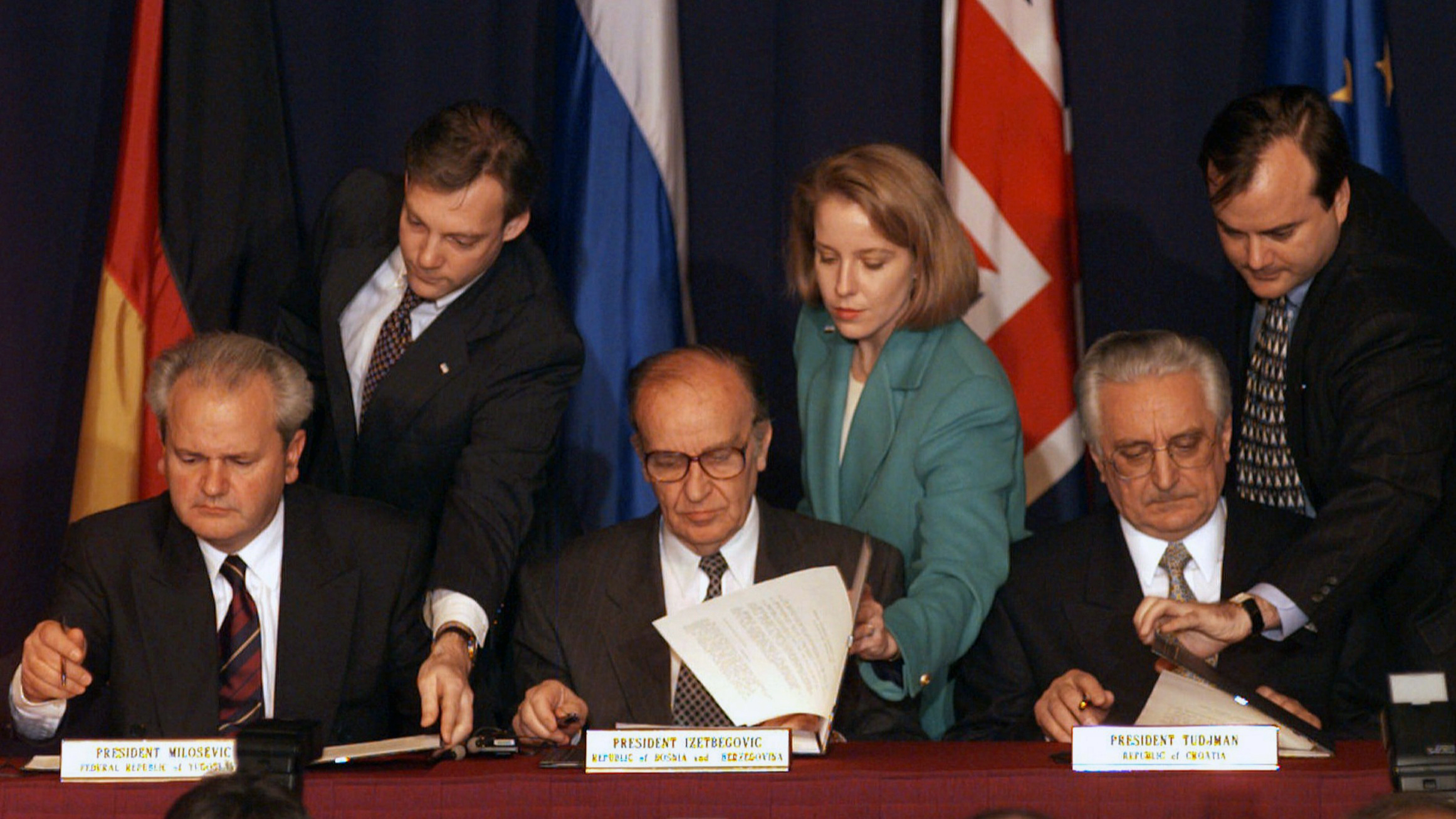
Schmidt’s crisis management once again served as a reminder of the chronic flaws of the Dayton Accords, which, on the one hand, preserved the territorial integrity of Bosnia and Herzegovina, but, on the other, failed to provide it with the ability to function effectively as a sovereign state. The very creation of a state within a state in the form of Republika Srpska and its coexistence with the Federation of Bosnia and Herzegovina — the Muslim-Croat entity, which is also a state within a state, but more closely tied to the central authorities — demonstrated from the very beginning the dysfunctionality of the country’s governance mechanism. And if one adds to this the aspirations of the Croat populace to have its own separate institution, the situation becomes even more complicated. Under these conditions, the High Representative was supposed to act as an arbiter between the parties. But how can he untangle these knots when his mission is openly ignored in Republika Srpska?
Perhaps Schmidt could have continued resisting pressure from Russia and China — especially given that China does not directly participate in resolving Bosnian affairs, while Russia, despite formally being part of the Peace Implementation Council, which exists to oversee the implementation of the Dayton Accords, has long ceased to be invited to its meetings. But another problem was added to all the difficulties faced by the German diplomat — the one that is now shaping changes in global politics as a whole: Trump.
In Sarajevo, it is believed that it was precisely the new American administration’s rejection of the High Representative’s actions that forced him to end his activities prematurely. However, Washington does not particularly conceal this. During a discussion in the UN Security Council of Schmidt’s report on current developments in Bosnia, U.S. Deputy Representative to the United Nations Tammy Bruce emphasized that the United States had never viewed the position of High Representative as an institution that should exist for a long time, and that Schmidt’s successor should have a much more limited mandate and transfer part of the powers to local leaders. What is this, if not veiled criticism of Schmidt’s actions?
Bosnian media are already naming the successor to the High Representative — Italian diplomat Antonio Zanardi Landi, who previously served as his country’s ambassador to Russia and Serbia. If such an appointment actually takes place, Bosnia will gain a High Representative with serious contacts in Moscow and Belgrade, capable of restoring relations with the Bosnian Serbs — above all, of course, with Milorad Dodik. And Dodik, naturally, will take advantage of this: to challenge previous court decisions, Schmidt’s policies, and for his own early return to high office in Bosnian politics. The former leader of Republika Srpska needs this return in order to call into question the very existence of Bosnia within its current borders. And the weakness of the institution of the High Representative and of international interest in pressuring those who wish to dismember Bosnia once again will only facilitate Dodik’s efforts.
But even if Dodik and his supporters fail — this still does not remove the main question from the agenda: how will “Dayton” Bosnia continue to exist and function when the Dayton model itself has suffered an obvious defeat and is being used exclusively by those interested in the disappearance of the Bosnian state — to accelerate precisely this process? And how long will Bosnia’s European neighbors and Turkey be able to tolerate the existence of a genuine black hole on the European continent?
Vitaly Portnikov. Ukrainian journalist, political commentator, author and opinion-maker.
The articles published in the “Opinions” column reflect the personal opinion of the author and may not coincide with the position of the Center