- Xi Jinping and Vučić Held Talks in Beijing on Economic and Military Cooperation
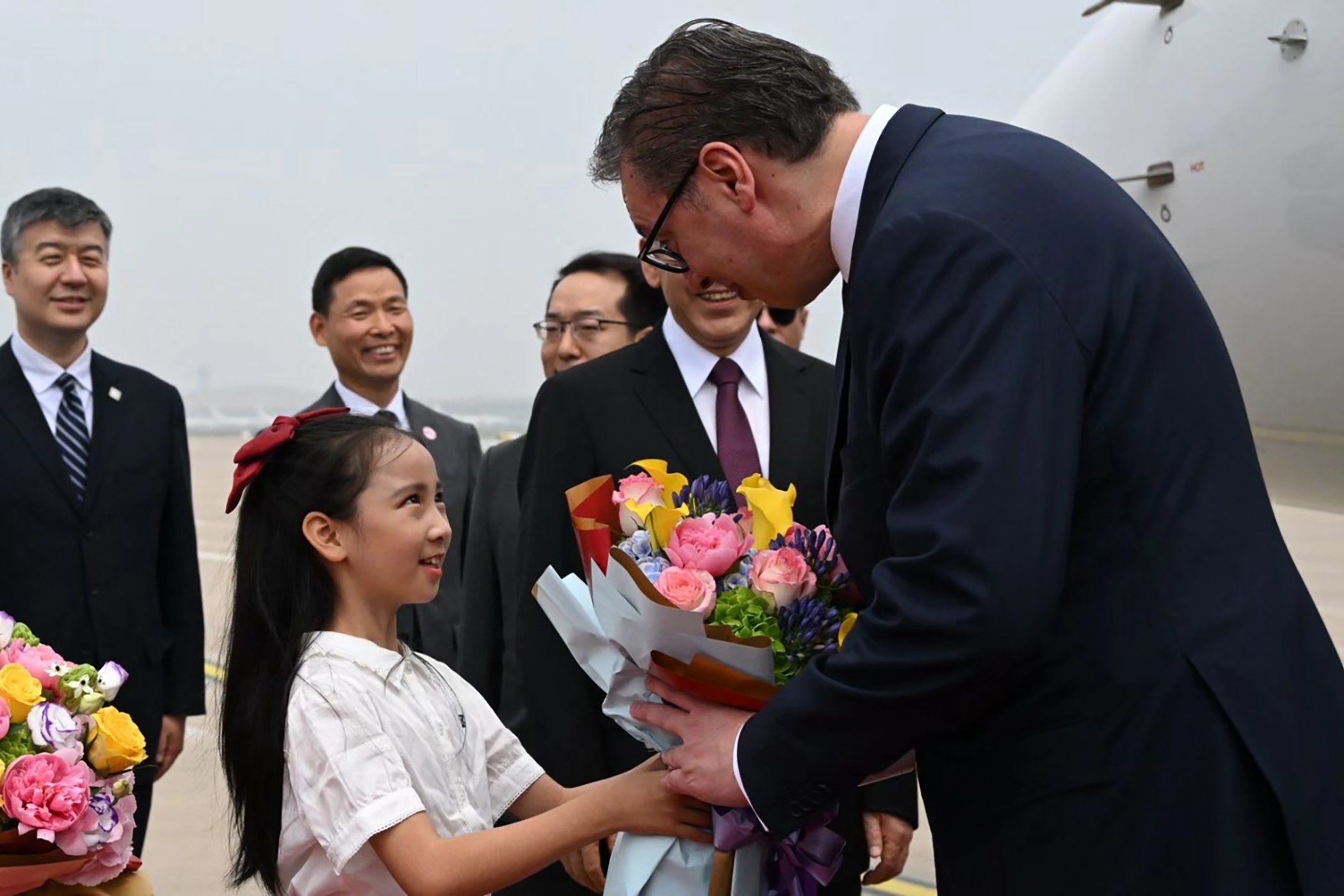
Serbian President Aleksandar Vučić paid an official visit to Beijing at the invitation of Chinese President Xi Jinping. The central event of the summit was the talks between the leaders at the Great Hall of the People, which lasted a total of 4 hours and 15 minutes.
In addition to customary protocol events, Beijing demonstrated the special status of bilateral relations — Vučić was awarded the Order of Friendship (the PRC’s highest state award for foreigners). In addition, during the visit of the Serbian delegation to the Great Wall of China, the traditional Serbian dance “kolo” was performed.
During the official part, Chinese President Xi Jinping emphasized the need for unity between the two countries against the backdrop of global instability. Xi Jinping also assured that China is ready to share its experience in state governance within the framework of its new 15th Five-Year Development Plan, and that the current visit would elevate the comprehensive strategic partnership to a new level.
In response, Aleksandar Vučić emphasized the economic results of cooperation, noting that Serbian exports to China increased by 85% in just the first 4 months of the current year. According to him, “today nearly 40,000 of our citizens work at Chinese enterprises, and four out of the six largest Serbian exporters are companies from China.”
Vučić also separately thanked China for its political support during voting in the UN Security Council and other international forums where “Serbia was being attacked.” It is reported that the Serbian delegation received assurances from the PRC regarding unwavering support for Serbia’s territorial integrity at the UN.
Following the visit, the parties signed at least 33 bilateral agreements and memorandums, as well as two major joint statements, including on building a “community with a shared future” for Serbia and China. The documents cover billion-euro investments, infrastructure projects, and financial assistance in preparation for the EXPO world exhibition, which will be held in Serbia.
The closed part of the negotiations attracted the greatest attention from international analysts. Aleksandar Vučić confirmed to journalists that “sensitive topics,” including military-technical cooperation, were discussed in detail in a narrow-format meeting and during the official dinner with Xi Jinping. As is known, Serbia remains the only European country actively purchasing Chinese weapons, while the special units of both countries are already conducting joint military exercises. According to Vučić, Beijing has “certain requests and wishes” regarding equipment supplies that are currently not intended for the broader public.
- Ukraine and Serbia Intensify Work on a Free Trade Agreement
A Ukrainian delegation headed by Deputy Prime Minister for European and Euro-Atlantic Integration and Trade Representative Taras Kachka was on an official visit to Belgrade.
On May 21, Serbian President Aleksandar Vučić met with Taras Kachka. “An open and substantive conversation with the Deputy Prime Minister of Ukraine regarding the improvement of bilateral relations, the European path of our countries, and the further development of cooperation in areas of mutual interest. We placed special emphasis on strengthening economic cooperation, continuing negotiations on a free trade agreement, as well as opportunities for additional growth in trade, investment, and cooperation in the fields of trade, energy, and infrastructure. We agreed that Serbia and Ukraine have room for significant expansion of their partnership, especially through a more concrete connection of the economies and better use of existing potential,” Vučić wrote on Facebook.
On the same day, Ukrainian Deputy Prime Minister Taras Kachka and Serbian Minister of Internal and Foreign Trade Jagoda Lazarević signed a Joint Statement on the resumption of negotiations on concluding a Free Trade Agreement between the Governments of Ukraine and the Republic of Serbia and the Terms of Reference for the negotiation process under this Agreement.
As part of the visit of the Ukrainian governmental delegation to Belgrade, the Serbian-Ukrainian Business Forum took place. President of the Ukrainian Chamber of Commerce and Industry Hennadii Chyzhykov emphasized: “Serbia is a strategic partner for us in the Balkans. …We keep the agricultural, food, and energy sectors in focus.”
Trade turnover between Serbia and Ukraine amounted to $442.2 million in 2025, and $152.8 million in the first quarter of 2026.
On the eve of the visit of the Ukrainian delegation, the President of Serbia held a telephone conversation with the President of Ukraine Volodymyr Zelenskyy.
Volodymyr Zelenskyy noted on social media: “We discussed with Serbian President Aleksandar Vučić issues of bilateral relations between our countries. We both believe that they should be strong, and we see potential for development.”
Vučić noted on Facebook that the conversation with Zelenskyy was “open and good” and was devoted to “the bilateral relations of our countries, the European path of Serbia and Ukraine, as well as opportunities for further improvement of economic cooperation and ties in areas of common interest.” Later, commenting on the phone conversation, the President of Serbia stated: “Ukraine did not recognize the independence of the so-called Kosovo. It did us no harm. We have the most normal relations,” adding that he believes and hopes that Volodymyr Zelenskyy will come to Belgrade.
- Greece and Albania Strengthen Defense Cooperation
Greek Defense Minister Nikos Dendias paid an official visit to Albania on May 25, where he held talks with newly appointed Defense Minister Ermal Nufi. The parties discussed deepening bilateral cooperation in the field of defense, regional security, and coordination within NATO.
In statements to journalists, Dendias emphasized that this was their first meeting and invited his Albanian counterpart to visit Athens at the end of next month. According to him, Greece and Albania must “coordinate a common vision of geopolitical challenges” and strengthen cooperation in the defense sphere.
The Greek minister separately noted the importance of sharing expertise in the field of cybersecurity, given the large-scale cyberattacks Albania has suffered in recent years. He stressed that Tirana’s experience could be useful for NATO allies.
Albanian Defense Minister Ermal Nufi emphasized that Albania considers strengthening regional stability a strategic priority. He recalled that Albanian military personnel participate in the EUFOR Althea mission in Bosnia and Herzegovina and KFOR in Kosovo, and also noted the close coordination of the Albanian and Greek naval forces in the Mediterranean and Aegean Seas, including participation in NATO’s Sea Guardian operation.
Among the other topics discussed were the burials of Greek soldiers killed in World War II. The defense ministers agreed to immediately convene the Joint Committee of Experts on Military Cemeteries.
During the visit, Dendias was received by Albanian Prime Minister Edi Rama. The parties discussed the geopolitical situation in the region and the Eastern Mediterranean. The Greek minister also mentioned his family’s origins from Himarë, emphasizing that the Greek minority is a “bridge of friendship between the two peoples.” Dendias stressed the importance of respecting the rights of the Greek national minority in Albania, calling it a “pillar of peace, security, and progress for the region.”
Dendias’s visit demonstrates that Athens expects rapprochement from Tirana within NATO, as well as real progress in ensuring the rights of the Greek minority in the context of Albania’s path toward the EU.
- The European Commission Paid a New Tranche of Financial Support Within the Framework of the Growth Plan for the Western Balkans
The total amount of €158.9 million was divided among Albania, Montenegro, and North Macedonia. At the same time, payments to Serbia and Bosnia and Herzegovina are currently blocked.
This payment became the third tranche of the program and is based on the successful implementation of reforms in the second half of 2025. Brussels positively assessed the countries’ progress in key sectors:
– North Macedonia received €65.7 million — for reforms in education and digitalization;
– Albania — €49 million, Montenegro — €44.2 million — for improving business competitiveness and innovation.
Overall, since the program was launched in 2024, Albania has already received €212.8 million, North Macedonia — €142.1 million, and Montenegro — €89.3 million.
Bosnia and Herzegovina remains the only country that has not received a single euro, as local politicians have still failed to agree on and adopt the mandatory Reform Agenda.
Serbia received only half of the planned amount from the EU because the country adopted controversial judicial laws. European Commissioner for Enlargement Marta Kos previously stated that Serbia would not see the money while provisions that significantly restrict the independence of the judiciary remain in force.
Kosovo is at the initial stage and received only basic pre-financing last month.
The Growth Plan for the Western Balkans is a €6 billion EU financial package for the region (a combination of grants and concessional loans). Payments are made every six months strictly according to the principle of “money in exchange for real reforms.” The total amount of funds already allocated under the program currently stands at €673.6 million.
- A Mass Rally Organized by Students Took Place in Belgrade
On May 23, the rally “You and Me, Slavija” was held at Slavija Square in Belgrade under the slogan “Because Students are Winning”. The authorities attempted to prevent citizens from other cities from participating in the rally by suspending train traffic to Belgrade for 24 hours on the day of the protest. It was announced that the reason was anonymous reports about planted bombs.
Despite the obstacles, citizen participation in the action was record-breaking: the non-governmental organization Archive of Public Gatherings estimated the number of participants at 180,000–190,000 people, although the Serbian Ministry of Internal Affairs claims that only around 34,000 citizens were present.
The main part of the rally passed peacefully. The situation escalated only late in the evening, after the official program had ended. Groups of young people began throwing pyrotechnic devices, flares, and torches at the police, while police officers, using stun grenades and batons, violently dispersed the protesters. Special police units in armored vehicles and full gear pushed protesters out of the central streets of the city.
Later, Minister of Internal Affairs Ivica Dačić announced the detention of 23 participants in attacks on police officers.
The May 23 rally became another manifestation of the anti-government protests that began after the collapse of the canopy at the railway station in Novi Sad in November 2024, resulting in deaths of 16 people. The tragedy caused outrage among citizens, mainly young people, especially students, because of corruption and the impunity of officials which led to the tragic incident, according to the protesters.
The protesters are demanding early parliamentary elections in order to change the government. President Aleksandar Vučić announced that elections could take place earlier than planned, already this autumn, but no final decision has yet been made.
Observers noted that, despite the declared goal of fighting authoritarianism and for democracy, some participants in the rally came with “No Capitulation” flags featuring a map of Kosovo, as well as banners directed against the European Union and NATO.
In mid-May, the students also published a Memorandum on Kosovo and Metohija on their official social media profiles. Referring to the Preamble of the Constitution of Serbia, they stated that Kosovo is its “inalienable and inseparable part.”
- A New Border Crossing Between Bosnia and Herzegovina and Croatia Was Temporarily Opened
On May 19, part of the fence of the bridge over the Sava River collapsed at the Gradiška border crossing between Bosnia and Herzegovina (Republika Srpska) and Croatia, completely blocking the movement of vehicles and pedestrians. The structure collapsed early in the morning under unknown circumstances. No one was injured.
Due to the emergency situation, a new border crossing in Gradiška was temporarily opened. The Ministry of Security of Bosnia and Herzegovina announced the opening during the day on May 19. “The location via the new bridge will be used during the suspension of traffic at the existing Gradiška border crossing, which occurred due to the collapse of part of the protective fence and pedestrian walkway on the bridge over the Sava River,” the press release states.
The decision of the Ministry of Security of Bosnia and Herzegovina on the temporary opening was adopted several hours after the Council of Ministers of Bosnia and Herzegovina failed to adopt the proposal of Chairwoman of the Council of Ministers Borjana Krišto that a new border crossing should be opened due to extraordinary circumstances. Ministers representing the Bosniaks opposed this.
The new border crossing and the new bridge had not been operating, although construction had been completed, because the Governing Board of the Indirect Taxation Authority of Bosnia and Herzegovina (Upravni odbor Uprave za indirektno oporezivanje BiH, UIO) did not grant approval for its opening in December last year, failing to adopt decisions that would allow customs officers to be assigned to the new crossing point. The UIO demands the settlement of the difference between collected VAT and funds paid to entities, emphasizing that Republika Srpska should pay the Federation of Bosnia and Herzegovina around 150 million marks (around €77 million).
In Republika Srpska and in Croatia, the position of the Indirect Taxation Authority of Bosnia and Herzegovina is considered politically motivated.
Because of the UIO’s position, the new border crossing in the legal sense operates as the old crossing, but фактически at a new location, while its functioning was ensured through the urgent and temporary relocation of employees from the old crossing point to the new one. According to the decision, the temporary crossing is open from May 19, 2026 until the cessation of the circumstances that led to the suspension of traffic across the existing bridge, but no later than August 19, 2026.
- The Deadline for Completing the Sale of NIS Has Been Extended
The Hungarian oil and gas company MOL received approval from the United States to extend the deadline for negotiations with the Russian company Gazprom Neft regarding the purchase of a controlling stake in the company Naftna Industrija Srbije (NIS). This was announced by Serbian Minister of Mining and Energy Dubravka Đedović-Handanović on May 22. According to her, the Serbian side was officially informed of the extension of the deadline previously established by the Office of Foreign Assets Control (OFAC) of the US Department of the Treasury. The previous deadline expired on Friday, May 22. The new deadline for completing negotiations is June 6.
As the minister noted, the trilateral consultations (between MOL, Gazprom Neft, and the Serbian government) are currently facing difficulties. The main disagreements concern the further operation of Serbia’s only oil refinery in Pančevo, which belongs to NIS, as well as guarantees of uninterrupted supply of petroleum products to the Serbian domestic market after the change of ownership. “The situation is difficult, but our task and goal are to find a long-term solution and protect the interests of the state of Serbia,” Đedović-Handanović wrote on social media.
The need for the urgent sale of NIS arose after the United States imposed sanctions at the beginning of 2025 because the controlling stake in the company is controlled by Russians (Gazprom Neft and other Russian owners hold 56.15% of the shares). The purpose of the sanctions is to deprive Russia of revenues from energy sales that the Kremlin uses to finance the war against Ukraine. The implementation of the restrictions began in October 2025.
Due to American sanctions, the Serbian company found itself under threat of a complete shutdown: the transportation of crude oil via the Adriatic Pipeline (JANAF) from the Croatian port of Omišalj to the refinery in Pančevo was blocked. At the end of February 2026, OFAC issued a temporary license for NIS operations, which allowed the pumping of crude oil. This license was extended several times, and it is currently valid until June 16, 2026.
In mid-January 2026, the Hungarian MOL and the Russian Gazprom Neft concluded a framework agreement on the buyout of the entire Russian share package.