- Dispute between Montenegro and Serbia against the backdrop of preparations for the EU–Western Balkans Summit
Against the backdrop of Montenegro’s preparations to host the EU–Western Balkans Summit on 5 June in Tivat, a dispute erupted between Montenegro and Serbia over security issues.
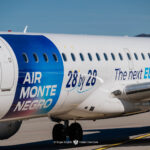
On the morning of 3 June, a charter flight operated by Air Serbia from Belgrade landed at Tivat Airport, carrying an organized group of 87 men, citizens of Serbia. After inspection, a joint team of border police and the National Security Agency (ANB) determined that the arrival of this group constituted a direct threat to national security, with a high risk of destabilizing public order during the international summit. In Montenegrin media, the group was described as a “special-purpose team for street actions” and the “shadow bodyguards of (Serbian President Aleksandar) Vučić.” All 87 persons were denied entry, and a few hours later they were deported back to Belgrade.
That same evening, Serbia’s Security Information Agency (BIA) issued a statement advising the President of Serbia not to travel to Tivat (for the EU–Western Balkans Summit), since his life would allegedly be in danger there because, according to their information, the leader of the “Kavac clan,” Radoje Zvicer (who had allegedly previously been commissioned to assassinate Vučić), was in Montenegro.
Also on the evening of 3 June, Serbia’s Ministry of the Interior effectively introduced a regime of enhanced control for citizens of Montenegro. Montenegrin border officials unofficially confirmed that their Serbian colleagues described this as a “temporary reciprocal measure.”
At the main road border crossings between the two countries and at Belgrade Airport, holders of Montenegrin passports were subjected to enhanced screening, and many were denied entry into Serbia. Particular attention was paid to men.
Montenegro’s Ministry of Foreign Affairs, through diplomatic channels and the embassy in Belgrade, began intensive communication with the Serbian side, sending official requests demanding legal justifications for the mass detentions and refusals.
On 4 June, the European Commission issued an official statement calling for the situation to be returned to normal without delay. “Artificial delays, queues, and selective restrictions on freedom of movement run counter to the principles of regional cooperation and good-neighbourly relations. At a time when the leaders of the Western Balkans and the EU are gathering to discuss a common future, mutual respect and adherence to international border-crossing protocols are mandatory,” the EC emphasized.
On the evening of 4 June, after arriving in Montenegro for the EU–Western Balkans Summit, the President of Serbia also commented on the situation involving the group of persons whom Montenegrin police had not allowed to enter the country for security reasons. According to Vučić, they were activists of the ruling Serbian Progressive Party (SNS) who simply wanted to unfurl banners reading “Serbia Wins” (“Srbija pobeđuje”) in support of him. He noted that the charter flight from Belgrade to Tivat had been organized by someone from his entourage who wanted to make his stay in Montenegro more pleasant, but that it was a “major political mistake.” When asked to name those who had organized the controversial flight, the President of Serbia replied that it was an internal party matter and that no one had any bad intentions.
Speaking about the stopping of Montenegrin citizens at border crossings, Vučić stated that the Serbian state authorities were acting in accordance with the principle of reciprocity. “I ask them not to do this. The citizens of Montenegro are our brothers and sisters; they should be allowed entry into Serbia,” he said.
Commenting on the BIA warning about the danger and the intelligence services’ recommendations to cancel his participation in the summit, Vučić said that records from the Sky application indicated that representatives of criminal clans had planned to kill him, but that he did not see this as grounds for canceling his participation in the summit.
- Pristina takes control of Serbian Railways facilities
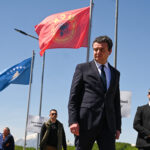
Kosovo institutions established control over railway stations in northern Kosovo that had until now remained under the management of Serbian Railways (Železnice Srbije). In Zvečan, representatives of the company “Kosovo Railway Infrastructure” (Infrakos), with the support of Kosovo police, entered the station building, removed a sign in Serbian Cyrillic, and raised the flag of Kosovo. Present at the scene were Interior Minister Xhelal Sveçla and other representatives of the authorities. Sveçla stated that the operation was part of the “implementation of legislation throughout the territory of Kosovo” and the liquidation of Serbia’s “parallel structures.” He also added that similar operations would continue if other facilities under the control of Serbian institutions were discovered.
According to media reports, Infrakos employees also established control over stations in Leposavić, Ibarska Slatina, and Lešak.
The OSCE Mission in Kosovo drew attention to the fact that the events at the railway stations coincided with the start of the election campaign (parliamentary elections will be held in Kosovo on 7 June). “All participants are advised to be aware of the particular sensitivity of this issue,” the Mission emphasized.
Petar Petković, Director of the Office for Kosovo and Metohija of the Government of Serbia, stated that the seizure of Serbian Railways facilities in northern Kosovo was part of Albin Kurti’s election campaign ahead of the 7 June elections.
- Protests continue in Albania against Jared Kushner’s project
Mass protests continue in Albania against plans for large-scale construction of an elite tourist complex linked to Jared Kushner’s investment company Affinity Partners, Jared Kushner being the son-in-law of U.S. President Donald Trump.
Kushner’s investment company, Affinity Partners, intends to invest more than USD 1 billion in creating a luxury resort. The project envisages the construction of hotel complexes and premium-class villas with a total capacity of about 10,000 rooms.
Two unique locations have been selected for the development: Sazan Island — an uninhabited island at the junction of the Adriatic and Ionian Seas, previously closed to civilians because of secret military facilities — and Zvërnec (the Vlorë region) — a picturesque coastal village directly adjacent to the protected Vjosa-Narta area (one of Europe’s last wild river ecosystems).
The protests intensified after the developers installed a barbed-wire fence at the future construction site. The demonstrations are taking place in Tirana and in the southern coastal areas where the future resort is supposed to be located.
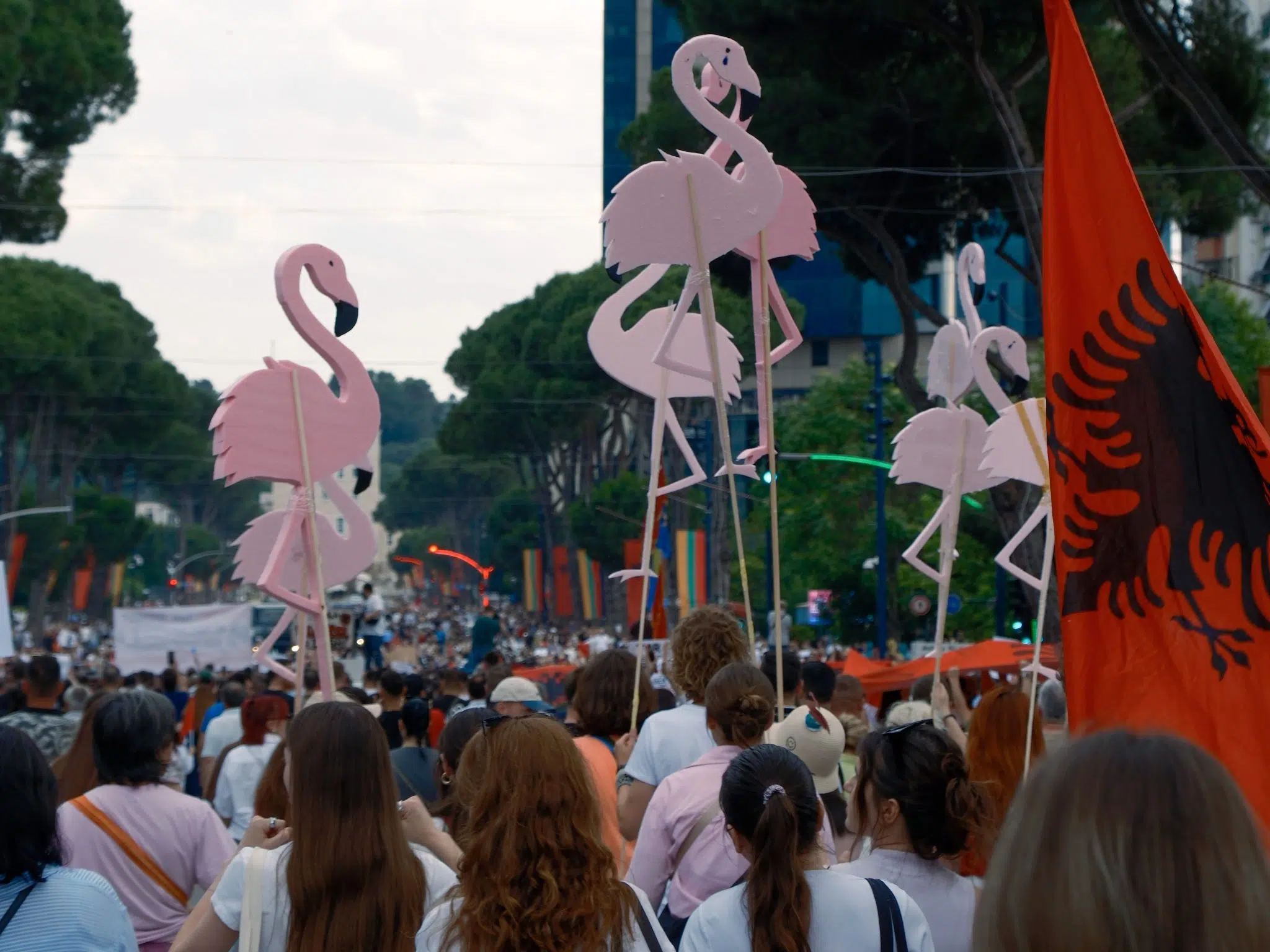
On 3 June, thousands of protesters gathered on Tirana’s main boulevard, holding large cardboard figures shaped like flamingos. The media have already dubbed the protests the “flamingo revolution.”
The flamingo became the symbol of the protests because the construction of the elite resort is planned within what was once a protected natural ecosystem where birds nest. Controversial changes to Albania’s law on protected areas in 2024 paved the way for tourism development in former nature reserves.
Albania’s Special Anti-Corruption Prosecution Office (SPAK) has already officially opened an investigation into the project that Affinity Partners plans to implement. Law-enforcement authorities are examining the legality of the decisions adopted in 2024 concerning the change in the status of land plots.
At the same time, the authorities emphasize that the protests are the result of mass disinformation and external interference. In an interview with international media, Albanian Prime Minister Edi Rama stated that this was a “hybrid war” being “waged through thousands of fake profiles.” According to him, there is as yet no final project and the environmental impact assessment is still under way. Rama also stressed that “the task is not to pour concrete over the heads of flamingos,” “the task is to prove that development and nature can not only coexist, but that nature and development need each other.”
- TV channels in Montenegro penalized over the broadcast of a propaganda film
Montenegro’s Agency for Audiovisual Media Services (AMU) announced the introduction of sanctions against a number of Serbian and Montenegrin television channels. The reason was the two-part documentary film “Referendum – A Story of Invented Freedom” (Referendum – priča o izmišljenoj slobodi). The film was prepared by the organization “Center for Social Stability” from Novi Sad, which is associated with the ruling Serbian Progressive Party (SNS). The film was timed to mark the 20th anniversary of the referendum on Montenegro’s independence and was broadcast on 20 and 21 May simultaneously on several outlets: TV Prva, TV Adria, Informer TV, B92 and Dokumentarna TV.
The Digital Forensic Center (Digitalni forenzički centar / DFC) from Podgorica stated in its analysis of the film “Referendum – A Story of Invented Freedom”: “Although the film is presented as a documentary, it does not offer an objective view of the 2006 referendum, but is a politically motivated attempt to reinterpret the most important event in Montenegro’s modern history. Its core message is aimed at delegitimizing the restoration of independence, contesting state subjectivity, and the image of the citizens of Montenegro.”
For broadcasting the film “Referendum – A Story of Invented Freedom,” Montenegro’s Agency for Audiovisual Media (AMU) fined the channels directly registered in Montenegro — TV Adria and TV Prva — EUR 10,000.
In addition, the AMU adopted a decision to restrict the broadcasting of programs from the Serbian television channel Informer TV in Montenegro for a period of six months.
Serbian President Aleksandar Vučić came to the defense of the film’s authors and spoke critically about Montenegro’s leadership. He stated, in particular, that he had managed to watch a small part of the documentary and had not noticed any insults directed at Montenegro. He called the decision to block and restrict the TV programs “undemocratic.”
- International military exercises are taking place in Serbia
On 1 June, the international tactical exercise “Platinum Wolf 26” (Platinasti vuk 26) began at military ranges and training centers near the town of Bujanovac (southern Serbia). This is already the eleventh exercise in this series, organized by the Serbian Armed Forces jointly with and with the support of the United States European Command (USEUCOM). The exercise will continue until 13 June.
This year, more than 550 military personnel from 11 countries are taking part in “Platinum Wolf.” In addition to the host country — Serbia — and the key partner — the United States — units from Azerbaijan, Bosnia and Herzegovina, Greece, Hungary, Italy, Romania, North Macedonia, Montenegro, and the United Kingdom are involved in the maneuvers.
As reported by Serbia’s Ministry of Defense, the main task of the exercise is to exchange practical experience, improve the level of combat training, and deepen mutual understanding and interoperability among the armies of partner countries during the joint execution of international peace support operations.
The practical part of the maneuvers is being conducted at the “South” (“Jug”) base, the “Borovac” training ground, and the “Vrtogoš” firing complex.
It is reported that over the course of two weeks, the multinational contingent will rehearse a range of tactical scenarios that arise during real peacekeeping missions.
Military exercises in the “Platinum Wolf” series have been held on the territory of Serbia every year since 2014. Serbia’s defense establishment emphasizes that these maneuvers make it possible to significantly increase the command’s capacity to plan and organize large international operations, while also preparing lower-level tactical units for effective integration into multinational contingents under the auspices of the UN or other international organizations.
Despite Serbia’s declared military neutrality, official Belgrade, through participation in such events, demonstrates readiness for broad international cooperation in the field of security.