Over the past four years, Serbia has effectively pursued two parallel campaigns in Washington. One was directed at the Biden administration, the other at the Trump administration. The rhetoric, priorities, and political symbolism differed, but the strategic objective remained remarkably consistent: to strengthen Serbia’s position in Washington without fundamentally altering its broader foreign policy orientation.
Under President Joe Biden, Belgrade sought to reassure American policymakers that Serbia had not irreversibly drifted into Russia’s orbit. Under President Donald Trump, the emphasis shifted toward personal relationships, transactional politics, and symbolic demonstrations of political affinity. What remained constant throughout both periods was Serbia’s effort to preserve strategic flexibility—deepening cooperation with the United States where beneficial, while maintaining close political ties with Moscow. Rather than resolving this ambiguity, successive Serbian governments have treated it as a source of diplomatic leverage.
Ambassador Christopher Hill, who served in Belgrade between 2022 and early 2025, brought decades of regional experience and considerable credibility in Washington to Serbia. His approach was pragmatic: rather than demanding a public geopolitical realignment, he focused on expanding practical cooperation in areas where Serbian and American interests overlapped.
This approach produced tangible results. Serbian arms manufacturers, heirs to Yugoslavia’s once substantial defense industry, quietly became important suppliers of ammunition to Ukraine through intermediaries in the Czech Republic, Poland, and other European states. Since 2022, the value of these transfers has been estimated at approximately $800–900 million. President Aleksandar Vučić consistently described these exports as ordinary commercial transactions conducted with third countries, while Russia’s Foreign Intelligence Service publicly condemned them as a “stab in the back.” Serbia’s ability to sustain military-industrial cooperation benefiting Ukraine while simultaneously preserving close political relations with Moscow illustrates the balancing strategy that has characterized its foreign policy throughout this period.
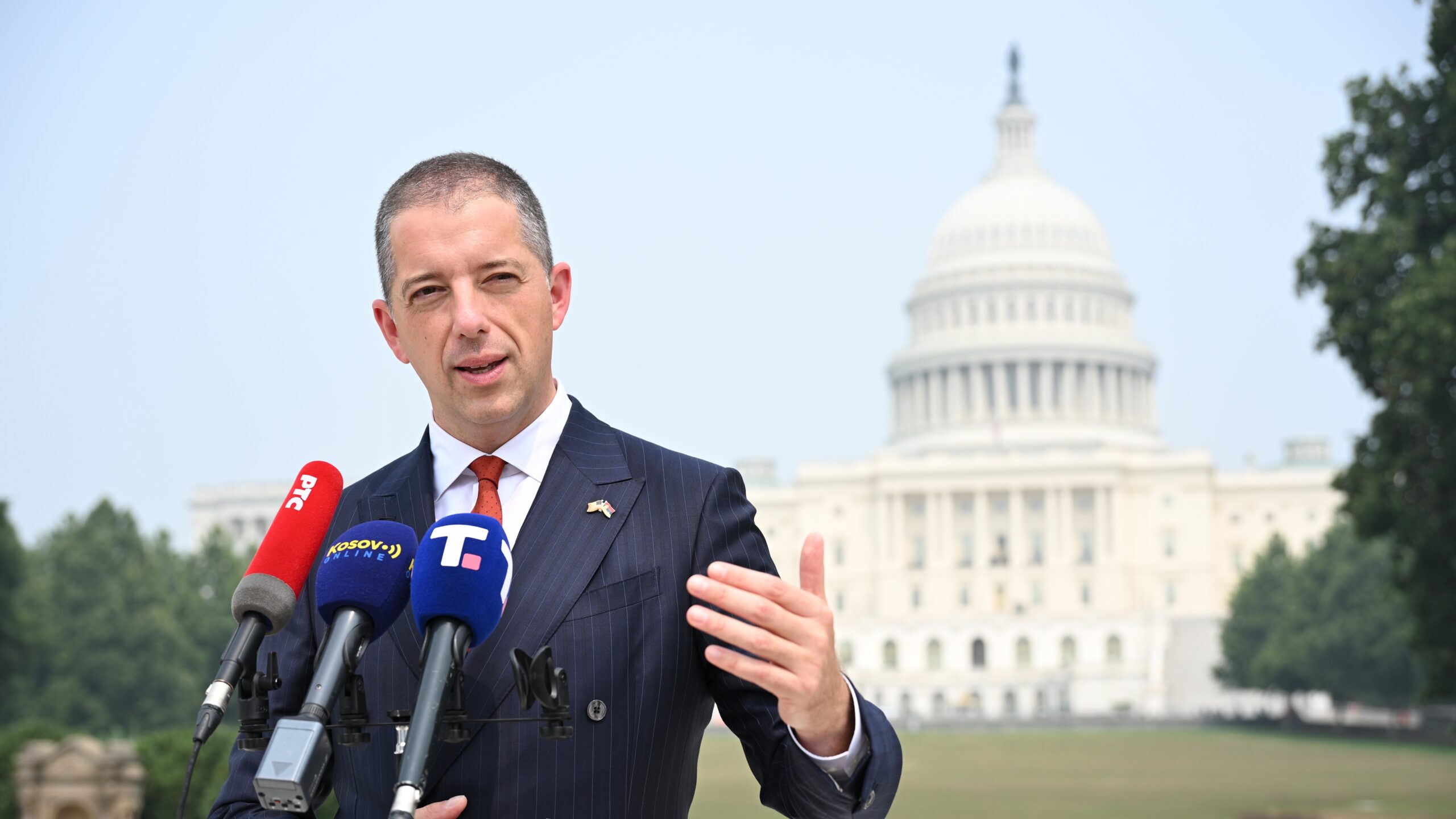
Serbia’s principal interlocutor in Washington during these years was Marko Đurić, first as ambassador to the United States between 2020 and 2024 and subsequently as foreign minister. His political trajectory illustrates the adaptability of Serbian diplomacy. Đurić is a veteran member of the Serbian nationalist movement and is remembered as one of the organizers of the 2008 protests following Kosovo’s declaration of independence, demonstrations that culminated in the burning of the U.S. Embassy in Belgrade. Less than two decades later, he emerged as one of the principal advocates of closer ties with Washington and Israel, publicly emphasizing and instrumentalizing his Jewish ancestry and using his command of Hebrew in that diplomatic outreach.
His tenure has coincided with a notable strengthening of Serbia-Israel relations. Serbia continued military cooperation with Israel after October 2023, while Elbit Systems announced an investment of approximately $2 billion in drone production facilities in Serbia, one of the company’s few manufacturing sites outside Israel. In July 2026, Đurić and Secretary of State Marco Rubio formally launched the U.S.-Serbia Strategic Dialogue, representing the most significant institutional achievement in bilateral relations during this period.
President Vučić has frequently suggested that Donald Trump enjoys broad sympathy among Serbian citizens. While Donald Trump has attracted support among parts of the Serbian-American diaspora—particularly organizations connected to Republican and MAGA political networks—public opinion within Serbia itself has generally been more mixed.
One of the clearest recent examples was the UFC Fight Night event held in Belgrade on 1 August 2026. The event, supported by approximately 260 million dinars (around €2.2 million) in government funding, featured a large “President Trump – Serbia Welcomes You” banner displayed in the presence of Trump ally Richard Grenell and Serbian Finance Minister Siniša Mali. It followed Dana White’s visit to Belgrade and two Vučić interviews promoted on Truth Social, forming a sequence of highly visible political messaging directed at audiences close to the Trump administration.
Not every attempt proved successful. Vučić’s planned visit to Mar-a-Lago in May 2025 ended amid conflicting accounts involving health concerns and reports—disputed by the White House—that he had been denied a meeting with the American president.
A more significant setback involved the proposed $500 million Kushner-backed redevelopment of the former Yugoslav Army HQ complex, destroyed during NATO’s 1999 air campaign. The project stalled after Serbian officials were indicted on allegations that documentation authorizing the demolition of the protected complex had been falsified. Kushner’s company subsequently withdrew from the project in late 2025
Behind the daily politics lies a relatively consistent set of American strategic interests.
Energy diversification remains a central priority. Washington has supported efforts to reduce Serbia’s dependence on Gazprom by applying pressure on Naftna Industrija Srbije (NIS), while Hungary’s MOL has explored acquiring controlling ownership.
Critical minerals constitute another major consideration. Serbia’s Jadar lithium deposit is viewed as one of Europe’s most significant potential sources of lithium, with the capacity to supply a substantial share of future European demand for battery production.
Serbia is also hedging with Europe. It has continued to diversify its procurement by acquiring French fighter aircraft, Spanish transport aircraft, and German helicopters, thereby gradually increasing interoperability with Western partners.
Finally, Serbia’s relatively consistent cooperation with both Israel and the United Arab Emirates distinguishes it from several other states in Southeastern Europe and contributes to its perceived strategic value within Washington.
Taken together, these interests present a more transactional rationale for engagement than the broader democracy and governance agenda that often dominated public discussions during the Biden administration.
Foreign Agents Registration Act (FARA) filings indicate that Serbia currently spends approximately $3.2–5 million annually on lobbying activities in Washington through a combination of state institutions and private entities. Government contracts involve firms including KARV, BGR Government Affairs, Valcour, CRB Global, and Yorktown Solutions, while private companies such as Millennium Team and Maneks finance additional lobbying connected to projects including Belgrade Waterfront and Expo 2027.
These lobbying efforts pursue multiple objectives, including Kosovo, U.S. sanctions affecting NIS, opposition to the Srebrenica resolution, and promotion of Expo 2027. The breadth of these objectives has, however, produced a relatively dispersed lobbying agenda that several analysts argue has struggled to overcome longstanding skepticism toward Serbia within parts of the American foreign policy establishment.
By comparison, Republika Srpska has pursued a narrower and more focused lobbying strategy. Through contracts with McGinnis Lochridge and Lucas Compton, together with the majority of Bosnia-related FARA registrations, Banja Luka concentrated on a single objective: challenging sanctions imposed on its leadership. That campaign culminated in October 2025 with the removal of Milorad Dodik and numerous associates from the U.S. Treasury sanctions list. Serbia’s considerably larger lobbying effort has generated broader access in Washington but fewer comparable policy outcomes. U.S. tariffs and sanctions affecting NIS have largely remained in place despite increased lobbying expenditures.
Montenegro Serbian politicians represent a much smaller component of this regional picture, but they are also jumping on the bandwagon of the Serbian advance in DC. The country’s most pro-Russian politician, Milan Knežević’s first visit to Washington last month included a meeting with Congresswoman Anna Paulina Luna, but otherwise consisted primarily of engagements with junior congressional and think-tank staff. His main Serbian competitor in Montenegro, Speaker of the Parliament Andrija Mandic, is engaging in DC much more effectively. His advisor, Nadja Ofner Bokan, is similarly to Marko Djuric instrumentalizing connections with the Jewish American diaspora to advance Serbian nationalist interests that are not directly under Belgrade’s control and not always aligned with Belgrade’s interests.
Congress itself remains divided in its approach to Serbia. Representative Joe Wilson has advocated removing Belgrade as host of the 2027 OSCE Parliamentary Assembly because of concerns regarding Russian, Chinese, and Iranian influence, while Representative Claudia Tenney’s Serbian Caucus hosted the Pupin Initiative’s first congressional briefing in April 2026.
Serbia’s engagement with Washington increasingly operates along two parallel tracks.
One relies heavily on political symbolism, public events, and messaging aimed at conservative audiences associated with the Trump movement. The other consists of more conventional diplomatic engagement conducted through the Serbian embassy, the Ministry of Foreign Affairs, and organizations such as the Pupin Initiative, which have sought to build longer-term institutional relationships with policymakers across party lines.
The Serbian-American diaspora reflects many of the same divisions. Some organizations have aligned themselves closely with the current Serbian government and Republican political networks, while others remain critical of President Vučić and maintain ties to Serbia’s domestic protest movements that emerged after the Novi Sad railway station canopy collapse in 2024.
Another dimension of Serbia’s relationship with Washington concerns intelligence and security cooperation.
Amnesty International’s documentation published during 2024 and 2025 alleged that Serbia’s Security Information Agency (BIA) employed surveillance technologies—including NoviSpy, Pegasus, and Cellebrite—against journalists, activists, and, in some cases, individuals associated with European institutions. Reports also pointed to pressure directed at members of the Serbian diaspora abroad. Although these allegations concern domestic and transnational security practices rather than bilateral diplomacy itself, they inevitably influence perceptions among Western intelligence and law-enforcement agencies regarding Serbia’s broader strategic orientation.
Russia’s role in Serbian politics extends beyond diplomacy alone. It is embedded in longstanding energy relationships, intelligence cooperation, political networks, and domestic narratives that have shaped Serbian politics for decades if not centuries. These structural factors limit the extent to which Serbia can—or is willing to—move decisively toward one geopolitical bloc.
Over the past decade, both the Trump I, Biden, and Trump II administrations pursued engagement with Belgrade using different methods. One emphasized institutional cooperation and gradual alignment, the other personal diplomacy and transactional politics. Both approaches produced areas of practical cooperation, particularly in defense, energy, and regional security. Neither fundamentally altered Serbia’s strategic balancing between East and West. Washington has secured greater access and achieved cooperation on specific policy questions, but Serbia continues to pursue a foreign policy that seeks to maximize flexibility rather than commit exclusively to either geopolitical camp.
Ljubomir Filipović. Montenegrin political scientist
The articles published in the “Opinions” column reflect the personal opinion of the author and may not coincide with the position of the Center