
Kremlin Propaganda Is Erasing the Culture of Remembrance of Democratic Changes in Serbia
The period between the Student List’s election victory and the constitution of the National Assembly of the Republic of Serbia was marked by the precipitous collapse, like a house of cards, of the autocratic hierarchy of the Serbian Progressive Party and Aleksandar Vučić.
Although the Serbian Progressive Party formally remained in power, immediately after the election began a wave of prosecutions, detentions, dismissals and resignations of the heads of state and public institutions, particularly those that were in the media spotlight, such as the police and public service broadcasters.
The captured state was suddenly freed. It was as if, even before the formation of the “student government”, the first demand from the student and civic protests dating back to November 2024 had begun to be implemented — that “institutions must start doing their job”.
However, have Serbia’s institutions really begun to function and started to “work”, or is this about the heads of those institutions positioning themselves ahead of the new government and settling scores among themselves within the previous system in a vacuum of political authority? The latter is more likely. The sight of sudden and mass “switching sides” to the “winners” has been witnessed during every major political change in Serbia: from the fall of communism, through the overthrow of Slobodan Milošević, to the rise to power of the former Radicals and the Serbian Progressive Party.
So, in the interregnum, the removal of traces, evidence and links to the “losers”, while political newcomers prepare to take over completely devastated institutions in a society infected with clientelism and corruption. The other factor is the “former” camp’s fear of revanchism, which many Student List voters expect in the form of some kind of civilised lustration.
Experiment in Direct Democracy
According to statements, the students are working hard on putting together the new government, while for quite some time hundreds of pages of a programme have been being written, of which during the election campaign we saw only the short version, the “11-Point Student Plan”.
With the Student List coming to power, the hourglass has been turned over and time has begun to run against the winners. Their voters’ expectations of seeing results are extremely high, and the first 6 to 12 months after the formation of the government will be decisive.
The problem is also that the Serbian Progressive Party holds power in almost all local governments in Serbia, without which it is very difficult to implement economic reforms. Aleksandar Vučić has still not fled to Moscow because he reckons that in these snap parliamentary elections he won not many fewer votes than in 2023.
The election of the prime minister of the “student government” will bring the leaderless phase of the Student List’s activity to an end. Judging by reports that the new Serbian government is being put together more at student plenums than in consultation with Student List MPs, it is obvious that the election winners have two centres of power: a social one — where the students are — and a political one — where their MPs are.
Under the Constitution of Serbia, a parliamentary mandate belongs to the MP, not to the electoral list or political organisation that nominated the list. Theoretically, if the students wanted to entrust the parliamentary mandates to the best and the smartest, then the government and ministers should also be chosen by the MPs themselves, without student plenums.
In practice, however, there is also the universal and old folk wisdom that “power tends to corrupt”. In states in transition with deep social fractures, such as Serbia, the democratic process cannot be left to the spontaneous actions of even a group of 140 of the most highly educated people who won the election. “Revolutionary justice” implies that the students continue to “monitor” those MPs, although such a practice is entirely undemocratic in parliamentary life.
A similar situation existed after 5 October 2000, when the youth and student movement Otpor launched the “We Are Watching You” campaign, with the aim of monitoring the government formed by the broad Democratic Opposition of Serbia coalition, which had then defeated Slobodan Milošević and his Socialist Party of Serbia in the election.
Will the experiment in direct democracy, which Serbian students have been successfully testing for a second year, prevail in a world of representative democracy? This is the key question, because so far the students have only fascinated us with their lawful methods of direct democracy, from student plenums to citizens’ assemblies in local governments, which, following protest gatherings, will now be able to develop into public demands and proposals, as well as civic initiatives.
Black Holes in the Culture of Remembrance
Here we return to the students from Otpor and the story of modern Serbian revolutions, within Serbia’s distorted culture of collective remembrance. It is a subject that begins with the widely accepted “Anti-Bureaucratic”, or “Yogurt Revolution”, which took place counter to the emancipatory democratic wave of 1989 in socialist South-Eastern Europe.
Political culture and the culture of remembrance in Serbia do not recognise modern democratic revolutions such as the “5 October” revolution of 2000, because Kremlin narratives about a “colour revolution” succeeded in portraying it as a coup by Serbian “mercenaries”, carried out with the help of the CIA and other Western secret services.
Every year on 5 October, Serbian Otpor activists celebrate among friends their brilliant non-violent victory over the dangerous Balkan unconvicted war criminal Slobodan Milošević, uneasy that they have to justify themselves, that they are not “traitors”, instead of taking pride in having helped Georgian, Ukrainian, Moldovan, Belarusian and other students also overthrow their post-communist dictators non-violently.
Because of the Serbian Progressive Party’s pro-Russian media narrative, even Serbian citizens are no longer sure whether they themselves brought down Milošević at the polls through mass turnout and defended the electoral will of the citizens, or whether it was an agreed “police coup”. Black holes in the culture of remembrance that threaten tomorrow to turn this new student movement too into some kind of “traitorous” movement.
In Ukraine, not only are Serbian Otpor activists remembered more than they are at home, but 21 November is the “Day of Dignity and Freedom”, an official state holiday commemorating two Ukrainian revolutions — the “Orange” Revolution of 2004 and the “Revolution of Dignity” of 2014.
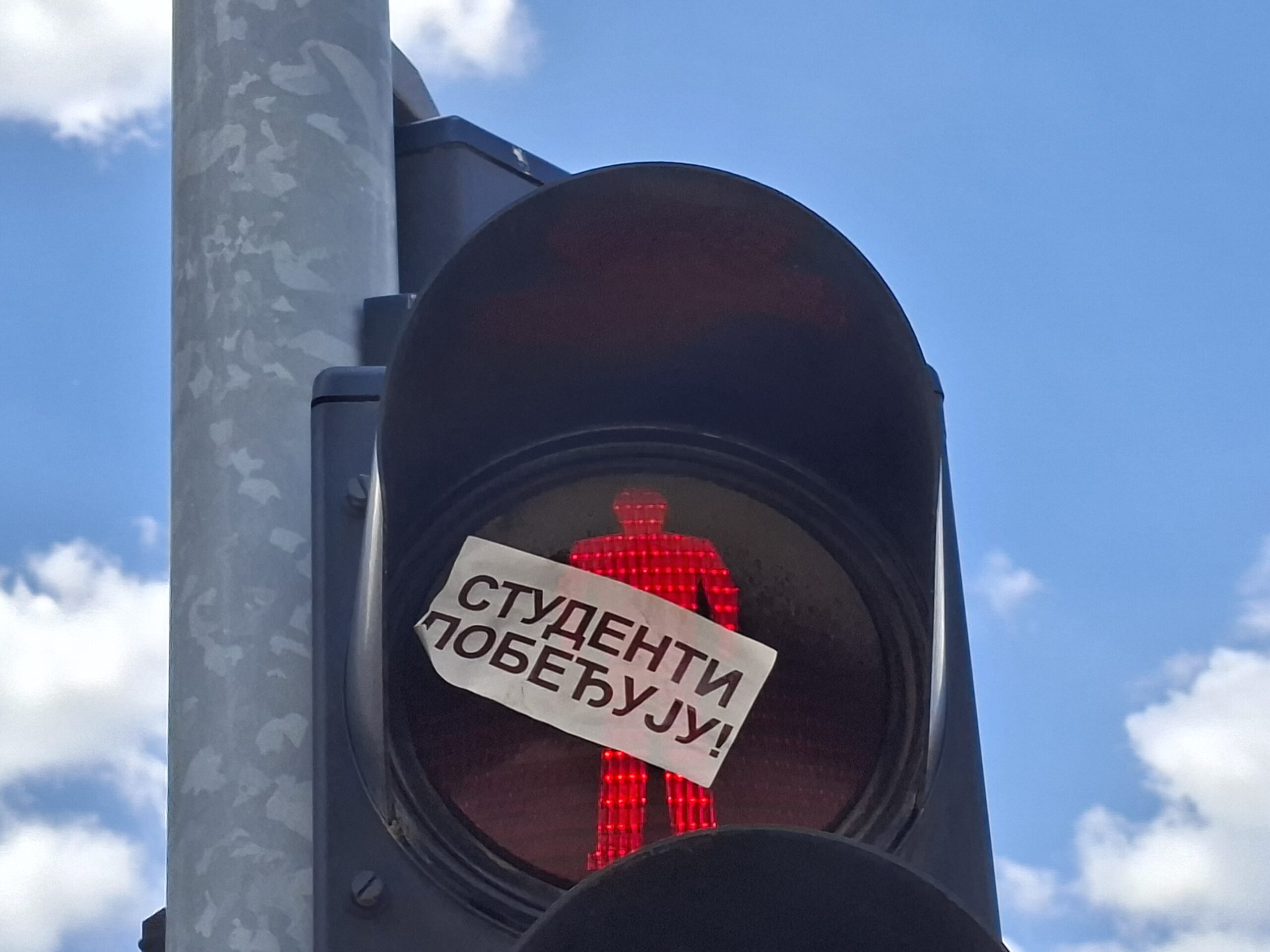
Not only have students in Serbia spent two years constantly having to justify themselves by saying that they do not want a “colour revolution”, something Vučić and the Russian propaganda machine accused them of daily, but there is also no awareness that on 25 October 2026 precisely the second Serbian “electoral revolution” took place.
And that is exactly what it is by definition: mass mobilisation of voters against an autocratic leader, intensified monitoring of the electoral process and prevention of electoral fraud, a referendum-like atmosphere and youth activism using methods of non-violent struggle.
There is no clear distinction in Serbia’s political consciousness between the time “before” and “after” the tyrant. The “victims” and the “perpetrators” get mixed up. The “permanent side-switchers” become normalised, and without any consequences they simply “cross over” from the old “losing” camp into the new “winning” one…
Only when October in the Serbian state calendar becomes a month of revolutions and part of the culture of remembrance will Serbia emerge from the “Groundhog Day” in which it has been going around in circles for decades — from the street to an autocratic leader and back.
Boris Varga. Serbian political scientist and journalist.
The articles published in the “Opinions” column reflect the personal opinion of the author and may not coincide with the position of the Center