When Viktor Orbán introduced Milorad Dodik at a conservative gathering in Budapest in March 2026 as a politician who had withstood sanctions and Western pressure, he cast Dodik’s conflict with the institutions of Bosnia and Herzegovina as part of a broader story about the persecution of conservative leaders. Dodik uses support from Budapest and Moscow, along with the contacts his lobbyists cultivate in Washington, to portray his disputes with state institutions as attacks on Republika Srpska. Citizens pay the price when dissent from those in power is portrayed as disloyalty to their own people.
Nejra Veljan, Nino Bilajac and Senada Šelo Šabić examined how Milorad Dodik uses international support in disputes with domestic institutions in their study Russian Influence and the European Right in Bosnia and Herzegovina: Dodik Between Moscow and Budapest and the Struggle over Political Belonging. The Atlantic Initiative published the study in Sarajevo in 2026. Edina Bećirević edited it, and it was produced with support from the Embassy of the Kingdom of Norway. Drawing on public appearances, official documents, lobbying filings and investigative reporting, the study examines what Dodik’s international ties mean for the institutions that oversee those in power and for the citizens who criticise them. According to a filing cited in the study, RRB Strategies distributed material on behalf of Republika Srpska highlighting Orbán’s support for Dodik. In less than three weeks, the message from the Budapest gathering had become part of the lobbying effort in Washington.
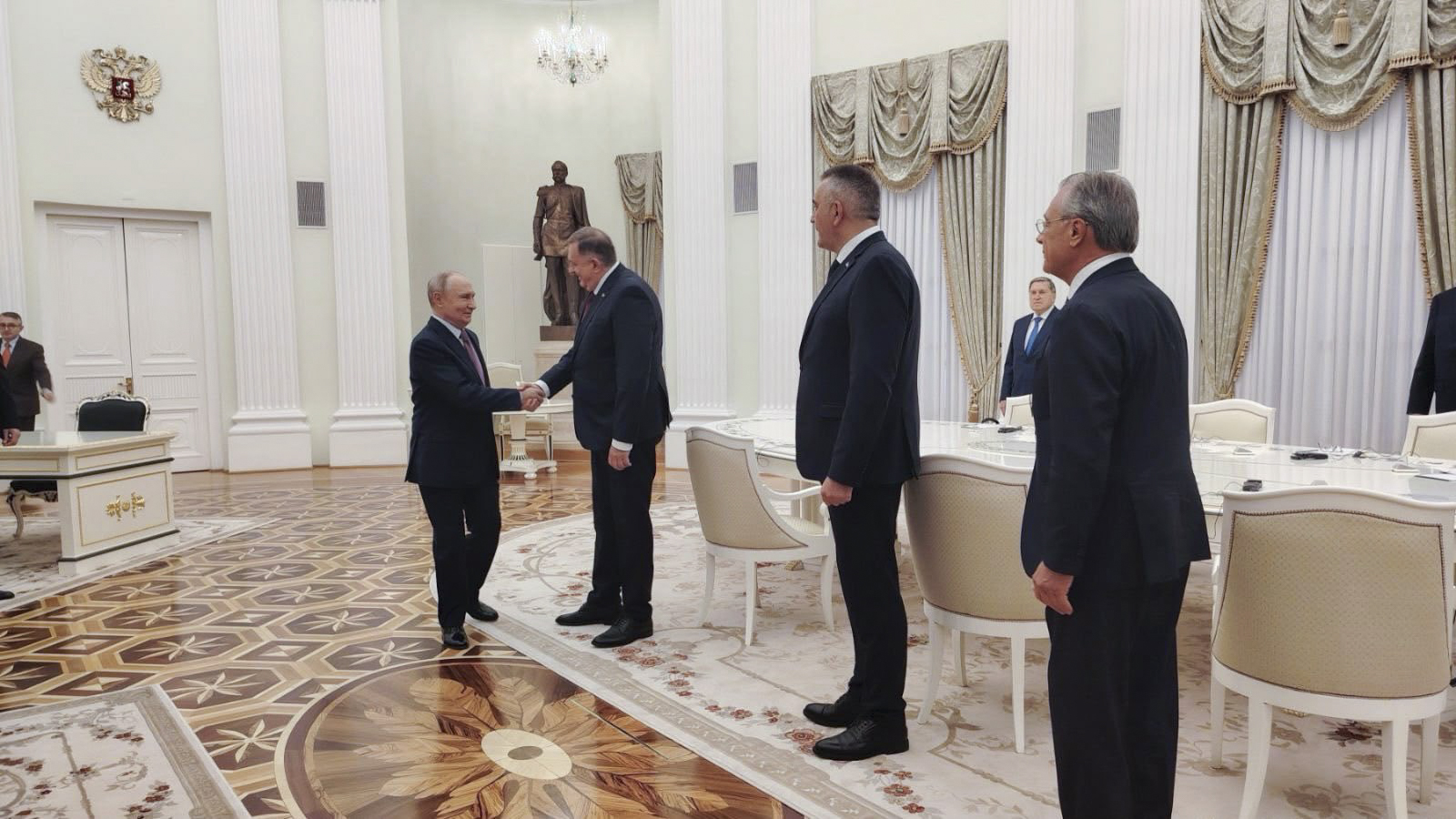
Dodik awarded Vladimir Putin a decoration in 2023. A year later, in Kazan, he reiterated his opposition to sanctions against Russia and to Bosnia and Herzegovina’s membership in NATO. When the Court of Bosnia and Herzegovina convicted Dodik at first instance in February 2025 for failing to implement decisions of the High Representative, Moscow portrayed the ruling as political persecution. The study concludes that Moscow’s response gave Dodik diplomatic backing in his challenge to the ruling. Budapest also voiced support. The court proceedings ran their course, and the Central Election Commission of Bosnia and Herzegovina issued a decision ending his term of office. The responses from his allies gave Dodik an opportunity to reframe a question of personal accountability as one of Republika Srpska’s survival.
Close ties with the government of an EU member state also carry institutional weight. EU sanctions under the Common Foreign and Security Policy require unanimity. Dodik credited his allies in the EU with the absence of sanctions, and his remarks show whom he publicly thanked. Any claim that a specific decision was blocked requires separate evidence. Orbán’s electoral defeat in April 2026 showed how much support from Budapest depends on who holds power.
In Washington, these efforts are documented in foreign lobbying filings. Materials aimed at audiences close to Donald Trump portrayed Dodik as an ally of the Make America Great Again (MAGA) movement. A contract with Dickens & Madson lists independence for Republika Srpska as the ultimate objective and calls for lobbying to remove the High Representative and lift US sanctions. The contract and its addenda provided for a total of $4 million. In October 2025, the US Treasury Department removed Dodik and some of his associates from its sanctions list. The delisting had concrete legal consequences. The contracts document the objectives and terms of the lobbying work. How much the lobbying influenced the decision remains an open question. The attendance of people close to Trump at a gathering of the Alliance of Independent Social Democrats (SNSD) shows that political contacts exist. Establishing the US administration’s position requires separate evidence.
From the 2021 Budapest summit to his appearances before US conservatives, Dodik has increasingly portrayed disputes in Bosnia and Herzegovina as a conflict between Christianity and Islam. When he makes the case for Republika Srpska’s independence to a US audience by arguing for separation from the Muslim community, Islamophobia becomes part of the case for territorial separation. This calls into question Bosniaks’ equal standing in their own country and puts pressure on Serbs to treat their leaders’ political choices as a duty to their people.
The same message about who belongs shapes how the past and public dissent are discussed. Some right-wing posts portrayed Russia’s veto of a draft resolution on Srebrenica as a defence of Serb identity. When Bisera Turković criticised the decision to honour Putin, Dodik responded by saying she deserved to be slapped, according to an example cited in the study. In both cases, discussion of a political decision gives way to a message about whose voice counts. Appeals to the traditional family have similar consequences when used to limit women’s choices or restrict the right of LGBTI people to assemble. We have documented opposition to Pride marches outside Republika Srpska as well. The attack on activists in Banja Luka in 2023 shows why protection from public authorities is essential to exercising that right.
Domestic politics also help explain why political and national belonging are tied to loyalty to those in power. The concentration of power in Republika Srpska gives the entity’s leadership more scope to put these messages into practice through its institutions. In the Federation of Bosnia and Herzegovina, the division of powers makes it harder for any one party to gain the same degree of control. Far-right groups in the Balkans often use similar rhetoric and diverge in their positions on the war in Ukraine. Some backed Russia in the name of Slavic solidarity, while others supported Ukraine for extremist reasons of their own.
The case involving the training of Moldovan nationals in Bosnia and Herzegovina puts claims about sovereignty to a practical test. Detektor and the Moldovan outlet CU SENS examined participants’ accounts, traced their journeys and investigated the training locations. Moldovan prosecutors linked the training to preparations for unrest during the 2024 presidential election and referendum. A court in Chișinău convicted three defendants at first instance. Moldova’s intelligence service attributed the coordination to Russian actors, and the Kremlin denied allegations of interference. The study examines how institutions in Bosnia and Herzegovina responded to warnings about the training. A separate investigation is needed to establish the responsibility of the organisers and anyone who may have assisted them in Bosnia and Herzegovina.
Nenad Nešić, then security minister, portrayed the warnings as political pressure over ties with Russia. The Prosecutor’s Office of Bosnia and Herzegovina opened a case and received information from the Moldovan authorities. According to Detektor’s reporting in April 2026, prosecutors in Bosnia and Herzegovina had yet to file an indictment. The study stresses that, whatever the debate over ties with Russia, the authorities need to establish who organised, funded and facilitated the training. At the time of reporting, it was unclear what the domestic authorities had established. The outcome could show how seriously Bosnia and Herzegovina takes the right of citizens of another country to decide their future free from intimidation.
When European partners overlook pressure on the media, activists or the judiciary in the interests of short-term stability, domestic leaders can portray international meetings as endorsements of the way they govern. For years, the European Commission has called on Bosnia and Herzegovina to implement the judgment in the Sejdić and Finci case and make progress on protection against discrimination, gender equality and freedom of assembly. In its 2026 report, the Commission again warned of weak oversight of the executive, pressure on activists and shortcomings in protection against discrimination. The effectiveness of European policy in Bosnia and Herzegovina can be judged by how much cooperation with domestic authorities helps protect those rights.
In the case of the training of Moldovan nationals, the study recommends that the Prosecutor’s Office of Bosnia and Herzegovina continue to investigate the allegations and cooperate with the Moldovan judicial authorities. Police and prosecutors should consistently investigate threats and attacks against journalists, activists and participants in public gatherings. Reporting on foreign alliances should specify what political statements, lobbying contracts, official decisions and court judgments each establish. For the citizens of Republika Srpska, the question is whether they can freely challenge Dodik’s decisions and alliances and publicly advocate a different future for the entity. Their ability to hold those in power to account depends on how freely they can speak and act.
Nino Bilajac. Journalist, Detektor.ba

The articles published in the “Opinions” column reflect the personal opinion of the author and may not coincide with the position of the Center