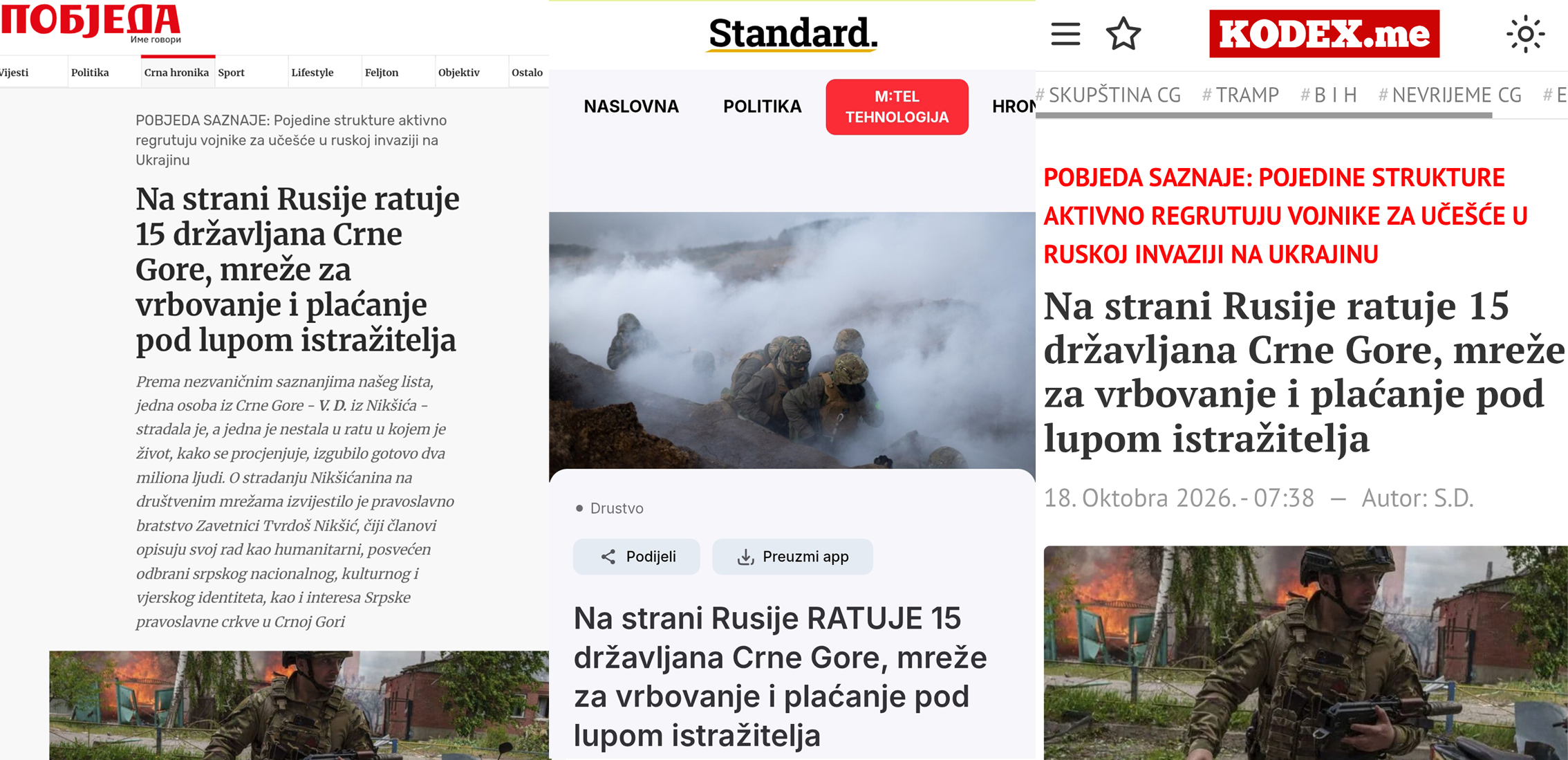
Russian military uniforms, assault rifles, patches, videos of frontline life and demonstrative support for the war against Ukraine. In recent weeks, posts from Instagram accounts belonging to people from Montenegro who, judging by their content, are serving in Russian armed formations have increasingly been discussed in the Montenegrin information space. Some are so eager to display the details of their stay in Russia that they are effectively leaving behind digital evidence for future law-enforcement scrutiny.
Several names have already appeared in public discussions — Miloš R., Zdravko S., Ilija V., Danilo O. and Vasilije P., Lazar R., Vasilije M. and Žarko P. They are natives of the Montenegrin coastal town of Budva, the country’s second-largest city, Nikšić, as well as the municipalities of Danilovgrad and Zeta (near the capital, Podgorica). Some of them clearly have criminal backgrounds. The accounts in question attracted attention because of posts featuring military symbols, armed men, Russian military personnel and materials related to the war. Some of the photographs and videos give the impression that their authors are directly present in a military environment.
It is clear that a photograph in military uniform does not in itself prove direct participation in combat, let alone on the front line. However, the sheer amount of such publicly available material raises a question that the Montenegrin state is unlikely to be able to ignore: how many people connected with the country are actually fighting against Ukraine, who is helping them join Russian formations, and what will happen after they return?
The issue is not new for Montenegro. In July 2025, the National Security Agency (ANB) told Montenegrin media that five Montenegrin citizens had fought on the side of pro-Russian formations during the war in eastern Ukraine in 2014–2015. One of them was convicted after returning, while the others, according to the security service, did not return to the country. At the same time, the ANB stated at the time that, since the beginning of Russia’s full-scale invasion in February 2022, it had no confirmed information about new Montenegrin participants in the war.
Today, that picture already appears incomplete, as the presence of Montenegrin citizens in the ranks of the army of the aggressor state has become evident. Over the past year, new criminal proceedings, publicly available materials and evidence have emerged that provide grounds for discussing the problem in much more concrete terms. There is still no reliable overall figure for the number of such people, but that number is clearly growing.
From Orthodox Radicalism to a Russian Contract
Why does a citizen of a small Balkan state that has been a NATO member for almost a decade and is moving closer to EU accession decide to go and fight for Russia at all?
There is no universal answer. Behind the outward similarity of the military symbolism may lie different biographies, motives and personal circumstances. Often, the point is that for them Russia is first and foremost an ideological reference point. For others, participation in the war may be a way to earn money or resolve their own financial problems, or to escape debts or criminal prosecution at home. Moreover, there are also adventure-seeking individuals from criminal circles who are attracted by money, weapons, violence and the opportunity to change their own situation.
The ideological component is clearly the most visible. Within part of Montenegro’s radicalised pro-Serbian milieu, Russia has for years been portrayed as the last great defender of Orthodoxy, the Serbian people and traditional values. In such a worldview, the war against Ukraine is perceived not through the lens of international law or the issue of territorial integrity, but as a confrontation between Russia and NATO and the collective West.
This worldview took shape long before 2022. It was sustained by political statements, certain media outlets, nationalist organisations and the dissemination of Russian propaganda. Ukraine is usually portrayed not as an independent state defending itself against aggression, but as an instrument of Western policy against Moscow.
It is important, however, not to conflate the Orthodox faith or Serbian national identity with radicalism. Among Montenegrin Serbs, there is no universally unequivocal approval of Russia’s war of aggression against Ukraine. Nevertheless, it is this milieu that is characterised by strong Russophile sentiments and scepticism towards the United States, Europe and NATO. The problem of Russophilia turning into concrete involvement in the war against Ukraine on the Russian side is created by a particular “charged” segment of the political and information environment, where religious and national symbols are used to justify Russian aggression and romanticise military service on Moscow’s side. Unfortunately, the Serbian Orthodox Church also plays a significant role in these processes: it is the largest religious denomination in Montenegro and, at the same time, a key pro-Russian social institution.
The Russian army, in turn, offers a quite tangible extension of these beliefs. Foreigners are recruited for contract service through promises of substantial one-off payments, monthly pay and other benefits. For a person with debts, unstable income or no prospects in life, such an offer may prove more compelling than ideological arguments.
Thus, a hypothetical Balkan volunteer is not necessarily a convinced follower of Russian imperialism. He may combine sympathy for Putin with pragmatic calculation, personal problems and a willingness to make money from the war.
A separate component of the problem of mercenaries from Montenegro is the possible connection with criminal circles. In Montenegro, where the activities of organised criminal groups remain one of the serious challenges facing the state, the participation of people with criminal backgrounds in foreign military formations requires particular attention. Combat training, familiarity with weapons, contacts with Russian military personnel and the possibility of receiving funds from abroad create risks that extend far beyond the Ukrainian front. Based on information from available open sources, it is already possible to speak of the existence of one or several organised networks of Montenegrin mercenaries. This can be seen even from the public social-media communications of the individuals concerned, who boast about their presence in the ranks of Russian armed formations (ideological affinity, photographs together, and so on).
Operation “Luhansk”: The Problem Has Ceased to Be Theoretical
The most telling publicly documented law-enforcement episode was Operation “Luhansk”, conducted by the Montenegrin police on 27 November 2025.
Danko S. was detained in Danilovgrad at the time, and prosecutors charged him with participation in a Russian armed formation in the occupied territory of Ukraine. During the operation, law-enforcement officers searched 13 locations in Danilovgrad, Podgorica and Nikšić. Twenty-four firearms, more than a thousand rounds of ammunition, military uniforms, equipment, foreign documents and symbols of armed formations were seized.
The police also reported €1.5 million in the main suspect’s account, linking those funds to his alleged participation in the war. The accused later denied these claims and also stated that he was not a citizen of Montenegro. In February 2026, the Higher Court in Podgorica considered the issue of confirming his Russian citizenship. According to the indictment, he is charged with participation in a pro-Russian formation between September 2023 and September 2024. Danko S. denies his guilt.
This case cannot automatically be included in the statistics on Montenegrin citizens who fought for Russia, since the accused’s citizenship is the subject of a judicial dispute. However, the operation in question showed that there are already definitely people on Montenegrin territory whose participation in Russian armed formations, financial transactions and links with specific paramilitary milieus investigators have grounds to examine.
The weapons deserve particular attention. The seizure of a large quantity of weaponry illustrates well how complex the criminal infrastructure surrounding milieus that come to the attention of law enforcement can be.
This is where the most troubling question arises: are people returning from Russia’s war merely individual offenders, or are they capable of becoming part of already existing local networks associated with violence, illegal weapons and radical political movements?
There is yet no complete and definitive answer. But for a state with a population of just over 620,000, even a small number of such people can pose a noticeable problem for the law-enforcement system. Especially in the future, when such experienced individuals may readily return with their “baggage of experience” to the ranks of mafia clans and may become effective Russian agents for destabilisation and hybrid operations in Montenegro.
Social Media as a Showcase for War and Possible Recruitment
Another feature of the current situation is its public nature. Russian military personnel and their foreign supporters readily use Instagram, Telegram and TikTok to display military life. There, war often appears as a combination of adventure, male brotherhood, nationalist romanticism and an opportunity to make money quickly.
This is precisely why social media are of dual interest to law enforcement.
First, they may contain digital evidence: photographs, dates, distinctive military insignia, videos from particular locations, information about stays in Russia or contacts with other military personnel. Taken together, such materials sometimes make it possible to reconstruct the general sequence of events even without access to closed state registers.
Second, the very display of service in the Russian army may influence other people. Particularly when military posts are accompanied by approving comments, ideological slogans, accounts of material benefits or invitations to join.
The extent to which this develops into organised recruitment of Montenegrin citizens still needs to be established. But it is precisely this aspect that is of particular interest. After all, there is a fundamental difference between a person who independently travels to Russia and signs a contract and a group of people who help others prepare documents, organise trips, provide contacts with Russian military structures or receive payment for doing so.
Such intermediaries, if their activities are established, would pose a significantly more serious threat than individual enthusiasts of military symbolism.
Indeed, social media are gradually becoming for the Russian military machine not only a means of propaganda but also a space for normalising contract military service. A person who today poses for photographs with a Russian flag and shares videos from the front may tomorrow become an example for someone in their circle.
The Law Exists. The Question Is Its Enforcement
Participation in foreign armed formations has been criminalised in Montenegro since 2015.
Article 449b of the Criminal Code provides for imprisonment of between six months and five years for unlawful participation in such formations, and between two and ten years’ imprisonment for organising, recruiting, preparing or transporting people for that purpose. The law also covers certain forms of financing such activities. Thus, the problem is not the absence of a legal framework.
As early as 2017, a sentence was handed down in Podgorica for the participation of a Montenegrin citizen in an armed formation of the self-proclaimed “DPR” (Donetsk People’s Republic). Relevant case law exists, although it remains limited.
Effective prosecution requires proper evidence of participation in a formation, identification of the individual and their legal status, and confirmation of the relevant actions abroad. In some cases, acquisition of another citizenship may create an additional complication. The case of the above-mentioned Danko S. can be regarded as an example of how important these circumstances become.
Systematic work is therefore required from the police, the prosecution service and the ANB. First and foremost, this concerns, of course, establishing the actual number of people connected with Montenegro who are serving in Russian formations; investigating possible local recruiters; monitoring illegal financial flows; and assessing the risks associated with the return of people who have acquired combat experience.
The last aspect deserves separate attention, because the combination of military training, experience of violence, radical beliefs and possible criminal connections creates risks that the state is obliged to assess. For Montenegro as a NATO member, possible contacts between such individuals and Russian military and intelligence structures are also of additional significance.
The absence of public reports about new cases does not yet mean that law enforcement is doing nothing. But the public has the right to general information about the scale of the problem and the results of the application of the law.
At the beginning of October, Montenegrin institutions already demonstrated activity regarding Russian-related security risks. On 9 October, the police and the ANB detained and subsequently expelled from the country sanctioned Mikhail Zvinchuk, head of the Russian pro-war information project Rybar, together with several of his employees. The operation attracted considerable attention because of the network’s role in disseminating Kremlin propaganda. This is a separate case, but it points to a broader security context — namely, that Russian activity in Montenegro has long ceased to be limited to statements by the embassy, the political sympathies of individual parties, local clergy of the Serbian Orthodox Church or disputes over sanctions.
Russian influence takes various forms — from information campaigns to personal contacts, travel and the activities of people interested in military cooperation with Moscow. And each of these manifestations requires its own legal assessment.
Montenegro is in the final phase of negotiations on accession to the EU. Its foreign-policy course provides for full alignment with European sanctions against Russia and support for Ukraine’s territorial integrity. This is a fundamental difference from that part of the domestic political environment where the war against Ukraine is still perceived as an acceptable or even heroic cause.
That is precisely why the story of Montenegrin participants in Russia’s war is currently so sensitive and important. It concerns the state’s ability to contain radicalisation, counter the possible recruitment of its citizens and prevent the emergence of new centres of violence after people return from the front.
How many such people there actually are — five, ten or more — is currently not known with certainty. Social media do not replace a register of participants in the war, but it would also be unwise to ignore their content. Especially now, when users themselves are increasingly displaying what would normally have to be established during lengthy investigations.
Individual Montenegrin politicians may explain support for Russia as much as they like by citing historical closeness, Orthodox brotherhood or criticism of NATO. But the participation of people connected with Montenegro in the war against Ukraine is an entirely different matter. It has a specific criminal-law and security dimension.
And if these people eventually return home, the country will have to deal not with abstract Russian propaganda, but with its very real consequences.
CWBS Analytical Group