
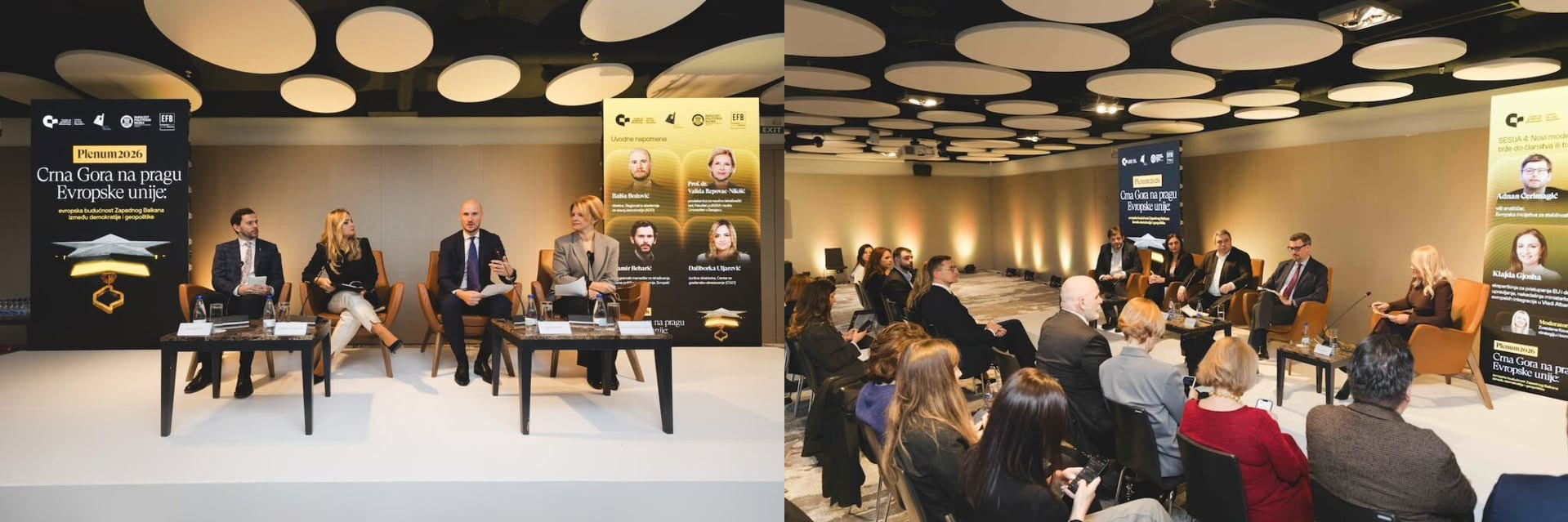
At the PLENUM 2026 Regional Conference in Podgorica, participants discussed Russian hybrid threats and their consequences for Europe and the Western Balkans.
“Sabotage, propaganda and disinformation are part of Russia’s efforts to destabilise European societies, weaken support for Ukraine and deepen citizens’ distrust of institutions. The response requires stronger European defence, the ability to react quickly and more resilient institutions,” stressed Balša Božović, founder and director of the Regional Academy for Democratic Development, summing up the discussion held as part of the forum.
“Participants highlighted the importance of developing European defence capabilities in coordination with NATO, as well as preparing the civilian population to face contemporary security risks,” he stressed.
The Western Balkans Are Particularly Vulnerable to Russian Influence
At the conference’s concluding thematic session, “Europe Between Russian Threats and Uncertain NATO Guarantees”, the discussion focused on growing security threats to Europe, including sabotage, attacks on critical infrastructure and hybrid operations, as well as the reliability of collective defence amid changing political relations within NATO. Particular attention was devoted to strengthening European defence capabilities, supporting Ukraine and the consequences of security uncertainty for the Western Balkans.
As was emphasised, Europe must develop its own defence capabilities more intensely, but without duplicating existing NATO mechanisms, because reliable collective defence requires updated military plans, the ability to react quickly and the resilience of the civilian population. At the same time, through sabotage, hybrid operations, propaganda and disinformation, Russia is seeking to destabilise European societies, weaken support for Ukraine and deepen citizens’ distrust of institutions. The Western Balkans are particularly vulnerable to such influences, which is why stronger institutions, greater societal resilience and a coordinated security response are necessary.
Nikola Lunić, a geopolitical and security analyst, noted that, in the context of the war in Ukraine, Russia is seeking to destabilise other parts of the world in order to divert international attention and weaken support for Ukraine, as was also demonstrated during the escalation of the conflict in the Middle East. He stressed that hybrid threats have become an integral part of the contemporary security environment, to which the Western Balkans are particularly exposed. He warned of the danger of sabotage, citing the example of the explosions at the Sloboda factory in Čačak in 2021, the circumstances of which, according to him, have not been sufficiently clarified, as well as six cases of sabotage in the European military industry during this year. He recalled that at the Washington Summit NATO recognised the seriousness of hybrid threats, which can reach a level that would justify the activation of Article 5, that is, the collective defence mechanism.
“The Student Movement Recognises That Serbia’s Future Is in the West and the EU”
Speaking about Russian influence in Serbia, Lunić assessed that Moscow does not rely on a single political actor, but is building a broad network of influence. “Russia is not betting on one horse in Serbia; it has bought the entire stable and the whole racecourse,” he said, linking such activity to the concepts of the so-called “Serbian World”, promoted by Aleksandar Vulin, and “Serbian integralism”, advocated by Milo Lompar. He also criticised the way security policy is implemented in Serbia, assessing that the ministries function like separate fiefdoms, which, according to him, allowed Vulin to incorporate cooperation with Russian services into strategic documents.
Reflecting on the political changes in Serbia, he expressed his conviction that “the student movement recognises that the country’s future is in the West and the EU”. He stressed that the elections were not a referendum on foreign policy or Kosovo, but on crime and the character of the previous government. “The horizontal structure of the student movement made attempts to undermine it more difficult, but now, as it takes power, it will also have to build a vertical structure,” Lunić said, noting that the new authorities face the stabilisation of the state and the formulation of a serious national and security strategy.
“Propaganda Is Increasingly Relying on Cultural and Values-Based Themes”
Nejra Veljan, Project Manager and Researcher at the Atlantic Initiative, noted that Russian propaganda cannot be viewed separately from citizens’ distrust of institutions, which creates fertile ground for disinformation and manipulation. She particularly highlighted the concept of cognitive warfare, whose aim is not necessarily to make citizens believe particular falsehoods, but to overwhelm them with information to such an extent that they lose the ability to distinguish reliable sources. “Russia is not trying so much to convince citizens that it is right as to convince them that they cannot trust the West,” Veljan stressed, explaining that propaganda is increasingly relying on cultural and values-based themes.
According to research by the Atlantic Initiative, issues concerning the traditional family, the position of women and sexual minorities are particularly instrumentalised, through which the West is presented as a threat to tradition and Russia as its protector. Such narratives deliberately target citizens’ emotions, particularly in patriarchal societies. As an example, she cited the Russian propaganda network Rybar, which is active in Bosnia and Herzegovina, Serbia and Montenegro and whose activities, according to her, include not only the production of propaganda content but also connections with institutions.
Scepticism About the Readiness of Bosnia and Herzegovina’s Institutions to Counter Russian Influence
Nejra Veljan expressed scepticism about the readiness of Bosnia and Herzegovina’s institutions to counter Russian influence, warning that some domestic politicians advocate positions that coincide with Russian interests, while the security services lack sufficient capacity to respond.
“In Bosnia and Herzegovina, we currently have more than 150 active networks on Telegram, including extremist and right-wing groups, as well as pro-Russian channels that disseminate content about NATO, Ukraine, the Western Balkans and gender issues,” Veljan stated. She warned that such content is flooding social media, which are the main source of information for young people. Similar patterns of information influence can also be recognised in Germany through support for the AfD. She concluded that Bosnia and Herzegovina still lacks stronger social mobilisation of young people of the kind present in some other countries in the region and Europe.
“Today There Is Greater Awareness of Russian Influence”
Milica Pejanović Đurišić, former Minister of Defence of Montenegro and diplomat, speaking about Russian influence during the session “Montenegro on the Threshold of the European Union: The European Future of the Western Balkans Between Democracy and Geopolitics”, noted that Montenegro recognised relatively early the risks it posed to democratic processes and European and Euro-Atlantic integration. She recalled attempts to polarise society and slow reforms during the process of accession to NATO, stating that it later became clear that Russia’s opposition was directed at the broader integration process. “However quixotic the struggle to draw attention to this influence may at times have seemed, our society recognised the risks and increased its level of caution,” she stated.
She assessed that today there is greater awareness of Russian influence, while institutions, despite their weaknesses, are gradually strengthening their capacities to recognise and counter it, with the support of the European Commission and its mechanisms. “It is not perfect, but it is better than ten years ago,” Pejanović Đurišić concluded, while at the same time expressing dissatisfaction with the current situation in the relevant institutions.
* * *
The PLENUM 2026 Regional Conference was jointly organised by the Centre for Civic Education (CCE) from Podgorica, the Regional Academy for Democratic Development (ADD) from Novi Sad, the Faculty of Political Sciences of the University of Sarajevo (FPN) and the European Fund for the Balkans (EFB). The forum brought together more than 70 representatives of institutions, the academic community and civil society, as well as experts from Montenegro, the Western Balkans region and the European Union.
The publication was prepared on the basis of materials from the Regional Academy for Democratic Development.
Analitička grupa CWBS-a