More than two and a half years have passed since the armed incident in the village of Banjska in northern Kosovo brought the region to the brink of a new war. Yet to this day, those responsible for organizing and carrying out the attack have not been punished — primarily due to the position of official Belgrade.
It is likely that the Serbian authorities presumed that, against the backdrop of global geopolitical upheavals, the shootout in some Balkan village would quickly be forgotten. But this did not happen. Public statements by NATO leadership and the previously expressed position of the EU demonstrate that the “Banjska case” remains in focus in Brussels, and that there is no intention to turn a blind eye to the impunity of those involved in the attack.
A Reminder from NATO
On 26 January 2026, NATO Secretary General Mark Rutte once again stated that NATO expects those responsible for the armed incident in Banjska, as well as for the attack on KFOR soldiers in Zvečan, to be brought to justice. Speaking at a joint meeting of two committees of the European Parliament — the Committee on Foreign Affairs and the Committee on Security and Defence — Rutte said:
“I have personal relations with President Aleksandar Vučić. We have known each other for many years. But of course, we expect him to establish accountability for what happened several years ago, on two issues. On both, he promised full accountability for those responsible.”
Although the NATO Secretary General has made similar statements several times over the past two and a half years, some commentators interpreted this appearance by Rutte as a “final warning” and as the end of the period during which Vučić was taken “at his word.” NATO, they argue, now wants to finally see concrete results — punishment of those responsible for the attacks in northern Kosovo.
It is noteworthy that Rutte voiced his warning precisely in the European Parliament. The EU, like NATO, has repeatedly pointed out to Belgrade the lack of progress in investigating and punishing those responsible in the “Banjska case.”
Since 2023, the Banjska incident has been mentioned in the European Commission’s annual reports on Serbia as one of the key problematic episodes in the fields of security and the rule of law. The reports emphasize that Serbia has not demonstrated progress in the investigation, even though indicting the organizers of the Banjska attack is one of the obligations Serbia undertook within the framework of opening Cluster 3 of accession negotiations with the EU.
Angry Citizens or Militants?
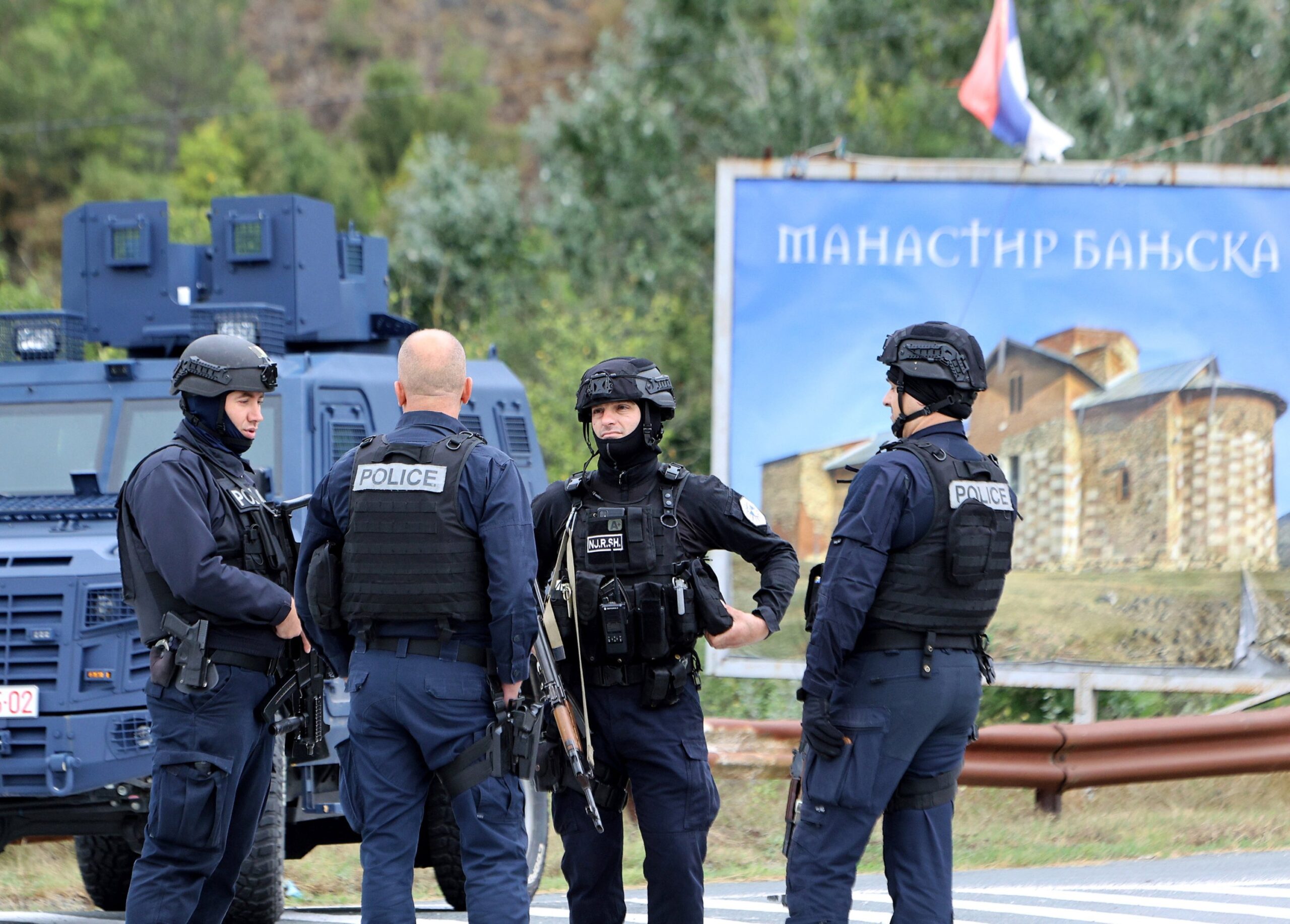
It should be recalled that on the night of 24 September 2023, near the village of Banjska in northern Kosovo, a group of approximately 30–40 well-armed militants blocked a bridge using two trucks without license plates. At around 2 a.m., these actions were recorded by video cameras. A Kosovo Police border patrol, which had just completed its shift, received orders to photograph the vehicles, which were believed to belong to smugglers.
At around 3:30 a.m., surveillance footage shows a group of armed individuals approaching the bridge in vehicles. Shortly thereafter, police reinforcements arrived. It was at that moment that an explosion occurred (of a Yugoslav-made MRUD anti-personnel mine), killing a police officer. The armed men then fired at the police using Zolja anti-tank rocket launchers. The police returned fire, eventually blocking the attackers within the premises of the Banjska Monastery.
It is known that three attackers were killed, but reports indicated that others were wounded and received medical treatment in Serbia.
Only two individuals were arrested at the scene — Blagoje Spasojević and Vladimir Tolić, both armed and dressed in camouflage uniforms. A third man, Dušan Maksimović, was detained the following day.
Representatives of the Kosovo Security Force emphasized that, given the weaponry and coordination of the armed group, the attack on the police in Banjska was carried out by specially trained militants.
The Radoičić Operation
In September 2024, the Kosovo Special Prosecution filed indictments against 45 individuals for terrorism and serious crimes against the constitutional order and security of Kosovo. The indictment claims that the armed group aimed to detach the northern part of the territory of the Republic of Kosovo and annex it to Serbia.
Trial proceedings are ongoing in Pristina against the three Serbs arrested after the Banjska incident — Maksimović, Tolić, and Spasojević. The other defendants remain unavailable to Kosovo’s justice system.
The central figure in the case is Milan Radoičić, at the time of the Banjska events the deputy chairman of the party Serbian List.
A few days after the attack, Radoičić stated that he was taking full responsibility for the attack and was resigning from his leadership position in the party. He described the events in Banjska as a “defensive” operation against the “terror” allegedly launched by Kosovo against Serbs. Radoičić emphasized that he had not informed either Serbian List or the Serbian authorities in advance of his plans and had received no support from them.
“I personally managed all the logistics to defend our people from the occupiers, and my actions have nothing to do with my previous political activity,” he stated through his lawyer.
The Belgrade Trail
Kosovo investigators and investigative journalists claim that the Serbian “operation in Banjska” could not have been Radoičić’s personal initiative and that his group received systematic support from Belgrade.
As evidence of the involvement of Serbian state structures in preparing the Banjska attack, they cite the weapons confiscated from those involved.
A BIRN investigation revealed that mortar shells and anti-tank rocket launchers passed through state maintenance facilities in central Serbia in 2018 and 2021.
As for the Zolja launchers, experts told BIRN that packaged launchers of this type rarely appear on the black market due to strict controls over their use.
In addition, according to the Kosovo prosecution, a few days before the Banjska events, Radoičić’s group trained at the Pasuljanske Livade military training ground in central Serbia.
It should be noted that all this evidence is denied in Belgrade, which argues that weapons of Serbian manufacture are also used by the Kosovo Police, and that training at the range involved reservists, including Serbian citizens from Kosovo.
Court and Investigation
Currently, proceedings in Kosovo in the Banjska terrorist attack case are at the final stage.
Kosovo lawyers are confident that the evidence is sufficient to convict the defendants, although the absence of trials in absentia for the majority of the group remains a challenge. Amer Alija from the Humanitarian Law Center also assesses the evidentiary base as sufficient and expects a first-instance verdict in 2026.
In Serbia, an investigation into Radoičić was opened in September 2023. In October 2023, he was questioned by Belgrade prosecutors. After the questioning, he was released under travel restrictions.
As of early 2026, Milan Radoičić remains at liberty in Serbia. Journalists periodically publish evidence of Radoičić’s presence at pro-government events. The Serbian prosecution states that it is “continuing to collect evidence” and has not brought formal charges.
Who Benefits?
Immediately after the incident and later, President Aleksandar Vučić emphasized that the cause of the armed confrontation in Banjska was the “terror of Albin Kurti’s government” against Serbs, claiming that Serbs were forced to defend themselves.
The same viewpoint was expressed by official Moscow. Russian Ministry of Foreign Affairs spokesperson Maria Zakharova, just hours after the shootout in Banjska, called the conflict a consequence of Pristina’s course toward “inciting conflict and cleansing the region of Serbs.”
In turn, Kosovo leaders stressed that the Banjska attack was an attempt by Belgrade to repeat a hybrid conflict scenario implemented by Russia in Crimea and Donbas in 2014.
However, although officials in Pristina spoke of a “Crimean scenario,” the Serbian leadership did not cross the line and did not move to direct military intervention in support of the “Radoičić group” — that is, “to protect the Serbian population of Kosovo and Metohija” — limiting itself to moral support and blocking the investigation.
Conclusions
The Banjska incident cannot be viewed as a minor local episode. The events of September 2023 demonstrated the readiness of certain forces in Serbia to implement radical force-based scenarios in Kosovo, Moscow’s readiness at least at the political level to support a Serbian attempt to escalate the situation in Kosovo, and the limited willingness of official Belgrade to support “armed Serbian patriots.” Yet even the half-hearted position of the Serbian leadership appears to contribute to destabilization in the region. It is therefore logical that NATO and the EU are trying to halt this escalation trend. As the overwhelming majority of independent experts are convinced, the development of the situation in the region along a destabilization scenario benefits only Moscow.
CWBS Analytical Group