Serbia does not know where it wants to be, and this is already an inherited generational problem
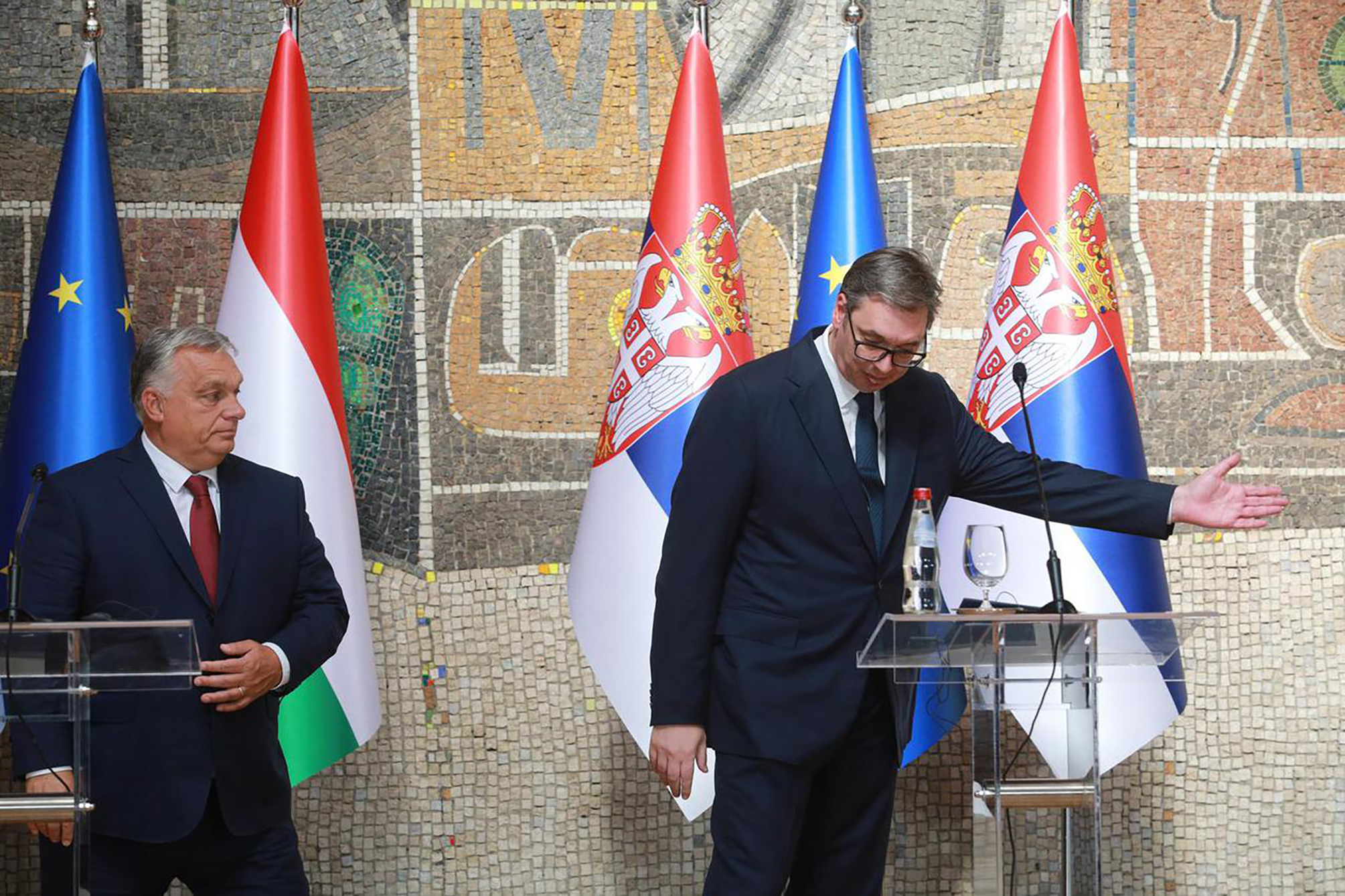
The victory of Peter Magyar and his party Tisza in the parliamentary elections in Hungary was celebrated the most in neighboring Serbia. First, because the defeated prime minister Viktor Orbán is a friend and protector of the Serbian president Aleksandar Vučić. And second, even more importantly — because it demonstrated in practice how an autocrat, after many years in power, can be defeated through elections.
In these sincere congratulations from Serbia, there are excessive hopes and unrealistic expectations, but this is understandable because for students and citizens who oppose the unchanging rule of Vučić, what is most important at the moment is enthusiasm.
Undoubtedly, this is a classic Central European peaceful “electoral revolution,” a term for a political phenomenon in which the opposition defeats an autocratic leader under electoral conditions favorable to him only. Such a model has already been observed in Slovakia with Vladimír Mečiar (1998) and in Croatia with Franjo Tuđman (2000).
Could you imagine that Vučić congratulates the rector of the University of Belgrade, Vladan Đokić, on winning the elections, as Orbán did? Not at all. Serbia is following its own, an already seen, scenario, where the victory of students and the opposition in fair elections is possible only with the physical defense of ballot boxes and the will of voters in the streets.
This is how Slobodan Milošević was defeated (2000), as well as other, tougher post-communist autocratic regimes, such as that of Eduard Shevardnadze in Georgia in the “Rose Revolution” (2003), that of Leonid Kuchma in Ukraine in the “Orange Revolution” (2004), and that of Askar Akayev in Kyrgyzstan in the “Tulip Revolution” (2005). These are the so-called “color revolutions” that both small and large authoritarians — from Vučić to Putin and Xi Jinping — fear so much.
Lessons from Hungary
The lessons are there, but are there actors for any of these scenarios? Although the student movement in Serbia in 2024–26 is avant-garde in nature and leaves a stirring impression, it is still not politically structured or definite in values. The lessons that students learned in the previous local elections are precious, but they are not sufficient for a decisive match against Vučić’s well-organized regime, which is ready to do anything just to remain in power.
Students still do not put forward the names of candidates and leaders for the expected parliamentary elections, who would have to be charismatic like the aforementioned rector Đokić. The future student political option must have a clear political program with people who are proven experts, and in the recent local elections this issue was quite “thin.”
Peter Magyar is a relatively young politician with a mandate given to him by voters to repair, both domestically and internationally, what Orbán has eroded in democracy. Institutions in Serbia are ruined far more than in Hungary, and the day after the imaginal victory of students and the opposition, everything will be devastated almost as it was after the fall of Slobodan Milošević.
It is believed that young cadres will one day enter Serbia’s institutions, as happened in Ukraine when the option of President Volodymyr Zelenskyy won. Will students and their candidates be able to resist the radical trap of Serbia’s relations with the EU and NATO, the independence of Kosovo, the crimes and genocide of the 1990s in Bosnia and Herzegovina, expansionism in Montenegro? These are rhetorical questions.
The Endless Vortex of Revolution
Vučić has been left without Orbán — a comrade, advocate, and protector in the EU. And not only him, but also the entire populist coalition gathered around his Patriots for Europe, of which the Hungarian prime minister was the spiritus movens in the European Parliament.
The situation in Central Europe is similar to that of the late 1990s, when in several post-socialist states the fear of the dissatisfied and nostalgia for a “strong-hand” leader were exploited. It is even more critical now, when populists receive far greater support from outside, including from super-dictators. The stance toward the war in Ukraine was not a moral principle, so Orbán had the support of Trump, Putin, and Xi.
And that support did not help him, which is symbolically perhaps the greatest victory on the 70th anniversary of the “Hungarian Revolution of 1956.” The people of Hungary chose not to be on the other side of the “Iron Curtain.”
Serbia does not know where it wants to be, and this is already an inherited problem. The new generations and students protesting against Vučić are disappointed in the EU, but if they fail to bring about change in Serbia, they will not go to study and work in Moscow or Beijing.
Before confronting corruption, Serbia must resolve a civilizational question of whether it wants to be part of the EU at all or not. There are no conditions whatsoever for a new Tito-style non-aligned Yugoslavia, while the closet of official Belgrade is full of “skeletons” from Croatia, genocide in Bosnia and Herzegovina, and ethnic cleansing in Kosovo.
Transitional justice has not been achieved, nor is there a desire to discover the truth about the wars of the 1990s, and for some time yet no one will repent for the crimes of their fathers and grandfathers. Serbia is stuck in 1989 with the question “where to next?”. The street will remain the main political institution in Serbia for the foreseeable future, an endless vortex of rebellion, and in “electoral revolutions” nationalists and populists will replace one another — Milošević, Vučić, and others like them.
Boris Varga. Serbian political scientist and journalist.
The articles published in the “Opinions” column reflect the personal opinion of the author and may not coincide with the position of the Center