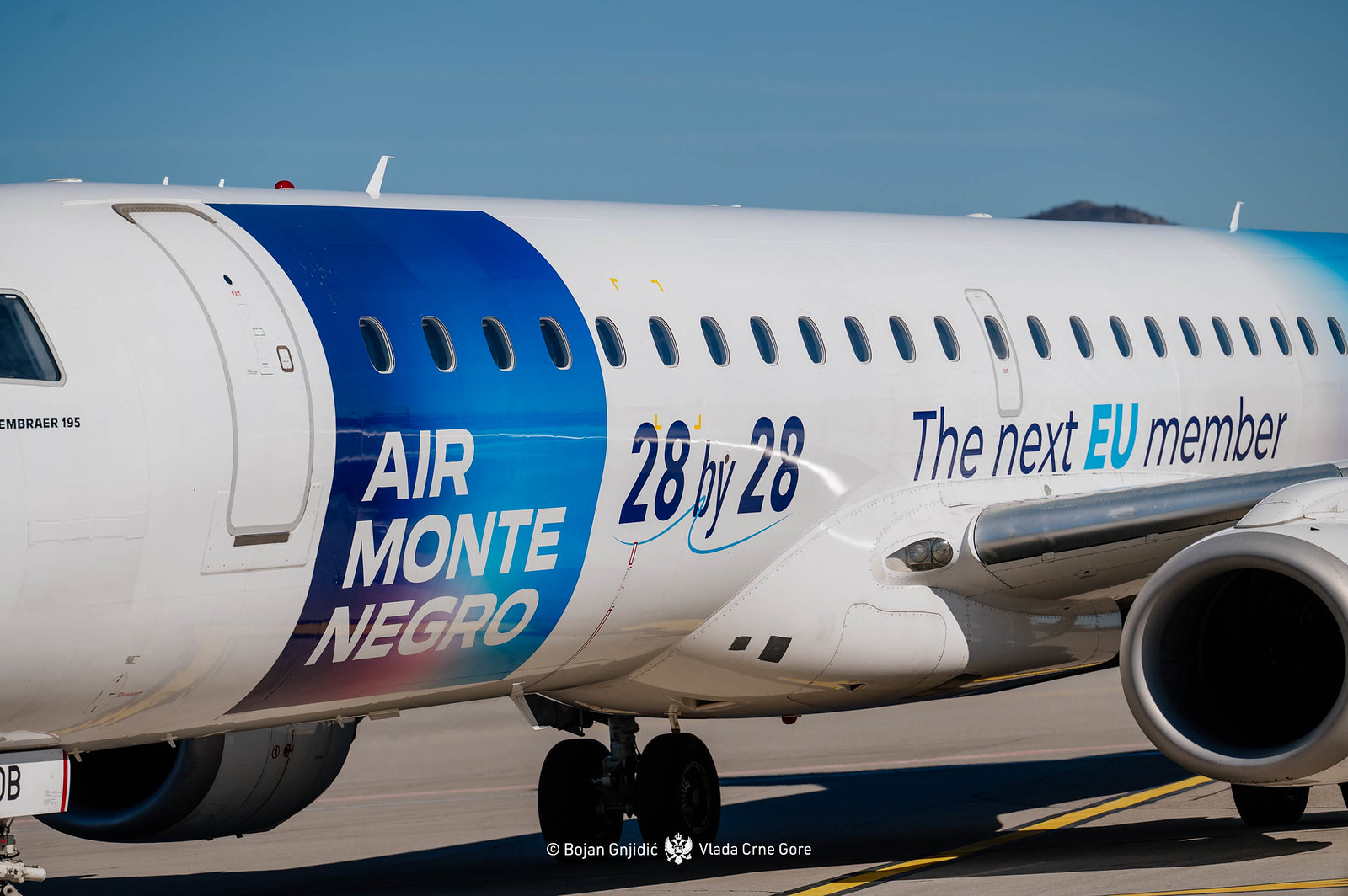
In a display of optimism, the Montenegrin government decided to paint the national flag carrier with the slogan “28 by 28,” signaling its determination to join the European Union by 2028. Yet the country’s European path has proven far more turbulent than expected.
Despite encouraging messages from Brussels and several EU member states, the accession process is moving more slowly than official narratives suggest. Contrary to earlier announcements, no intergovernmental conference and no closure of negotiation chapters took place in May — a symbolic setback during the month in which Montenegro marks the twentieth anniversary of its independence. The absence of progress sends both a political and structural message.
Uncertainty also surrounds the coming months. With Ireland assuming the presidency of the Council of the European Union in July, expectations for rapid movement have diminished, making the goal of closing all negotiation chapters by 2027 increasingly unrealistic.
At the same time, unresolved bilateral disputes, particularly with Croatia, continue to complicate Montenegro’s accession trajectory and expose the fragility of the government’s European strategy.
Several possible scenarios now emerge.
In the most optimistic scenario, Montenegro could close the remaining chapters by 2027 and begin the ratification process in 2028, potentially paving the way for EU membership by 2029 or 2030. However, this depends on two key conditions. The first concerns structural reforms, especially in Chapters 23 and 24, which remain crucial for convincing member states such as Denmark and the Netherlands that Montenegro is capable of meeting the rule-of-law standards required by the Union. The second condition is political: resolving bilateral disputes with Croatia.
If these conditions are not met, Montenegro may increasingly look toward alternative models of integration.
In that context, recent proposals promoted by the Prime Minister of Albania, Edi Rama, and the President of Serbia, Aleksandar Vučić, regarding phased or gradual integration into the European Union, are becoming more relevant. Such proposals envision deeper participation in the EU single market before full membership.
For the Western Balkans, access to the single market would provide many of the economic benefits associated with EU membership, particularly access to capital, investment, and the free movement of goods and services. Yet this model would still require substantial reforms. In practice, fulfilling the conditions for participation in the single market would mean implementing most of the reforms already demanded in the accession process itself.
A third scenario could involve Montenegro and Albania advancing together toward membership. Such a development would not only reshape the dynamics of EU enlargement in the Western Balkans, but could also send a broader geopolitical message by demonstrating that enlargement remains possible for candidate countries such as Moldova and Ukraine.
However, even this scenario depends on two factors: Albania’s ability to continue implementing reforms and Montenegro’s capacity to resolve bilateral tensions with Croatia.
Ultimately, the success of Montenegro’s European path depends not only on diplomacy and technical reforms, but also on the political orientation of the government itself. Despite efforts by parts of Montenegro’s diplomatic apparatus, the country’s credibility within the EU is increasingly tied to questions about the ideological direction of the ruling coalition.
For that reason, the next elections may effectively become a referendum on Montenegro’s European future.
It is difficult to imagine Montenegro joining the European Union while key parts of the governing structure are perceived in Brussels as closely aligned with Russian or Serbian nationalist political interests.
The composition of the next government may therefore determine not only the pace of Montenegro’s integration into the EU, but also the broader geopolitical direction of the country in the years ahead.
Danilo Kalezic. Montenegrin political scientist

The articles published in the “Opinions” column reflect the personal opinion of the author and may not coincide with the position of the Center