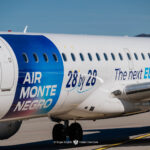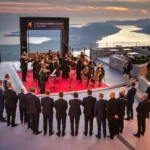
In Montenegro, the EU–Western Balkans Summit in Tivat was assessed as unquestionably successful not only from a political standpoint, but also in terms of the demonstrated ability to cope with hybrid threats. Although a whole range of issues important for EU enlargement and the region’s European integration were discussed at the meeting in Montenegro, the controversial charter flight carrying Vučić supporters overshadowed the important political discussions.
“Leteći Ćacilend”
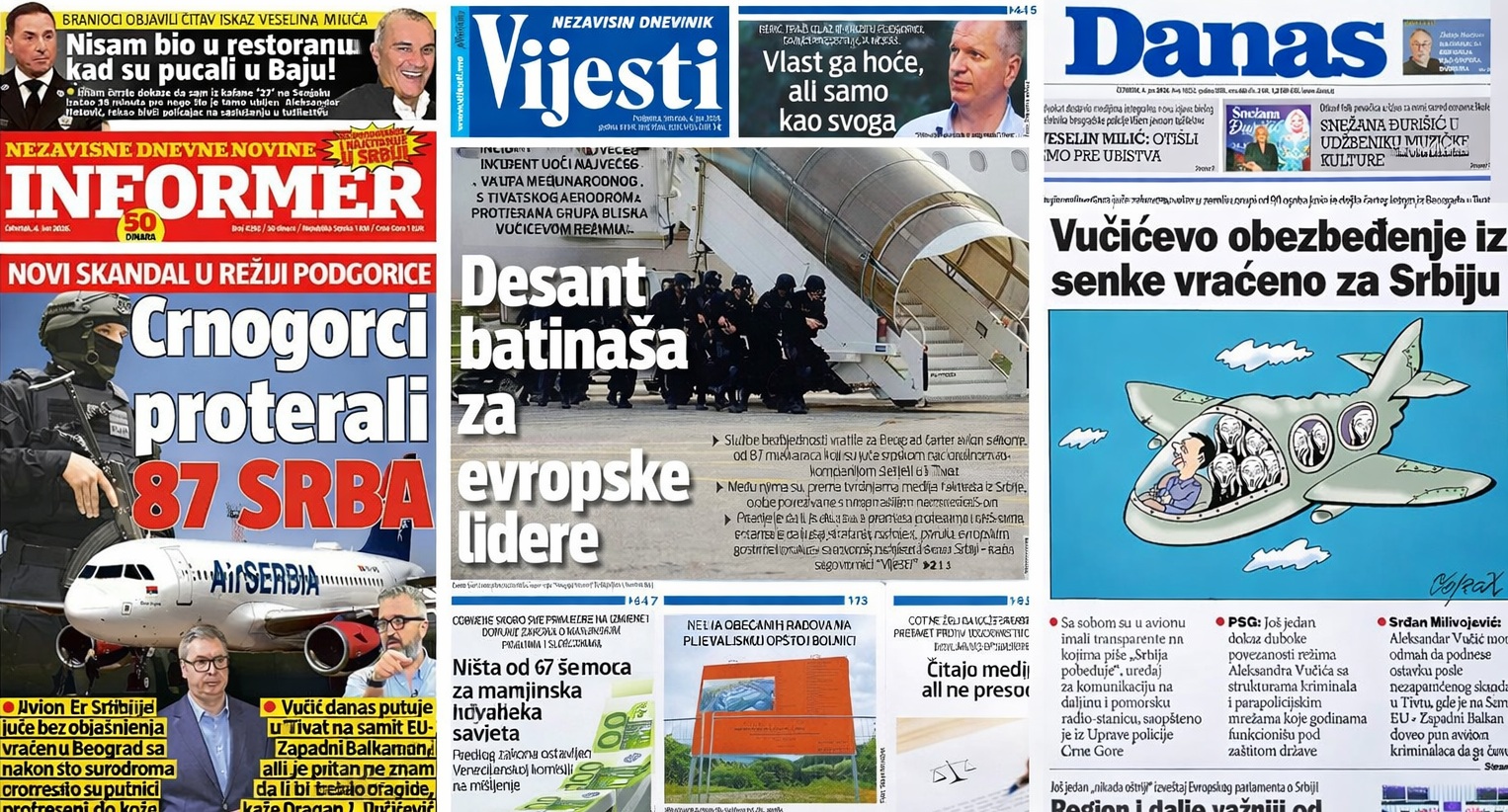
On 3 June 2026, Montenegrin police detained a charter flight from Belgrade on the runway of Tivat Airport. There were about 90 Serbian citizens on board. Not a single one of them ever left the airport.
According to Montenegrin media, the Police Directorate and the National Security Agency of Montenegro (ANB) acted on the basis of information previously received from the French intelligence service — the Directorate-General for External Security (DGSE), whose officers had arrived in Montenegro several days earlier to prepare the visit of French President Emmanuel Macron.
Following the screening, the ANB banned 87 men from entering the country. All of them were returned to Belgrade on the same flight — after several hours of delay, the Air Serbia aircraft took off from the runway of Tivat Airport.
What was found in the possession of the detained individuals spoke volumes about the nature of the trip. Communication equipment, a marine radio station, and banners bearing the slogan “Srbija pobeđuje” (“Serbia Wins”) were found among the passengers — symbolism inseparably associated with Vučić and his Serbian Progressive Party (SNS). Among those detained were well-known SNS activists who in Serbia are accused of attacking student demonstrators. These are people whom the party has for years engaged in rallies, guarding party premises, and organizing events in support of the authorities. Some of the detained individuals had participated in “numerous high-risk public gatherings.” Some of the charter passengers had criminal records.
A politician from Novi Sad, Miran Pogačar, requested information from Air Serbia regarding who had organized and paid for the flight to Tivat. Although he received no answer, journalists from Montenegro informed him that the company involved was “Happy Travel” from Bosnia and Herzegovina, headquartered in Bijeljina (Republika Srpska, Bosnia and Herzegovina). “Maja Antić, the owner of this agency, remains silent and does not want to say who hired this travel agency for the ‘Flying Ćaciland’ (Leteći Ćacilend),” he said.
While in Tivat, Serbian President Aleksandar Vučić stated that the charter flight from Belgrade had been organized by someone from his entourage who wanted to make his stay in Montenegro more pleasant. He confirmed that a group of his supporters had intended to fly to Montenegro, but denied that they posed a security threat. According to him, of the 87 people returned to Serbia, “five had criminal convictions, which is below the average for a regular flight or a bus.” Vučić called claims about a threat of destabilization absurd, while at the same time acknowledging that organizing the flight had been “a major political mistake.”
What Was This?
What did the entourage of the Serbian president hope to achieve by organizing the “Tivat deployment”?
Based on public statements, it can be concluded that the main purpose of the group of Vučić supporters was to provide the Serbian leader with informal protection.
According to the information made public, there were two threats that needed to be countered: a security threat and a political threat.
The security threat: immediately before the summit, Serbia’s Security Information Agency (BIA) recommended that President Vučić refrain from traveling to Tivat for the summit because of a high level of security risk. According to the BIA, Radoje Zvicer was in Montenegro, who the Serbian services describe as the leader of the Kavač criminal clan and, according to intelligence information, he may have been preparing an assassination attempt against Vučić. Nevertheless, the Serbian president ignored the BIA’s recommendation. This decision could theoretically have led to the appearance of “additional bodyguards” provided by someone from Vučić’s entourage.
The media even referred to the group that arrived on the charter flight at Tivat Airport as “Vučić’s shadow security.” However, it is highly unlikely that the group of “ćaci” was truly a response to the threat of an assassination by a hired killer. Moreover, as Željko Ivanović, a well-known Montenegrin journalist and one of the founders of the Podgorica-based outlet Vijesti, noted, “if Vučić and his services had relevant information regarding Zvicer’s location, they would have rushed to share that information with Europol, the DEA, and other partner services. Since they obviously do not have it and are only guessing, they are creating a circus around a serious issue in order to entertain their voters.”
Therefore, another version appears more likely — the political one.
On the eve of the summit, images of banners and posters in Tivat appeared on social media bearing the inscriptions “Tivat je uz studente pumpaj” and “Smrt Vučiću”. The local Police Directorate called these photos fake. However, it cannot be ruled out that Vučić’s entourage and supporters still feared that actions in support of the student protests in Serbia might be held during the summit. In that case, the group of pro-government activists could have been useful in countering protesters on the spot. This is precisely why the group from the charter flight brought pro-government banners with them — to create an atmosphere of support for the Serbian leader.
At the same time, the actions of the so-called ćaci may not simply have been intended to do something pleasant for Vučić. Organizing public actions could have meant increased security risks during the summit. In fact, this is apparently how Montenegro’s security services viewed the matter as well.
The security threat lay not so much in the fact that the “deployed” were supposedly going to “protect Vučić,” but rather in the fact that any provocations during the summit could damage Montenegro’s image among its European partners. On the other hand, these provocations could have had an openly anti-Montenegrin character, which could be expected in light of the recent developments on the Belgrade–Podgorica axis.
A Hungry Vučić
The deterioration of relations on the Belgrade–Podgorica axis ahead of the EU–Western Balkans Summit cannot be viewed separately from the overall atmosphere of current Montenegrin–Serbian relations. In short, it can be described in one word — tension.
The escalation of 3–4 June did not occur in a vacuum — it was the culmination of several weeks of open escalation.
In mid-May, Vučić publicly declined an invitation to the celebrations marking the 20th anniversary of Montenegro’s independence. “I received an invitation to participate in the glamorous celebration of separation from our country — of course I will not go. I would be ashamed; I would spit in my own face and in the face of my people,” he stated. Montenegro’s Ministry of Foreign Affairs responded at the time that Montenegro had never been part of Serbia in the sense that Vučić was trying to present. One Montenegrin politician then proposed banning the Serbian president from entering Montenegro. Vučić responded with an authored column in a pro-Serbian media outlet from Podgorica, where he explained that he had insulted no one and had merely exercised his right to his own opinion.
A week later, on the very day Montenegro celebrated its independence, a two-part documentary (or allegedly “documentary”) film titled “Referendum – priča o izmišljenoj slobodi“(“Referendum – A Story of Invented Freedom”) was broadcast on several Serbian television channels in Serbia and Montenegro. It was produced by the Center for Social Stability from Novi Sad — a structure openly linked to Vučić and his Serbian Progressive Party. The film promoted the thesis that Montenegro’s independence in 2006 had been illegitimate and that Montenegrins were an “artificial nation” that had betrayed a shared history, faith, and family. In Montenegro, the content was classified as hate speech and propaganda, leading to the temporary suspension of Serbian channels that broadcast the film and fines for those registered in Montenegro that also participated in airing it.
The appearance of the aircraft carrying the “ćaci” two weeks later appears to be the next episode in Belgrade’s campaign of pressure against Montenegro. It cannot be ruled out that the aim of the “group from the charter flight” may have been to stage anti-Montenegrin demonstrations that would convey to the European community the current view of the Serbian authorities regarding the existence of an independent Montenegro.
The tense nature of relations between Belgrade and Podgorica was also underscored by Serbia’s response to the entry ban and deportation of 87 Serbian citizens. From the evening of 3 June and for more than a day, Serbian border authorities effectively blocked holders of Montenegrin passports from entering Serbia. Kilometer-long queues formed at road border crossings, passengers arriving on flights to Belgrade were delayed, hundreds of Montenegrin citizens underwent lengthy checks (reportedly involving the BIA), and dozens of Montenegrins were denied entry, mostly without explanation.
Notably, the situation at the border began to normalize after Vučić “requested” it from Tivat. “Our state authorities are acting in accordance with the principle of reciprocity, but I ask them not to do so. I ask them to allow citizens of Montenegro to come to Serbia as calmly as possible,” he stated, thereby confirming that decisions to block the border for Montenegrins had been made at the highest level as a response to the deportation of his supporters.
Conclusions
Several conclusions can be drawn from the events surrounding the summit in Tivat.
First. Aleksandar Vučić and his entourage react very painfully to student protest actions. Even a small possibility of anti-Vučić rallies being held in Montenegro was enough to mobilize significant funds and dozens of people to organize a charter flight “to the seaside.” The story involving Zvicer appears more as a justification for these actions aimed at “protection from the blockaders” than from organized crime figures.
Second. Belgrade has no intention of abandoning the idea of keeping Montenegro within its sphere of influence. This track can be viewed as part of the construction of the “Serbian World.” A separate, fully independent Montenegro is not accepted by Belgrade.
Third. Belgrade is extremely dissatisfied that Montenegro will join the EU before Serbia. This dissatisfaction manifested itself not only in the attempt to create security risks during the EU–Western Balkans Summit, but also in Vučić’s personal attitude toward the forum in Tivat. Initially, the very participation of Vučić was under question. After returning from Tivat, the Serbian leader expressed his dissatisfaction in a rather original way — effectively accusing the summit organizers of departing from national identity by stating that he had remained hungry after the forum because guests had been served only European food (instead of traditional cuisine).
Fourth. Although the policies of the current Serbian authorities may appear multi-vector and pragmatic on the international stage, the regional dimension of Belgrade’s foreign policy and, even more so, its domestic policy look entirely different. According to Željko Ivanović, “Vučić’s performance” “once again showed why he has transformed from a stabilizer into a destabilizer of the region,” “and why Europeans, as he himself complained, perceive Serbia as the Balkans’ ‘little Russia,’” and him personally “as a regional Lukashenko.”
Fifth. The events accompanying the summit in Tivat once again demonstrated the high level of hybrid threats facing the Western Balkans and Montenegro in particular, which is increasingly finding itself on the front line of countering such threats.
CWBS Analytical Group