- Diplomatic Scandal Between Podgorica and Moscow
Russian Ambassador to Montenegro Alexander Lukashik was summoned to the Ministry of Foreign Affairs of Montenegro for a meeting. The Montenegrin Ministry of Foreign Affairs explained that this was prompted by an article written by the diplomat and published on the occasion of the 20th anniversary of the establishment of diplomatic relations between Montenegro and Russia, as well as by a comment from the Russian Embassy concerning the decision of the Government of Montenegro to harmonise the country’s visa policy with that of the European Union. (Under this decision, visas were introduced for citizens of the Russian Federation.)
In his article for the Russian journal International Affairs, Lukashik writes about the “subsidies” and “grants” provided to Montenegro by Russian tsars and about Russia’s support for Montenegro in the international arena. According to him, Russia was “not merely a donor to Montenegro, but the guarantor of its existence.”
The Ambassador sharply criticises Podgorica’s current foreign policy, claiming that since 2014 the Montenegrin authorities have acted on the instructions of their “Western overseers” in accordance with the principle: “Listen to instructions from abroad and carry them out.” The Russian diplomat singled out for criticism Montenegro’s support for sanctions against the Russian Federation and its participation in NATO and EU missions providing military assistance to Ukraine.
In addition, commenting on the introduction of visas for Russian citizens, the Russian Embassy in Podgorica also criticised Montenegro’s foreign policy, stating that it “regards the introduction of a visa regime for Russians as further evidence of the extreme dependence of Podgorica’s foreign policy on the influence of its foreign patrons.”
In its statement following the meeting with the Russian Ambassador, the Ministry of Foreign Affairs of Montenegro reported: “During the meeting, the Ambassador was informed that the article and comment in question contain assessments and statements that go beyond the bounds of customary diplomatic communication.” It was particularly emphasised that statements calling into question the independence, authority, and ability of Montenegro’s institutions to take sovereign decisions and conduct state policy, as well as claims challenging the legitimacy of decisions adopted in accordance with the Constitution, laws, and democratic procedures, are unacceptable.
“With regard to the reaction of the Embassy of the Russian Federation to the decision on visa policy, it was noted that full harmonisation with the visa policy of the European Union is one of the final benchmarks for the closure of negotiating Chapter 24 and one of the key commitments under the Reform Agenda. This is a sovereign decision of the Government of Montenegro, adopted in accordance with national interests, its strategic commitment to membership of the European Union, and the obligations undertaken in the process of European integration, rather than a measure directed against citizens of the Russian Federation,” the Ministry of Foreign Affairs stated.
In the context of Russia’s aggression against Ukraine, it was stated that Montenegro’s position is based on consistent respect for international law, the Charter of the United Nations, the principles of the territorial integrity and sovereignty of states, and the international obligations that it has voluntarily assumed.
The Ambassador’s attention was drawn to the obligations set out in Article 41 of the Vienna Convention on Diplomatic Relations, under which all persons enjoying diplomatic privileges and immunities are required to respect the laws and regulations of the receiving state and not to interfere in its internal affairs.
- North Macedonia Conducts Confidential Talks on Unblocking European Integration
North Macedonian Minister of Foreign Affairs and Foreign Trade Timčo Mucunski stated that the Government was making confidential efforts to find a “lasting and sustainable solution” to the long-standing dispute with Bulgaria, which is blocking the start of EU accession negotiations. “We are working on a solution, but not on a solution at any cost, nor on one that will prove unsustainable and return us to the situation in which we find ourselves today,” Mucunski said in an interview with a news agency, adding that disclosing details could jeopardise the negotiations. He stressed that Skopje would not cross the established “red lines” in these negotiations and was seeking guarantees from EU member states that its accession process would become more predictable once the current deadlock had been overcome.
Commenting on the Foreign Minister’s statement, the opposition Social Democratic Union of Macedonia (SDSM) accused the authorities of reaching secret agreements involving concessions to the Bulgarian side. “The Government of Hristijan Mickoski is preparing the ground for the acceptance of the French proposal. Our information from Brussels indicates that the Government has already agreed to it, and these are clear signals that have come from Brussels, Berlin, and Paris,” Andrej Žernovski, a member of the SDSM Executive Board and the party’s Secretary for International Cooperation, stated at a press conference.
The “French proposal” is a diplomatic package proposed by France in 2022 to unblock Bulgaria’s veto on the opening of North Macedonia’s EU accession negotiations. Among other things, it provides for the inclusion of Bulgarians in the Constitution of North Macedonia as a constituent people; the implementation of the Treaty of Friendship, Good-Neighbourliness and Cooperation between Sofia and Skopje, including the effective work of the bilateral historical commission; and guarantees that North Macedonia’s European integration will not require Bulgaria to recognise the Macedonian language.
The Macedonian authorities, led by VMRO-DPMNE, had previously criticised the “French proposal” and stated that they would not agree to fulfil the conditions it contained without clear guarantees from Brussels regarding the country’s accession to the EU. The opposition regarded the Foreign Minister’s latest statement as a departure by the ruling party from its previously declared principles.
However, the Ministry of Foreign Affairs and Foreign Trade of North Macedonia rejected the SDSM’s claims that there were hidden agreements or concessions in the negotiating process.
Claims of a secret agreement or secret negotiations are merely another fabrication that the SDSM is spreading among the public, the Ministry of Foreign Affairs stated. “The fact is that the institutions communicate regularly with the member states of the European Union, the European institutions, Bulgaria, and other international partners. These talks are conducted transparently, and the Government’s position is clear and has been publicly reaffirmed on numerous occasions. There are no concessions concerning national interests, identity, language, or history. Full membership of the European Union remains the strategic decision and ultimate objective of this Government,” the Ministry stated.
- Operation Storm – 31 Years Later
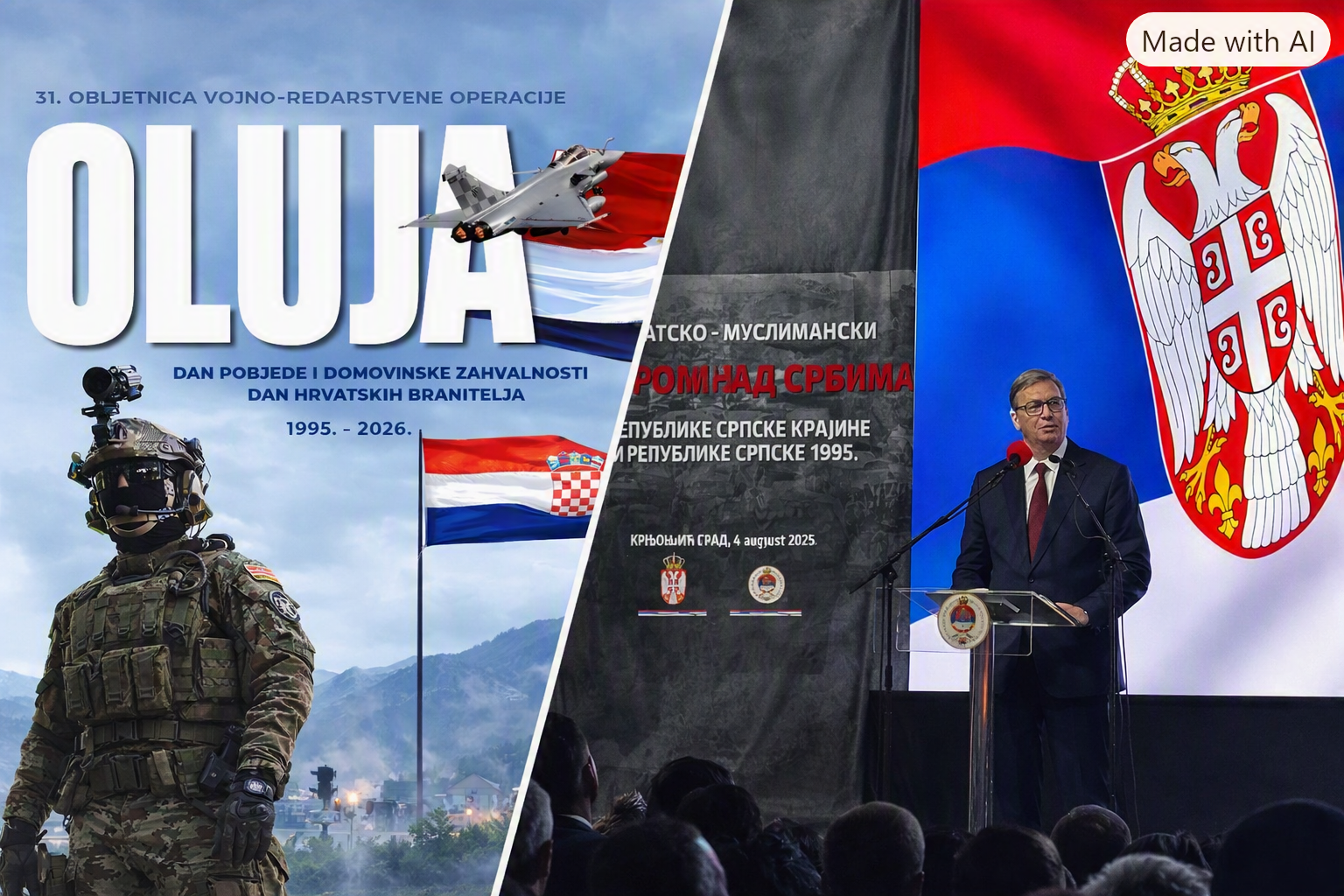
On 5 August, Croatia marked Victory and Homeland Thanksgiving Day, Croatian Veterans Day, and the 31st anniversary of the military and police operation Storm.
In his address at the ceremony in Knin, Prime Minister Andrej Plenković stressed that the military and police operation Storm had been a lawful liberation operation. He emphasised that the victory in Operation Storm had saved Bihać, a city in Bosnia and Herzegovina that was allegedly facing the same fate as Srebrenica, changed the balance of power in Bosnia and Herzegovina, and made possible the peaceful reintegration of the Croatian Danube region.
***
On 4 August, the Republic of Serbia and Republika Srpska, Bosnia and Herzegovina, marked the Day of Remembrance for All Victims and Exiles of the Croatian Military Operation Storm (Dan sećanja na sve stradale u hrvatskoj vojnoj akciji “Oluja”).
In his address at a large rally in Mrkonjić Grad, Republika Srpska, Bosnia and Herzegovina, President of the Republic of Serbia Aleksandar Vučić stated that Serbia would never again allow Operation Storm to be repeated and that the country was strong enough to protect its people.
He blamed not only the Croats but also the West for the events of 31 years ago. According to his remarks, as quoted by Tanjug, the Croats attacked the “Republic of Serbian Krajina” from all sides with American and European logistical, political, economic, and every other form of support.
Expressing a similar view, the Russian Embassy in Belgrade stated that Operation Storm had been carried out by the Croatian Armed Forces “with the support of the West,” adding that “particular responsibility for the bloodshed in the former Yugoslavia lies with the NATO and European Union states, whose intervention contributed to the country’s disintegration and the escalation of interethnic conflicts.”
- Kosovo Investigates Alleged War Crimes in Zubin Potok
At the end of July, the Special Prosecution Office and the Kosovo Police conducted an operation in the municipality of Zubin Potok on suspicion of war crimes against the civilian population. At that time, two Serbs were remanded in custody for one month by a court decision. Several days later, a third suspect was also arrested and remanded in custody for 30 days.
Excavations at the sites began in parallel with the arrests. The first exhumations were conducted in the village of Mala Kaludra (Albanian: Kalludër e Vogël), where investigators searched for the remains of people who went missing during the war. The work was then extended to the village of Jabuka, where the Government Commission on Missing Persons announced the exhumation of the remains of four people. They were sent to the Institute of Forensic Medicine for forensic examination and DNA identification.
In early August, the Special Prosecution Office reported that the investigation was also being conducted at a third location.
Several days after the Kosovo authorities began excavations in Zubin Potok on suspicion that a mass grave existed there, it became known that a man who had allegedly worked for Kosovo intelligence had been arrested in Kraljevo, Serbia. R.T., born in 1980, was arrested on 30 July by court order as part of an espionage case being investigated by the prosecutor’s office. The detainee is suspected of having cooperated for a long time with the “Albanian Intelligence Service” operating in Kosovo. It was stated that several ethnic Serbs had been arrested in Kosovo as a result of his activities. According to these allegations, the arrested R.T. is accused of collecting and providing data and information about the activities of former and current members of the Serbian Armed Forces, the Serbian Ministry of the Interior, and other state security agencies.
According to media reports, in early 2013 R.T. told Kosovo media about the alleged killing of 23 Albanian civilians and the secret burial of their bodies near the village of Mala Kaludra and gave testimony to investigators from the United Nations Interim Administration Mission in Kosovo (UNMIK) and the Kosovo Police.
In Kosovo, R.T.’s detention was described as an attempt to sabotage efforts to determine the fate of missing persons. Acting Prime Minister of Kosovo Albin Kurti accused Serbia not only of refusing to cooperate in the search for missing persons by providing access to archives, but also of detaining people who provide information about possible locations of mass graves.
The head of Kosovo’s negotiating team in the EU-facilitated dialogue, Agron Bajrami, has already sent two letters to the European Union Special Representative for the Belgrade–Pristina Dialogue, Peter Sørensen. He asked the European Union to ensure Serbia’s full implementation of the commitments contained in the Declaration on Missing Persons, including access to archives and the protection of persons who possess information about missing persons.