- Ratko Mladić Dies
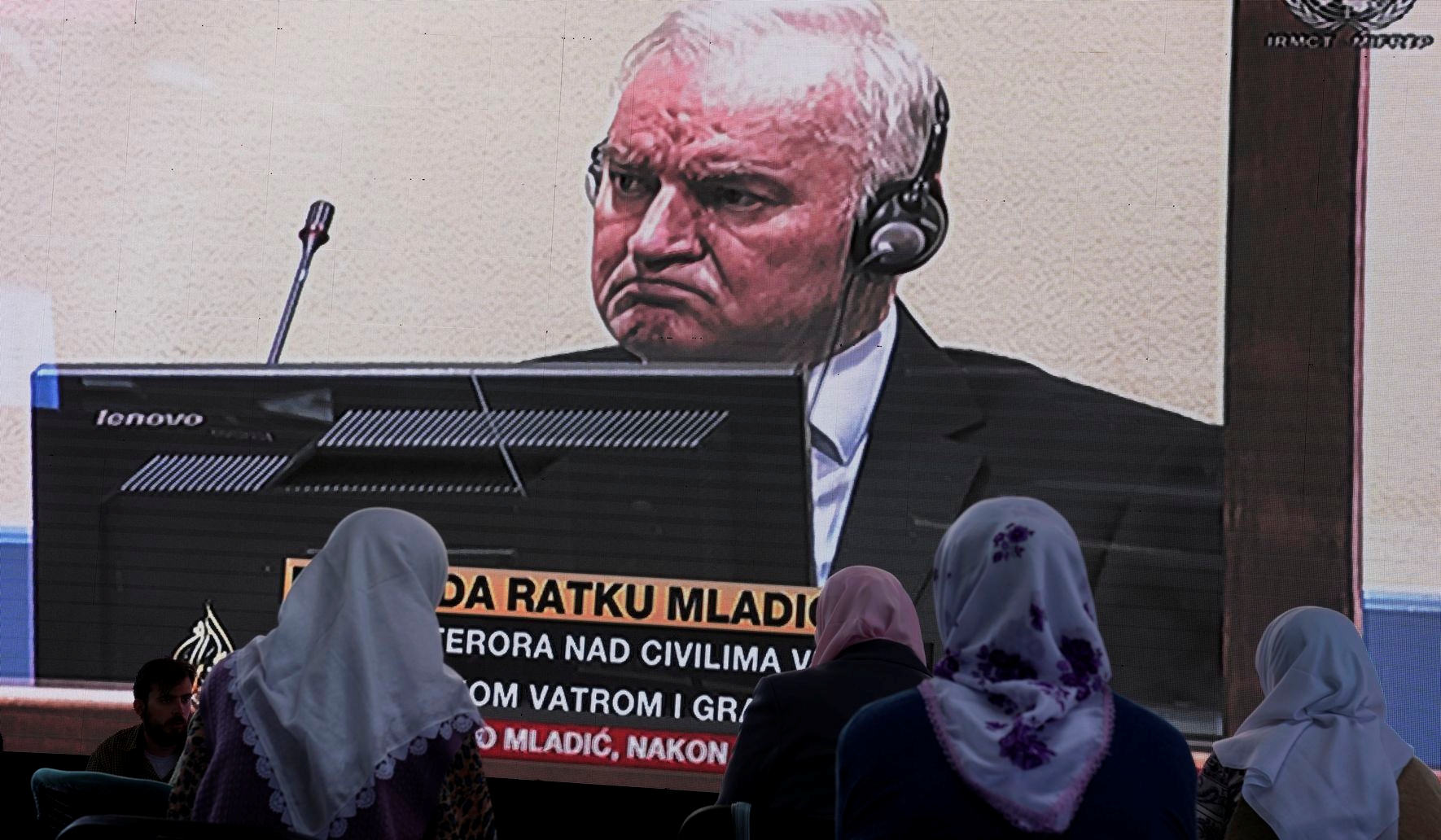
General Ratko Mladić, former Chief of the Main Staff of the Army of Republika Srpska (1992–1995), who was sentenced by the International Criminal Tribunal for the former Yugoslavia to life imprisonment for the Srebrenica genocide and the siege of Sarajevo, died on 27 August at the age of 84 in the hospital of the Hague Tribunal’s detention unit. For several years, he had suffered from serious health problems. Mladić’s family, as well as the leadership of Serbia and Republika Srpska, repeatedly appealed to the Tribunal to allow him to receive medical treatment in Serbia or Russia, but their requests were rejected each time.
The President of the International Residual Mechanism for Criminal Tribunals ordered a full investigation into the circumstances of Ratko Mladić’s death.
Ratko Mladić was arrested on 26 May 2011 and transferred to The Hague shortly afterwards. On 22 November 2017, the Trial Chamber of the International Criminal Tribunal for the former Yugoslavia found him guilty of genocide, crimes against humanity, and war crimes. On 8 June 2021, the Appeals Chamber of the International Residual Mechanism for Criminal Tribunals upheld the judgment.
Commenting on Mladić’s death, United Nations Secretary-General António Guterres expressed his support for the victims of the war criminal. “The Secretary-General expresses solidarity with the victims, survivors and their families who suffered from the crimes of which Mladić was found guilty,” his spokesperson told journalists.
Kamil Duraković, former Mayor of Srebrenica and current Vice President of Republika Srpska, who managed to escape from Srebrenica in 1995, noted that Mladić had outlived his victims by decades. “Above all, we feel bitterness that he lived to such an advanced age, while thousands of others, unfortunately, did not,” Duraković said.
Following the announcement of Ratko Mladić’s death, Serbian President Aleksandar Vučić stated that if the family of the former commander of the Army of Republika Srpska wished him to be buried in Serbia, “the state will help them do so with dignity.” According to Serbian Minister of Justice Nenad Vujić, Ratko Mladić will be buried with the highest state and military honours.
- Serbia and Russia Develop Security Cooperation
Serbia and Russia have agreed to develop regular consultations and maintain close contacts in the field of combating international terrorism and other security challenges, the Russian Ministry of Foreign Affairs reported.
According to the statement, this was agreed at a meeting between Russian Deputy Foreign Minister Dmitry Lyubinsky and Serbian Deputy Foreign Minister Miloš Jončić, who is responsible for security policy.
“The parties intend to develop the practice of regular consultations and maintain close contacts in the field of combating international terrorism and other security challenges, both bilaterally and on key international platforms,” reads the statement by the Russian Ministry of Foreign Affairs, which was circulated by Russian and Serbian media on 26 August.
During the talks, the sides exchanged assessments of global and regional terrorist threats, with particular emphasis on the situation in the Middle East, Africa and Europe, as well as on the two countries’ experience in combating terrorism. The need to deepen international cooperation in this field was also emphasised.
In addition, on 24 August Serbian Deputy Foreign Minister Jončić met in Moscow with Russian Deputy Foreign Minister Sergei Ryabkov. During the working meeting, the sides discussed “current issues of bilateral interaction between the two countries in the field of arms control and non-proliferation” and “noted mutual interest in developing dialogue and coordination on these sensitive issues,” according to the statement by the Russian Ministry of Foreign Affairs.
On the same day in Moscow, consultations on this issue were held at the level of the heads of the relevant structural departments of the Russian and Serbian foreign ministries. “The firm mutual commitment to intensifying substantive dialogue … with an emphasis on combining efforts in the interests of strengthening national and international security was confirmed. Positions were coordinated on the current agenda on which intensive work is being conducted at the relevant international platforms,” the Russian Ministry of Foreign Affairs stated in its release.
The Serbian side provided no further details about the talks in Moscow.
- EU Plans to Accelerate Montenegro’s Accession Negotiations
The European Union is preparing a new accelerated plan for completing accession negotiations with Montenegro, which provides for the closure of all remaining negotiating chapters by the end of this year and the preparation of the first draft of the Accession Treaty by the end of September, the Montenegrin daily Pobjeda reported, citing several sources in the European Commission.
According to Pobjeda, at the next intergovernmental conference between Montenegro and the European Union, another four or five negotiating chapters are expected to be provisionally closed.
According to the newspaper, five permanent representatives, or ambassadors, of key EU member states held urgent consultations in Brussels last week on the latest political and social developments in Montenegro. “Over the past several weeks, and particularly in recent days, Montenegro has faced an intensification of hybrid influence from the region, primarily from Serbia, which may be aimed at slowing down or jeopardising its European path,” Pobjeda was told. Following the consultations, the ambassadors reportedly informally conveyed their conclusions and recommendations to the European Commission regarding the protection of Montenegro’s accession process. “Montenegro’s European path must be protected from hybrid influence,” sources in the European Commission stated.
The plan also provides for greater involvement of European partners in resolving problematic bilateral issues between Montenegro and Croatia. Brussels believes that dialogue between the two countries should be intensified and that a compromise should be found that would prevent these issues from blocking the completion of Montenegro’s accession negotiations.
- Montenegro’s Prime Minister Warns of a Hybrid Threat from Countries in the Region
Montenegrin Prime Minister Milojko Spajić stated that the country’s authorities have “serious operational security information” indicating that, following the closure of chapters in the accession negotiations with the European Union, hybrid actions involving officials from at least two countries in the region will take place.
“We have serious operational security information indicating that, following the announced closure of new negotiating chapters, coordinated hybrid actions will take place, involving officials from at least two states in the region.
According to our information, such activities are aimed at destabilising Montenegro, with the expected support of certain political actors and part of the media scene in our country.
We are aware of these intentions and understand their objective. Attempts at destabilisation will not change our course or stop Montenegro’s European path, which transcends the day-to-day interests of any political structure,” he wrote on X.
Following Spajić’s statement, Montenegrin President Jakov Milatović convened an emergency meeting of the Defence and Security Council. Milatović’s office stated that the heads of the security services would be asked to provide precise information regarding Spajić’s allegations, as well as a comprehensive assessment of the security situation in the country.
Later, the Montenegrin newspaper Vijesti wrote that Spajić had been referring to Serbia and Albania. The newspaper cited an unnamed source who said that some key players in the region are dissatisfied with Montenegro’s rapid progress towards European integration and want to slow it down.
Albanian Minister for Europe and Foreign Affairs Ferit Hoxha rejected suggestions that his country was part of any “destabilising scenario” in Montenegro. “Although no official accusations have been made against Albania, I want to state clearly and firmly that Albania is not and cannot be part of any destabilising scenario, whether in Montenegro — a neighbour, friend, partner and NATO ally with which we share the same goal of EU membership — or anywhere else,” he wrote.