
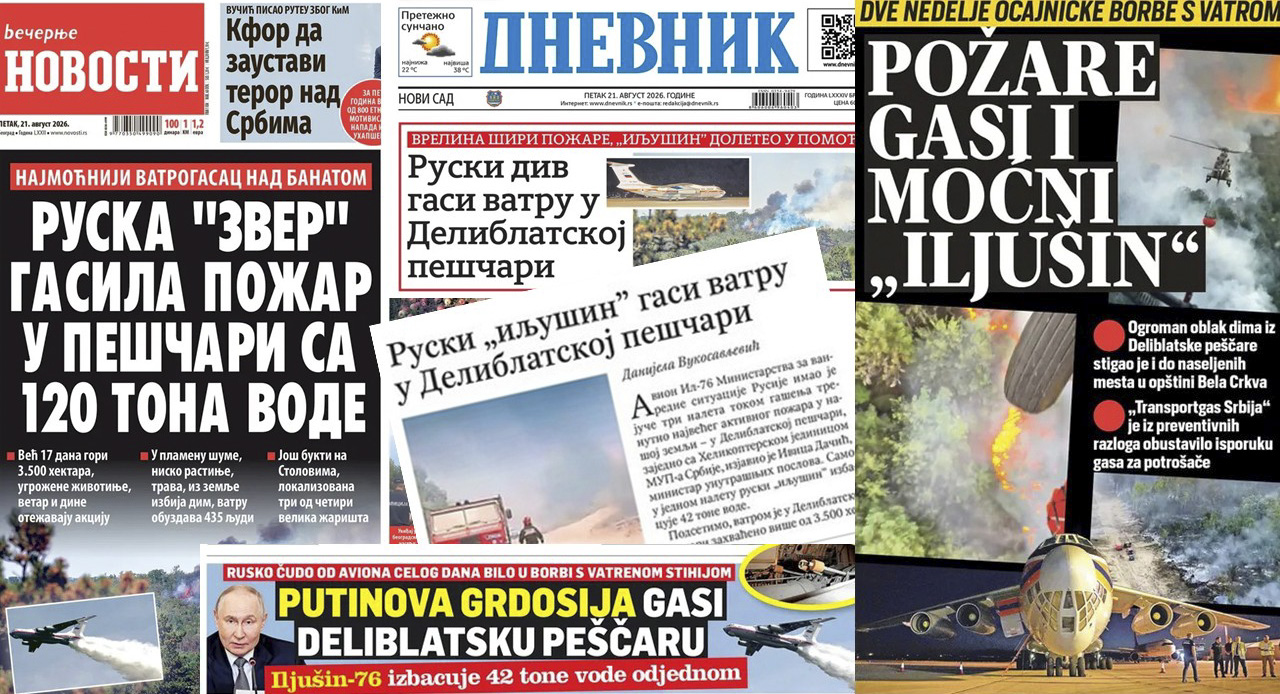
The arrival in Serbia of an Il-76 aircraft of the Russian Ministry for Civil Defence, Emergencies and Disaster Relief was presented by Moscow and Belgrade as a purely humanitarian mission. The aircraft did indeed actively participate in fighting the fire in the Deliblato Sands. However, the circumstances surrounding Serbia’s decision to seek Russian assistance raise many questions, primarily concerning security.
Russian Assistance
The large-scale fire in Serbia’s Deliblato Sands Nature Reserve (Deliblatska peščara), located near the Danube, close to the border with Romania, became an emergency of national significance. The fire, which had been spreading rapidly since the beginning of August, destroyed thousands of hectares of forest and unique vegetation. The Serbian authorities were forced to declare a local state of emergency and evacuate villagers and visitors from the Danube area. Eventually, Belgrade decided that it could not cope with the blaze on its own and turned for assistance… to Moscow.
On 19 August, an Il-76 aircraft of the Ministry of the Russian Federation for Civil Defence, Emergencies and Disaster Relief landed at Niš Airport.
“The assessment of our emergency headquarters was that we did not lack people or equipment, but an aircraft capable of dropping a large amount of water at once… The assessment of the people on the ground was that, given the strong winds, difficult-to-access terrain, and scale of the fire, a high-capacity aircraft could make the greatest contribution to protecting the area under threat,” Serbian Deputy Prime Minister and Minister of the Interior Ivica Dačić explained regarding the decision to request assistance from Russia.
“Given that the EU Civil Protection Mechanism does not have firefighting aircraft of such capacity, the arrival of Russian aircraft will significantly strengthen our capabilities in fighting the fire in the Deliblato Sands,” stated Assistant Minister of Internal Affairs and of the Emergency Situations Sector Luka Čaušić.
Commenting on the use of Russian assistance, Ivica Dačić insisted that “there is no politics involved in this,” and that “it is about what is most effective.” “We will use every mechanism that can help us, including the Russian-Serbian Humanitarian Center,” he stated.
A Hybrid Special Operation?
However, many saw politics — more precisely, geopolitics — in the arrival of the Russian aircraft in Niš. Despite the officials’ explanations, the decision to seek assistance specifically from Russia appeared to be an attempt to demonstrate favour towards Moscow.
The arrival of the Russian aircraft in Niš also brought security issues in the wider region of South-Eastern Europe back onto the agenda.
The Russian firefighters reached Niš after Bulgaria granted permission for the aircraft to fly through its airspace. Ivaylo Mirchev, Deputy Chair of the Bulgarian Parliament’s Defence Committee and co-chair of the “Yes, Bulgaria!” party, saw this as a Russian hybrid operation.
“A 40-year-old Russian firefighting aircraft flies over Bulgaria. The old Russian hybrid trick: ‘You have fires, the EU cannot help you, we are coming to put them out with our aircraft!’ The small detail is that while the aircraft is flying from Russia to Serbia, a dozen fires caused by Ukrainian attacks are raging in Russia itself that the Russians cannot put out.
There are still people who fall for this – good Putin sends us a firefighting aircraft to save us from the fire. This works in many places — Syria, Venezuela, Iran… But we remember what happened there — these are all countries where allied relations with Russia did not end particularly well for their now former dictators.
Only three weeks ago, Serbia sent its firefighters and a helicopter to Spain through the European mechanism. Today, the same Serbia does not activate this mechanism, while Vučić turns to Putin. And then the propaganda explains that Europe has abandoned it.
What is particularly cynical is that on the very same day that Putin sends an aircraft to extinguish a fire in Serbia, Russian missiles set residential buildings ablaze in Kyiv, where in the past night alone at least 12 civilians have been killed and 34 wounded.” (On the night of 20 August 2026, Russia carried out one of its largest-scale attacks on Kyiv using ballistic and cruise missiles and drones. According to the latest information, 15 civilians in the Ukrainian capital were killed in the Russian attack that day and more than 40 were wounded.)
A Reconnaissance Flight?
The Bulgarian government stressed that the Russian aircraft’s flight was humanitarian in nature. However, journalists and security experts raised the possibility that the flight had an intelligence-gathering purpose.
International analyst Martin Tabakov commented on social media on the flight path of the Russian Il-76, pointing out that the aircraft passed near Bezmer Air Base. This gave rise to speculation that the aircraft had deliberately altered its route in order to observe U.S. tanker aircraft stationed at Bezmer.
Todor Tagarev, a former Bulgarian Defence Minister, stressed: “An expert must accept the hypothesis that [the aircraft] is equipped with highly sophisticated intelligence-gathering sensors, and that they are on board the aircraft. He can safely assume, and this should be the primary hypothesis, that they were activated over our territory. As this aircraft flies over, it can detect elements of the airspace surveillance and air-defence system. It will know exactly where the American aircraft at Bezmer are located. Exactly where the F-16 aircraft are located at the base near the village of Graf Ignatievo. It will fly over Novo Selo to see the allied structures deployed there. And then it will continue towards Niš.” He also added that Russia supplies Iran with intelligence information: “These are known, publicly known facts. And if these things are connected, I would not have given this aircraft permission to fly over our territory.” “For me, it is practically guaranteed that this aircraft has intelligence-gathering equipment. That it conducted reconnaissance of these critically important elements of Bulgaria’s defence system. And almost certainly, information of interest to Iran will be transmitted from Russia to Iran. They cooperate very closely, including in providing this type of intelligence information,” Tagarev stressed.
Rejecting claims about possible surveillance from the Russian Il-76, the Bulgarian authorities stated that U.S. “flying tankers” were no longer on Bulgarian territory. Defence Minister Dimitar Stoyanov stated that the U.S. tanker aircraft had left Bezmer and Bulgaria on 20 August. However, Bulgaria, which is a NATO member, has other military bases and other allied forces that may be of interest not only to Iran, but also to Russia itself. It is probably no coincidence that Russian reconnaissance drones have been found increasingly often along the Bulgarian coast in recent days.
Nor can one ignore the fact that in neighbouring Romania, air-raid alerts have been sounded almost every day in recent weeks because of continuing Russian attacks on areas of southern Ukraine bordering Romania, particularly Ukraine’s Danube region. In August, the Romanian Air Force has already shot down several Russian drones, while several others have fallen on the country’s territory. On the night of 20 August, an alert was also sounded in Romanian areas bordering Ukraine, NATO combat aircraft were scrambled, and debris from a Russian drone was subsequently found on Romanian territory near the bank of the Danube.
Against the backdrop of events in the region, granting permission for an aircraft from Russia that could potentially conduct reconnaissance to fly near areas where there is a constant need to protect NATO and EU airspace from Russian aerial threats appears to be an extremely risky step from the perspective of regional security.
The “Hybrid” Center
Particular attention was drawn to the Russian aircraft’s destination, namely the Russian-Serbian Humanitarian Center at Niš Constantine the Great Airport.
The Center is presented as a regional logistics base for responding to natural disasters and other emergencies, including wildfires, floods, earthquakes, and industrial accidents. However, the facility has been a constant subject of geopolitical controversy. Moscow and Belgrade maintain that it is a structure for responding to humanitarian emergencies. At the same time, Washington and European capitals believe that the Center may also serve hybrid purposes, primarily intelligence-related ones.
During the current fire season in Serbia, the Russian-Serbian Humanitarian Center became involved in firefighting activities with a UAV unit that conducted aerial monitoring of fires using unmanned aerial vehicles and provided Belgrade with satellite images of what it described as “the most critical thermal hotspots in Serbia and the region.” Such activity could be regarded as intelligence gathering, but the Serbian authorities evidently do not see it that way.
EU Assistance
The most controversial aspect of the story involving the Russian firefighting aircraft proved to be the humanitarian dimension of its mission.
The day after the Russian aircraft arrived in Niš, a European Commission spokesperson stated that Serbia had not at that point activated the EU Civil Protection Mechanism, while stressing that the EU was ready to provide assistance in accordance with the actual situation and Belgrade’s needs, including by deploying aircraft.
On 20 August, the Russian Emergencies Ministry’s Il-76 began firefighting sorties, and on 21 August the European Commission reported that Serbia had activated the EU Civil Protection Mechanism.
Assistant Minister of Internal Affairs and of the Emergency Situations Sector Luka Čaušić stated that, “at the proposal of the operational headquarters leading the firefighting operation in the Deliblato Sands, and taking into account the extremely high temperatures forecast for the entire territory of our country in the coming period, the Republic of Serbia activated the European Union Civil Protection Mechanism, of which it is a member, after which it accepted the European Union’s offer of assistance in fighting the fires both in the Deliblato Sands and, possibly, in other parts of our country, given the extremely unfavourable hydrometeorological forecasts for the coming period.” According to him, an offer of four Black Hawk helicopters from the rescEU strategic reserve was accepted, as were offers from Germany and Romania to send fire and rescue teams to Serbia comprising more than 120 personnel and almost 40 vehicles in total.
Deputy Prime Minister and Minister of the Interior Ivica Dačić also reported that the European Union had made its satellite fire-monitoring system available to Serbia.
In other words, EU assistance, which the Serbian government still considered unnecessary on 19 August, suddenly proved important on 21 August.
This manoeuvre once again appears geopolitically motivated.
Commenting on the arrival of the Russian aircraft in Niš, Brussels described Belgrade’s decision to seek assistance from Moscow as unacceptable. In comments to journalists on 20 August, a European Commission spokesperson stressed that there could be no “business as usual” with Russia as long as it continued to wage its “unprovoked and unjustified war of aggression on European soil in Ukraine.” After this, the Serbian authorities resorted to their traditional multi-vector approach, also bringing in assistance from the EU. The step towards Moscow was, so to speak, “offset” by a step towards Brussels.
Unanswered Questions
By 24 August, the active phase of the fire in the Deliblato Sands had been brought under control. Civilian casualties and the destruction of residential buildings were avoided. By the end of August, the situation was considerably calmer than it had been previously, although Serbian firefighters, with international assistance, were still continuing to fight the fire.
This is good news, and it is good that the efforts of the Serbian authorities ultimately produced positive results. But the actions of official Belgrade in seeking international assistance raised many questions that remained unanswered.
Why was the EU Civil Protection Mechanism not activated immediately when the fire in the Deliblato Sands — notably, in an area bordering the EU — reached catastrophic proportions?
Why did Belgrade not turn first to Bucharest for assistance, given that the fire was raging precisely along the border with Romania?
Were the security implications of the Russian aircraft’s flight to Serbia through NATO and EU airspace taken into account when Sofia decided to grant permission for the flight?
Does the presence in Niš of a Russian base that, among other things, has drones at its disposal not create security risks for the region, including for NATO and EU countries neighbouring Serbia?
Was the Russian side’s provision of satellite data to the Serbian side a one-off action, or is it part of broader cooperation between the two countries in the exchange of such information?
Overall, how far does cooperation between Belgrade and Moscow extend in areas of dual civilian and military use? Because the arrival of the Russian Emergencies Ministry aircraft in Serbia is evidently only the tip of the iceberg in bilateral relations.
CWBS Analytical Group