When Russia launched its invasion of Ukraine in 2022, I began investigating the operations of the Russian retail chain MERE in Bosnia and Herzegovina. At first, I had only documents from the Register of Business Entities in Sarajevo. It was not until four years later that I obtained concrete information, after discovering that the European Union had placed the owners under international sanctions for financing Russia’s war in Ukraine.
I began visiting the chain’s stores, starting with a discount shop at the entrance to Doboj, in northern Bosnia and Herzegovina. Among the pallets, cardboard boxes and shelves stocked with inexpensive goods were products originating from the European Union.
For approximately 120 convertible marks, we filled a shopping trolley with a range of products. We examined their labels, photographed the items, and recorded their countries of origin, manufacturers, importers and distributors.
It appeared to be an entirely ordinary shopping trip. But every product label represented a potential lead.
We wanted to know how products from EU member states had ended up in stores belonging to a business network whose owners were under European Union sanctions.
The answer pointed to a much broader problem. Sanctions may appear decisive in official statements, but they remain largely ineffective when a country fails to establish a system for enforcing them.
The MERE store in Doboj resembled a warehouse more than a conventional supermarket. Food, hygiene products, tools and work equipment were displayed on pallets and in cardboard boxes. Customers with whom I spoke informally said they mainly shopped there because of the lower prices. Most knew little about the company’s ownership structure or the sanctions imposed on the people behind it.
During our visit in August 2026, we found at least 15 products originating from the European Union. They came from Italy, Croatia, Poland and Estonia. The shelves also carried goods from Russia, Serbia, China, Türkiye, Moldova, and Bosnia and Herzegovina. Some products contained raw materials originating from the United States, Canada and China.
One item stood out in particular: a bottle of wine produced in Poland in 2026. As early as April 2025, Poland had frozen the financial assets and economic resources of Torgservis PL, a company connected to the Schneider family. This raised an obvious question: how had a product manufactured after the Polish sanctions were imposed reached a store linked to the same business network?
The product labels enabled us to identify the manufacturers, importers and distributors. We then contacted them individually. We asked whether they knew who ultimately sold their products, whether they were aware of the sanctions, and whether they had procedures in place to verify the final destination of their goods.
They said they were unaware of the sanctions or the potential risks of continuing such business relationships. Most explained that they had supplied the goods under standard commercial agreements. Some said they would seek legal advice, while others intended to wait for guidance from the relevant authorities.
Robert Socha, a sanctions expert from Poland, explained to us that European manufacturers and exporters must verify who ultimately receives or sells their goods. He warned that failing to establish an appropriate due-diligence system could have legal consequences.
“Such a failure may constitute a violation of European sanctions,” he explained.
This added another dimension to our investigation. Our questions were not merely intended to explain what had already happened. In some cases, distributors learned from us for the first time that they were supplying products to a retail chain connected to sanctioned owners.
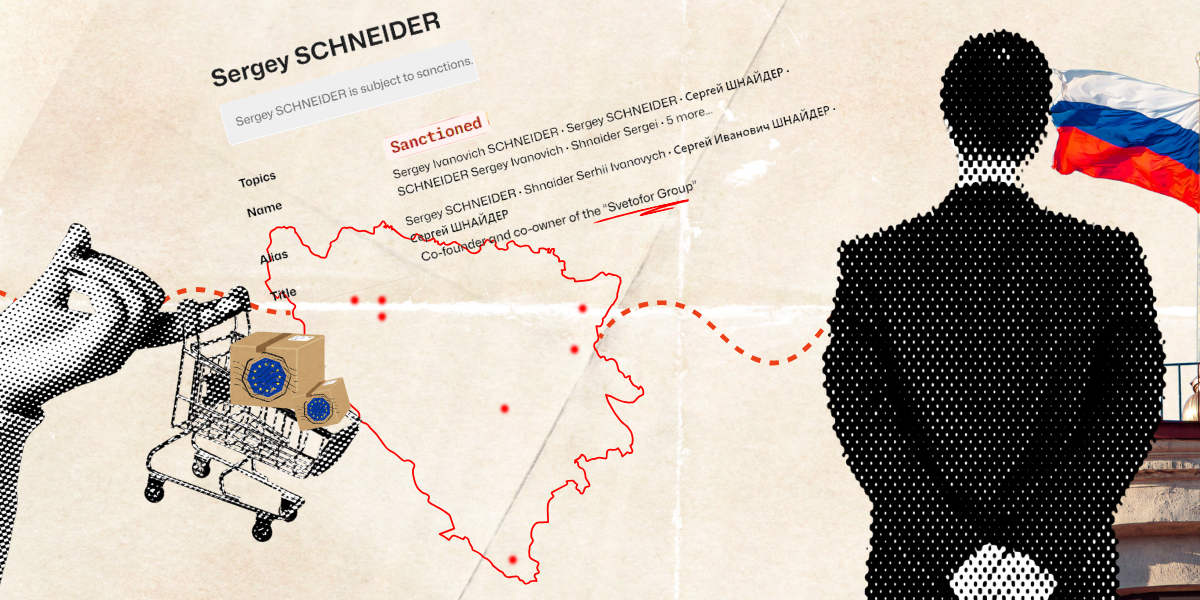
Our next step was to examine the available court registers and business records in Bosnia and Herzegovina and Serbia. We established that Sergey Schneider, his brother Andrey, Evgenii Pshenitsyn and Valeriy Iakovlev founded the company Eksperttorg in Sarajevo in 2021.
The company was later re-registered in East Sarajevo, with the Belgrade-based company SKTrade becoming its owner. The ownership link, however, did not disappear. The Schneider brothers, Pshenitsyn and Iakovlev also appear behind SKTrade.
Eksperttorg operates stores in Zvornik, Banja Luka, East Sarajevo, Bijeljina, Doboj, Prijedor, Laktaši and Trebinje. Available records show that the company in Bosnia and Herzegovina has more than 682,000 convertible marks in registered capital, while the affiliated company in Serbia has approximately €170,000.
On July 23, 2026, the European Union imposed sanctions on Sergey Schneider, his brother Andrey and their mother, Valentina. European institutions concluded that their business network had provided material and financial support for activities undermining Ukraine’s territorial integrity, sovereignty and independence. According to the EU’s justification, revenue generated on European markets was used to transfer capital to Russia, thereby indirectly contributing to the Russian state budget.
Latvia’s Financial Intelligence Unit confirmed to us that companies associated with the MERE network were required to suspend their regular business operations after the sanctions were imposed.
“Supplying sanctioned companies, including through intermediaries, is not permitted,” Detektor was told.
This response further demonstrates why the role of the intermediaries through which EU products reached MERE’s shelves in Bosnia and Herzegovina must be investigated.
The Schneider family built one of Russia’s largest discount retail networks. Their group operates under the Svetofor, MERE and MyPrice brands and has more than 2,200 stores. Its business model is based on low-cost premises, a minimal workforce, almost no investment in advertising or store appearance, and pressure on suppliers to offer prices significantly below market rates.
In 2024, Forbes estimated the family’s wealth at approximately $1.4 billion.
This means that a purchase at a discount store in Doboj is not merely an isolated local transaction. It is part of an international business network whose principal owners have been sanctioned for supporting Russia’s war against Ukraine.
We did not rely exclusively on company registers and telephone conversations. We also visited Eksperttorg’s registered address in East Sarajevo.
We were told that we were not the first journalists looking for the company and were directed to the other side of the building. There, we found a small red-and-yellow door bearing the MERE sign.
An employee who did not wish to be filmed told us that he was not authorised to make official statements. He also said that he had never met the company’s actual owners and that they were currently in Russia.
We left written questions and requested that they be forwarded to an authorised company representative. We also attempted to contact Eksperttorg’s registered director, Evgenii Boklach. We contacted the Schneider brothers through Telegram. We received no responses by the time the investigation was published.
We also contacted the Indirect Taxation Authority of Bosnia and Herzegovina, requesting information about the value and quantity of imported goods, their countries of origin, and the companies that distributed them. The Authority declined to provide the requested information.
Bosnia and Herzegovina’s Ministry of Foreign Affairs did not respond to our questions, while no response from the European Commission had arrived by the time of publication.
In Bosnia and Herzegovina, however, the stores continue to operate and publicly advertise the opening of new locations.
Tanja Topić, a Banja Luka-based analyst, described domestic institutions’ approach to sanctions as selective and dependent on the political interests of those who lead them. According to her, when political allies are involved, institutions often – “Turn a blind eye to so-called political friends,” she told Detektor.
Her assessment summarises one of the most important conclusions of our investigation: the problem lies not only in insufficiently clear procedures, but also in the political unwillingness to enforce existing obligations consistently.
Bosnia and Herzegovina generally aligns its positions with those of the European Union regarding Russia’s invasion of Ukraine. But endorsing a political declaration is not the same as enforcing sanctions.
EU restrictive measures do not apply automatically in Bosnia and Herzegovina. Their implementation requires decisions and concrete action by domestic institutions. Political representatives from Republika Srpska have blocked such measures for years.
Consequently, under the existing legal framework, MERE’s operations in Bosnia and Herzegovina remain lawful.
Socha further explained that European manufacturers and exporters must determine who ultimately receives or sells their goods. If they do not have appropriate systems in place to prevent their products from reaching sanctioned entities, that failure may constitute a breach of EU sanctions—even when the goods are initially exported to a country outside the European Union.
Our investigation demonstrated that a channel exists through which European goods reach a business network controlled by sanctioned owners. This also raises the question of who was responsible for monitoring that channel.
While institutions remain silent or claim that the matter falls outside their jurisdiction, responsibility becomes lost somewhere between manufacturers, exporters, intermediaries, distributors and government authorities.
In his interview with us, Robert Socha noted that European institutions should investigate how these products ended up in a retail network connected to sanctioned owners.
“The competent authorities of EU member states can investigate domestic manufacturers whose goods are sold in MERE stores and determine whether they disregarded an obvious risk,” he explained.
Nino Bilajac. Journalist, Detektor.ba

The articles published in the “Opinions” column reflect the personal opinion of the author and may not coincide with the position of the Center