- Kosovo Court in The Hague Finds Former Kosovo Liberation Army Leaders Guilty of War Crimes
On 16 September, the Specialist Chambers, which operate within Kosovo’s judicial system but work with international staff in The Hague, delivered a first-instance judgment against four former leaders of the Kosovo Liberation Army (KLA), finding them guilty of committing war crimes during the armed conflict in Kosovo in 1998–1999. The Trial Panel found that the accused were responsible for unlawful detention (385 people), cruel treatment (49 people), torture (303 people) and murder (96 people).
Hashim Thaçi, a former member of the General Staff and Political Directorate of the Kosovo Liberation Army who served as president and prime minister in the post-war period, was sentenced to 25 years’ imprisonment.
Former head of the Kosovo Liberation Army’s intelligence service and former Speaker of the Kosovo Assembly Kadri Veseli received an 18-year prison sentence.
Former Kosovo Liberation Army spokesperson and former Speaker of the Assembly Jakup Krasniqi was sentenced to 25 years.
Former member of the Kosovo Assembly and former Kosovo Liberation Army commander Rexhep Selimi received 13 years.
All four have been held in detention in The Hague since 2020.
The prosecution had sought 45 years’ imprisonment for each of the accused, who were also charged with crimes against humanity. However, they were acquitted of those charges after the allegation that widespread and systematic attacks against the civilian population had been committed was not proven.
During the hearing, the presiding judge stressed that the trial concerned neither the legitimacy of the Kosovo Liberation Army nor its objective — an independent Kosovo, “but the use of certain criminal means by some of its members to achieve those objectives.”
The first-instance judgment is not final, and the defence announced that it would appeal.
***
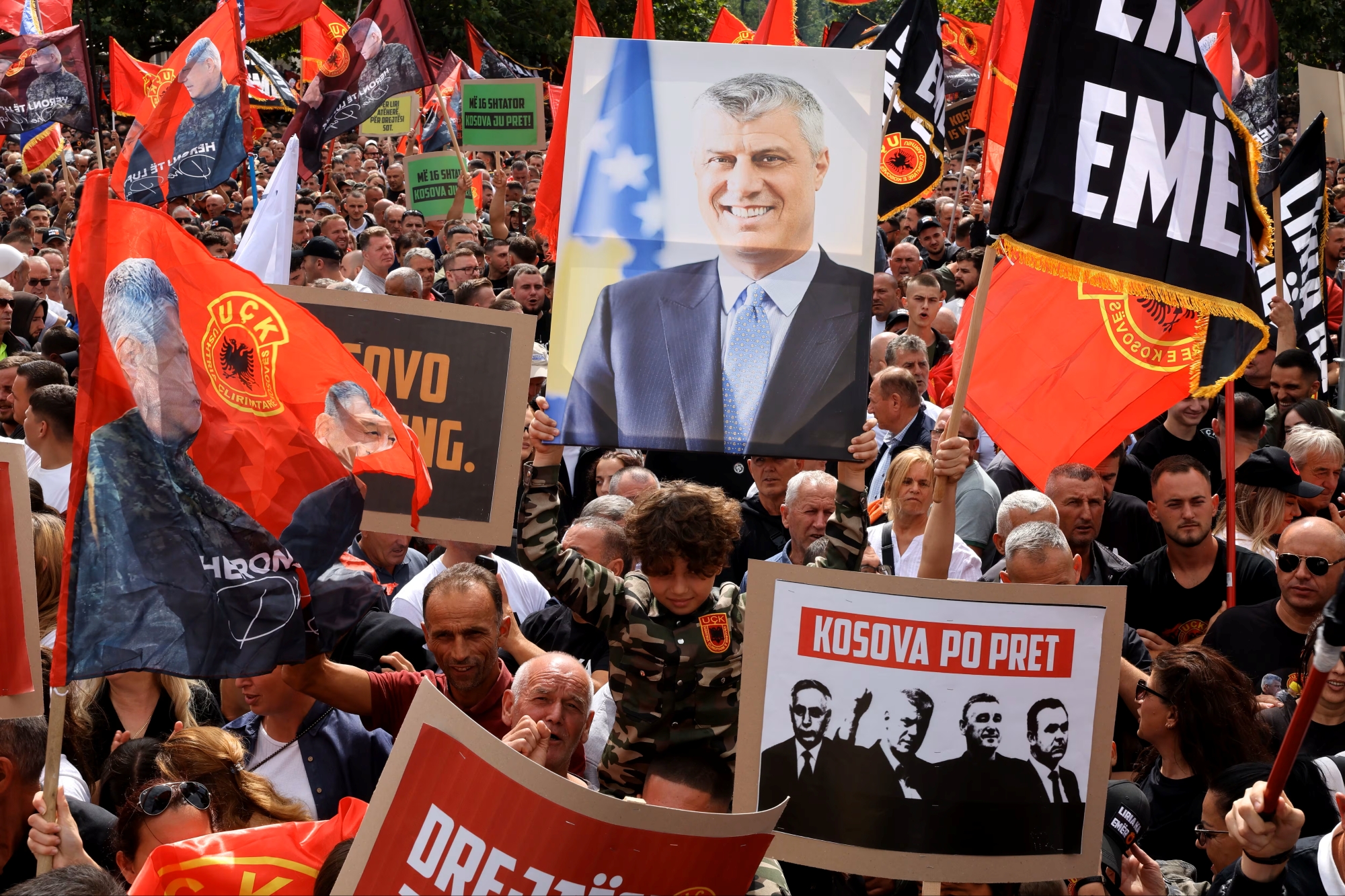
The decision of the Specialist Chambers in The Hague provoked a strong reaction in Pristina. Citizens who gathered in the centre of Kosovo’s capital for the announcement of the judgment by the court in The Hague staged protests outside the headquarters of the European Union Rule of Law Mission in Kosovo (EULEX) and outside the government building. Protesters threw stones and other objects at the institutional buildings. Clashes with police also took place.
***
Kosovo Prime Minister Albin Kurti, commenting on the court’s decision, stated that the sentences imposed on the four former leaders of the Kosovo Liberation Army were unjust, but that they “are not final and will be reviewed on appeal.”
Albanian Prime Minister Edi Rama called the judgment “shameful.”
Albanian President Bajram Begaj expressed “deep sadness,” stating that “for Albanians, no one and nothing can tarnish the Kosovo Liberation Army.”
***
Serbia’s Acting Minister of the Interior Ivica Dačić stated that the first-instance judgment against the four former Kosovo Liberation Army commanders “disproved the false narrative of national heroes and confirmed the true nature of the Kosovo Liberation Army.”
Serbian President Aleksandar Vučić was critical of the judgment of the Specialist Chambers in The Hague, noting that the court had not established the existence of systematic attacks against the civilian population because it did not want to undermine confidence in the Kosovo Liberation Army. In his view, “there should be no euphoria over first-instance judgments,” since they can be changed.
***
Representatives of the United States, the United Kingdom, Germany, France and the EU called on the parties to respect the decisions of the Specialist Chambers.
European Commission spokesperson Guillaume Mercier stated that the EU had taken note of the first-instance judgment and noted that the convicted individuals had the right to appeal it.
- Kurti’s Fourth Government Begins Work in Kosovo
Members of the Kosovo Assembly voted for a new Kosovo government headed by Prime Minister Albin Kurti, who is serving in the post for the fourth time.
The new cabinet was approved at a parliamentary session on 13 September by 62 votes in favour out of 120 and eight votes against, cast by MPs from the Serbian List party. Representatives of the opposition Kosovo parties — the Democratic Party of Kosovo (PDK), the Democratic League of Kosovo (LDK) and the Alliance for the Future of Kosovo (AAK) — did not participate in the session.
Following the formation of the new government, under the Constitution, parliament has 60 days to vote for a new President of Kosovo. At the first meeting of the new government, Albin Kurti called on political parties and MPs to resolve the presidential issue, noting that going to new elections was unacceptable.
The parliament elected in the snap elections on 7 June began its work on 9 September by electing Albulena Haxhiu as Speaker. Following the election on 13 September of three deputy speakers representing the Democratic League of Kosovo, the Serb community and non-Serb communities, the Speaker declared the legislature constituted, although a deputy speaker from the Democratic Party of Kosovo had not been elected.
However, in the view of the Democratic Party of Kosovo, parliament cannot be considered constituted without the election of all deputy speakers. The party has already submitted a request to the Constitutional Court to assess the constitutionality of the procedure for constituting parliament.
- Snap Parliamentary Elections to Be Held in Serbia on 25 October
Serbian President Aleksandar Vučić signed a decree on 9 September dissolving the National Assembly and calling snap parliamentary elections for 25 October.
The Main Board of the ruling Serbian Progressive Party (SNS) nominated Vučić as the leading candidate on its electoral list and as its candidate for prime minister. Vučić announced that on 27 September he would submit his resignation as head of state and run as an ordinary citizen.
Serbia’s Republic Electoral Commission has already officially approved the electoral list of the coalition led by the Serbian Progressive Party for participation in the elections. The list, entitled “Aleksandar Vučić — United Serbia,” is headed by Aleksandar Vučić himself. He is followed on the list by SNS President and former Prime Minister Miloš Vučević and Speaker of Parliament Ana Brnabić.
The student protest movement, which has been organising anti-government protests for several months, is participating in the elections with its own list: “Student List — Students Win.” First on the list is Ilija Srdanović, a professor at the Faculty of Medicine in Novi Sad.
- Serbia Begins Joint Drone Production with Israel
Serbian President Aleksandar Vučić on 17 September opened a joint Serbian-Israeli drone assembly plant. According to him, the new plant will produce “the most advanced equipment” for the Serbian Armed Forces and the armed forces of other countries.
Vučić did not disclose the location of the new factory or the name of the Israeli partner company, stating that journalists were not allowed to attend the opening because of “the confidentiality of the production process.”
Media reports had previously identified Israeli defence company Elbit Systems as Serbia’s partner in the drone production process.
According to Vučić, the government, together with its Israeli partners, plans to open three more similar plants in different regions of Serbia.