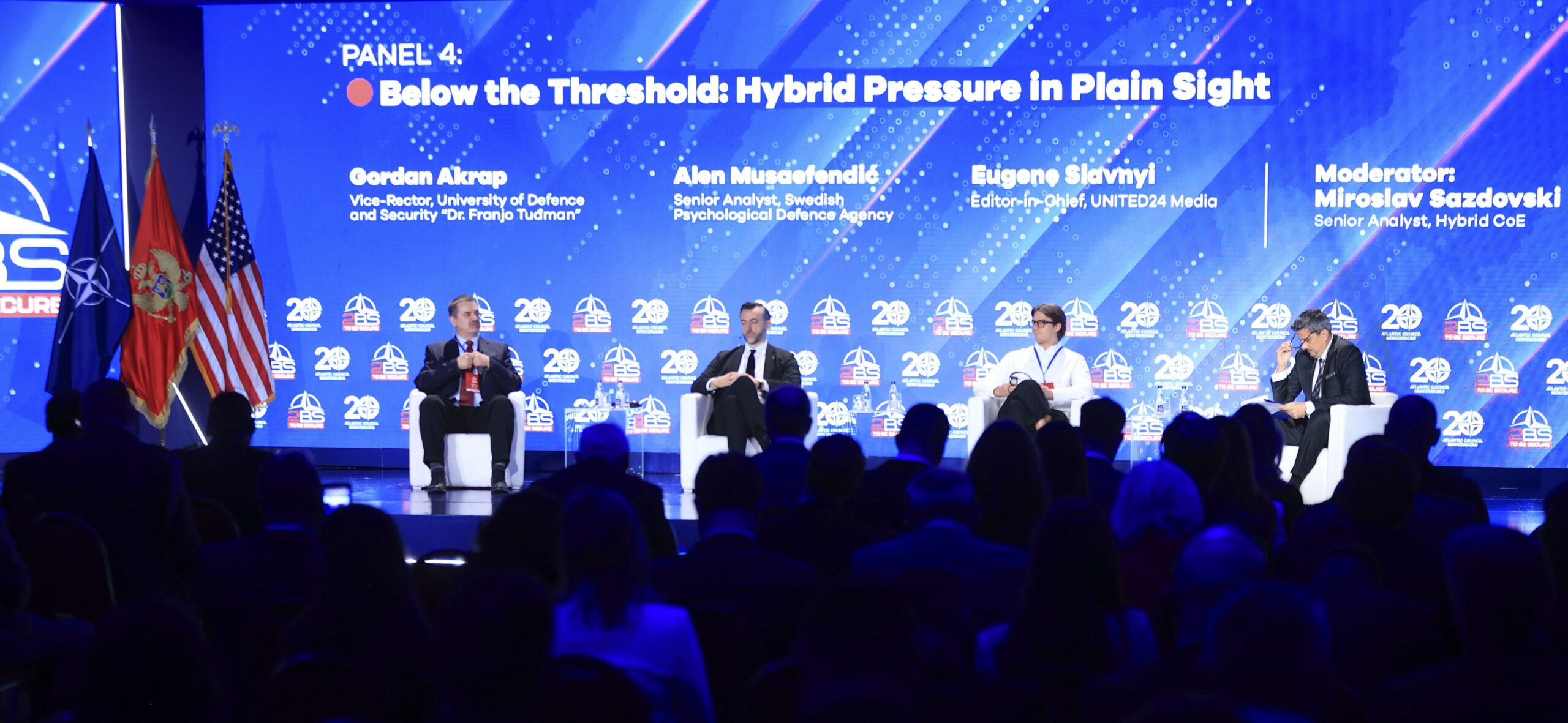
In late October, the sixteenth international To Be Secure (2BS) Forum, organised by the Atlantic Council of Montenegro, was held in Budva, Montenegro. Over a decade and a half, it has become one of the region’s well-known platforms for discussing European and Euro-Atlantic security. However, this year’s event differed noticeably from previous ones.
For those who had attended 2BS in previous years, the difference was striking. A much smaller scale, fewer senior officials, a noticeably lower level of representation. Among members of the Montenegrin government, only Minister of Public Administration Maraš Dukaj and Minister of Culture and Media Tamara Vujović attended. Neither Prime Minister Milojko Spajić nor Foreign Minister Ervin Ibrahimović came. On the sidelines, participants also noted the forum’s noticeably more modest organisational capacity.
This can partly be explained by the calendar. The previous day, a Berlin Process leaders’ summit was held in Miločer, near Sveti Stefan, with the participation of the leaders of the Western Balkan states, German Chancellor Friedrich Merz and other European partners. It was there that the main political talks took place, including a meeting between the prime ministers of Montenegro and Croatia.
Consequently, no one expected any major diplomatic sensations from 2BS. In substantive terms, the programme did not offer much that was new either. The Russian threat, the development of European defence, cybersecurity, hybrid operations, elections and the future enlargement of the EU have long become standard topics of such discussions.
Nevertheless, several speeches deserved attention. Primarily because of Montenegro’s current position, as it approaches the completion of negotiations with the European Union but still has many unresolved problems.
In his opening remarks, Atlantic Council of Montenegro President Savo Kentera called on Western democracies finally to move from condemning threats to taking effective action. In his view, Russian aggression against Ukraine, acts of sabotage, cyberattacks and attempts at political interference require a much more decisive response. European democracies must have not only principles and values, but also sufficient strength to defend them.
For Montenegro itself, Kentera formulated an equally important point: EU accession must remain a state interest, rather than a project of a particular party, government or electoral cycle. Budva Mayor Nikola Jovanović also spoke at the opening in a similarly pro-European spirit.
This is particularly relevant following Podgorica’s latest negotiating success. On 12 October, Montenegro provisionally closed three more chapters, bringing the total to 21 out of 33. Nine chapters have been closed this year alone. The Spajić government continues to expect to complete the negotiations by the end of 2026 and secure accession in 2028.
However, issues that cannot be resolved simply by adopting the necessary laws will now play an increasingly important role. And the forum’s first panel demonstrated this well.
Croatia: We Support Accession, but We Are Not Dropping Our Demands
The Croatian contributions were of the greatest practical interest. After all, Zagreb currently has perhaps the greatest ability to influence the timetable for completing Montenegro’s negotiations.
The first panel featured Frano Matušić, State Secretary at Croatia’s Ministry of Foreign and European Affairs, Peter Grk, a representative of Slovenian diplomacy, Montenegrin researcher Nikoleta Đukanović and former Montenegrin Prime Minister Igor Lukšić. Separately, a Vijesti journalist held a conversation with Vanda Babić Galić, special adviser to Croatia’s Minister of Foreign and European Affairs and a native of Kotor.
Croatian diplomats consistently repeated the same position: Zagreb is not blocking Montenegro; on the contrary, it is interested in its accession to the EU as soon as possible. However, this does not mean that it is prepared to leave unresolved the issues that have accumulated over decades.
Matušić spoke in detail about Croatia’s own experience. EU membership required difficult reforms, compromises and compliance with requirements that were not always popular. The country joined the European Union in 2013, but did not enter the Schengen Area until a decade later. Today, according to the diplomat, those efforts are paying off: Croatia receives billions of euros more from the EU budget than it pays into it.
Zagreb’s logic is understandable. If Croatia itself once had to make difficult compromises, it expects Podgorica to take a similar approach, particularly regarding the wartime past of the 1990s, the rights of those affected and good-neighbourly relations.
Croatian representatives repeatedly recalled that without Zagreb’s support Montenegro would not have been able to close any of the 21 negotiating chapters already completed. Formally, this is indeed the case, since decisions require unanimity among EU member states. But the reminder itself had an obvious political subtext: Podgorica will have to take Croatia’s position into account until the very end of the negotiations.
Ahead of the forum, Prime Ministers Andrej Plenković and Milojko Spajić had already discussed bilateral issues at the Berlin Process summit. Plenković welcomed the Montenegrin government’s recent decisions to preserve the memorial plaque at the site of the former Morinj camp and to rename the municipal swimming pool in Kotor that had borne the name of water polo player Zoran Gopčević.
For Zagreb, both issues were sensitive because of the events of the 1991–1995 war and the treatment of Croatian prisoners. However, as Plenković immediately recalled, these are only two of the eight points that Croatia had previously put before Montenegro.
In Budva, the diplomats assessed these steps positively, but made it clear that the more difficult part of the work still lies ahead.
The conversation with Vanda Babić Galić was particularly interesting. She stressed that Croatia is not blackmailing Montenegro but helping it prepare for membership. According to the diplomat, at least fifty Croatian experts are involved in the relevant work.
At the same time, Babić Galić was quite categorical about the training sailing ship “Jadran”, which is in Montenegro but is claimed by Croatia. She described the vessel as merely the tip of the iceberg of the much broader issue of succession to the military property of the former Yugoslavia.
According to her, “Jadran” should unite the two states as a symbol of their shared maritime past. However, the Croatian side considers it its property and has no intention of abandoning its claim. Moreover, the issue concerns a much broader range of former military property.
The diplomat also stressed that there are no grounds for reopening the issue of the land border, while maritime delimitation and other aspects of succession remain the subject of negotiations.
Zagreb’s position did not fundamentally change after the forum. Croatia is not demonstrating an intention to derail Montenegro’s accession, but it seeks to use the final stage of the negotiations to resolve the broadest possible range of bilateral problems. Some of the demands have an entirely well-founded historical and legal basis. At the same time, the EU negotiating mechanism gives Zagreb additional leverage.
For Podgorica, this is also difficult because of domestic political divisions. Even the concessions over Morinj and the Kotor swimming pool drew criticism from pro-Serbian political forces, above all Milan Knežević’s Democratic People’s Party. The next issues, including military property, the maritime border and compensation for those affected, may provoke much sharper conflicts.
Most likely, the Spajić government will continue to seek individual compromises while trying to prevent a large-scale domestic escalation. But after resolving two relatively simple issues, this approach may prove considerably more difficult.
Dodik, NATO and Europe’s Dependence on the United States
At the panel on NATO and European security, it was primarily the composition of the participants that attracted attention. Among the speakers was Bosnia and Herzegovina Deputy Minister of Defence Aleksandar Goganović, a representative of Republika Srpska and Milorad Dodik’s party, the Alliance of Independent Social Democrats (SNSD).
For those who follow Bosnian politics, his very presence at such an event was telling. After all, Dodik has for years opposed BiH joining NATO, maintained close relations with Russia and regularly resorted to anti-Western rhetoric.
Goganović, however, spoke in an extremely restrained manner. He spoke about regional stability, peace, building trust and the need for constructive cooperation with NATO. At the same time, he cautiously reiterated a position of principle for the Bosnian Serbs: in BiH there is consensus on partnership with the Alliance, but no consensus on full membership.
A quite characteristic illustration of Bosnian politics. SNSD representatives can participate constructively in international security events without changing their party’s basic political positions. Goganović’s speech itself was fairly sterile, but in the context of Dodik’s politics even such restraint appeared interesting.
Far more substantive assessments came from Federica Mangiameli of the GLOBSEC think tank. The main theme of her remarks concerned the need to build up Europe’s own defence capabilities against the backdrop of changing U.S. priorities.
This was not about distancing Europe from Washington or creating an alternative to NATO. European allies must learn to meet a greater share of their own defence needs while remaining in a close transatlantic partnership.
Mangiameli’s answer to a question about the possible consequences of a further reduction in U.S. support for Ukraine was particularly telling. In her assessment, the loss of access to U.S. intelligence and satellite data would be especially painful. This would weaken Ukraine’s defence and create additional problems for Europe itself, which is not yet capable of fully replacing such U.S. capabilities.
One of the forum’s most substantive points. European states can rapidly increase defence budgets, but the technological capabilities that the United States has developed over decades cannot be recreated in a few years.
European defence autonomy will increasingly depend not only on the production of weapons and ammunition, but also on satellite intelligence, communications, command-and-control systems and its own technological base.
Hybrid Threats: Many Statements, Fewer Specifics
The subsequent panels dealt with information security, cyber threats, the use of artificial intelligence and the protection of electoral processes. Overall, these discussions continued the now familiar conversations about Russian interference, disinformation and the resilience of democratic institutions.
Nevertheless, several statements by Montenegrin officials deserve attention.
Miloš Nikolić, representing Montenegro’s Ministry of Foreign Affairs on NATO and security policy, warned that the country is under constant hybrid pressure originating both from Russia and from within the Western Balkan region itself.
Among the examples, he mentioned the recent expulsion of representatives of the Russian propaganda network “Rybar”. According to him, the group had planned to spread disinformation concerning the introduction of visas for Russian citizens. The official also recalled threats surrounding previous regional events in Tivat and warned of a possible intensification of hybrid influence ahead of the 2027 parliamentary elections.
Minister of Public Administration Maraš Dukaj, in turn, drew attention to continuing cyberattacks against Montenegro’s state infrastructure. Some of the threats, he said, originate from neighbouring states, although he did not name any specific countries.
These remarks effectively continued a warning made by Prime Minister Spajić back at the end of August. At the time, the head of government said that coordinated hybrid actions against Montenegro might be being prepared with the involvement of representatives of at least two states in the region.
However, almost two months after that statement, the government’s National Security Council had still not held the relevant meeting. TV Vijesti reported this on 18 October. The absence of public decisions does not, of course, mean that the security services are inactive. Nevertheless, the question of political coordination and the readiness of state institutions to respond to such challenges remains open.
Against this background, the situation appears somewhat contradictory. Officials speak quite openly about external threats and possible electoral interference, but the public has yet to see a corresponding systematic response at the highest political level.
Nor should the political interests of Belgrade and Moscow automatically be equated. Serbia is interested in preserving its influence over Montenegro’s Serbian population, while Russia seeks to weaken Euro-Atlantic unity. On specific issues, these interests may coincide, but allegations of organised interference require evidence.
Ahead of the 2027 elections, sensitive issues will continue to include the status of the Serbian language, dual citizenship, national symbols, relations with Croatia, the role of the Serbian Orthodox Church and attitudes towards Russia. Each of them has already repeatedly caused domestic political conflicts.
The EU Is Ready for Montenegro. But Is Montenegro?
Assessments of the prospects for EU enlargement were also of particular interest.
Peter Grk, representing Slovenia’s Ministry of Foreign and European Affairs, formulated the current dilemma quite aptly: the EU as a whole is not yet ready for large-scale enlargement, but it is ready to admit Montenegro.
Indeed, the accession of a small Balkan state and the future accession of Ukraine or several other candidates at the same time pose institutional and financial challenges of very different scales.
Former Montenegrin Prime Minister Igor Lukšić drew attention to another point: Montenegro’s accession is unlikely to significantly alter the EU’s economic or demographic potential, but the political significance of such a step could be far greater.
After a prolonged period of stagnation, Brussels has an opportunity to demonstrate that accession negotiations can genuinely culminate in membership. This is important for the entire region, as well as for Ukraine, which is also moving along the European path.
However, there is another side to this. After accession, Montenegro will become a full participant in EU decision-making, including on sanctions, foreign policy and future enlargement.
At present, Podgorica fully aligns its foreign policy with that of the EU, supports Ukraine and sanctions against Russia. However, domestic political polarisation, the influence of pro-Serbian parties and opportunities for external interference will not automatically disappear once the negotiations are completed.
This, perhaps, was what made this year’s 2BS Forum interesting. Despite its more modest scale and the absence of high-profile international guests, the event reflected quite clearly the problems with which Montenegro is entering the final stage of European integration.
Croatian diplomats once again recalled the unresolved bilateral issues. A representative of Dodik’s party demonstrated the pragmatic side of cooperation between Bosnian Serbs and NATO. European experts spoke about the need for Europe’s own defence capabilities, while Montenegrin officials warned about hybrid threats, responding to which requires greater institutional coordination.
The forum produced nothing sensational. Nevertheless, several of its discussions clearly showed how difficult the final stretch of Montenegro’s path towards the EU may prove to be.
Six unresolved issues with Croatia, difficult negotiating chapters, the 2027 parliamentary elections and the need to counter external security threats still lie ahead. Podgorica genuinely has a chance to become the first of the Western Balkan states to join the European Union. But completing the negotiations and building a resilient European state are not quite the same thing.
CWBS Analytical Group